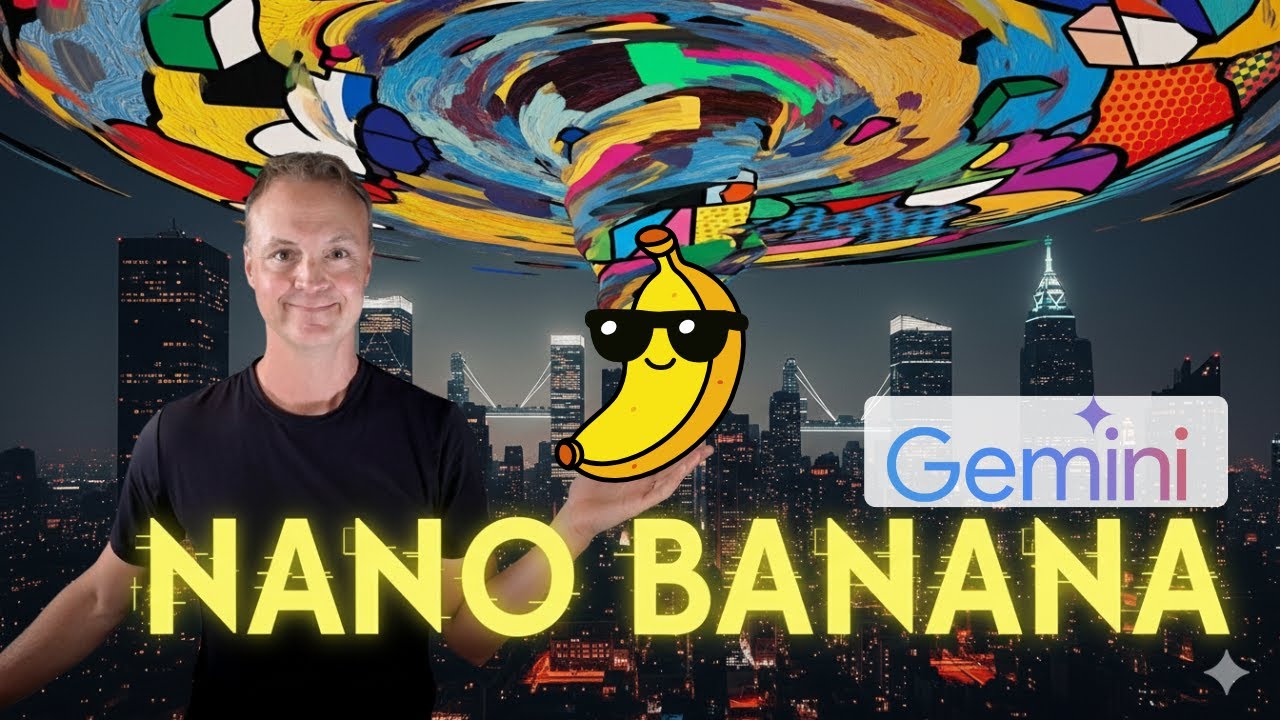
Google Gemini's Nano Banana Makes Photo Edits EASY
6:23

Google Gemini's Nano Banana Makes Photo Edits EASY

Teacher's Tech 27.08.2025 52 441 просмотров 450 лайков обн. 18.02.2026
Поделиться Telegram VK Бот
Транскрипт Скачать .md
Анализ с AI
Описание видео
Google just dropped a massive update for Gemini's image editing, codenamed "Nano Banana"! In this video, we're putting Google's new Gemini 2.5 Flash Image model to the ultimate test to see if it lives up to the hype. Can it really maintain your likeness across different scenes? How powerful are the new multi-turn editing and design mixing features? We're diving deep into this new AI image generator and editor, running a series of real-world tests to show you exactly what's possible. From changing outfits and backgrounds to blending multiple images and applying new art styles with a simple prompt, this video is your full guide to Gemini's most powerful creative tool yet. If you're a content creator, a designer, or just a tech enthusiast, you'll want to see these results. Let us know in the comments what you think of Nano Banana! Video Chapters: 0:00 - Intro: What is Nano Banana? 1:00 - Test 1: Likeness Preservation 2:46 - Test 2: Photo Blending & Design Mixing 4:06 - Test 3: Multi-Turn Editing 5:32 - Final Thoughts & Conclusion
Оглавление (5 сегментов)

  1. 0:00 Intro: What is Nano Banana? 181 сл.
  2. 1:00 Test 1: Likeness Preservation 352 сл.
  3. 2:46 Test 2: Photo Blending & Design Mixing 270 сл.
  4. 4:06 Test 3: Multi-Turn Editing 259 сл.
  5. 5:32 Final Thoughts & Conclusion 125 сл.
0:00

Intro: What is Nano Banana?

Hey everyone, I'm Jamie and welcome back. Today  we're diving into something super cool that's   been making waves in the AI world. Nano Banana.   No, it's not a new fruit. It's actually the code   name for a massive upgrade to Google's Gemini  app. Specifically, its image editing features.    We're talking next level AI editing that  promises to preserve identity, blend photos,   and make complex edits unbelievably  simple. I'm excited to put to the test.    So, what exactly is Nano Banana? Well, according  to Google, it's a new image editing model from   Google DeepMind that's built into Gemini. Its main  goal is to be incredibly smart about how it edits,   especially when it comes to keeping the likeness  of subjects. Think of your face, your dog's face,   or even a specific object consistent no matter  how much you change the scene around it. This is   a huge deal because often with AI, things can get  a little bit inconsistent, but Nano Banana aims   to fix that. I've got some prompts ready. Let's  go. I'm going to be demoing this from my Gemini
1:00

Test 1: Likeness Preservation

app that I'm logged into. You can also go over  to Google AI Studio. And here it is right here,   Gemini Native Image with Gemini 2. Flash. So,  you can use it in a few different ways. So,   let's start off with the first one is how it can  preserve the image. So, I'm going to open up this   image. I'm going to drag it in here. This one  right here. I just took a quick picture of me   in my office, my messy office. And I'm just going  to drag this over into Gemini. And let's start.    And what I like about this, the few times I've  I've done this, I can make my prompts pretty uh   simple. And it's kind of this conversation that's  happening. Let's send this off. Okay, that took   about 10 seconds. Let's see what we have here.   Let's make this a little larger. So, it definitely   kept the likeness of my face and it changed  everything around. I see the sunset, the city,   cyberpunk in the outfit. So, that did a pretty  good job. So, what I'm thinking right now that's   going in my mind, this is such going to be such  an easy way to make thumbnails on YouTube, uh,   just by changing the image and how quickly this  happens. Let's see how else we can change this.    We'll just hit back and we're just going to give  a quick new prompt using the same image of me.    Place me in a magical forest sitting on a giant  mushroom. Give me a fantasy elflike outfit. We'll   send that off. So, here's the magical update.   You can see I'll click on it and we have the face   preserved, the background, the giant mushroom,  everything is there. I'm impressed with how quick   that happened and it starts giving me ideas of  how a lot of people are going to use this. Next,   we're going to tackle photo blending and a new  feature called design mixing. This sounds like it   could save hours in photo editing suites. I have  two different pictures. I'm going to drag in a
2:46

Test 2: Photo Blending & Design Mixing

cozy living room and some modern art. You're going  to see between the two of them, I don't really   think that this art will match this, but we'll see  what happens. I'm going to say blend the modern   art sculpture in the living room, making it  look like it's natural part of the decor. Let's   see what happens. Well, that doesn't look very  natural. And I kind of knew that this might have   some troubles trying to blend this in naturally  just based on the coziness of the living room and   the modern art and how big it was, but it did do  a good job at cutting this out and it put it in a   spot where I thought it could fit. I thought maybe  it would shrink it down and place it on the table   or the mantle, but I just wanted to try this and  see what would happen. Let's try another blending   one. I have a coffee cup here, just a plain white  coffee cup. And I have a mosaic pattern. And what   I'm going to ask it to do is put the pattern onto  the coffee cup. So apply the mosaic pattern from   the second image onto the coffee mug, keeping  the mug's original shape and texture. So we'll   go ahead and send this off. Now, that did a much  better job. It looks like the mosaic is spot-on   and the coffee cup. Here's the original coffee  cup. And here is the original mosaic. And this is   the final result that did a great job of blending.   This could be massive for product design mockups
4:06

Test 3: Multi-Turn Editing

or just personalizing items. Finally, let's  explore multi-turn editing. This means you can   refine your image with multiple specific commands  without starting from scratch. It simulates a   conversation with an editor. Here we go. I'm going  to add a dog. This is a golden retriever that's   playing in the park. And I'm going to ask it to  change the park to a snowy mountain landscape.    Let's see what happens. Well, it did place it in  the right situation. It's in the mountains. It   still has its Frisbee. Let's try to do something  else here. Let's say using the same image,   add a small, friendly looking rabbit hopping near  the dog's paws. Make it look like it's a cold,   overcast day. I wonder if it'll get rid of the  Frisbee now. Well, that's interesting. It did   add the rabbit, but I don't think things look too  realistic here. Let's try one more thing. I want   to see if I can remove the Frisbee here. Let's  see what happens. All right, so it did remove   the Frisbee. So, again, this conversation that we  could have back and forth with it to get exactly   what we needed. Probably I could have started  with a more realistic picture, but I'm kind   of impressed with how easy it is to tell what  we want. It understood the context, added new   element, and even adjusted the overall mood of  the image with lighting change. The ability to   converse and refine is what makes this AI editing  so powerful. So, what are my final thoughts on
5:32

Final Thoughts & Conclusion

Google's nano banana image editing in Gemini? I'm  seriously impressed. The likeness preservation is   a huge leap forward, making AI edits much more  reliable for subjects. The blending and the   design mixtures are incredibly intuitive and open  up so many creative possibilities. And multi-turn   editing means you can really sculpt your vision  piece by piece. Of course, like all AI, it's not   always perfect, but the results we've seen today,  I find them kind of mind-blowing because it was so   easy to do. This feels like a significant step  towards democratizing professional level image   editing for everyone. The fact that this  includes synth ID watermarks is also a responsible   move by Google, helping to identify AI generated  content. What do you think of Nano Banana?

Ещё от Teacher's Tech

Ctrl+V

Экстракт Знаний в Telegram

Транскрипты, идеи, методички — всё самое полезное из лучших YouTube-каналов.

Подписаться