🚨 Get 50% off PRO: https://www.dividenddata.com/march-madness-sale
💻 Dividend Data: https://www.dividenddata.com/
─────────────────────────────────
0:00 Software Stock Crash
1:59 Buying Opportunity
6:00 I'm Buying Microsoft
7:00 Intro
7:48 50% Off Dividend Data PRO
8:51 The Growth Thesis
16:25 Microsoft Financials
26:18 Microsoft Stock Analysis
29:44 Price Target & Analyst Estimates
─────────────────────────────────
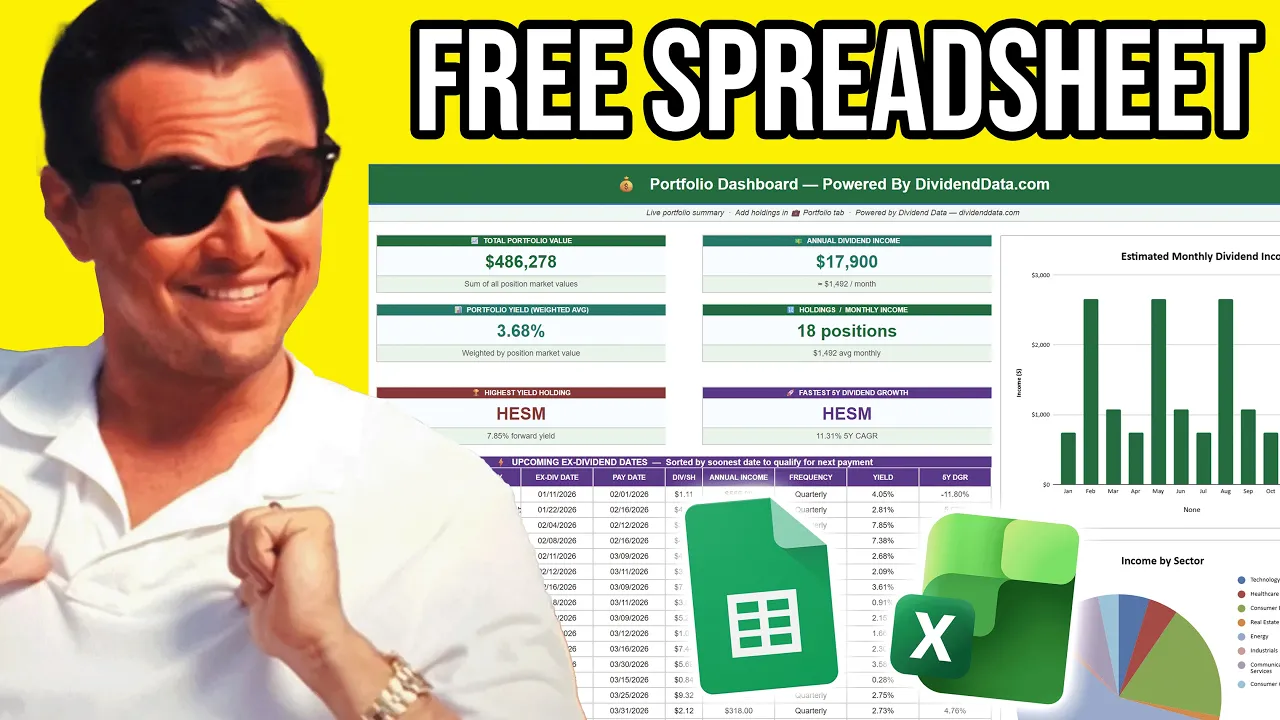
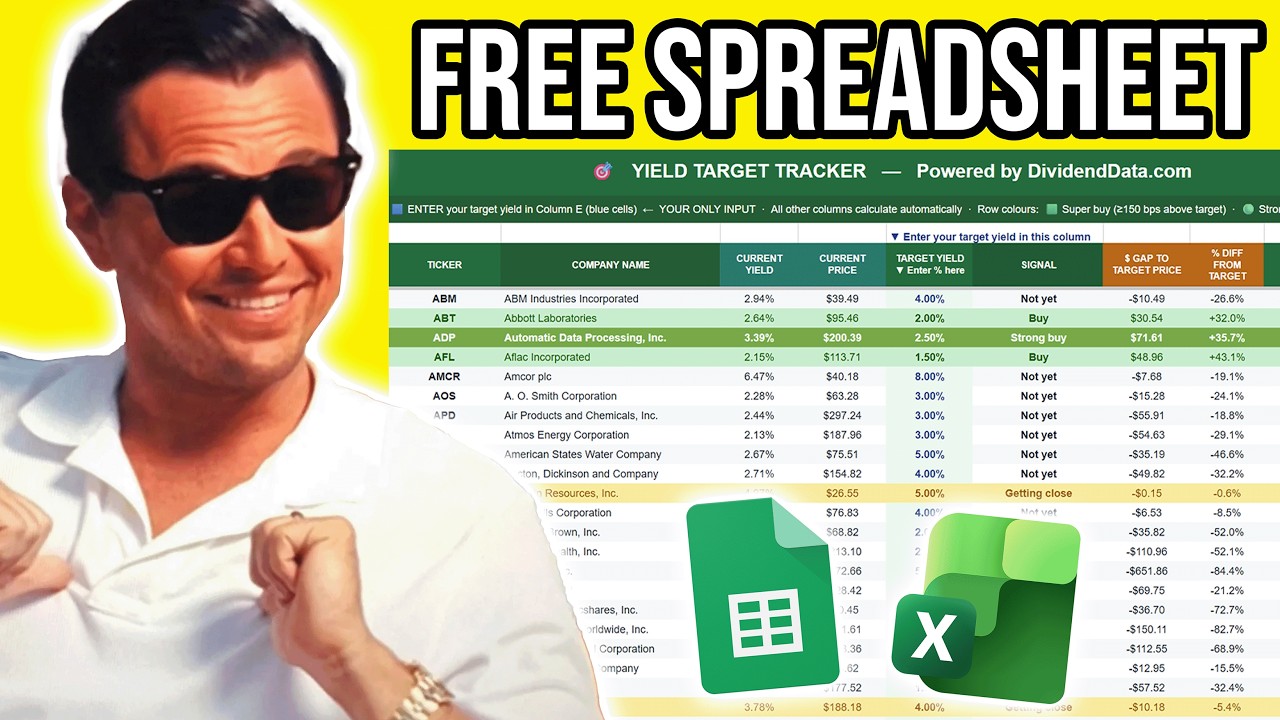
I built a free dividend portfolio tracker that pulls live data automatically — no copy-paste, no manual dividend entry, no workarounds.
Track your projected annual dividend income, yield on cost, dividend growth rate, and monthly income projections — all updated automatically using the Dividend Data add-in (free tier available).
Works in Google Sheets and Excel.
📥 Download the free template here:
https://www.dividenddata.com/products/dividend-portfolio-tracker-spreadsheet
─────────────────────────────────
My Links:
💻 Dividend Data: https://www.dividenddata.com/
🚀 Get Live Data in Your Spreadsheet (Free): https://www.dividenddata.com/sign-up-free
Follow on X: https://x.com/dividend_data
Listen on Spotify: https://open.spotify.com/show/4dBCd8IWgBYJgrbI2zROPR?si=084da0648e694103
Follow on Instagram: https://www.instagram.com/dividenddata/
─────────────────────────────────
Dividend Growth Investing creates cash flow without selling your position. Reinvested dividends compound powerfully over time — and tracking them properly is the first step toward financial freedom.
Disclaimer: This is my opinion and not financial advice.
#microsoft #stocks #investing
Оглавление (9 сегментов)
Software Stock Crash
Software stocks are selling off again in early 2026, and it's once again due to the threat of AI. We have outsourcing companies down 20% on the day, HubSpot down nearly 8% on the day, Salesforce down nearly 6% on the day, Paycom software down 5 1. 5% on the day, into it down 5. 3%, Apple Oven down 5%, Faxet Research down 4. 8%, 8%, Shopify down 4%, Oracle down 4%, Robin Hood down 4%, and even big tech giants like Alphabet are down 3. 5%. Other Microsoft are down 2. 4% on the day, bringing the stock down 21% year to date. In fact, Microsoft is now down 31% from its all-time high. So, why is this happening? Well, it's another post from Claude about a new product update. And of course, this went mega viral at 59 million views and is just another massive update in AI which is causing a stock market selloff specifically in software related companies. This new update is focused around computer use and taking a lot of the agentic principles that became popular with openclaw this year and natively integrating them into claude. And so far in 2026, it seems like every single week there's a new thing in AI that's causing a sell-off in the stock market. And you can see that with these memes people are posting. Cloud update, new Cloud update, newest Claude update, tomorrow's Cloud update, and it's that meme with the snipers. But this update, it's really not unique to Claude at all. This is a broad trend that's going to be happening in every major AI company. And it's just another rock to add on to the pile of uncertainty in the stock market right now. And the reason why software is selling off right now is because it's being perceived as vulnerable. Because these new AI tools, they have gotten so good at coding. that's becoming easier and easier to potentially replicate large sets of the features that these software products offer, if not replace them entirely. So, people are wondering what the future of companies like Salesforce and into it even look like.
Buying Opportunity
But anytime there's these mass selloffs of sectors where they're not even necessarily looking into the individual companies, that creates huge opportunity for long-term investors. And today, I'm going to cover a few of those opportunities. And ultimately I'll dive into the stock that I have personally been loading up on and I actually think is the most sure winner in this current environment. So first I'll just mention Salesforce here. This stock is down 27% year to date, 35% over the past year. Meanwhile, they have been hitting all-time highs in earnings per share and are growing double digits every single year. But the stock is selling off because of fear around AI and future uncertainty around the business. But the ironic thing is that right now there's no evidence of it negatively impacting the actual operations and Salesforce stock is looking dirt cheap. As an example, if you look up a chart of the daily P ratio for Salesforce stock throughout history, we will see that it is currently trading at an all-time low. As you can see, here's the Ford P ratio of Salesforce stock. And this is a company which used to trade in the 50s to60s. And that's because it was perceived as rock solid subscription SAS revenue. And back then they were growing revenue nearly 20% a year. During 2022, we started to see revenue growth slow closer down to 10% where it has stabilized. And you saw a reduction in the forward P ratio for Salesforce stock. At that time, that was due to slowing seat growth as we did start to see some layoffs in 2022. And it was a very frothy environment prior to that. And as we sit now, Salesforce stock is trading at a forward P ratio of 14. That's cheaper than some cigarette companies. Meanwhile, Salesforce is still reliable. Recurring revenue, growing topline, 10% plus a year. As you can see, revenue per share, 3-year compound annual growth rate of 11. 42%. They just hit an all-time high, and their revenue is consistently climbing every single year. This business is also incredibly profitable and they generate very high free cash flow. Over the past five years, free cash flow per share has grown at a compound annual growth rate of 27. 47%. That was $14. 4 billion in free cash flow. And Salesforce is not a company which is investing in these large capex intensive data centers. That's not their business. Instead, they get to use all these models and their products and they don't have to pay any of that upfront. So as long as a company like Salesforce doesn't get disrupted and they can potentially benefit from AI, this is a very high quality cash generating business which is still growing and is now trading at a low multiple. And this is the kind of opportunities that are created when we have these largely emotional sectorwide kind of uninformed perspectives in the stock market. Right now in my opinion the market has no idea what they're doing. The only thing they know is that they are uncertain about what's going to happen. They don't want to invest in software stocks cuz they don't know what the future's going to look like. And then on the other side, you even have negative perception around the AI boom, thinking it's a bubble. The perspective that a lot of these AI labs, whether it's OpenAI, Anthropic, there are perspectives that those companies are overvalued. You had the big tech giants building out massive data centers being Alphabet and Microsoft and Amazon and Meta as well. They are becoming a core infrastructure level of AI and seeing massive growth in their data center and cloud businesses. But these companies are also selling off in early 2026 due to concerns around their massive capex spending. Even the most certain winners in the next few years are not going up right now. They're selling off. Companies like Nvidia that is down 7% year to date. Meanwhile, they are seeing massive earnings per share growth, still hitting all-time highs, expecting more than 70% growth in EPS this fiscal year, trading at a 4P ratio of 21. But the market still doesn't even know what to do with Nvidia. So, as we look at the stock market and the software selloff in early 2026, there are a ton of opportunities. The one I've
I'm Buying Microsoft
personally been loading up on is Microsoft, ticker symbol MSFT. In my perspective, they're a very clear winner in AI. So, I'm taking advantage of the sell-off and buying the dip. Microsoft is currently trading at a Ford P ratio of 21, which is one of the lowest ever in the history of Microsoft. This is lower than the November 2022 lows and the lowest we've seen since 2018. So, today I'm going to dive into the business behind Microsoft and explain why the stock is actually so cheap despite it still seeming like it has a relatively high stock price. You have to look at everything in context to the fundamentals of the business. And Microsoft has kept growing at a high rate year after year. And as we sit in early 2026, the business growth is outpacing the growth in stock price. So this sell-off is creating potentially a great buying opportunity if you're planning on holding the stock for 3, five, or 10 years. With that said, I'm going to roll the intro and then dive into my investment case in Microsoft.
Intro
The following reflects the opinions of a man who spends far too much time thinking about stocks. Please do your own research before making any investment decisions. Nothing in this video is personal financial advice. Continue at your own risk. My name is Zach. This is Dividend Data and you should leave a like and subscribe to the channel if you enjoy the video. And
50% Off Dividend Data PRO
throughout I'm going to be using my stock research tool over on dividend. com. Right now you're seeing our terminal product and the goal of this is basically bring all the stock market fundamentals for every company and create easy to see visualizations so that you can analyze the quality of a business. You can track your watch list, track your portfolio, automatically link the accounts, research stocks with an AI analyst, and access our new spreadsheet add-ins for Excel and Google Sheets. This allows you to get all of our stock data directly in your spreadsheets. It automatically refreshes and you can build powerful templates powered by our data. And right now is the best time to join because you can lock in 50% off annual membership. That is only going to be available for the next week. That's when the sale is ending and we will not have another sale for quite a while. So if you want to follow along with the tools I use in this video, you can lock in 50% off. That's every single year. And that gets you both the dividend data terminal and dividend data for spreadsheets with our maximum amount of data and usage. So click the link in the description and pin comment the video and get 50% off divin data pro. So as I look at the software and tech selloff in
The Growth Thesis
early 2026, I see tons of opportunities and personally I think the most high certainty winners in this selloff that you can buy right now are the big tech giants. And today I'm going to be diving into Microsoft. But I don't just mean Microsoft. This AI boom is going to be a massive wave. And a lot of the big tech companies who already had the best and most profitable businesses, they are in an extremely strong position to take advantage of this long-term growth. As an example, companies like Alphabet, the parent company of Google. They not only are going to have some of the best models and AI products that come out, arguably they should be considered the number one AI lab because of the combination of funding, researchers, and infrastructure. But I'm actually quite bullish on all of the big tech giants who have extremely profitable growing businesses that are also in the hypers scale cloud segment because that is where the most certain AI growth I think is going to happen and I think 10 years from now those are going to be some of the biggest businesses in AI. So Alphabet they're a big winner there with Google Cloud. Microsoft Microsoft Azure. A lot of people don't know this, but Meta also has a huge data center infrastructure that they use internally for their products, and they're now joining the fight and investing hundreds of billions of dollars into AI data centers, and they'll have a clear ROI using that in their own business, but it's unclear whether or not they're going to become a commercial cloud as well, but they're certainly building the AI infrastructure to support that. And then we have Amazon with Amazon Web Services. All of these companies have been selling off in early 2026, and personally, I don't think it makes any sense, and I am actually more bullish on these than I have been in recent history. Amazon's down 8 12% year-to- date. But in my opinion, the best value of that group is actually Microsoft. This is an extremely profitable, high growth business, and I think they have a rockolid market position that's not going anywhere. And when you hear Microsoft, a lot of the consumer people, they think uh the Windows stinks, micro slop, all that But the actual business of Microsoft, it all has to do with Microsoft 365, that software suite, and now the AI upsells on top of that, being co-pilot, being Agent 365, their new co-work product that they're working with Enthropic on. And that business is going through a lot of change right now in the same way that they went through change when they switched from you would buy, you know, when you would buy like a physical copy of PowerPoint and Docs and Excel at, you know, Best Buy to when they shipped it to being a cloud subscription service. The next five years is going to be another shift there where we're adding AI services on top of all of these products likely having new pricing offerings and I think the idea of agentic work and co-workers Microsoft's going to be a big provider of those services to large enterprises and over the next 5 to 10 years that whole industry is going to be massive growth. Microsoft is in a strong position to capture a slice of that thanks to their large presence they already have in enterprise software. They have all the relationships. I also think Microsoft 365 since it's a much more affordable service than many of the other enterprise SAS companies and it's more deeply integrated into operating systems and workflows. People use Outlook for email. It's a giant bundle of services that they can easily keep adding things into that bundle in the same way they added Teams to that bundle after the rise of things like Slack and Zoom. I think people are underrating the strength of that business. But the other big pillar of Microsoft is their cloud business, which is actually becoming their largest business overall. And while its margins aren't as strong as that high gross margin recurring software subscription model that Microsoft 365 has, the topline revenue growth of this segment is super strong, up 40% year-over-year. And they are supply constrained right now in compute. So you're going to see Microsoft Azure, Google Cloud, and AWS. They're investing so heavily. They have deals locked up. And this is the infrastructure that is going to power all of AI. And these cloud services, they have everything from more traditional things like hosting databases and web services to basically everything that you can do with AI, whether it's using the APIs, building bots or tools. And ironically, as we're coming into early 2026 and we're seeing a selloff in a lot of these companies, I'm actually more certain than ever that AI usage is going to be at all-time highs and incredibly fast growth in the coming years. And I think that's just going to keep compounding and compounding. And this isn't going to be just like a couple years of growth. It's not going to be 5 going to be 10. 20. And I think a lot of people struggle to visualize this because when they think AI, they think chat GBT and they just think of chat bots and they think of it as like a new way to do search or research. But it's really much deeper than that. At a fundamental level, what these companies, what these data centers are building now, they are manufacturing intelligence. In the industry, they call these tokens. So, Microsoft Azure, Google Cloud, Amazon Web Services, what they're spending all this money on is they're building token factories, manufactured intelligence, and that can be applied to countless different things. It could be tokens to predict the next protein or it could be a chatbot some deep research report that goes for days and days and it's constantly thinking. That was one big pillar of growth that we had in inference. The idea of reasoning and that you could have these models reason with themselves and continue going for long periods of time to get better results. And last year in 2025, we had a big advancement in tool use. These AI models became very good at using programming languages and built-in tools, whether it's things like calculators, command line interface, and that's when you saw a massive advancement in tool use. That was another layer of capabilities and token usage. In 2026, we saw computer use and agentic functionality. And this became highlighted when we got the Opus 4. 5 model. And then we had the release of OpenClaw. and this agentic functionality and computer use that thing uses tokens like crazy and it's becoming more and more obvious that's why bullish that there is going to be an explosion of demand for intelligence so much so that on a relative basis we're still in the first inning that is the part of AI I am most certain about and I think no matter what these big tech giants these hypers scale data center companies they're going to be huge extremely high cash flow businesses and specifically Specifically, I think you want to focus on the ones that already have extremely profitable businesses outside of the data centers so that they can fund the construction. Companies like Microsoft with their Microsoft 365. Companies like Google with Google search that is a cash cow money printer. Companies like Meta with social advertising Amazon which have many different cash drivers. Amazon Web Services itself is a cash generator. E-commerce is low margin but incredibly high revenue. On top of though, they're building profit drivers, whether it's Amazon digital advertising, their recurring revenue within Amazon Prime, their subscription service, and thirdparty seller services, which I know they've been more aggressive on and in increasing its profitability. And this is why you're seeing these big tech giants lead the charge in investing in the AI infrastructure. They have the profitable businesses where they can afford to. Companies like Alphabet, for years, the complaint was that they had so much cash and they didn't know what to do with it. That was one of the complaints among investors. Google was sitting on $142 billion of cash on hand and now they're starting to put that money to work. They have found the thing to be investing in. So, I talked about
Microsoft Financials
the big picture environment here with Microsoft, which is important if you're going to understand the full context of the situation. But now, let's dive into the actual business and financials and stocked perspective of analyzing Microsoft. And I'm going to show what a strong powerful company this is. So, first let's take a look at the earnings per share. This is on a quarterly basis using non-GAAP and really this company has been on a decade of high growth after plateauing a little bit in the 2000s. They missed mobile which was a big opportunity but what Microsoft ended up getting right in platform shifts was cloud and they went all in on cloud and that's when they got into this large data center infrastructure. They've been in this game for 10 to 15 years. And the reason why cloud was amazing because companies no longer had to manage their own data center infrastructure and services. So it took out a layer of complexity. It made it far easier to run a web-based or software business, anything technical. As a result, you also saw Microsoft 365 becoming a cloud-based subscription software product. So Microsoft's core business it became Microsoft cloud both in the applications they provide to their users and on the infrastructure which they use for themselves and also rent out as compute and infrastructure as a service their cloud infrastructure the primary customers are enterprises and Microsoft 365 the primary revenue source is large enterprises and since this is a Microsoft video I'll bring up Excel here to load in some financial data and help you visualize Microsoft cloud. So, as you can see here, we have our dividend data addin. Lets you bring in and analyze all of our data instantly into Excel. So, as an example here, we'll load in the quarterly KPIs for Microsoft. And you can see how fast this information loads into Excel. It's kind of crazy, but the reason why I'm bringing this in is I'm going to make a chart for you here. So, what I did here is I graphed out quarterly Microsoft Cloud revenue going back from 2019 to the latest quarter, which just reported, which ended December 31st. So as you can see in the latest quarter, Microsoft cloud meaning the cloud parts of their application business so Microsoft 365 and the cloud parts of their infrastructure business Microsoft Azure that hit $51. 5 billion of revenue in the quarter in 2019 that was $12. 5 billion a quarter. In 2019 so 6 years ago in that same quarter ending in 2019 that was $12. 5 billion of quarterly revenue. So, in six years, we've seen Microsoft's quarterly cloud revenue grow more than four times from 12. 5 billion to $51. 5 billion. And this is not changing. Microsoft, if anything, they're starting to accelerate again. And Microsoft cloud revenue overall is now nearly $200 billion of their overall revenue on a forward-looking basis. Here you can see the Microsoft Azure growth rate in constant currency. In the latest quarter, that was 38% year-over-year for something which is now their largest business. And in the prior quarters, it was 39% growth year-over-year. So, Microsoft Azure, it's growing much faster than Amazon Web Services. Now, Amazon's a little bit larger, but this is industry-wide growth. You're seeing massive growth at Google Cloud as well. In fact, they exceeded the Microsoft Azure growth. And I listened to the earnings call from Microsoft last time, and they mentioned that they could have juiced this number into the mid 40%, but they're using a lot of the AI infrastructure for their own internal products being Microsoft Copilot and developing their own models. So they are supply constrained and that's the thing you're hearing from all of these AI companies. They are constrained in compute infrastructure. They could be growing much faster. And this demand I think is only going to keep accelerating as the capabilities accelerate. So that's why every single week when I'm seeing these massive news stories around new capabilities and I'm trying them out myself, it's just confirming the need for future demand. When you see something released from Claude Enthropic or OpenAI or really pretty much any AI company, whose infrastructure do you think this stuff runs on? It runs on Microsoft Azure. It runs on Amazon Web Services. It runs on Google Cloud. Meta's products run on Meta data centers. And I'll get into the capex investment and the potential risk around that. But the reason why they're doing this is because they have the clear commercial opportunities in front of them. Not to mention all of the technological advancement that they want to be on the frontier of which this infrastructure provides for creating their own applications. In the latest quarter, Microsoft reported $631 billion of total remaining performance obligations or RPOs, which is basically contracted future revenue. And prior to that is around $400 billion. Now, let's get to the big story, which is capex. So, here I'm loading in the cash flow statement for Microsoft stock. And what we're going to be taking a look at right here is down at the bottom. We're going to look at operating cash flow, capital expenditures, and free cash flow. And at Microsoft, you're seeing a huge explosion in capex because they are building out these massive AI data centers. And purely from a financial standpoint, this is one of the more interesting and one of the potential arguments you could make for why Microsoft stock could be down. But this is the same thing also with Google. It's the same thing with Amazon. Meta. Each of these they had beautiful cash printing businesses at their profit center as I mentioned with Microsoft get Microsoft 365 high margins capital light business. Same thing with Google search extremely high margin capital light you don't need to invest in these products they're just profit but all of these companies they went into the cloud business which started to introduce cafex into their business but they were still so profitable that relative to everything else it was tiny. As an example, Microsoft in 2022, they were spending around 5 to6 billion a quarter in capex. That was while they were generating, you know, 2025 billion in operating cash flow a quarter. But with the AI buildout, you started to see this capex climb. By mid 2024, it got to nearly $14 billion a quarter. Then it got to $20 billion a quarter. And in the latest quarter for Microsoft, it got to $30 billion, which on a forward-looking basis would be $120 billion a year in capex. And the interesting thing is that this is actually more conservative than the likes of Google, which forecasted $180 billion, Amazon, which forecasted $200 billion, and Meta, which forecasted $160 billion. So this capex is likely going to go up for Microsoft as well. And this is where it's starting to get interesting because the companies, they're getting very aggressive with their spending. Now, Google and Amazon, they're knocking out all of their free cash flow. Same with Meta. Microsoft seems to be slightly more conservative and wants to retain some of their free cash flow, but they're quickly going to get on that path as well. As an example, over the past four quarters, their trailing 12 months operating cash flow was $160 billion and that was $77 billion in free cash flow, which as I'm saying this, it goes to show how profitable really all of these companies are. The idea that you can be spending 20 to$30 billion a quarter on these data centers and still be generating tens of billions of dollars in free cash flow. Pretty crazy. But in order for this capex to be sustainable and for it to even go up, which who knows, you know, it could even keep increasing, we're going to need to see continued growth in operating cash flow of these businesses. But right now, the capex growth is outpacing the growth in operating cash flow. But this is kind of expected because you put the money up front, you have to build out these whole data centers and then it starts to pay off year after year. And I was doing some research around this and for a stock like Microsoft and for all these companies whether it's Google, Microsoft, Amazon and Meta, this capex investment is going to take a few years to start to play out. As an example, I was doing some research with Microsoft and let's say they peak at around 150 to $200 billion in annual capex spend. It's going to look like a cost for a few years, but this is building the future of these companies into massive profitable businesses that I think are some of the high certainty winners in this AI trade. As an example, for a company like Microsoft, by 2030, they're currently just under $300 billion a year in annual revenue. By 2030, that could be $580 to $680 billion. And if capex stays constrained around that $135 billion mark and it doesn't keep ballooning year after year, which I actually don't think it should because I think what people are underestimating is how much of a process building out these data centers are. You can't just throw money at the problem. It's a realworld thing of you have to get these built, plugged in, functioning. them powered. I don't know if we're going to be seeing capex expand massively way past what we're talking about now, but I really don't know. It could. I think the constraint will prove to be though how much they can actually get built in a reasonable amount of time. At certain point, you can throw more money at it and it doesn't necessarily help it get built faster. Microsoft would be generating 230 to $270 billion in operating cash flow. And even with this elevated capex, there'd be 110 to$155 billion of free cash flow. But these investments, they're not just for 2030. It's for 2035, 2040. By 2035, Microsoft could be generating 400 to510 billion of operating cash flow. 245 to345 billion of annual free cash flow, operating cash flow in the 600 to $850 billion range by 2040, $425 billion to 570 billion in annual free cash flow by 240. And I think when we're talking about AI and where the enterprise value long-term is going to acrue to, right now we have it all going to Nvidia pretty much because they're making all the profits as all these big tech companies, they're paying Nvidia to get the chips. But at a certain point, the capex growth is going to plateau and slowly grow from there. And the next layer of the stack is these hypers scale cloud companies. And 5 to 10 years from now, they're going to be massive cash generators. So, as we're
Microsoft Stock Analysis
looking at a stock like Microsoft, I'll give you my financial overview looking at all the key metrics and then I'll give you my personal price target by 2030 where I think Microsoft will be as well as analyst forecasts. So, overall Microsoft revenue, if we look at revenue per share, it's been accelerating. It slowed down a little bit in 2023, but then we had 15. 9% growth followed by 14. 9% growth. And they're on a little bit of an accelerated fiscal calendar. So, they're already two quarters into 2026. and they are on pace for another year of great growth. Five-year compound annual growth rate of revenue was 15%. If we take a look at net income per share, 5-year compound annual growth rate is 18. 68%. Free cash flow per share over the past year, it's down 3% despite the massive increase in capex. And before the latest quarter, which historically Q2 is always the lowest quarter for Microsoft in terms of operating cash flow coming in and then they doubled that with super high capex in this quarter, the record number. So in terms of free cash flow, they had a bad Q2 and they're likely going to be not growing much in free cash flow, probably declining. As I mentioned earlier, you're seeing Google and Amazon take out their free cash flow completely. But what I thought was really promising just in terms of the business fundamentals and really shows how strong they are in Q1 and Q4, they had record free cash flow per share in both of those quarters. Even while they were investing nearly $20 billion in capex, they still generated $26 billion in free cash flow in both of those quarters. And over the past 5 years, free cash flow per share, it's grown at a 10. 14% 5-year kegger. And Microsoft's interesting. They went from an asset light business to becoming more capital intensive. and you're seeing their shareholder equity absolutely explode, nearly hitting $400 billion. And this is going to keep going up. Microsoft, like Google, it's one of those businesses that had so much cash sitting around, they didn't know what to do with it. More than hundred billion in cash on hand. They had a lot of that in treasuries. They're still in an incredible financial position. $89 billion of cash and short-term investments. And of course, the cash generating machine bringing new money in all the time. But I think in hindsight, one of the big mistakes that Microsoft made was that Activision Blizzard acquisition for I think it was like $70 billion or something. In hindsight, with this AI boom and how the gaming business has kind of stagnated. In hindsight, you would definitely want all of that money to just strengthen your position and pour into AI. And historically, Microsoft has very little debt and their cash always exceeds their debt. But recently, that flipped with the AI buildout. It's still in a pretty reasonable position, $33 billion. Again, I mentioned that in one quarter they can make $26 billion in free cash flow. So, this is not at all in a dangerous position. Overall, the balance sheet of Microsoft and all of these big tech companies, it's world class. Here you can see Microsoft shares outstanding. They've slowly repurchased over the years, but I would say that share purchases are pretty done for now cuz they're investing in AI. It's a much better use of their capital right now. But they still do have a growing dividend payment. Their forward-looking dividend is $3. 64 64 cents per share, which is nearly a 1% dividend yield now. And overall, it's a small dividend payment, 23% of their earnings per share, 33% of their free cash flow, and it grows 10% year after year. They've been doing increases going back to 2005, and it's always in a pretty sustainable range. So, Microsoft, I actually think they'll keep their dividend, keep it slowly growing, even with the massive capital expenditures. And I think 10 plus years from now, Microsoft's going to be able to afford a much much higher dividend and shareholder returns
Price Target & Analyst Estimates
overall. So, as we're looking at Microsoft stock here, you can see the future earnings estimates for the company. They have two more quarters in their 2026 fiscal year. And based on that, they're around a 22 or 21p ratio depending on the estimates. So, Microsoft is trading cheaper than a lot of other companies that are not nearly as high quality with as much growth prospects. and analysts are projecting 15 plus percent annual growth every single year and I think this is pretty realistic and that's the same with revenue growth as well. So personally right now I think Microsoft is trading at a low multiple. I think they should be trading at least a 30 looking forward P ratio. I mean that's where they were trading just last July a 30p ratio which is historically kind of in the middle of Microsoft. And I think with the highly reliable growth prospects ahead seems to make sense to me. And it's really interesting right now. The market is so worried about a bubble in AI. so much pattern recognition from prior bubbles, whether it's the dot era, that a lot of the actual stocks in terms of the multiples they trade at, that's not where the bubble is. The only arguable bubble going on is the amount of spending going on in AI to build out these data centers and also in the private sector investments into new AI frontier model labs, a lot of which have not even come to market yet and have like tens of billions of dollars. That's where there's the bubbly stuff going on. But in terms of the multiples these companies are trading at, that's not where the bubble is. If we were in a bubble in terms of multiple for Microsoft back with like how it was in the dot era, Microsoft would be trading at 60 or 70 times earnings. So if we go back to these forward-looking earnings estimates, I think these are all fairly reasonable. Microsoft would have about $3341 in fiscal 2030. And the reason why I'm bringing this up is I'll give you my price estimate for what Microsoft stock will be in 2030. So, let's say by then they trade at 30 times their 2030 earnings, which I think is very reasonable. That would bring Microsoft share price to $1,02 per share. The current share price is $372. So, that means Microsoft stock just in terms of stock price would go up about $2. 5% by 2030 by about mid 2030. And that's my personal rough target. But I am also aware it's going to be very bumpy along the way, especially until the market starts to be more certain about these capex spendings and the potential return on investment. So that's why personally I'm accumulating shares right now, dollar cost averaging in more when I can. I already did a big chunk purchase in early 2026. It's gone down about 8 or 10% since then, so kept adding to it. And Microsoft, this is a stock I'll probably keep adding to over the next couple years as long as it doesn't start trading at like a 35p ratio or something, which I mean to be honest, I have no idea what's going to happen. It could the market dynamics can flip like this. Among Wall Street analysts, Microsoft is currently one of the stocks that a lot of super investors are buying. I don't really pay attention to that though. I like to just look at it myself. Wall Street analysts like it as well. Current consensus price targets. So, the average of all the different price targets right now, $58,367. That implies the stock is 56% undervalued at the current price. The lowest price target on Wall Street is $392 and the highest right now is $675. So, I think no matter what way you crack it up, Microsoft, I think it's an attractive buy right now. And you really shouldn't be looking at what the market is saying in terms of why a stock price is going down any day or any week or any month or any year to date. You got to look towards the business and do your own analysis on it. The market is there to provide opportunities for you. It is not there to inform you. And I know emotionally that can be hard to register, but don't let the prices inform your analysis on the business. Always look towards the business. So, if you find that interesting, make sure to leave a like, comment, and subscribe to the channel. Leave a comment below uh what you're buying in this software selloff, what you think is the best buy right now. And if you want to use the stock research tool I showed throughout, it's all available at dividenddata. com. We have our March Madness there where you can get 50% off annual membership. That's the best deal we're ever going to offer. You can lock that in every single year. And there's a 30-day money back guarantee. So no risk in trying it out. And you get our dividend data terminal, which is the website that I was using throughout. And then you also get our spreadsheet addin for Excel and Google Sheets that allows you to access all of our data natively into Excel. Create your own templates and watch list. And by the way, I'm launching templates. I've got a new one that I'm excited to share with you. Probably going to record a video for that right after this. This sale ends in a week, so make sure you click link in the description and pin comment to redeem it. With that said, thanks for watching and I'll see you in the next