What Coffee Actually Does to Your Brain (131,821 Person Study)
6:19

What Coffee Actually Does to Your Brain (131,821 Person Study)

Dr Brad Stanfield 24.02.2026 13 677 просмотров 729 лайков

Machine-readable: Markdown · JSON API · Site index

Поделиться Telegram VK Бот
Транскрипт Скачать .md
Анализ с AI
Описание видео
For weekly health research summaries and extra insights, sign up here 👉 https://drstanfield.com/pages/sign-up 💊 Supplements I Take: https://drstanfield.com/pages/my-supplements 💊MicroVitamin+ (Pro) Powder: https://drstanfield.com/products/microvitamin-plus 💊MicroVitamin Standard Capsules: https://drstanfield.com/products/microvitamin 🩺 Get your personalized health roadmap (free): https://drstanfield.com/pages/roadmap Timestamps: 00:00 New Coffee & Dementia Study 03:30 Decaf vs Caffeine 04:26 Caveats and Limitations 05:03 Practical Tips ✔️ Twitter: https://twitter.com/BradStanfieldMD ✔️ Patreon: https://www.patreon.com/bradstanfieldmd Here are the links to the research papers referenced in the video: https://alz-journals.onlinelibrary.wiley.com/doi/full/10.1002/alz.70235 https://www.frontiersin.org/journals/public-health/articles/10.3389/fpubh.2025.1585711/full https://www.sciencedirect.com/science/article/abs/pii/S0899900715005389 https://jamanetwork.com/journals/jama/article-abstract/2844764 https://pmc.ncbi.nlm.nih.gov/articles/PMC12702361/ Thumbnail by James Kelly Video edited by Troy Young Script by John Milliken The links above are affiliate links, so I receive a small commission every time you use them to purchase a product. The content contained in this video, and its accompanying description, is not intended to replace viewers’ relationships with their own medical practitioner. Always speak with your doctor regarding the content of this channel, and especially before using any products, services, or devices discussed on this channel.


Оглавление (4 сегментов)

New Coffee & Dementia Study

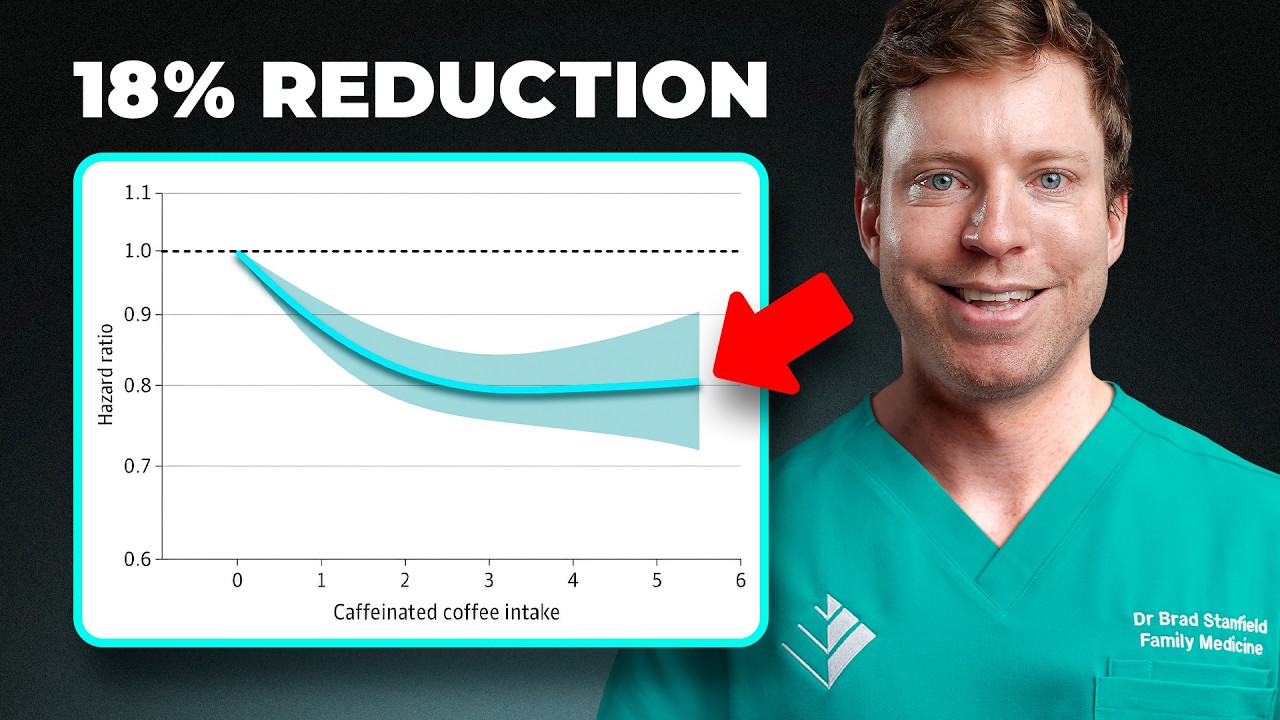
Right now, there are more than 7 million Americans living with Alzheimer's disease. And by60, that number is projected to nearly double to 13. 8 million people. And Alzheimer's disease is just one type of dementia. If we take all forms together, there's an estimated 49 million people over the age of 65 worldwide who live with dementia. But currently, there's no cure for it, and treatment options are severely limited. And recent FDA approved medications, they only show modest benefits. Yes, they can help to slow the condition, but they don't stop or reverse it. and they're very expensive and they do carry risks which is why prevention has become so critical. If we can identify modifiable risk factors so these are things that we can actually change in our daily lives we might be able to delay or even prevent dementia before it starts and that brings us to your morning coffee. So some have speculated that it might be protective against dementia and limited evidence has pointed in this direction but until recently the study results have been mixed and researchers haven't been sure. So, could something so simple potentially make a difference? And does caffeinated versus decaf matter? These are hard questions to answer. Dementia develops slowly over decades. So, to answer these questions properly, you need more than just a few hundred people followed up for a couple of years. What you need is a massive decadesl long investigation. And that's exactly what this new study gives us. The study included two large cohorts with over 130,000 people. And they started accumulating data for one cohort back in 1980 and the other one in 1986. They were followed up for 43 years. And here's what makes the study distinctive. So in addition to its size and time frame, the data includes frequent repeated measures of coffee intake. Participants filled out detailed food questionnaires every 2 to four years. So it captured their daily habits and how they changed over the decades, giving a true picture of long-term consumption. So researchers also kept an eye on multiple health outcomes. They didn't just track dementia diagnosis. So instead, they measured cognitive function to look for markers of decline that could indicate early stages along the path to this disease. They did this by asking participants how they felt their minds were working. And they also looked at scores on cognitive performance tests. And finally, researchers took great pains to account for factors that could skew the results. So they adjusted for multiple different factors here from basic demographics to lifestyle and diet quality. And after analyzing all of the data, here is what they found. Over 43 years of follow-up, just over 11,000 people developed dementia. But here is where it gets interesting. So the researchers divided the participants into four separate groups depending on the amount of coffee that they regularly drank. So compared to the group that didn't drink coffee, the next highest level of intake was associated with a 2% risk reduction for developing dementia. These are people who drank less than one cup of coffee per day. For the third group, they drunk between 1 to 2. 5 cups of coffee per day. And here is where we see a massive reduction. Now it's 19%. But then something surprising happens. So with the fourth group, these are people who drunk the most coffee. About 2 1/2 to 4 1/2 cups per day. The risk reduction actually pulls back a little bit. Here it's 18%. To put it simply, moderate coffee drinkers had about 1/5 fewer dementia cases. But it looks like coffee may have protective effects even before a dementia diagnosis. So researchers when they asked people to report on their memory and thinking here again they saw differences based on coffee intake 9. 5% of non- coffee drinkers reported noticing some cognitive problems. The share for the highest coffee consumption however was 7. 8%. But here comes the twist that no one was

Decaf vs Caffeine

really expecting. So we were trying to figure out why coffee might be protective. So they looked at decaffeinated coffee versus caffeinated coffee. And for decaffeinated coffee there was no protective effect which raises a natural question. How what is it about caffeine that seems to be protective against dementia? There are many proposed theories but truthfully we don't know. So for instance, how caffeine works is by blocking adenosine receptors in the brain which is why it helps to prevent drowsiness. So that might be able to decrease amaloid plaque formation which is thought to be an important driver of Alzheimer's disease but that is very speculative here and caffeine is associated with other protective effects as well. So for instance it may help to lower inflammation in the brain. It may improve insulin sensitivity. But again, this is all speculative. We don't have a true understanding as to why caffeine seems to be lowering Alzheimer's disease rates. Coffee and tea, they contain other polyphenels and other compounds that have been demonstrated to counter some of the effects of oxidative stress and also improve the function of blood

Caveats and Limitations

vessels. But before we get too excited about this data, I do have to mention two important caveats. So the first one is that this is observational data, so it can't definitively tell us about causation. Now, unfortunately, we're never going to have a 40-year randomized control trial with coffee. So, this might be as close as we get. The researchers took pains to consider factors that might distort the results, but it is still possible that something else is going on here, that coffee consumption isn't the real driver for the patterns found. And the second caveat is this. So, just because the study suggests that caffeine is an important element of the protective effects of tea and coffee, it doesn't mean that the findings would translate to energy drinks. But now, let's get

Practical Tips

practical. If you already drink coffee, the evidence here suggests that an optimal intake as far as dementia risk goes is about two to three cups of coffee per day. And that's actually quite consistent with other research on coffeey's health benefits in other areas like heart health. And when we drink coffee is also important. So we want to make sure that we don't drink coffee later in the day because we don't want it to disrupt our sleep. And for some patients that I see in the clinic, even if they tell me that coffee doesn't affect their sleep, it still will affect the quality of their sleep. So, as a general rule, I recommend to them to finish their caffeine intake within 4 hours of waking up. That way, we can make sure that the caffeine has got plenty of time to get out of the system so it doesn't affect our sleep. And we also want to make sure that we don't add things like sugar and cream to our coffee. Those can have negative health impacts that can counteract some of the benefits. And finally, we should stick to filtered coffee because some studies have shown that unfiltered coffee can raise LDL cholesterol levels. And recently there was another study that uncovered a surprising way to lower dementia risks. So this has got nothing to do with diet, exercise, or any of the usual suspects. Instead, it's a simple thing that we can do once to significantly cut our risk. And you wouldn't expect it to have anything to do with dementia. So, make sure to check out this next video here to find more about this ridiculously easy intervention.

Другие видео автора — Dr Brad Stanfield

Ctrl+V

Экстракт Знаний в Telegram

Экстракты и дистилляты из лучших YouTube-каналов — сразу после публикации.

Подписаться

Дайджест Экстрактов

Лучшие методички за неделю — каждый понедельник