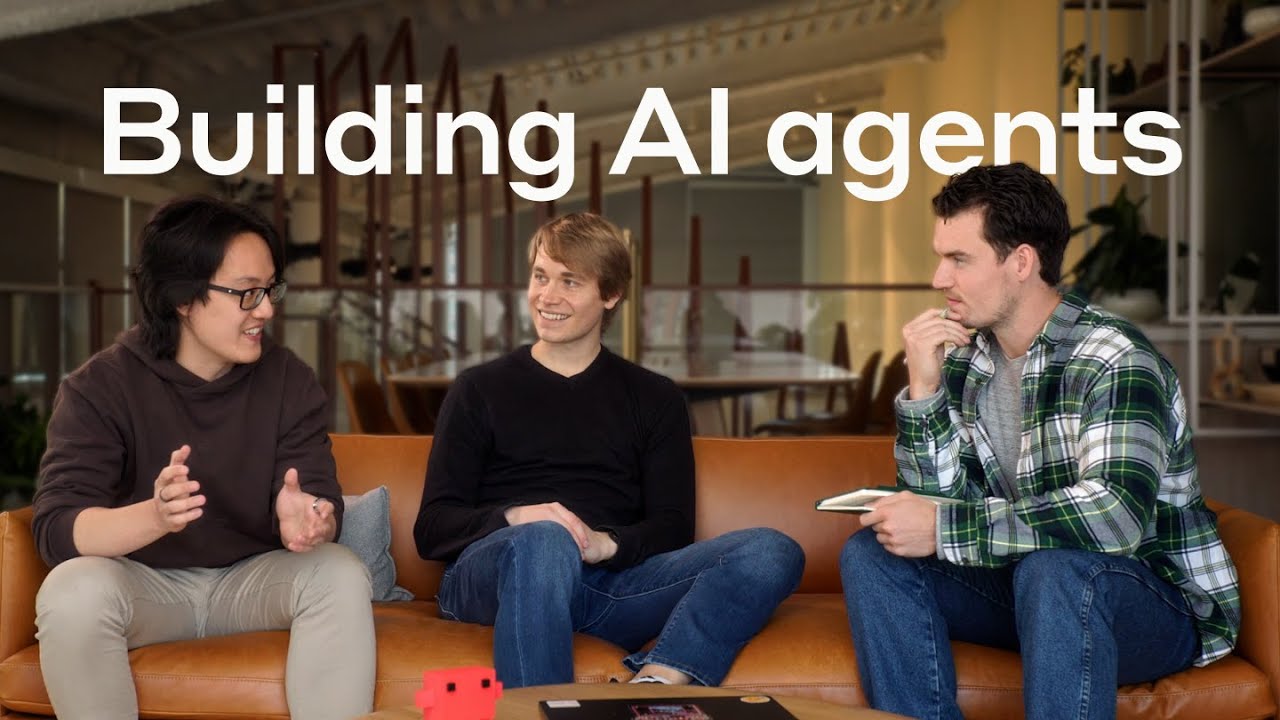
Anthropic’s Alex Albert (Claude Relations), Brad Abrams (Product) and Katelyn Lesse (Engineering) discuss the evolution of building agents with Claude, the latest Claude Developer Platform features, and why agents perform best when developers “unhobble” their model with tools.
Learn more about the Claude Developer Platform: https://www.claude.com/platform/api
00:00 - Introductions
00:30 - What is the Claude Developer Platform?
2:30 - What is an AI agent
3:15 - Building frontier intelligence for AI agents
4:00 - Reducing model scaffolding to build better agents
5:05 - The evolution of agentic frameworks
6:40 - Unhobbling the model with tools like web fetch
8:35 - Building agents with the Claude Agent SDK (formerly the Claude Code SDK)
10:50 - Best practices for identifying agentic use cases
11: 40 - Driving better agentic outcomes with the SDK
14:35 - Best practices for managing context and memory with Claude
19:00 - The future of the Claude Developer Platform (observability, computer use, and other ways to unhobble the model)
Оглавление (11 сегментов)
Introductions
- Because as a developer, my creativity ends at some point. I can only think of so many use cases. But the model, like anything, anything somebody comes with, the model will figure out a way to go do that thing. - Hey, I'm Alex. I lead Claude Relations here at Anthropic. Today we're talking about building the future of agents with Claude, and I'm joined by my colleagues. - I'm Brad. I run the PM team on the Claude Developer Platform. - I'm Katelyn, I lead the engineering team for the Claude Developer Platform.
What is the Claude Developer Platform?
- Let's talk about the Claude Developer Platform. - Yeah, let's start with that. - Start there. - It used to be called the Anthropic API. - Yeah. - We just went through a big name change. Can you walk me through why we made that change and also what this new platform is and what it encompasses? - Yeah, totally. So the Claude Developer Platform really encompasses our APIs, our SDKs, our documentation, all of our experiences within the console, and really everything that a developer needs to actually build on top of Claude. We're really humbled, proud to serve some really awesome customers around the world who are trying to, what we like to say, raise the ceiling of intelligence using Claude. And the platform really enables them to do that. And I would say one of my favorite parts about it is the platform doesn't just serve customers externally, the platform actually serves our internal products. So we love telling people, Claude Code, for example, is actually built directly on our public platform. - I see. - Yeah, I mean, I think when we started, we were just the Anthropic APIs very simple access to the model, but over the last year or so, we've added so many features to it. We added prompt caching, we added a whole separate batch of API, we added web search, web fetch, we have this context management support, the code execution. So all these tools, you know, now this kind of, we feel like, yeah, it's aspirationally, it's a platform now. - I see, so there's just a lot more to it now. It's evolved in a pretty drastic way over the past year. - Yeah, yeah. - Better, I think so. - And I think that's what developers were sort of calling it anyway. You know, so it's always natural to just sort of go with what developers were saying. - We were a little late to the game there. It's always had it, right? - It's okay. - We've made our amends. One of the cool things you can do now as we're moving from the sort of chat model to maybe this more agentic future is building agents as part of this developer platform. Before we get into how we're actually doing that on the platform, can we talk about what even is an agent to begin with?
What is an AI agent
- Yeah, I mean, agents is, it's almost sort of a buzzword, right? Like everybody you talk to now is building agents and whenever a industry tech term gets to that level, you know, the definition gets very gray. Everything everybody builds is an agent. But Anthropic, what we really think about agent is where the model is taking some autonomy to be able to choose what tools to call, to call those tools, to handle the results, and kind of choose the next step. So as a foundational research lab, leaning into the model and what its reasoning, how it decides what to do, we think that's a really important element of what an agent is. - Mm, so it's kind of like the aspect of it being autonomous in some sense. - Yeah. - Charting towards-
Building frontier intelligence for AI agents
- I mean, I think there's also, I mean, we have customers doing really useful workflows where they're sort of predefining the path that Claude should walk and that is a super-useful thing to do. But what's nice about the agentic thing is as the model gets better every couple of months, you know, we release a new model and with a true agentic pattern, you know, those services are just gonna get better. Where if you build a workflow with a lot of scaffolding in it, you kind of put bounds on the model, which is maybe okay in some use cases, but that means that you may not take advantage of the next level of intelligence that a next model release gets. - Yeah, so it seems like there's this interesting trend with agents, at least over the past 6-12 months, where like you've said, the scaffolding
Reducing model scaffolding to build better agents
has been a bit of a hindrance, and maybe we're dropping some of that. Can you explain the intuitions behind that around is this actually the future is we give less and less things to the model? - Yeah, I mean, I think over time what we're seeing is the scaffolding the model needs to be able to accomplish tasks is it's needing less as the level of intelligence of the model goes up. And we believe is gonna keep going up that basically the model has more contextual understanding of the high level task that it's trying to accomplish. So therefore it doesn't need as many sort of guardrails, And in fact, those guardrails in some cases become some like a liability to have. We've had customers try out new models and say, "Oh, well, it's actually only just a little bit better. " And then we kinda look into it with them about what's going on. And it turns out well, yeah, they were constraining it in ways that makes it harder for them to see the intelligence of the model. - Ah, does this match what we see in the field with our customers where they're also following these same trends?
The evolution of agentic frameworks
I know at the limit we have customers exploring all sorts of innovative techniques for managing Claude. - Yeah, totally. And there's actually a lot of discourse about this right now, right? Like, what is an agent and what does it need? What do you need to build? And there are people saying, you know, "It's just a wild loop. " Like, "You don't have to try that hard. " And I think ultimately there's been a lot of evolution of frameworks that people are putting around the model that are helping them orchestrate their agents, try to get the most outta the model. And I think what the industry is maybe kind of circling around is a lot of that has become maybe too heavy and maybe too opinionated and which is why you kind of get the people coming back to like, "It's just a wild loop and that is all you need. " And I think what we're trying to do there is to say maybe in a lot of ways it is a wild loop, but the things we can more uniquely do to help people get the most out of the model is a lot of those tools, those features and otherwise. And so what we wanna do is put, you know, frameworks and tools and platform out there that is opinionated to some extent on how people should use those tools. But it's not this super-heavy framework that really to Brad's point gets in the way of what the model's ultimately trying to do. So it's strike the right balance. It's like, you know, we've seen what a lot of people have tried to do, so we know we can be opinionated there, but we wanna be lightweight in the way that we're doing that and make sure that the real thing we're doing is helping you get the most out of the model without, you know, bogging you down in some super-heavy framework. - Right, so would you describe
Unhobbling the model with tools like web fetch
part of the strategy here then as providing these auxiliary tools and things that we can give to the model, but we're not necessarily placing the bumper spawn the model itself? - Yeah, we think about it as like, how do you unhobble the model? The model already has a lot of capabilities. In fact, I'm convinced that even if you take your current generation of models, there's way more intelligence in there than we've been able to unlock. But anyway, that intuition is if you just give the model tools it needs and set it free, let it be able to use those in the right way, you'll get great results. And I think a good example of that is we launched this server-side web search tool and web fetch tools. And it's been interesting to watch customers use those. And you know, all we did really, I mean it's a very minimal prompt that we have. We just give it the web search tool and all of a sudden deep research tasks are almost completely done with just turning on that switch on the API, because the model will call that tool, it'll look at its results, it'll say, consider it and say, okay, maybe I need to call, you know, do these other searches and then, oh, that fourth link you return, that's the great one. It'll do a web fetch on that link and bring that data back. And really all that very autonomously on its own kind of deciding. - Right, I think it's almost kind of like an interesting shift in where the intelligence of a system is being applied. - Exactly, yeah. - From the developer having to apply their intelligence to guiding towards the model now, figuring it out. - Right, and it's so exciting what the model does it, because as a developer, my creativity ends at some point. I can only think of so many use cases, but the model, like anything, anything somebody comes with the model will figure out a way to go do that thing. So it's great, great to unhobble the model. - Yeah, so if I'm a developer today and I'm getting started building
Building agents with the Claude Agent SDK (formerly the Claude Code SDK)
with the developer platform, what do you recommend? What are some best practices or ways for me to get started? - Yeah, so super-tactically, actually the number one thing that we recommend right now is the Claude Code SDK. And what's really, really interesting about the Claude Code SDK is we essentially built an agent harness an agentic harness around the model to run that loop, right? And automate a lot of that tool calling and otherwise feature use. And obviously originally was built for coding purposes. And what the team really quickly figured out was like, actually this is an excellent general purpose agentic harness. And so what the SDK does is it gives people a perfect out-of-the-box solution to actually just start prototyping agents without having to go and build, you know, the loop with all the tool calling and otherwise. It's built on top of the messages API and all those same tools that we're mentioning. But it kind of gives you that really great starting place right out-of-the-box. - Right, I feel like this is a pretty common misconception, at least when I talk to developers about the Claude Code SDK. So I'm not building a coding application. Why would I wanna use this? But you can kind of remove the coding-specific parts, - Yeah, I mean I think that's a great example of what we were talking about removing scaffolding on the model. It's like once we got done removing things from Claude Code to really unhobble the model, it turns out there was nothing coding left. When you remove everything else, then it's just agentic loop and you're really a minimalistic thing to give Claude access to a file system, to a set of Linux command line tools to the ability to, you know, write code and execute that code. So those are all very generic kind of capabilities it turns out could solve a wide variety of problems. - Right, yeah. I feel like something I've been running up to in my own side projects and also seeing with projects within Anthropic is before the Claude Code SDK, everybody's implementing some form of managing prompt caching or their tool calls and that loop. And now it's like, oh, just start at this base point, and then build from there. - You start a little bit higher up. - Yeah. - Yeah, yeah. - So it's like a further level abstraction.
Best practices for identifying agentic use cases
I think that's super-interesting. - I mean, I think the other really interesting thing to think about, especially for businesses looking at agents is what use case to go target. So thinking beyond the technology, what is the actual problem to go solve? And I think, you know, we see a lot of customers and doing a lot of things we love all of it, but where, you know, the biggest impacts are is where a customer has thought hard about what's the business value of this? Will it actually save this many engineering hours or will it help us remove this much manual work or whatnot? And being able to articulate what you expect the outcome of the agent project to be, I think is really helpful in defining the scope of the agent. - Right, and tying back one more time to the SDK. So it seems like it's been really, really useful for individual developers like myself, you know, starting out and just wanting to get hacking on something really fast for these customers, for enterprises that are actually trying to get real business value on these things. Should they be using the SDK? Is it ready for them? scaled use like that? - Yeah, so I think in a lot of ways it is, if you are in a spot where you can, like, you can deploy that runtime, essentially, that's what you get outta the SDK is an agentic loop runtime. You can go and deploy that runtime wherever you want, whenever you're ready to do so. But I think what we're really trying to do is take the spirit of what the SDK unlocks for people, go kind of up to that higher order abstraction where we give you the loop, we give you a lot of the tool calling in an automated way and say, how can we learn from that and give people out-of-the-box solutions that at scale will really be able to solve for their use cases. And I think that's a lot of where we're kind of trying to go with our roadmap throughout the rest of the year. And one really important bit when we think about that is if the entire goal here is to help our users really raise that ceiling of intelligence, get the absolute best outcome outta the models, then higher order abstractions are not just make it easier, because you don't have to write all that code yourself. It's actually like, how can we really, truly help you get the best outcome? Because we're in the room with research, inference, we know how to make sure that our abstractions, our agentic loop is going to be extremely powerful and extremely good at working with Claude. And the last thing that I would add in there is, especially as these things get longer running and as we provide more and more tooling to help people get at those longer running tasks, another big problem that our users we know are gonna keep trying to solve is observability within those longer running tasks. And so that's one of the most common things that comes up for folks is, you know, I have these long running tasks, I'm trying to get these really great outcomes, but you know, I might need to do some steering or tune my prompt, think about tool calling a little differently. And that's something that we know we can give people that observability through the platform over time. And that's another big area of focus for us. - Mm, okay, that's really interesting. I mean, this has been a huge issue that's starting to come to a head with agents- - I think so. -... especially as you trust them to go work in some, you know, other application in the background, how do you make sure they're actually doing the right thing and then if you're deploying them. - Yeah, how do you audit it? Like if we're gonna give some level of autonomy to the system, there needs to be a way to audit it and make sure the right things are happening, so that you can tune things and whatnot. So I think observability is really a key piece of this. - And putting a pin there that I wanna ask a question on, just the future of how we're gonna address that.
Best practices for managing context and memory with Claude
Before I do, is there other tools that exist right now that folks should be aware of when they're getting started with the developer platform, things that you've found helpful or useful? - Yeah, I mean, I think there's a, so we mentioned web search and web fetch. I think an another big thing that we're seeing is customers right now have to do a lot of work to manage the context window. So by default, Claude has 200 K tokens of context. We have a million token available now in beta on Sonnet, which is great, but even a million, there's a limit there. And what many customers have told us is that they get better outputs, higher intelligence if they even use a smaller part of the context. And so we've done, we have a couple of cool features that are just coming out to help developers manage that context. So in these agentic loops, a lot of times you're doing 10, 15, 100 tool calls and you edit this file or look up data in this database or you know, send this email and each of those tool calls takes up 100, 200, 1,000 tokens. And so we have this cool feature that lets the model actually remove some of the older tool calls that are not needed anymore. - Interesting. - And that gives, just like you, if you declutter your desk and declutter your notebook, you can focus a little bit better. So if you declutter the prompt actually, the model can actually focus a little bit better. - Ah, interesting. So okay, we're moving unnecessary context. Is there a risk that we remove necessary context? - Yeah. - How does that work? - Yeah, yeah. So we have some guardrails and some bounds around it, but the general rule is we try to remove the tools that are several turns back, that the model's already made decisions based on those tools. Yeah, I was playing with it recently and I removed the tools that it was just called and it's, oh, my tool results are gone, I don't know what to do. And then, but the model, the Sonnet doesn't give up. It's like, I'm just gonna call this tool again, you know? - Yeah, yeah, yeah. - But yeah, so generally we have put some bounds on that, because of that experience. So we do preserve the most recent set of tools. - I see, okay. - And then the other cool thing we do is tombstone it. So by that we mean when we remove the tool calls, we put a note in there to the model that say, oh, the tool results for the search call were here. - Oh, okay. - And they've been removed. - So the model's not completely memory wiped. - Exactly. I think we found the model does better if we just give it a little more context about what is happening. And so that's a key feature. And the other one is this kind of agentic memory feature that we've added. And there we have seen that the model does, right now, if you give a task to the model, say a deep research task or play Pokemon or whatnot, the model does about the same every time it runs. But if you give a human a task, the fifth time the human does a task, they do it way better, because they've learned, okay, if I'm gonna do this search, okay, probably the Wikipedia site is better than this other site or whatever. They learn which thing, so they get better over time. So we've given this memory tool to the model now, so that the model can actually take some notes while it's going and say, oh, I realize that this website maybe isn't the right one, or if I'm doing a search, it should be like this, or if I'm looking up, I should use this database, not that database or whatnot. And it makes those notes. And then when it's stumped, it can actually go back and review its notes and say, okay, oh, I'm starting this task, let me go read the notes, so I can figure it out. - Ah, cool. So we're handling all of that for the developer to say. - Yeah, well, we're giving the model this core capability to do memory, and right now we're letting the developer manage the memory. So, because, you know, different developers, they might wanna store it in some cloud storage or somewhere else. So we're letting developers figure out exactly where to store the memory. That way they have more control over that. - But exposing the tool. - But expose the tool. Yeah, we expose the tool. - So going back again to a roadmap question here.
The future of the Claude Developer Platform (observability, computer use, and other ways to unhobble the model)
So it sounds like there's a ton of new features that we've recently launched. There's a lot of momentum, and now there's other offerings as well, like the Claude Code SDK and things coming out soon. What are you most excited about, Katelyn? What's the future looking like here in the next 6-12 months? - Yeah, so we talked a little bit about these higher orders of abstraction where we can really just make it as simple as possible for you to get the absolute best outcomes out of Claude. And we wanna pair that with the observability that we talked about, so that you can really, you know, see the data and take those insights from those longer running tasks. And if you can combine these things together and start to think about some of the capabilities like memory that Brad just talked about, you can really start to see this flywheel where over time we're not just able to help you get the best outcomes out of Claude, but we can help you get self-improving and continuously improving outcomes out of Claude. And that to me is kind of the galaxy brain magic of the roadmap is get to a point where, you know, we have people coming to us, they're building on Claude, they have their tasks, they know what they're trying to do, and they get these really like aha moments where over time it's getting better and better. And you know, that's kind of the biggest thing that in everything that we're doing, we're trying to make sure we're going after. - That's awesome. - Yeah, I mean, I guess I'd have to say I'm always excited about model launches. It's like Christmas, wow, what will be possible now? So I love playing with the model launches they come out, just unlocks more use cases, some use cases that, you know, we've been working hard on and trying to improve, which is satisfying to see, but also some things I had no idea the model would be able to do this thing. You know, now it draws ASCII pictures so much better or what, you know, whatever. - The important things. - Very important things. But beyond that, the other thing I'm really excited about is we're in the early stages of giving Claude a computer. You know, I think about if we hire an employee here at Anthropic and we welcome 'em, "Here's your first day. " But we don't give them a computer. They would not be very successful at Anthropic. So right now, essentially everybody is using Claude and it doesn't have a computer. So I'm really excited about giving Claude a computer and you see the very baby steps of that with the code execution tool, where the model can write code executed on the VM and get the results back. So it can zoom in on images or take a Excel spreadsheet and create amazing data analysis with charts and graphs. And that's just the baby step. What if I had a persistent computer that was always there and it could organize the files in there the way it needed and get the tools set up the way it wanted. And I just think there's a lot of headroom to that scenario. - Yeah, and I guess that all ties back into this unhobbling into this too. - Exactly, exactly. It's all about unhobbling the model. That's exactly, just give Claude the tools. - Yeah. - Well, I'm excited for that future. Thanks so much for this conversation. - All right, cool. Yeah, thank you. - Thanks.