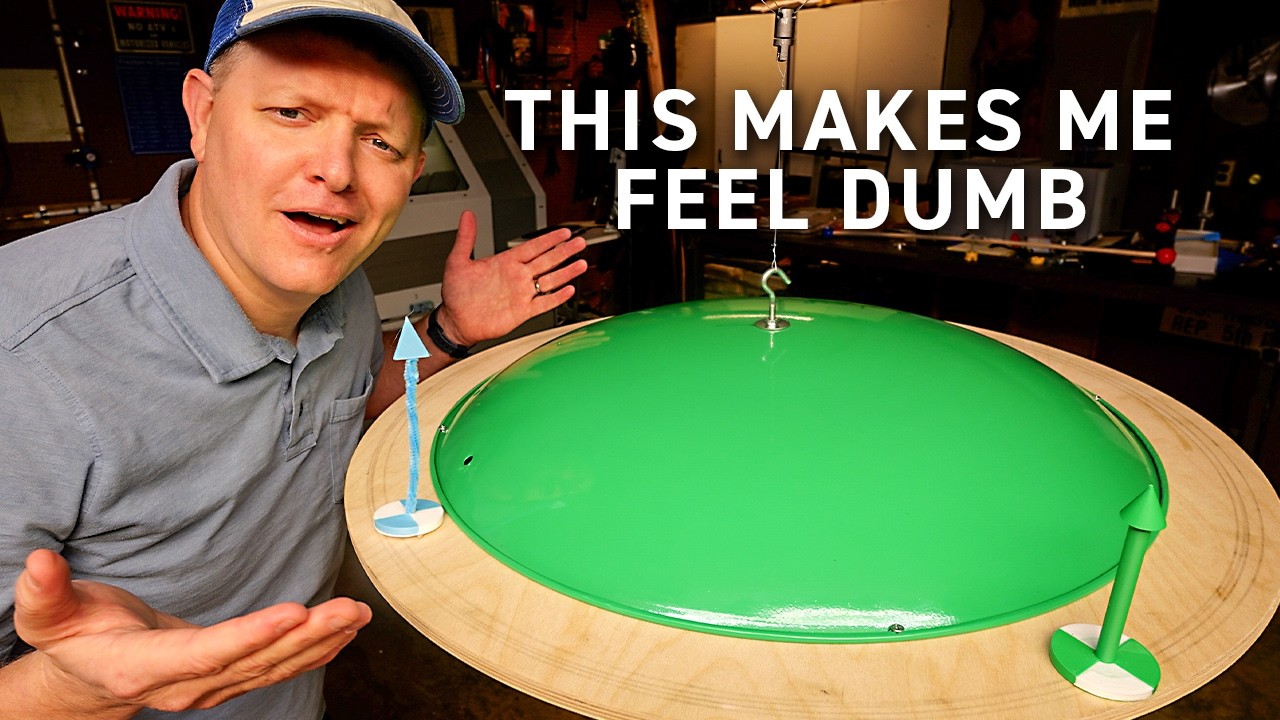
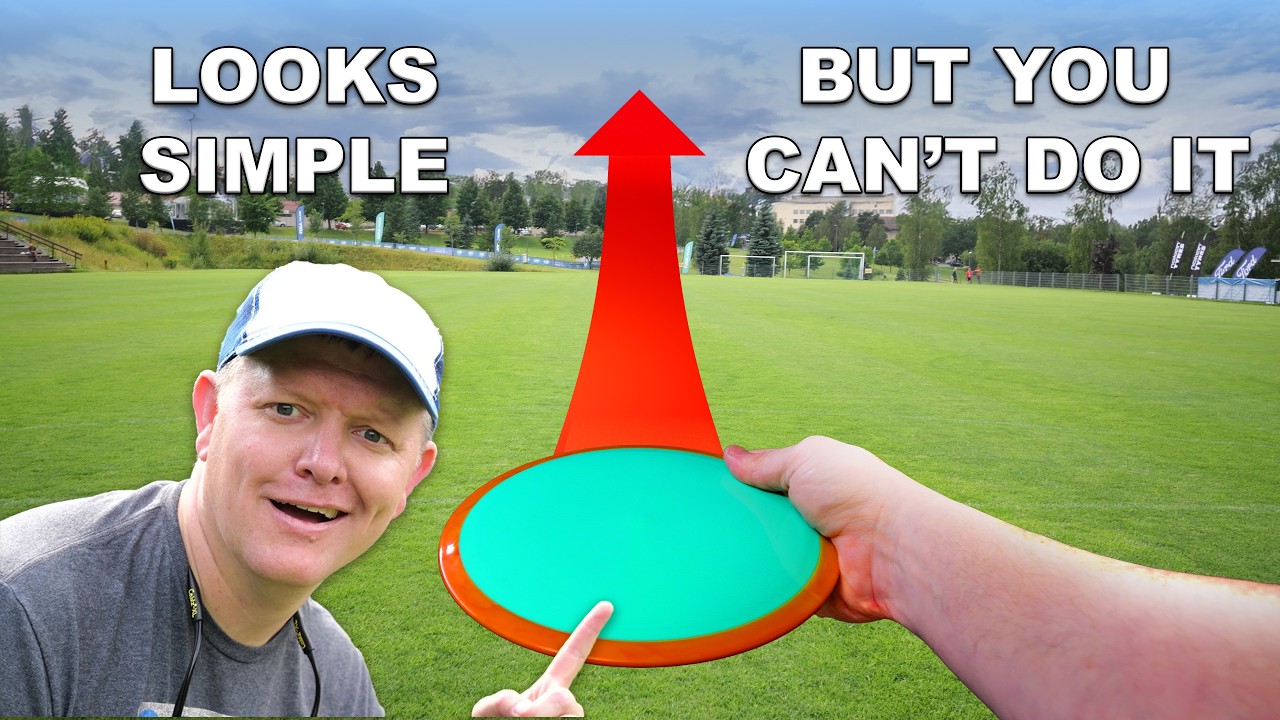
It's finally time for the flying saucer video. No, I'm joking. Welcome to Smarter Every Day. This is a YouTube channel that I... My name's Destin. I make little experiments sometimes to try to understand things. There's a thing that I want to understand that, if I'm honest, I have pretended to understand it in the past, but I don't think I really did. That thing is gyroscopic procession. I know how gyroscopic procession works. If you touch a thing on one direction, it happens 90 degrees out of phase if it's spinning. There's been a lot of explanations on the internet, and most of them involve a bicycle wheel. I've got friends that have made videos about this. You can see professors use a bicycle wheel to explain gyroscopic procession. I've even made a video using a bicycle wheel with my friend Carl trying to explain gyroscopic procession. But what I explained is what happens, not why it happens. I think a lot of videos, mine included, kind of assume a lot of prior knowledge, and they jump from zero to 10. But what I need is a baby step towards understanding about gyroscopic procession. So this video today is for me. I'm trying to understand this, and I'm happy that you're here because I have a crazy setup in the garage, and I'm going to show it to you now. First of all, this is the garage, and I have cameras everywhere. I'll just show you the cameras. Got a camera here. Is it on? Are you on camera? Yeah, that camera's on. Got a camera there. Got a camera down there on the floor, and got one way over here. Okay? So what you'll notice is I've got an arrow in the floor, and that represents the direction that this model of a disk is going to fly. If I were a big person and I could throw a frisbee or a disk like this, this is how the disk would fly. And the reason we're making this video is because I'm doing a series on how disk golf disk fly, and I want to understand it. I came up against this problem where gyroscopic procession is involved, hard to even say. And I realized I didn't understand it. I built this model, and then I realized this video needs to be its own video because I haven't seen an explanation like this on the internet. First of all, let's look at this disk. If I have just a disk suspended from these four wires that you can see, one, two, three, four, I've got a bearing here so things spin. But what would happen if I just take my finger and I push down on this disk right here? So this camera is 90 degrees here. I'm throwing it that way. What happens if I push down on this? Ready? One, two, three. Okay, it just tips. No big deal, right? No big deal. So now let's look at gyroscopic procession. Let's look at what happens when the disk is spinning and I put a force there. Okay, let's do that. And the way we're going to put the spinitude in this is I have 3D printed that thing, and I have the disk, Spinomatic 3000 here. And what I'm going to do is I'm going to put that little silicone paint stirrer that's my last of three because I broke the other two. We're going to put that in there and we're going to slowly add spin to this. Another way to say this is we're going to increase angular momentum, but we're not going to use the physics words here. We're just going to spin things. Okay, so spinning this thing up I've learned that if it's bent like that, then I can go faster once it straightens out. All right. Caught up to me. Catching up to... All right, there it goes. All right. One of the hardest parts is to decouple. Okay, hold on. Okay, we have decoupled. It's very stressful. I've broken two of those so far. Okay, so we now have a spinning disk with a lot of angular momentum. Let's do the same thing as before, except this time we're going to push down with air right here, okay? So Is it going to do the same thing it did last time? Let's watch. Got a 90-degrees angle here. Watch what happens. Three, two, one. It does not. It does not do the same thing. If you were watching, I pushed down here with the air, and that side over there went down. So 90 degrees after the applied force, it went down. You'll notice it's doing this wobbling thing now. The more experienced of you out there will note that this is
Segment 2 (05:00 - 10:00)
actually gyroscopic procession. Yes, you're right. That's a function of how I have my device set up here. But I think it's neat that we apply the force here and it saw something happen 90 degrees out of phase over there. Let's do it one more time, and then I'll show you one other thing. We're going to slow this down, quit the wobble. This time I'm going to push up, and I'm going to let you think about what's going to happen. Where's my drill? Okay, here it is. Decoupling? All right. Man, that's like refueling an airplane or something. All right. We've got our angular momentum applied. This time, I'm going to push up right here. Okay, and so if I push up, gyroscopic procession says that whatever I do here is going to happen 90 degrees later. If you just watch the first second and a half before all the friction and stuff takes over. Watch what happens. Ready? One, two, three. You can see it lifted on that other side. It's not exactly 90 degrees. I've got some problems with my setup, but you can see it's not lifting where I'm blowing the air, which is what it seems like it should do. This is what's happening. This is a way of thinking about what just happened. I pushed on the bottom of that thing with air right here. We're right here, but the displacement of the disk was actually over here. So I had this lift vector here, but the displacement didn't happen till way over here, right? And if you look at that from the top down. That's pretty weird. Isn't that weird? Why am I pushing here and a thing happens over here? This is the part that I'm super excited about. This is an explanation that finally my buddy told me about this, and it works. Here's what we're going to do. We are going to ignore angular rotation and angular momentum. Those are big words that are intimidating. We're going to look at plain old linear momentum. That's what we're going to do. I've got this camera here. You're now on that tripod up there. I'm going to talk to you right here, and I've got this cue ball here. So what I'm going to do is I'm going to grab this number five ball here. And what I'm going to do is you know how pool balls work, right? If I have just a ball sitting right there. Let's zoom in on that. If I've got a ball sitting there and I want to roll this other ball into it, there's a momentum transfer there that happens, right? Let's do it one more time. I'm going to roll into it. Whatever angle it hits at, it's going to go off at a different angle. But let's look at what happens when this thing is rolling. If I have a ball, this five ball is moving from right to left, and then I hit it as it goes by, look at that, it goes down at an angle. Did you see that? Let's try that one more time. I'm going to roll it here. Five ball coming across. I hit it, goes down at an angle. The ball rolls in and it has just velocity in this X direction, right? It's just going in that direction. This ball comes in and hits it about right here, and it's got velocity in this Y direction. So we've got momentum in X, momentum in Y. And then what happens is you get a resultant momentum. And that resultant momentum is that ball going off at an angle, okay? So the system remains the same. So watch, all the X that I put in and all the Y that I put in, it stays the same even after the collision. Okay, that's interesting. Okay, so here's what we're going to do now. We're going to go back to our other little thing that we were looking at over there. Let me get you off this tripod. Let me bring you back over here, and I've got a trick for you. I think this is really neat. Okay, so if you think about our disk, our model of the Jolly Green Giants Disk golf disk or whatever this is, right? All it is basically is its mass out at a radius from a pivot point. That's all it is. Smart people will know how to calculate the moment of inertia as MR², or in this case, it's going to be somewhere between one-half MR² and MR². But what if we replace that mass at a radius with pool balls? Just like that over there, we had that little situation where we had linear momentum. What if we use the tool of linear momentum to think about this rotational momentum or this angular momentum. It'll make sense in a second. Remember, I've got a camera over there looking in the direction of flight, indicated by the arrow on the floor there. That's where the red ball is right now, the number ball.
Segment 3 (10:00 - 15:00)
We also have this blue one over here. And then we've got this camera that's looking 90 degrees off, right? So I can do the same thing as before, okay? I can rotate this thing up. But what I want you to do is just think about this reference frame. This camera right here is the most important camera in the whole place. So what I'm going to do is I'm going to rotate it up again. Let's do this. I'm not going to rotate this as fast because I've learned I learned that lesson the hard way. Don't worry about it. It was crazy. So I'm rotating this thing up a little bit. I'm going to decouple. So now think about this camera as the same thing. I've got a ball coming in from the right going to the left. And what happens if I roll another ball down and I hit it? What happens? You're just thinking about this camera. It goes down at that angle like we talked about earlier, right? So if you think about it, if I've got an X component of momentum, I've got a Y component of momentum, I get a resultant, right? I'm just looking at this 2D plane right here on this camera. But that's not where we live in right now. We're living in a rotational reference frame, and we're connected to this stick. So if it goes down, it's got to go down like that. And that means that ball up there goes up. And then once we get like that, well, there's nowhere to go. We have to continue rotating like that, right? So I like to think of this whole thing as a linear momentum problem that manifestsates itself in some weird gyroscopic wobble that only really smart physicists can understand, right? So watch again. We're going to rotate. I'm going to go a little faster if I can. Going to rotate. I'm going to come in. I'm going to try to drop it. I've missed it a lot. Look at that. About 90 degrees. That's something I want to think about. You notice it wobbled in a really bad way after the fact. That's because I've got friction here. That's because this is an imperfect demonstration. I've got this pendulum, and there's this other thing happening here that's hard to explain. But for now, this is just a tool that lets me think about the effects of gyroscopic procession in terms of displacement. That's what this does for me mentally. We have that. Let's go back to the disk. If I were to put the disk back on there, let's think about it like this. We're going to start. The reason I'm doing all this is because in this disk golf disk video, I realized how much gyroscopic procession plays into rotational dynamics. When I finished my master's degree in mechanical and aerospace engineering, I left the room and I went outside and I looked up and there was a helicopter flying, and I realized I have no idea how that's working. And so I'm guilty of a lot of time thinking I know things, but I don't really understand them. And so that's why we're doing this, is because I want to understand it in a way that I haven't before. So let's go back and think about this spinning disk. Okay, so I'm going to spin the thing again, and this time I'll spin it that way, and we'll blow up this time. Okay? So I'm going to get it going. Let me, this is fun. Let's just get another camera here just because it's fun to watch this part. It's really hard to see. All right, so here we go. Let me get this going here. I always have to concentrate a whole lot here because I could do things like that and break things. All right, I feel like I'm docking with a spacecraft, in interstellar. Okay, so now we've got this thing moving. And now what I want you... It's rotating that way. I want you to think of it not as mass, but as a bunch of billiard balls. And we're going to come in with the air, hit it right there. So what's going to be the effect? If we do that... No, let's go up. Let's say I'm going to hit it with a billiard ball going up. Let's just change it up. What's going to happen? If I blow up here, it's going to go what? It tilts up on that side over there. Now, it's not perfect. Let me slow it down. It's not perfect because I've got a lot of friction and stuff there. Oh, I just marked up the top of the thing. But you get the idea of what's going on, right? With gyroscopic procession, if it's rotating, if you apply a force in one location, the displacement actually occurs in a lag-type way, 90 degrees out of phase. It's a really interesting concept, this gyroscopic procession. A lot of the explanations that you'll see on the internet involve a bicycle wheel. But if you go back and you look at the bicycle and you just think about it
Segment 4 (15:00 - 20:00)
in these terms, you can get to the place where you understand it just using this simple linear momentum model. I recognize that I probably said a lot of things wrong, but this is just a mental tool that allows me to understand what's going on, and I love it. I think it's really, really cool. So what if we did it one more time and you got to guess? Do you want to do that? Okay, so let me spin it the other way. I'll way and you guess where it's going to go. It's rotating. Maybe not as fast as I want it to. But now, if it's rotating this direction and I put the air down right here, what's going to happen? My hope is that you now understand this and you enjoy it because I think it's really neat. It took me a while to understand exactly what was going on with gyroscopic procession. I just think of it as a rotating mass that's being hit. I think of it as just generally a billiard ball that's rotating. I guess I have to balance it. I think of it as a billiard ball that's rotating in this direction. Then if I hit it as it's rotating, it has to go down. It goes down like that, which tilts the thing like that. That's how I think of it. All right. Well, there's an imperfect physics analogy that I'm sure the internet is going to love. Now what I want to do is I want to show you a really cool thing. Every year on Smarter Every Day, I create stickers for people that support Smarter Every Day on Patreon. And it's a gimmick. It's totally a gimmick, and everybody's in on the gimmick. My goal here is to make intelligent, respectful content that's just genuine and fun. And people that support on Patreon allow me to be free from the algorithm. The idea is I want to thank you for sticking with me. It's a dad joke. But the cool thing is these stickers only happen once. If you're either in that sticker team or you're not, and I want to show you this year's sticker team. So on Patreon, patreon. com/smartereveryday If you are a patron by the end of January, We're going to cut it off then. I'm literally going to mail you these stickers, and you can do whatever you want with them. They're really fun. Okay, so I asked the patrons, What do you want as a sticker? And the overwhelming response were two things. The first one was the smarter scrubber. This year's one of the stickers here is the smarter scrubber. It says, I support local manufacturing because we wanted it to apply to people who don't live in America. The purpose of that video earlier this year was about made in America. But I think no matter where you live, you should support local manufacturing. So the smarter scrubber, I support local manufacturing. I love this one. We went through a lot of iterations. The smarter scrubber, if you don't know, it's a chainmail grill scrubber. The purpose of that is so if you're cleaning your grill, you won't get those wire bristles on your grill, which can be a medical issue. But the smarter scrubber sticker is beautiful, and I'm excited about that. The second sticker, we. So we did a nuclear power series this year. We started the nuclear power series. One of the first things we did was we visited EBR1, and we talked about a fast reactor, and it uses fast neutrons. We created this little character called the Fast Neutron. Weeeeeee! And he shoots across the screen. And so I think this one's really, really fun. So you can get your own fast neutron to put anywhere that you feel needs neutron radiation. And that's a sticker. You can do whatever you want with it. It's made to look like felt. I love it. And then this is the Big Daddy sticker. one. All right, here we go. The smarter everyday nuclear power team sticker. So this is only going to happen once. I love it. It looks like lithium. I got it. It's the Bohr atom of the model. Some people don't like the Bohr model of the atom. I think I said that wrong, but I love it. I think it's great. Lithium is very important for fusion power, and so that's what we went with. So if you would like to be a part of the Smarter Every Day nuclear power team, this is your one shot to join. If you're not a Patreon member by the end of this month, January, it's over. You can't do it. But if you are a member, we're going to mail it to you, which I think is awesome. So these are the three stickers. So we've got the smarter scrubber, I support local manufacturing. Really cool holographic rainbow-looking thing. Then we've got Weeeeee! Fast neutron, and then we've got the Smarter Every Day nuclear power team. All right, that's it. Thank you for watching this video. I hope you enjoyed it. This was just a thing that I wanted to understand better. What better way to do it than to make a goofy contraption? I mean, look at this. It's wild. And it took a really long time to figure all this out.
Segment 5 (20:00 - 20:00)
So I hope you enjoyed it. That's it. I'm Destin. You're getting Smarter Every Day. Feel free to subscribe if you're into that sort of thing. If not, no big deal. Have a good one. Bye.