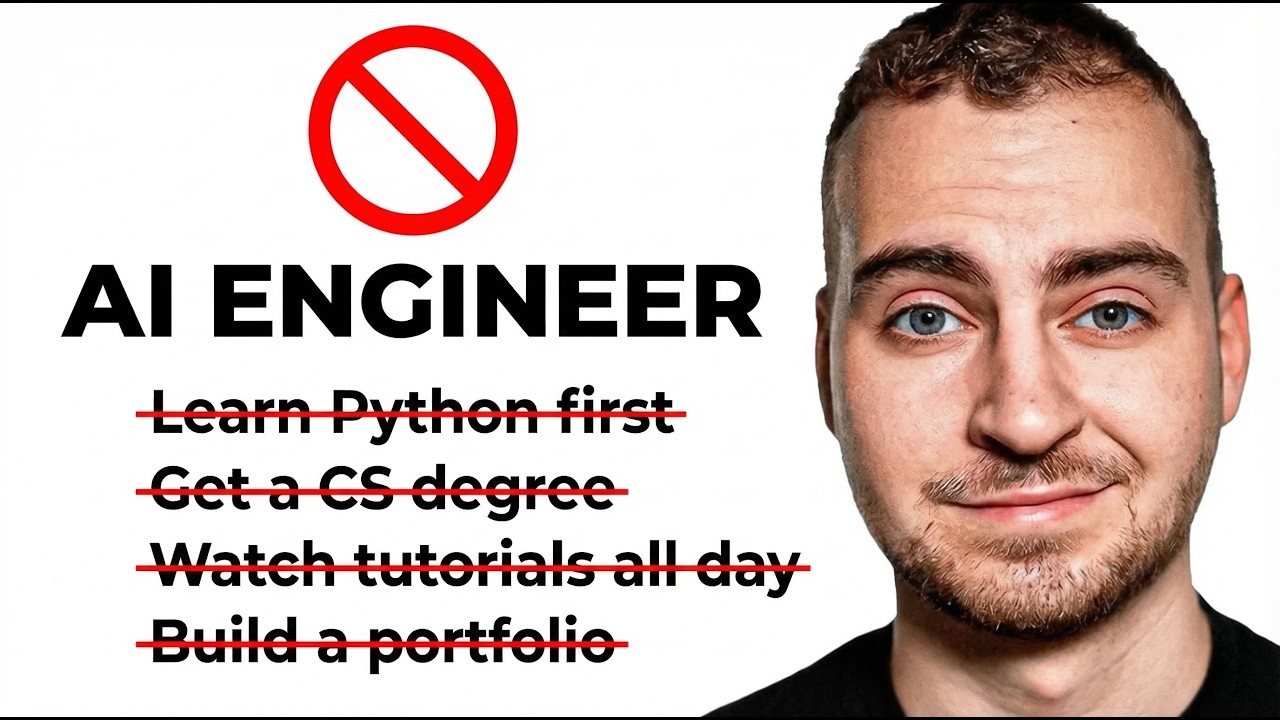
Everyone keeps saying just pivot into AI like it's some weekend decision. Like you wake up Monday as a junior developer and by Friday you're an AI engineer making 250K. Now here's the uncomfortable truth. AI engineer is not an entry-level role. And pretending it is why so many people are stuck in tutorial hell right now. Now if you've ever been confused or felt overwhelmed or feel like you're behind, it's not because you're bad at this. It's because most advice around AI careers is fundamentally wrong. So, in this video, I want to reset expectations and show you what actually works in 2026. Now, when hiring managers say they want AI experience, they're not talking about prompting chat GBT, taking a random Gen AI course, copying and pasting Lang Train examples. What they really mean is that can you take an existing system and make it smarter without breaking it? Most AI engineering work is just software engineering work that happens to involve some kind of AI. Now, this assumes that you already understand systems, right? APIs, data flows, trade-offs, failure modes. Now, that's why most true AI roles are add-ons and they're not starting points. So, you need to understand that while AI knowledge is necessary, it's not the only thing that you need and it starts from being a good software engineer and then picking up the additional skills. Now, let's talk about what hiring managers actually mean when they ask for AI experience. Now, truthfully, what they're screening for behind the scenes is the following. First, can you design an AI backed feature that actually solves a problem? Can you explain why you choose one approach over another? And can you debug bad outputs, hallucinations, or edge cases? And can you ship, monitor, and iterate systems? Notice what's missing here. They're not asking, "Do you know every single AI model? Have you trained a transformer from scratch? How many prompts have you written before? And that's why so many people are learning the wrong things that want to become an AI engineer. Now, that leads me to the three traps that kill most people's AI pivots. So, let's talk about the traps that I just constantly see. Trap number one, tool only learning. Now, this is prompt spam, watching demos, jumping between a 100 different frameworks. It feels productive, but there's really no depth in what you're learning. Now trap number two is researchheavy paths that never ship anything. So some people go the opposite direction, right? They drown in papers, math proofs, architectures they'll never implement. They understand the theory, but they haven't actually built anything useful or written any real code. And trap number three, random course hopping. And this is probably the most dangerous. You're always learning, but you're never finishing anything. No projects, no output, nothing you can actually show. You feel busy, but you're not really progressing. So, look, if you're in any of those traps, keep watching this video because I'm going to break down what you actually need to focus on. But first, just a quick break because this is highly related to what we're talking about. Now, look, we've all seen what generative AI can do. Write an email, summarize a doc, generate some code, but there's a new wave happening right now, and most people are sleeping on it. Now, it's called agentic AI. And this is where AI stops suggesting things and starts doing them. Now, we're talking about systems that execute workflows, call APIs, update databases, and make decisions autonomously. And that's exactly why I'm excited to partner with SimplyLearn on this video. Now, they've collaborated with Microsoft. Yes, that Microsoft on a program called Applied Agentic AI. And I want to be real with you, when I saw Microsoft's name on the curriculum, not just as a logo, that definitely got my attention. Now, this is a 10-week practitioner level program where you're building with Microsoft Autogen, Azure AI, Foundry, Langchain, Crew, AAI, Rag, the actual stack that companies are hiring for right now. You learn multi- aent systems, MCP, and you even complete seven real world projects, including a capstone. Now, this is not a what is AI course. This is for working professionals who have already had the fundamentals and want to architect the systems that everyone's going to depend on in the future. Now, when you finish, you earn a joint completion certificate from Microsoft and SimplyLearn, which on a resume or even a LinkedIn profile speaks for itself. Now, you'll also earn Microsoft Learn badges on the Microsoft Learn portal from the Microsoft branding courses. Now, I'll drop the link below. And if you're ready to go from prompting AI to building it, then this is a great first move. So, definitely check it out. Now, with that in mind, let's reframe the goal that will help you become an AI engineer. Now, here's the mindset shift that actually works. You don't just jump straight into AI engineer. You have to move through various stages. The first stage is AI adjacent. This means you're working near AI systems. Then you move to AI enabled where you actively use AI inside of real workflows and then you become AI specialized where AI is a core feature of your role. Now most people try to skip the middle step and that's a
Segment 2 (05:00 - 10:00)
massive mistake. Now, the reason for that is that the fastest path to becoming an AI engineer is not starting from zero. And this part matters a lot because the fastest pivot into AI is never just starting over completely. It's really layering AI on top of what you already know. So, with that in mind, let me break people into a few buckets here so we can kind of get into some more details. So, first we have software developers. Now, if you're already a software engineer, you actually have a massive advantage. And that's because your path is AI enabled software engineering, APIs, LLMs, rag, agents, automation, right? Whereas, if you're in like data analytics or like a business kind of background, then your edge is that data intuition. You're well positioned for applied ML or analyticsdriven AI roles. And then if you're into something like it, DevOps, QA systems, etc., you understand reliability, pipelines, infrastructure, and AI systems desperately need that skill set. And if you're someone who's non-technical but technical adjacent, then you probably are better at product operations, strategy, and your path is more like AI, product, and system design, not the actual technical model training. There's different starting places, which means there's different paths, but ultimately they lead you to the same destination of layering AI on top of what you already know. So keep that in mind. Not everybody should go with the exact same path. And there's different types of AI developer roles. And three of them that companies are actually hiring for right now I'm going to get into. So the first kind of role that you're going to see pop up a lot right now is the AI enabled software engineer. Now this is definitely the fastest growing role. And this means that you're building back-end systems, APIs, LLM integrations, rag pipelines, agents, and automations. Now, that means that AI is a capability that you have, but it's really not your entire job. Think of this more like a back-end software developer role where you just happen to be layering in some AI solutions. Now, number two, we have applied ML/ATA engineer. Now, this is less research and more production. You're focused on data pipelines, model evaluation, monitoring, real world performance, and this role exists to make models useful, not just to make them impressive. Then we have number three kind of AI product or technical lead and this role is quietly gaining a lot of traction where you essentially translate business needs into technical systems that leads to AI solutions. You decide where AI makes sense and where it doesn't. Right now here's the thing with all of these roles. The core thing that you actually need to know is probably different than you're hearing online. So I want to dive into it. So let's start with the foundations which is non-negotiable. Now first Python you need to know that pretty much all AI stuff is using Python. Then we have basic math intuition. So not like proofs or anything complicated but basic understanding of like stats, linear algebra, something you might do in a university course. Then data handling working with like pandas, numpy, large data sets and just generally being comfortable working with data especially in Python. Okay. Then we move to AI core skills. Now this would be machine learning fundamentals. So actually understanding something like linear regression, classification algorithms, etc. A conceptual understanding of LLMs and transformers, you should be able to explain to like a 10-year-old how does chat GPT actually work? What's happening behind the scenes? Then evaluation, limitations, and failure modes. Super important with AI. Then we move to the applied layer of skills. Now this is where most people are falling short, at least from what I'm seeing. This is Gen AI tooling, APIs, orchestration, agents, and shipping real features. This is using AI in a real system, and understanding all of those smaller nuances that you don't get from just building small demos. Okay, so with that in mind, how do you go from someone who's a beginner, specifically in AI, not completely in software development, to be job ready in 6 to 12 months? And to be honest, you can do this faster, but generally this only works if you do it in phases. Now phase one is I would recommend building AI literacy and foundations. So this is you learn how things work without drowning in the theory. You look at all of those skills that I talked about, right? Transformers, LLMs, neural networks, machine learning fundamentals. Then phase two, applied projects, not tutorials, but projects where you have to make decisions. There's trade-offs. There's messy outputs and you need to actually get a real result. And then phase three, real world systems. So, rag apps, internal co-pilots, automations that save time or money. And then phase four, positioning and proof. So, you need a portfolio, right, to explain that you actually know what you're doing. AI projects that you've built and legitimate proof that you know what you're doing. Okay. So, with that in mind, what does being job ready actually mean when it comes to AI? Now, being job ready doesn't mean that you have to know every model or train massive systems from scratch. What it does mean though is that you can design an AI backed
Segment 3 (10:00 - 12:00)
feature. You can explain the trade-offs. You can debug bad outputs. You can deploy, monitor, and iterate. Now, that's what teams are paying for, and that's what it means to be an AI engineer to be able to do those things. Now, with all that said, let's talk about who this path is actually for and who it's not for. Because I want to be honest here, if you hate ambiguity, this is tough. If you want a guaranteed job in 30 days, this isn't the path you should probably go with. But if you're willing to build, break, and iterate, this is one of the best career pivots that's available in 2026. Now, here are some clear next steps that you can actually follow if you want to do this. First, pick your target AI role. Go out there, look at real AI roles, companies that are hiring, and look at those three buckets that I talked about earlier. Then, build one to two serious projects that fit into one of those role categories. Learn just enough theory to support your practice. Don't get too deep into the weeds here. and get feedback early and often. If you can meet someone in this field, that's fantastic. And even if you can just share your project online or with other people, you really just need to get someone else using it so you can see if you actually know what you're doing. Now, if that's it, it's not everything, right? It's not forever, but that's enough to move forward. Pick a target role, start learning the theory, don't dive into the weeds, and then start building something right away. This is going to immediately give you some traction, and then you can start checking off all of those skills that I actually put in this video. Now, generally speaking, if you want to work in AI, you need to start building right away. Things are changing fast. AI is adapting extremely quickly, and you need to demonstrate that you are a capable engineer. Now, with all that said, that's pretty much all that I have for you. I know it's not the most clear-cut path possible, but that's because the path depends on where you're starting. The important thing is that software engineering skills come first before AI. Make sure you keep that in mind. And if you can be a comfortable software engineer with that AI capability, that's what's going to set you apart. And I know I've helped many people land these roles. Those are the type of people that get hired. So anyways guys, that's all that I have for you. If you enjoyed the video, make sure to leave a like, subscribe, and I will see you in the next one.