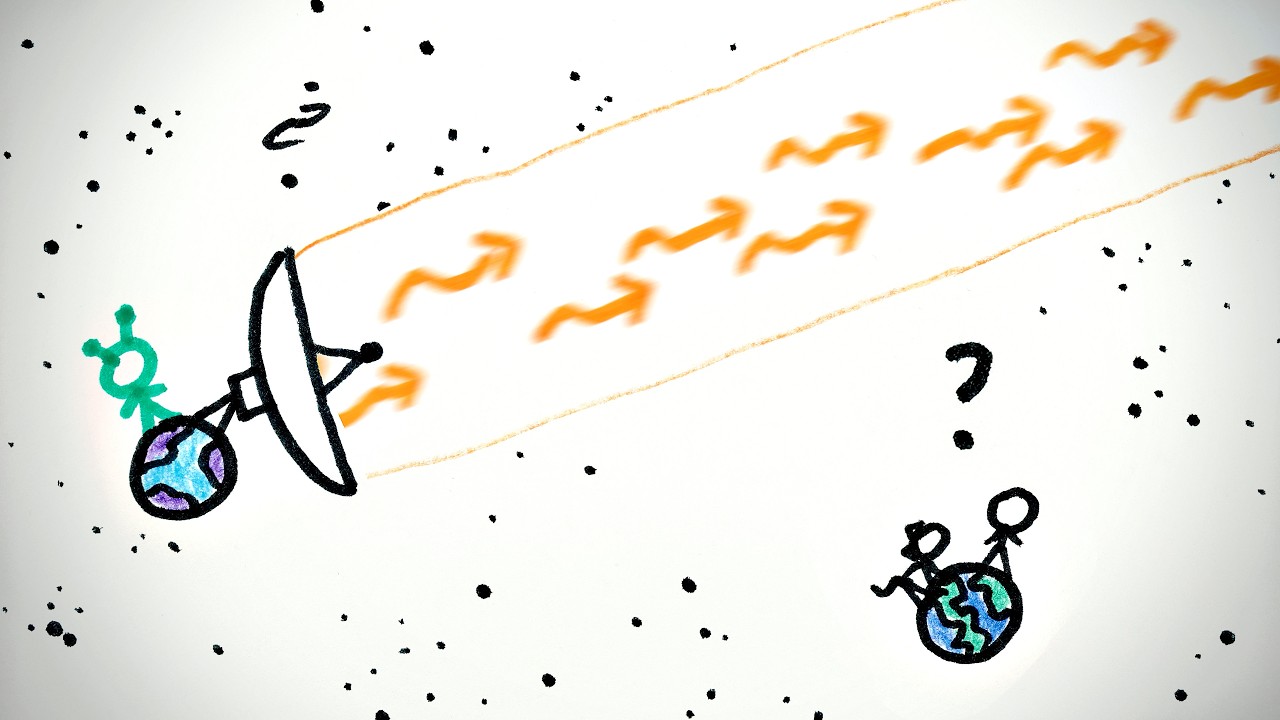
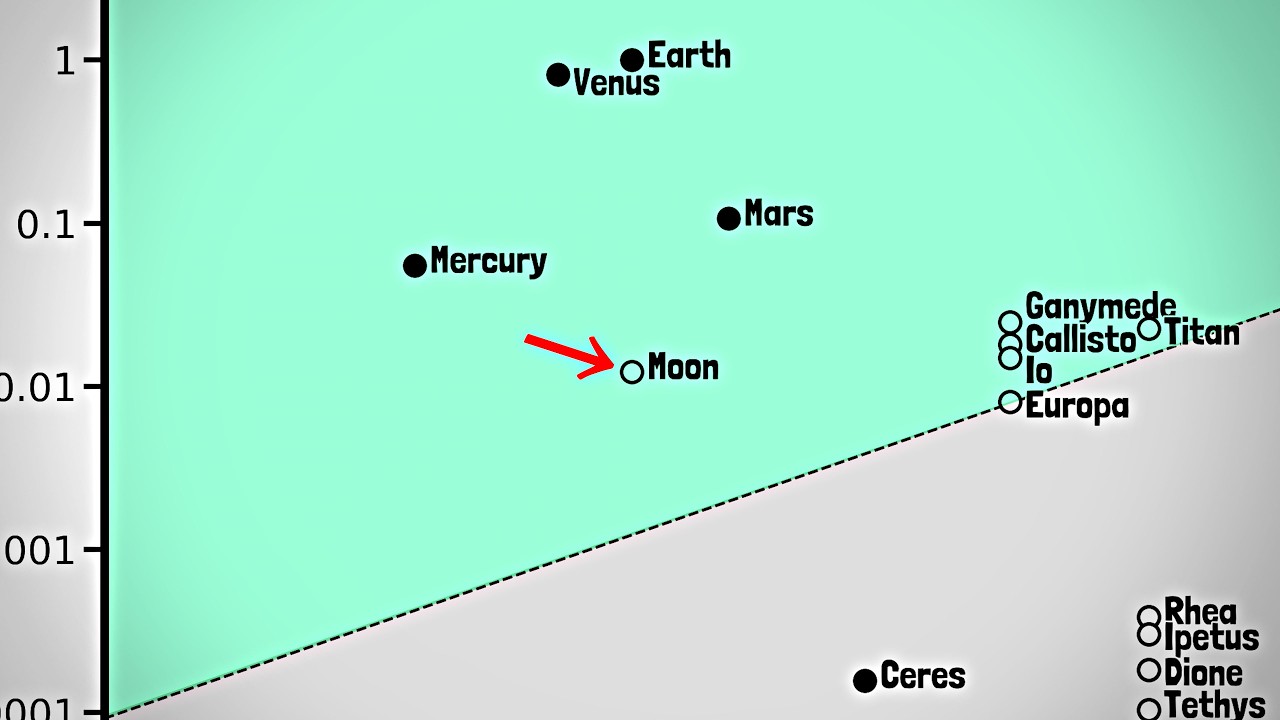
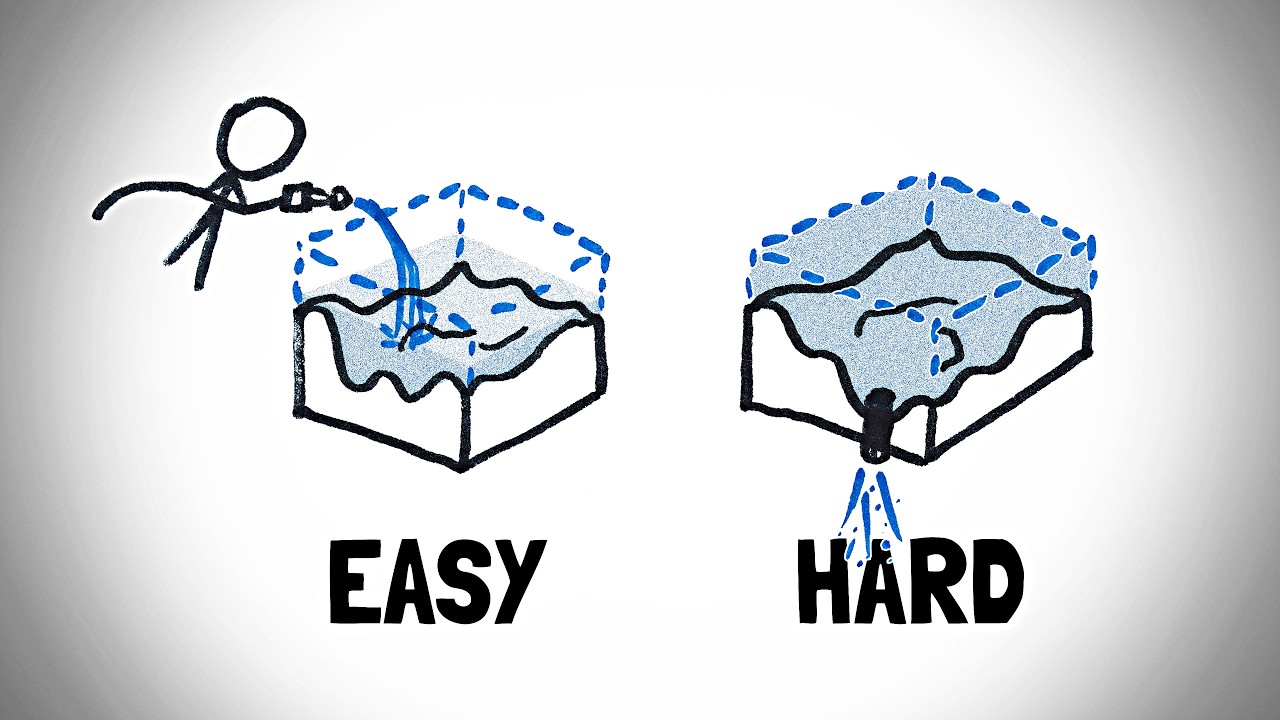
Most moons in the solar system are thousands of times lighter than the planets they orbit – but The moon is only 80 times lighter than earth. So how do we know the moon is actually a moon, and not say – a binary planet together with Earth? What about Pluto and its moon, Charon? For that matter, how do we know that Jupiter actually orbits the sun, rather than Jupiter and the sun together being a binary system? And what about the planet TOI-2379b, which is 5 times heavier than Jupiter and whose star is smaller than our sun? Questions like these are best answered with the Trojan test, which I suspect you haven't heard of before, in part because I only just now gave it that name, but also because it’s not usually mentioned when defining moons – normally, we say “the earth and moon orbit around their common center of mass, called their barycenter, and the earth is sufficiently heavier than the moon so the center of mass is actually inside the earth, which means we can say it’s the moon that orbits the earth (rather than the two orbiting each other). Done. ” But this barycenter criteria has two major problems. The first problem is that (perhaps surprisingly) the barycenter criteria doesn’t actually tell us anything about the movement of the objects. On one extreme, take two objects with the same mass on opposite sides of an identical orbit around their center of mass – this is the quintessential definition of a binary system. But, if one of the objects had a low enough density, its radius could be big enough that the center of mass would be inside that object, and suddenly our quintessential binary system becomes – according to the barycenter test – a satellite/planet system. And at the other extreme… A star could be a million times more massive than an orbiting planet, and so the planet’s orbit around the barycenter would be a million times further out than the star’s – the polar opposite of a binary system. But in spite of all that, if the orbit was ten million times the radius of the star, then the barycenter would be located at ten times the radius of the star… which is outside the star, and the system is then – according to the barycenter test – a binary system. The problem is, the barycenter criteria isn’t testing the right thing: binary-looking orbits and satellite-looking orbits can both get labeled as either binaries or satellites. What's more, objects with elliptical orbits move closer or farther from the barycenter throughout their orbit, and so can have the barycenter move from outside them to inside to outside to inside over and over again. The second problem with the “barycenter being inside one object” criteria is that it’s an intellectual threshold, not a physical one with physical consequences. There’s nothing different that happens when the center of mass of a system moves outside of an object’s radius. The barycenter of the solar system regularly moves in and out of the sun without any effect whatsoever. This contrasts with other physically meaningful thresholds, such as the definition of a star (where below a certain mass you can’t do fusion and above it you can), or how an elliptical orbit (where the object returns again and again) becomes – once the eccentricity goes above 1 – a hyperbolic trajectory where the object will escape, passing by only once. So, when it comes to binaries, a much more natural and physically meaningful cutoff for being able to say one object orbits another is – you guessed it – the Trojan Test – which is a name I’ve just now given to something normally called the “L4/L5 instability. ” If you have two planets, or stars, or whatever, orbiting each other, there are always – no matter the relative masses or distances of the objects – there are always five points where the combination of their gravitational attractions together with the centrifugal completely cancel out, and so an asteroid or spacecraft at one of the points can in principle orbit “along with” the smaller planet or star. These points are called “Lagrange Points” and are labeled L1 through L5. But it turns out that only L4 and L5 are what’s called “stable” – if you park your spacecraft near points 1 through 3, it will slowly but eventually drift off and stop orbiting along with the smaller planet or star, or get ejected from the system entirely. L4 and L5, on the other hand, are stable [Due to coriolis force being dominant over the gravitational forces], so your spacecraft (or space rock) can be parked there indefinitely, orbiting in tandem ahead of or behind you. For example, Jupiter has tons of asteroids orbiting in the vicinity of its L4 and L5 points relative to the sun, called the “Trojan asteroids” because the first ones discovered were named after figures from the Trojan war. And Earth has a few small asteroids orbiting along with us at our L4 and L5 points relative to the Sun, which we also call Trojan asteroids in imitation of the ones in Jupiter’s orbit. A couple of Saturn’s moons even have smaller moons orbiting at their Trojan points relative to Saturn! But there’s a less well-known property of the Trojan points L4 and L5: they’re not always stable – their stability requires the bigger object to be more than 25 times the mass of the smaller one. If the two objects are too close in size – too close to being a binary system – then the L4 and L5 points become unstable like L1, L2 & L3. Though unstable doesn’t mean un-useful – the “unstable” L1 and L2 lagrange points around Earth are regularly used for positioning spacecraft. The spacecraft do gradually drift away from the L1 & L2 lagrange points, but only enough to need a small correction from a rocket thruster every few months. Asteroids don’t have thrusters, so they can only collect at the L4 and L5 points, and only, as we’ve mentioned, if the bigger object is more than 25 times the mass of the smaller one. In short, you can only have Trojan asteroids or moons (or park your spacecraft with the engine off) if you’re at least 25 times less massive than the thing you’re orbiting. This is the trojan test: if you can in principle have Trojan asteroids (regardless of whether or not you actually do) then you’re a little thing orbiting a big thing. If the big object is less than 25 times more massive than you, then you can’t have Trojan asteroids and you should be considered a binary system. Case in point: both Jupiter and the Earth can in principle have Trojan asteroids (and both do) – so by the Trojan test, they're orbiting the Sun (unlike the faulty barycenter test that thinks Jupiter and the sun might be binary companions because their shared barycenter is outside of the sun). In contrast, Pluto is only around eight times more massive than Charon, so Charon can’t have Trojan asteroids, and therefore (according to the Trojan test) the two are a binary planet. The great thing about the Trojan test is that it’s purely about the relative masses of the two objects. It doesn’t matter how dense they are, or how far apart you put them: Earth, for example, would still be able to have trojan asteroids regardless of how far you moved it away from the sun (in contrast with the barycenter center test where if you move the Earth far enough away from the Sun, like really, really far away, eventually the barycenter of the Earth-Sun system will move outside of the Sun’s
Segment 2 (05:00 - 06:00)
radius). Another great thing is that the Trojan test is a cutoff with an actual physical effect: on one side of the cutoff, an object can have Trojan asteroids orbiting along with it. On the other side of the cutoff, Trojans are impossible. The Trojan test is so good it has been proposed to be used as part of a criteria to determine if an exoplanet is really orbiting a star instead of being a binary companion. But I think that we should use it even more broadly! In my mind, if you have ANY two objects gravitationally orbiting each other, anywhere in the universe, regardless of what they are, we should use the Trojan Test to distinguish between the two possible situations: either one of the objects is less than a 25th the mass and is actually orbiting the other (like a moon around a planet, or primary planet around a star), or they’re closer in mass and therefore orbiting each other as a binary pair. And what does the Trojan Test say about our moon? Well, the earth is about 80 times heavier than the moon, well above the Trojan test cutoff, which means the moon can in principle have trojan asteroids… (even though we haven’t discovered any yet). Therefore, according to the Trojan test the moon is indeed orbiting the earth – that is, the moon is a moon. Hello, I’m Josh from MinutePhysics, letting you know that we recently made a T shirt that shows how musical harmony works - and it has been incredibly popular. We’ve just restocked for the holidays, so this is your reminder to pick one up for the Physics & Music nerds in your life. We have also teamed up with MinuteEarth to create a special bundle where you get the Dissonance Tee, the Solar Eclipses Across The Solar System Tee and the Earth and Moon Tee. That’s 3 discounted physics shirts, all in time for the holidays (if you order in the US)! Get yours now at the DFTBA store, link in the description.