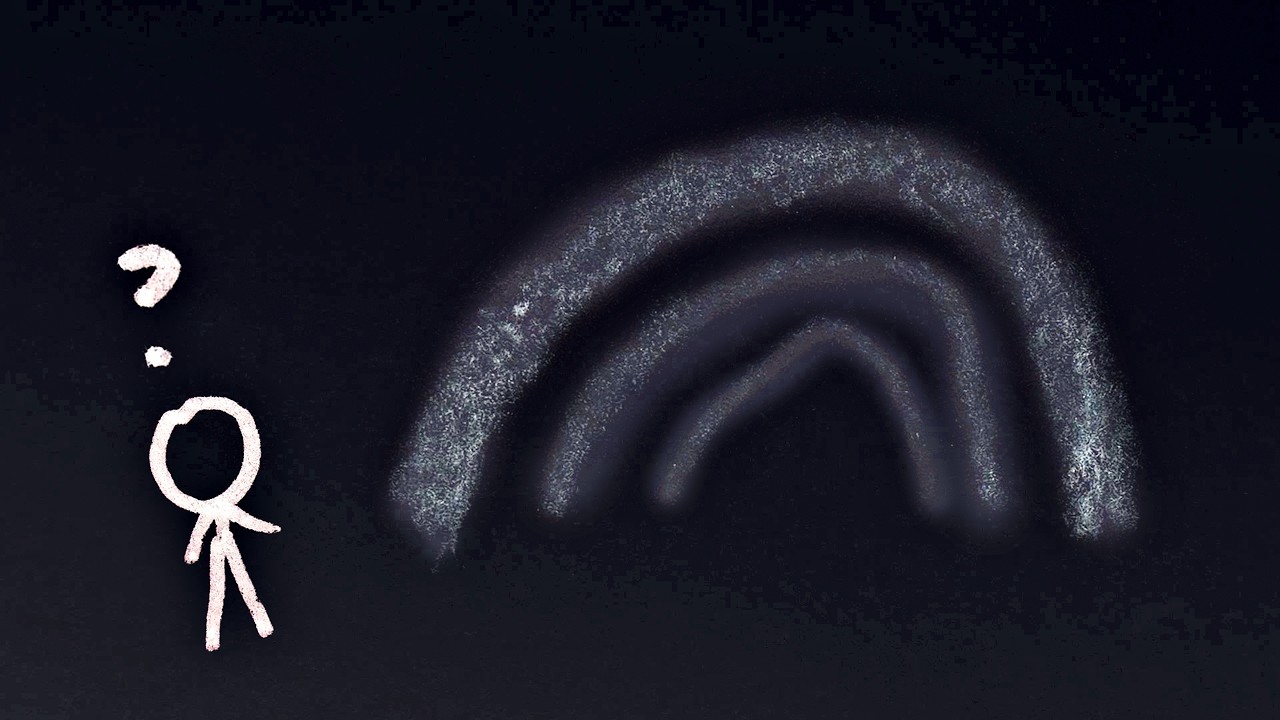
Warning, there are ideas in this video that you may not be able to unsee. There are many ways to draw the moon incorrectly, but this video isn't just about pedantically correcting children's books and animated movies, though it at least partially is. Here's the thing. The moon is up there for any of us to look at, basically as much as we want. And yet, the proliferation of incorrect illustrations of the moon suggests that very few of us actually do. I shouldn't need to make this video, but I guess here it is. Mistake number one is showing the outside of the crescent moon as anything other than half of a circle. This isn't a realistic moon. I kind of get this one. When I think of a crescent moon, I kind of just imagine taking an arbitrary arc and drawing another arc either outside or inside of it. But the moon is a sphere and half of it is illuminated by the sun. And when you look at a half illuminated sphere from different angles, the opposite points of the crescent are always on sphere. And the same thing applies for gibbous moons where you can instead think of the dark part as the crescent. Okay, technically speaking, the points are only exactly opposite if you're infinitely far away from the sphere. And if you're somewhat closer, then the crescent won't quite reach the poles. And non- halfcircle moon related shapes can form, but only during an eclipse. A shortened crescent moon can appear during a lunar eclipse when the dark part is the Earth's shadow covering the moon. And an elongated crescent sun can appear during a solar eclipse where the moon is the dark part. The ultimate point is in any realistic moon illustration, the outer unobstructed portion of the moon will always be half a circle so that the points of the crescent are opposite each other. Mistake number two is the big one. Showing stars inside the crescent of the moon. The moon is a solid rocky sphere and the crescent is the illuminated part of the sphere. Just because the dark part isn't lit up doesn't mean you can see through it. I get the artistic desire to put something there. It's a nice negative space beautifully framed by the thin crescent. But stars are farther away than the moon, so they'll be blocked by it. If you want to put something inside the crescent, use something that wouldn't be blocked from sight by the moon, like a cloud, or firefly, or the International Space Station. Or how about the rest of the moon illuminated from Earth shine, but no stars inside the moon's disc, unless you're illustrating a sci-fi future where we've colonized the moon and the twinkles aren't stars, but are actually lights from cities. That is acceptable. Mistake number three is about the moon's orientation and placement. The sun lights up the moon. So, the bright part of the moon, whether crescent or gibbous, should always point towards the sun. And we see a fuller moon when the moon is on the opposite side of the sun from Earth and a thinner crescent when the moon is between the Earth and the Sun. So in an illustration, the fuller the moon, the farther away from the sun it should be. And the thinner the crescent, the closer to the sun. In fact, the thinnest new moon crescent rise and set almost in tandem with the sun. Which brings us to number four, the mistake of having the moon only come out at night. It's true that a full moon is full because it's opposite the sun in the sky. So a full moon always comes out at sunset, stays up all night, and goes away at sunrise. But a crescent moon is a crescent because it's in the same part of the sky as the sun. So it moves along with the sun, rising near dawn, staying up during the day, and setting near sunset. In this case, moonrise is sunrise, and moonset is sunset. And a half moon will be 90° away from the sun, spending part of its time out at night and part of it during the day. Mistake number five is having the moon in the wrong orientation for the location on Earth. Because the moon's orbit is approximately aligned with the Earth's equator, an approximately horizontally pointing crescent only happens when you're standing on top of the Earth near the poles, while a cup-like crescent happens near the equator, where you've rotated yourself 90° relative to the Earth's axis. It also works the other way around. This photo of the Earth was taken as the Apollo spacecraft traveled along the moon's equator. And here, the Earth's crescent points vertically, not horizontally. Anyway, intermediate latitudes get intermediate angles, and the angles also vary a bit by the seasons. The Lion King has a great example of mistakes 1, four, and five all combined. The crescent moon above Pride Rock is one, way too elongated and looks more like the shape of a solar eclipse. Four, it shows a thin horizontal pointing crescent moon out in the middle of the night rather than moving in tandem with the sun and setting near sunset. And we can tell this scene is well past sunset because of how many stars are visible and the lack of a colored after sunset glow. The illuminated portion of the moon implies the sun should be on this line here about 40 to 50° away, which puts the sun so close to the horizon that we should still be in twilight. And five, the crescent moon is pointed horizontally, much like the way the crescent moon would look in, say, North America, where the film was made. But the movie is set in equatorial Africa, where a crescent moon is oriented more like a cup. Plus, when oriented vertically like this, the sun would be down here, far enough below the horizon to be past twilight and into proper nighttime, justifying the dark sky and the stars. Here's what the moon should probably look like in that scene in case they ever decide to do another remake. If you're a Disney animator or just any human being, here's a trick to always know what the moon looks like right now. Take a ball outside on a sunny day, hold it out in the same direction the moon is from you, and the way it's lit from your perspective will show you what phase the moon is in and what that phase looks like. It's that simple. And even if you can't see the moon, you can use an augmented reality astronomy app to tell you where it should be, and you'll still get the right moon phase. P. S. Jupiter's stripes are also only horizontal when viewed from near the poles on Earth. If you're near the equator, they'll look vertical, just like how the moon turns into a cup. Just something to keep in mind the next time you're illustrating Jupiter in the sky of a tropical animated film. Thanks to Minute Physics Patreon supporters for making my work possible. Head to patreon. com/minutysics to become
Segment 2 (05:00 - 05:00)
a supporter and see a special behind-the-scenes look at the making of this