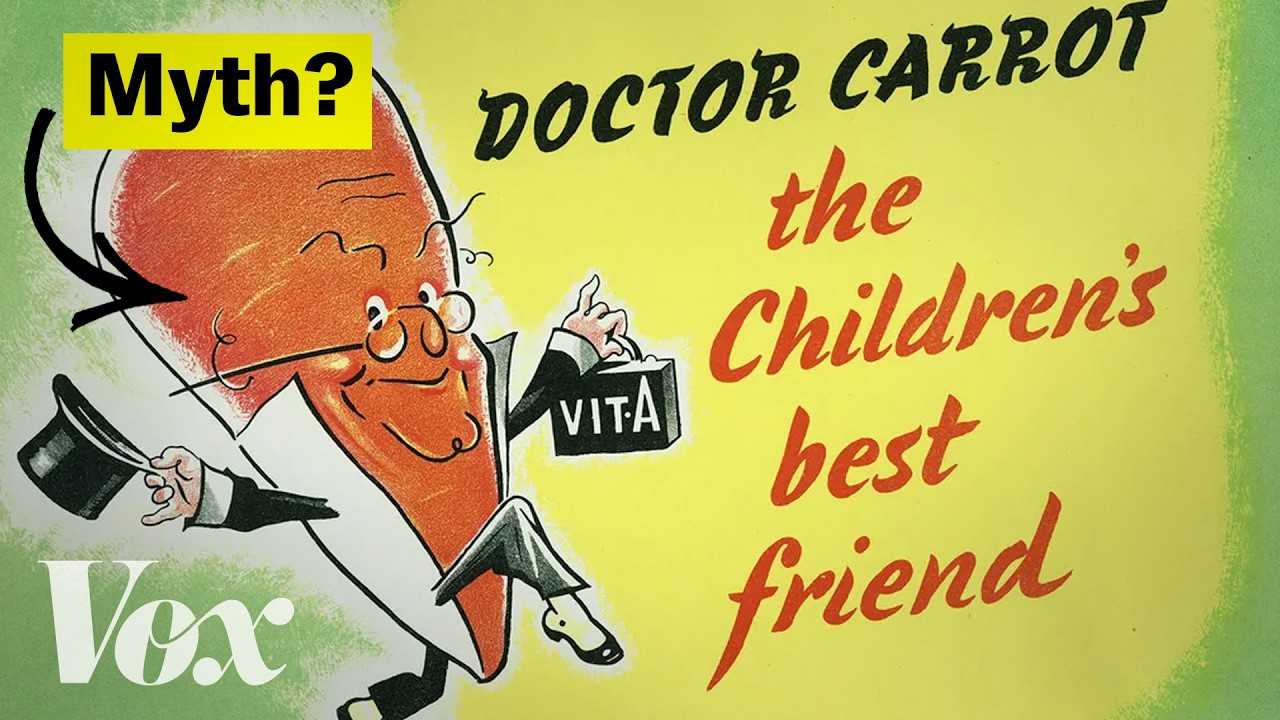
Carrots have been around for thousands of years. There are even records of carrot seeds from as early as 3000 BC. But the most famous thing about them is pretty recent. — Better have one of these. Best thing in worldw. — Sergeant, you need to eat a few more carrots to improve your eyesight. — Mom, is it true if you eat carrots, you can see in the dark? — I have no idea. — I don't believe eating carrots will help you see in the dark. In fact, in some conditions like retinitis pigmentotosa, um, taking too much vitamin A can actually be toxic. — So, why did we grow up thinking this? And where did the myth come from? Well, the answer actually takes us back to World War II with a story of propaganda and secret British technology. The humble carrot or dacus kota is a member of the apaci family along with parsnips, parsley, dill, fennel, and other plants that go in delicious soups. Carrots find their origin in central Asia with evidence pointing to their exact birth being in present day Afghanistan, but they quickly spread throughout North Africa, Europe, and Western Asia. In an early book of herbal medicines written by Padanios dioscurities in around year 65, he writes that the carrot seed is good for ye painful discharge of urine in potions. He also wrote that carrots were good for wild animal bites and even helpful for people trying to conceive. In fact, it kind of seems like the ancient Greeks thought carrots were good for just about everything but eyesight. And it's in this 7th century manuscript of Dioscar's book that we have our first ever image of an orange carrot. Because for centuries, carrots weren't usually orange. They were purple, white, yellow, and other colors of fancy carrots you see at bougie farmers markets. The iconic orange carrot that we eat today wasn't popularized until Dutch farmers bred them in the 1600s. And some claim that the orange was chosen to honor William of Orange. And orange remains an important color in the Netherlands to this day. From then until the 1900s, carrots slowly became more popular. We can see them showing up more and more in the kitchen, but they were mostly fed to livestock. As recently as a 100 years ago, the carrot wasn't quite the iconic, ubiquitous vegetable that it is today. And then during World War II, that changed thanks to one ingenious piece of propaganda. 500 German bombers and messes fighters roared over the English coast. — By November of 1940, London found its nights filled with terror from the skies that made sleep above ground impossible. — During World War II, the Germans sustained a bombing campaign in the United Kingdom called the Blitz. And the German bomber planes frequently struck at night. But the British developed a new secret radar that would help them in these nighttime raids. It meant that you were more difficult to detect, but more importantly, you were able to detect the enemy uh more clearly. — And there was one pilot who made great use of this new radar technology, John Cunningham. — He was one of the first pilots to test this out and he became highly successful. He'd actually shot down at least 20 enemy aircraft and probably more. — Overnight, he became a British hero. But there was a problem. the Royal Air Force who did not want the Nazis to recognize that we'd gained this advantage. They came up with this idea that if they could secure a wellknown pilot, Lee could then persuade the British people, he had this exceptional night vision because he was very fond of carrots and he ate many of them. So he was nicknamed Cats eye cunningham for his ability to spot bombers at night. And the British told the newspapers that his uncanny ability to see in the dark came from a certain orange vegetable. — There's no mention of, you know, this particular campaign and that it was actually having any impact on sort of Nazi reactions. — But it did trick the British at home. The myth that carrots could help your eyesight was spreading quickly. Along with the stories of Catsai Cunningham that they were feeding the newspapers, Britain launched the dig for victory campaign. Because the British had another vital reason to convince the population that carrots were good for them. During the Second World War, as Britain faced food shortages, the government encouraged their people to grow their own food in home gardens. And with limited space and a difficult climate, one of the easiest crops to grow was carrots. The Ministry of Food put out lots of carrot based recipes like carrot trile, carrot fla, and even carrot cigarettes. And iced carrots on a stick sold at candy stores to replace lollipops due to sugar rationing. And they developed characters aimed at convincing children to eat carrots like this guy, Dr. Carrot. Combined with the stories about cats Cunningham, the myth that carrots could make you see in the dark was cemented. Today, the carrot's one of the most popular vegetables. It's ranked fourth in the world behind only its old
Segment 2 (05:00 - 07:00)
friend, potato pee. Another piece of British propaganda that I can't really get into, but Google potato pee. You're not going to be disappointed. Speaking of delicious carrots, this video is presented by a delicious yogurt, Stonyfield Organic. For over 40 years, Stonyfield Organic has been a champion for truth in our food system. There's a lot of misinformation out there. That's why they believe in highquality ingredients to ensure that what they put on shelves is the best product for you and your family. The milk they use comes from family farms across the country like Molly Brook Farm and Cabbat, Vermont. It's USDA organic certified, which means no pesticides, no antibiotics, and no growth hormones. So, when you're on your next grocery run, consider checking out Stonyfield Organic Yogurt. It's also important to note that Stonyfield Organic didn't dictate the content of the story, but their support made this tasty reporting possible. Now, back to carrots. I've heard all kinds of interesting myths and the interesting thing about myths that last a long time is there is a particle of truth to it. Yes, we do need vitamin A and other things, keratenoids to see better, to actually see. I'm not sure they actually make it better as much as they keep it from going blind if you don't have vitamin A. So, it's not so much that carrots can help you see better, but people who don't get enough vitamin A do actually experience some negative effects to their eyesight. — They get night blindness. They stop being able to see at night, and over time, they lose even daytime vision. The vast majority of us get enough vitamins if you're eating a normal, healthy diet. — And the things that are best for your eye health might have nothing to do with your diet at all. Multiple pieces of data have shown us that people who look at phones a lot, which is 100% of the population at this point, end up getting myopio over time. The two ways to prevent it, and data shows this very clearly, which is to get about an hour of sunlight during high sun times, not look at the sun, just be outside and not look at any near target. So, if you grew up believing that carrots were good for your eyesight or could even make you see in the dark, then you fell for World War II British propaganda. But that might not be such a bad thing cuz carrots really are good for you. And in that sense, maybe Dr. Carrot was on to something. Thanks for watching. If you're not already a member, head over to patreon. com/vox where we're doing really cool stuff like chats with our reporters and where Dolly just did a taste test of all the different bananas she found in her last video. It's so important to support independent journalism. Your membership allows us to keep making videos like this, allows us to have fun and research really cool, weird stories, but also really dig into the investigative reporting. And if it doesn't make financial sense for you to support us today, you can still follow us on Patreon for free and stay uptodate with all the great reporting going on at Vox. The teleprompter from there. — Oh yeah, really good eyesight um from all the carrots.