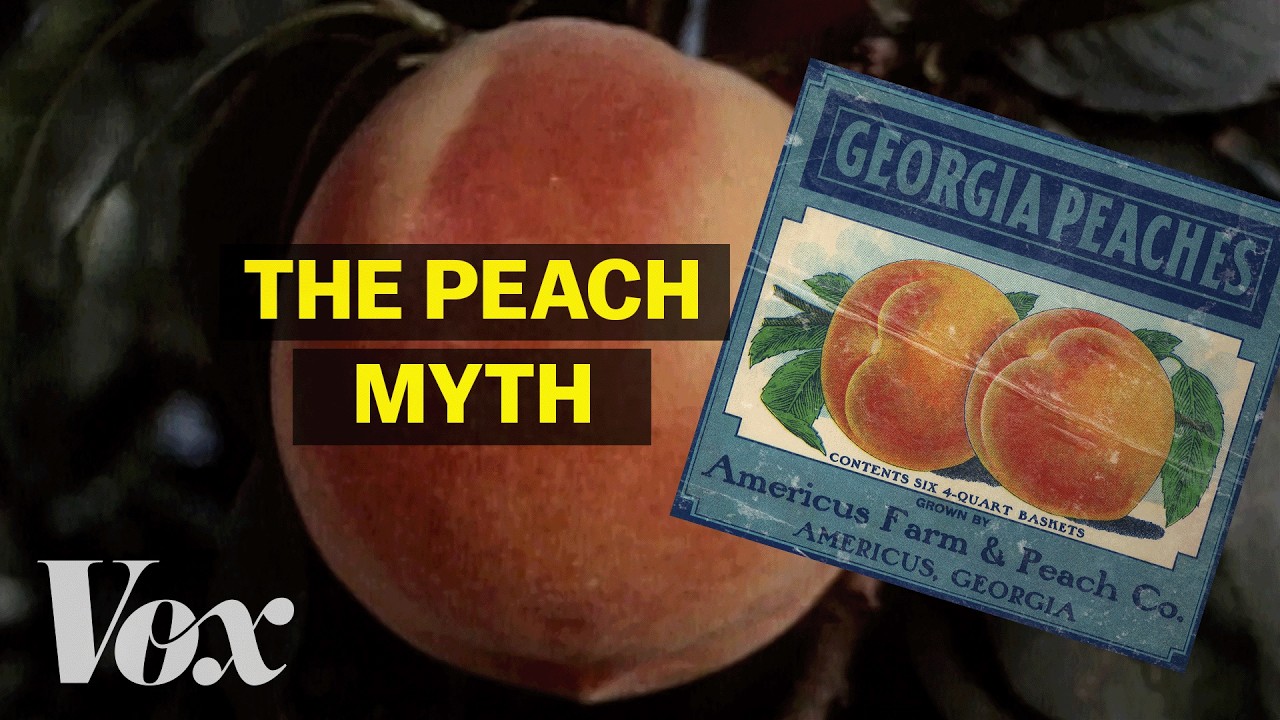
This is a peach. Soft, fuzzy, sweet, and oh so delicious. — When you get a really good peach, it's a tremendous kind of sensory experience. — The US produces 600,000 tons of this stone fruit each year, and it's synonymous with one place, Georgia. — That's one of those Georgia peaches. — Georgia peaches. Those are considered the best. — Look at your outfit. You look like a little Georgia peach. — It's on license plates and road signs and at the end of almost every film you've ever watched. There's even an entire county named after it. But here's the thing. Despite its nickname, Georgia doesn't even produce the most peaches in the US. — So, there's an active mythmaking. It's really not a southern fruit in particular. — So, how did Georgia become the peach state? A peach is what's called a stone fruit, meaning there's a hard pit at the center. There are cling stones, which cling tightly to the pit, and free stones, which pull away cleanly. They could be yellow or white, fuzzy or smooth. Those are nectarine. Same fruit, just no fuzz. And like most crops grown in the US, peaches came from somewhere else. The earliest evidence we have for peach usage dates back to China around 7,000 years ago. They came to Europe via the Silk Road, and so they acquired the scientific name Prunis Persa because it was assumed they originally came from Persia. From there, Spanish explorers carried peach pits across the Atlantic in the 1500s and planted them across Florida, where Native Americans used them for food and medicine and spread them up the coast. So, by the time English colonists arrived in Virginia in the early 1600s, peaches were abundant, but they weren't glamorous. — Most peach usage seems to have been for uh foraging hogs and making cider and brandy. — It tastes like peach brandy to me. — No one was calling it a state symbol. It would take a war, a broken economy, and a new generation of horiculturalists to turn that idea into an industry. When the Civil War ended, Georgia's economy was shattered because cotton had built the Old South. There's a really strong push uh among a lot of newspaper men and sort of upper class folks in the South to develop a new reputation, like a new face for the South. There was also in Georgia really active horicultural society. So there's a lot of language like Queen Peach is dethroning King Cotton to sort of say Georgia is doing something different. We're making a new kind of agricultural civilization. Peaches were already growing in Georgia, but getting them to market was the issue. They bruise easily and spoil fast. So if Georgia was going to build a new identity around this fruit, it needed a peach that could travel. Enter Samuel Rump. — In Georgia, the most important commercial peach variety was developed. Uh, it was called the Alberta by Samuel Henry Rump down in Marshallville. — Rumpt likely crossed Chinese cling with a yellow freestone known as Bley Crawford. — However, he was never able to provide a clear genealogy for the Alberta. He named it after his wife. That was also kind of an important move for uh, you know, a southern gentleman. — And at the same time Rump was experimenting in his orchards, something else was changing. — The development of refrigerated transport. That was a key part of getting the commercial industry going in the south. Georgia really is kind of the first peach growing region that's shipping at a considerable distance to some of the big marketplaces of the north. There were at one time more Alberta peaches grown than any other fruit variety. — By the early 1900s, Georgia was known for its peaches. Labels on crates shipped north featured the word Georgia front and center. — Mon Georgia hosts a big peach carnival in the 1890s that culminates in the 1920s in Peach County. Peaches were becoming something people in Georgia rallied around. They were pies and cobblers and crisps. Even during World War I, peach pits were burnt down and packed into the filters of gas masks. But despite their many uses, peaches never really did overtake cotton. — Peaches were never more important than cotton economically. As far as I can tell, peaches fit kind of handin glove with the cotton economy, especially with regard to labor. — But the story stuck. More than a century after the Alberta peach was introduced. Georgia made it official. In 1995, the peach became the state fruit. But today, Georgia's reputation is bigger than its harvest. Speaking of delicious peaches, this video is presented by a delicious yogurt, Stonyfield Organic. For over 40 years, Stonyfield Organic has been a champion for truth in our food system. There's a lot of misinformation out there. That's why they believe in highquality ingredients to ensure that what they put on shelves is the best product for you and your family. The milk they use comes from family farms across the country like Molly Brook Farm and Cabbat, Vermont. It's USDA organic certified, which means no pesticides, no antibiotics, and no growth hormones. So, when you're on your next grocery run, consider checking out Stonyfield Organic Yogurt. It's also important to note that Stonyfield Organic didn't dictate the content of the story, but their support made this tasty reporting possible. Now, back to peaches. South Carolina and California have both overtaken peaches and today California produces by far
Segment 2 (05:00 - 06:00)
the most peaches in the country. But even they're dwarfed by China. China produces way more in peaches than anybody else in the world. By the 1920s, nearly 150,000 acres of peaches were planted across the state. But by 2017, Georgia just had nearly 12,000 acres of peaches left. In Georgia, peaches and the people growing them look different today. The mostly black labor force that powered these early orchards declined during the great migration. And modern orchards rely heavily on immigrant labor, mainly through H2A guest worker programs. And labor isn't the only challenge. Peaches needed a certain amount of chill hours every winter, time below 45° to reset and bloom properly in the spring. Too much cold and there's risk. — If peach trees start to bloom and then there's a late freeze, you can lose most of your crop. In 2023, some Georgia growers reported losing more than 90% of their peaches. The season was described as disastrous. But despite all this, Georgia is still the peach state. At that moment when the South was really looking for this sort of new reputation, a new face, um, peaches were there. They were emerging as a major crop. I think there's been a continuation of a maintenance of the myth — because it turned peaches into a story and that lasts longer than any crop ever could. Thanks for watching. If you're not already a member, head over to patreon. com/vox where we're doing really cool stuff like chats with our reporters and where Dolly just did a taste test of all the different bananas she found in her last video. It's so important to support independent journalism. Your membership allows us to keep making videos like this and allows us to have fun and research really cool, weird stories, but also really dig into the investigative reporting. And if it doesn't make financial sense for you to support us today, you can still follow us on Patreon for free and stay up to date with all of the great reporting going on at Vox.