[NARRATOR] Before Peter Tenorio became an air traffic controller, he imagined he'd have a simpler job. [PETER TENORIO] I thought that I would be going and doing the wands, right? You know, the guys with the wands near the planes. I thought that's what I was going to be doing. I was completely wrong. [NARRATOR] Peter joined the Air Force in two thousand eleven. The job he got? Air traffic control. He made it through a rigorous training program and was assigned to a position in New Jersey covering some of America's busiest airspace. Peter was quickly put to the test. [PILOT] Tower, United, uh, 1544. [CONTROLLER] Ident. [PILOT] I'd like to declare an emergency. [PETER TENORIO] I had a United aircraft declare an emergency. [CONTROLLER] Okay. Uh, what is the emergency? [PETER TENORIO] It was a medical emergency, and they needed to land at Newark ASAP. [PILOT] New York, United 1544, 182 souls on board, seven hours fuel. [PETER TENORIO] I had to basically get everybody out of his way and have him go in a straight line towards the airport. [CONTROLLER] 1544, roger. Maintain 3,000. Turn right heading 340. [PILOT] 3,000, 340. United 1544. [PETER TENORIO] It was tough, but I felt like I did a good job getting them to the airport as fast as I could. Hopefully we saved their life. [NARRATOR] Peter, who is now stationed in the Pacific near Guam, has been guiding planes for almost 25 years. He says one of the biggest challenges is managing so many high-stakes scenarios at the same time. [PETER TENORIO] When I was working in Arkansas, when I was with the FAA, we had one controller in the radar facility, and we were servicing one, two, three, four towered airports. So at one time you could have four other controllers calling you from the towers. You could have three other air controllers calling you from other facilities trying to get something from you. Then you also have the aircraft that are calling you. Then you have to try to figure out what's the highest priority here. [NARRATOR] It's not an overstatement to say that every decision Peter makes is potentially a matter of life and death. But when you direct planes from the sky to the ground long enough, it becomes second nature. [PETER TENORIO] It takes a lot, a lot of practice. I genuinely enjoy doing my job. I have fun with the puzzles. [KEVIN COOL] From the air traffic control tower to the corporate boardroom, these puzzles are a regular feature of professional life. When we navigate dynamic environments, we're often using economic intuition, according to Paul Oyer, professor of economics at Stanford Graduate School of Business. And he says that intuition Shows up everywhere. [PAUL OYER] I think understanding and applying economic logic can be valuable in pretty much any job or any other sort of endeavor in your life. [KEVIN COOL] This is If/Then from Stanford GSB, where we sit down with faculty and explore how their research deepens our understanding of business and leadership. I'm your host, Kevin Cool. (upbeat music) (upbeat music playing) [KEVIN COOL] Paul Oyer has written several books about how economics shows up in everyday life. His most recent book, An Economist Goes to the Game, applies that to the world of sports. I talked to Paul about all of that, as well as what online dating can tell us about the job market and about the problems AI still can't solve. But I started with soccer superstar Lionel Messi sizing up a penalty kick. [PAUL OYER] The soccer penalty kick is maybe the most pure example in the world of something economists refer to as a mixed strategy equilibrium [KEVIN COOL] And I'm sure Messi, before he hits the ball, he's thinking of that term exactly, right? [PAUL OYER] So you know, there's an old saying that pool players are great physicists, or maybe it's that they don't know any physics, but they know how to apply it. And the same is true of great athletes. I don't know. For all I know, Messi has a degree in economics. [KEVIN COOL] But I don't think he does [PAUL OYER] But most athletes don't have any formal or very minimal training in economics. (laughter) But the thing about economics is if you repeat a game, and other parts of soccer and tennis and baseball are games, if you repeat them often enough and you really are focused on winning, then over time you're going to learn how to optimize. And people have studied this very carefully. The most perfect laboratory for studying mixed strategy equilibria out there is these penalty kicks.
Segment 2 (05:00 - 10:00)
And economists who studied it show that really good soccer players know exactly how to play that equilibrium out. So let me just lay out the details of a, of the economics of a soccer penalty kick for you. So let's just take the simplest version. You either are going to aim for the left part of the goal or the right part of the goal, and if the goalie waits and sees which way you've gone, if they wait to see what happens before they react, it's too late. So if I kick into the left and you then dive that way, it's too late. So goalies have to decide ahead of time which way they're going to dive. (mm-hmm) [PAUL OYER] So it's, it's what we call a simultaneous move game, And if you just kind of naively thought, which way am I going to kick? Most players would probably, if they're right-footed, kick to the left because they tend to be more accurate pulling the ball than pushing it. But of course, now we get the game theory. strategy. If the goalie knows that the person is going to kick, pull the ball, they're clearly going to dive to their right or the, the kicker's left. And then a smart player will say, "Wait a minute," I know the goalie's gonna dive to their right, So maybe I'll kick to their left or to my right. [KEVIN COOL] Even though that's their weaker side. [PAUL OYER] Yes, So then it becomes a game of you know that I know, and economists can go on all day thinking about who knows what. And in, in the case of a penalty kick, it ends up that if you really wanna be. If Messis are really good at doing penalty kicks, Messi will randomize. He will, in his head, flip a coin and kick left with some chance and right with some other chance. Now, it's not a 50/50 coin flip. Um, and people have done studies and shown that indeed the best soccer players do this just about right, just about optimally, which they'd have to because otherwise they wouldn't be the best soccer players. [KEVIN COOL] Yeah. Well, this is interesting to me. I'm a sports fan as well, but there's data everywhere now. Yeah about tendencies- Yes and what players are likely to do or not likely to do. But you use the phrase, which the, the fancy term that you used before, I think is connected to what you describe as economic intuition. Mm-hmm. So there's something that players or people in sports are developing on their own based on what? Circumstances, situations? What's [PAUL OYER] repeating? Just the pool shark, he or she learns physics by hitting enough pool balls. And so, you know, by the time Messi gets to be doing penalty kicks in a World Cup, he's done this so many times that he has a good sense for it. But more broadly, sports analytics and sports has become a big deal, and part of what they're doing is helping players develop that intuition or helping managers make decisions based on it. And so we use analytics to help now train people's intuition or override the intuition where they haven't had enough experience to get it right on their own. [KEVIN COOL] Mm-hmm. [PAUL OYER] So the analytics groups, I'll tell you, you know, and I'm sure they're helping with penalty kicks too, because, um, like I said, the top people could figure that one out intuitively. Tennis players are definitely hiring analytics professionals to help them with picking their strategies. [KEVIN COOL] Mm-hmm. [PAUL OYER] A place where you see this, where the math gets so (laughter) complicated is pitching in baseball. So if you think about it, a baseball pitch, sorry to those of you who are not baseball fans, (cough) [PAUL OYER] but every pitch in baseball is a simultaneous move game where the pitcher is deciding on the pitch and the batter, they can't watch the whole pitch arrive before deciding how to swing and what they're— [KEVIN COOL] They have a fraction of a second. [PAUL OYER] second to adjust. Am I gonna swing or not? [KEVIN COOL] Yeah. [PAUL OYER] And so they have to have some intuition for what's coming or not. And the pitch, is it gonna be high or low? inside or outside? Is it gonna be a curveball, a split-finger fastball, a slider? There are so many varieties, and the optimal pitch, it depends on how many runners are on base, what's the count? So if it's three and two, I have to throw a fastball because I have to be more sure of throwing a strike. [KEVIN COOL] What's the [PAUL OYER] score? All these things change. I can, well, I can't because it's too complicated for me. People can write down the math of how do I think about what percentage of the time I want to throw a slider on any given pitch? [KEVIN COOL] Mm-hmm. [PAUL OYER] And that, like, you can develop intuition for that over time, which gets you maybe 75% of the way there by the time you're a major leaguer. So now baseball teams have hired people to look at these types of things and help the manager call the pitch. [KEVIN COOL] So these are interesting insights in the sports world for the rest of us. Why is it important for us to understand economics?
Segment 3 (10:00 - 15:00)
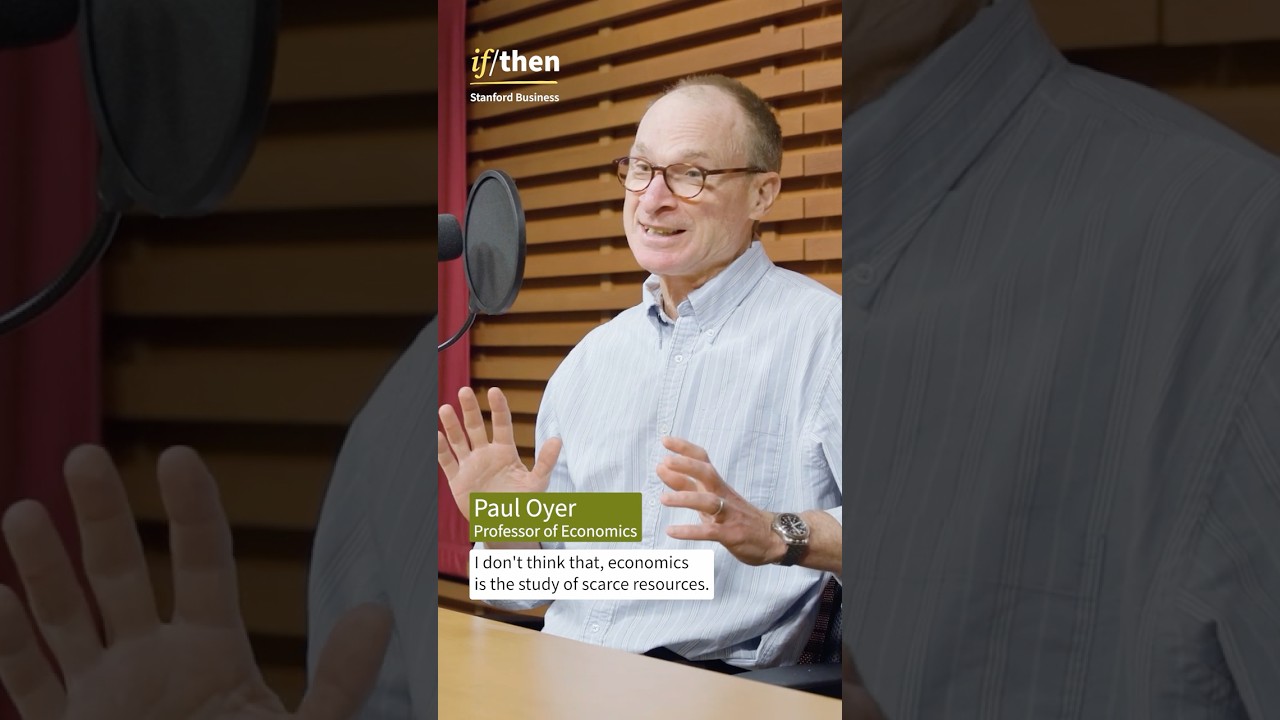
[PAUL OYER] I think understanding and applying economic logic can be valuable in pretty much any job or any other sort of endeavor in your life. Now, it's not enough. You can't just apply economics and have great relationships with people and have a very fulfilling life. But in terms of really thinking about, well, how do I make the best use of resources? Because remember, economics is not the study of money. Economics is the study of scarce resources. Mm-hmm. And that's always been important to me, and that's why I love applications. Maybe you know that, mm, I've applied it to things like online dating. There's no money involved. Mm-hmm. And that's, to me, is what makes economics valuable, is it's really thinking through how do I make little changes in my everyday perspective? [KEVIN COOL] Well, it's interesting that you mentioned online dating. You actually wrote a book, Everything I Ever Needed to Know about Economics I Learned from Online Dating. So what makes dating good for learning about economics? [PAUL OYER] Yeah. So the reason I wrote that book is I'm a labor economist, and I want to get across a lot of the ideas of labor economics, and the dating market is the labor market in many ways. There are some differences, Mm-hmm. But there's so many similarities. And so that book is really labor economics, but the hook is online dating. So let me-- I'll just give you one simple example. In both the dating market and in the labor market, all participants are out there looking for the best possible match. That I think we can all agree on. [KEVIN COOL] Mm-hmm. [PAUL OYER] And like, as a completely non-romantic economist, my view on it in both cases is you keep looking until you've done as well as you can expect based on the costs and benefits of continuing to search. Oh, so, you know, and, and in the book and in classes, we talk about the optimal search in the labor market, and the same idea applies in the dating market. [KEVIN COOL] So, speaking of labor economics, is there something about the dynamics of online dating that could tell us about how people do or don't get hired? [PAUL OYER] So, just a couple that come to mind off the top of my head are, first of all, in both cases, there's these incentives to misrepresent the truth. [KEVIN COOL] Mm. [PAUL OYER] Now, you can't misrepresent the truth too much because you're going to get found out. You know, if I say I'm six foot tall and I'm five foot four and I show up, the person will end the date. And by the same token, in the labor market, if I say I was the CEO of a huge company and I wasn't, that's going to be found out very quickly. [KEVIN COOL] Mm-hmm. [PAUL OYER] But empirically, you can find that people both exaggerate on their resumes and on their dating profiles, and it's the same underlying economic logic. It's trying to think about, how do I maximize getting to my goal, which is getting my foot in the door, and then I can work it out. [KEVIN COOL] Sure. And you talk about, you describe this, this notion of, quote-unquote, "cheap talk. " [PAUL OYER] Yeah, [KEVIN COOL] to describe how people exaggerate. For example, men, you know, round up, let's say, when they're talking about their height. Uh, and this phenomenon is so ubiquitous that it actually starts to impact how people are viewed who don't do that. Talk a little bit about that. [PAUL OYER] So in equilibrium, as we like to say, a term we use a lot in economics, in equilibrium, people are going to fudge the truth a little bit on their dating profiles because they have an incentive to. So you mentioned men and height. Men also lie about their income on dating sites and on resumes. People say they managed a team of some number that might be larger than the truth. [KEVIN COOL] Mm-hmm. [PAUL OYER] All these things are done because you can get away with these little things and get your foot in the door. And if you don't, that's good. I never would advocate misrepresenting the truth on any of these sites. But I will remind people, as I often do, that you have to keep in mind that other people are exaggerating. And so in equilibrium, you don't quite believe anything exactly as it's written, but you also can't push your misrepresentation too far. [KEVIN COOL] So part of what you're describing here would be applications of game theory where people's interactions together and models around that could lead to some conclusions. Is knowing how that works helpful to people in some way? Like, could they overcome challenges that might present themselves by knowing this?
Segment 4 (15:00 - 20:00)
[PAUL OYER] Sure. And I think that the main reason the common person really should understand these models is because it allows them to think a few steps ahead. And what game theory is good at is thinking about not just what is my best action, but how's my, how are other people going to reply right to my actions? I like to use sports as an example. There's a lot of game theory that will explain why people take performance-enhancing drugs. Mm. Right? And that's just very game theoretic. If you don't take it and your opponent does, you're going to lose. But game theory isn't always so negative and competitive. So let me give you another example. Here at the GSB, a term you hear a lot is community. Well, that's game theoretic, too, but in a positive way. It's, "Hey, we are all coming together," and if we're going to make the whole greater than the sum of the parts, I have to take into account not just my own interests, but those of other people in my community. " And that means coming to class prepared so they learn more. It means picking up the phone three years from now when you're an alum and some current student wants to know how to get into your industry. Mm-hmm. And so we have these relations which are game theoretic because you have to have an underlying contract that can make sure that everybody has an incentive to play their part in these things. [KEVIN COOL] We'll be back in a moment with more from my conversation with Paul Oyer. We'll get into the complex dynamics of finding the right career and what AI can and cannot do. (music playing) [KEVIN COOL] A few episodes ago, Professor Susan Athey was here, and she talked a little bit about how the use of AI robots is in some fundamental ways changing how people are evaluated and hired. AI is now writing resumes and cover letters to the extent that people have cover letters, and AI is reading those materials. She talked about how the lack of what she said was friction, in other words, people aren't using their own skills, their own sensibilities to do this, and as a result, there's no sort of differentiation. [PAUL OYER] Yeah. [KEVIN COOL] Um, so how is this going to reshape the job market and how are people responding in this context? [PAUL OYER] Yeah. So this is newly highlighted in the age of AI and LLMs, but it's something that's been going on in the labor market for 20 years or so. The job market moved from sending your resume in an envelope to applying online, I don't know, 20 years ago now or more than that. [KEVIN COOL] Mm-hmm. [PAUL OYER] And, and ever since then, the job market has been evolving. And to use that word friction, friction's gotten lower. It's much easier to apply for a job than it ever used to be. When this first started happening in the '90s or early 2000s, a lot of labor economists, including myself, were naive in thinking this was a great thing. It was just going to lower the barriers to applying for jobs. Mm-hmm, and that's great. And then we'd just use algorithms or matching technologies to figure out who's the best person for this job, and we'd get much better matches. Well, that was naive because if you lower the barriers and frictions too much, it becomes too easy. Look, frictions are bad in a lot of ways. They can make it very costly to apply for jobs, and people have to waste time sending out envelopes and opening envelopes. On the other hand, frictions can be good because it puts up a barrier and says, "If you're really interested in this job, you're going to take the trouble to put this in an envelope and mail it out. " This idea of putting up frictions on purpose can be useful, and it's actually an idea in labor economics or in economics more broadly. [KEVIN COOL] So let's dig into this just a bit more. So if it's essentially robots talking to robots here it's on both sides of the transaction. First of all, how do hiring managers deal with this? How are they responding? [PAUL OYER] Um, they're asking a lot of questions about, how do I respond to this? And, uh, some of them are saying, "How do I just hire the AI robot instead of the person? " [KEVIN COOL] It sounds pretty good. [PAUL OYER] But I think the answer is that as much as we thought that AI and, and lowering the frictions to hiring was going to democratize the labor market. I think there are at least pockets of the labor market where
Segment 5 (20:00 - 25:00)
it's doing exactly the opposite. Mm. So instead of dealing with a thousand applicants where I used to have a hundred, I'm now thinking, "Okay, I can't deal with a thousand applicants, so I'm just gonna call my friends and ask and use my network and end up hiring my buddies from college or from (coughs) high school to fill these jobs. And then we fall back into this world that's not very fair. [KEVIN COOL] Yeah. Right. And there's a stratification that occurs presumably if that's the case- Yeah, so- based on who the hiring managers are. [PAUL OYER] Exactly. We end up hiring through networks. Now, networks can be incredibly valuable, and that's why, especially in a world where other forms of picking through people aren't as informative as we'd like them to be. So then networks are incredibly valuable because you have precise knowledge of what the person is good at and not good at. But the people who aren't in your network, then become at a big disadvantage (coughs) and miss out on opportunities. [KEVIN COOL] Mm-hmm. [PAUL OYER] And even in the age of AI and hopefully demonstrable objective output being so easy to measure, even in that world, I think networks are going to be just as important as ever, if not more so. [KEVIN COOL] What questions or what's on the minds of executives that you're encountering in your courses and those with respect especially to technology changes and so on? [PAUL OYER] So executives are, are asking us all the time, "How am I gonna make better use of AI? " And what I think workers should be asking themselves is, "What can I do that AI can't do—mm—and hopefully won't be able to do for a while? " The line I use a lot in the classroom is, "What can I do that a computer can't do, and," this is an important and, "that people will pay me money for? " 'Cause you can do a lot of things that AI can't do, but, you know, nobody's gonna pay you money for it. So the constant updating of the job market has to be so- thinking about that. Again, that's not an AI thing. That's been going on for a long time. Right. Right? I mean, you know, my grandfather was a farmer, and most people from his generation don't anymore because now it's not that a computer can do it, but a tractor can do it. (throat clearing) [PAUL OYER] So jobs have always been undone by technology at a huge cost to the individuals who used to do those jobs and are kind of old and not in a position to retrain. [KEVIN COOL] So you've been at GSB 25 years. You've been studying these things for a long time. What's the itch that you've never been able to scratch in terms of getting people to understand something about economics? [PAUL OYER] As a labor economist, there's one, one thing that still has been very hard for us to study, but one thing where I just feel like we haven't really nailed it is how to do a better job of matching the people to the best possible job. [KEVIN COOL] Mm-hmm. [PAUL OYER] The beauty of the labor market is jobs are very different and people are very different. And again, it comes back to the dating world. People are very different, and the value of matching the right person with the right spouse is huge. We don't want to randomly do that. And the job market's the same way. I've had a very good life because I found a job that's been fantastic for me, and a lot of people do that and get lucky that way, and a lot don't. And by the same token, it's not just from the worker's side. A lot of firms don't find the people who would be best for their circumstance. And we as economists have been really good at studying how to design incentive systems and pay for performance. We don't get that exactly right, but we kind of answer questions there really well. And what I, as a labor economist, would like to get at a little better is how do we solve these problems of matching people? And I think we naively thought technology and AI was going to fix the problem, and it hasn't. Mm-hmm. And so really understanding how to put the right people in the right positions, boy, if I can figure that one out— Yeah, that would— that's really going to add a lot of value. [KEVIN COOL] If/Then is a podcast from Stanford Graduate School of Business. I'm your host, Kevin Cool. Our show is written and produced by Making Room and the content and design team at the GSB. Our managing producers are Michael McDowell and Elizabeth Wyleczuk-Stern. Executive producers are Sorel Husbands Denholtz and Jim Colgan. Sound design and additional production support by Mumble Media and Aech Ashe. And a special thanks to air traffic controller Peter Tenorio. For more on our faculty and their research, find Stanford GSB online at gsb. stanford. edu or on
Segment 6 (25:00 - 25:00)
social media at Stanford GSB. Thanks for listening. We'll be back with another episode soon. (music playing)
Другие видео автора — Stanford Graduate School of Business