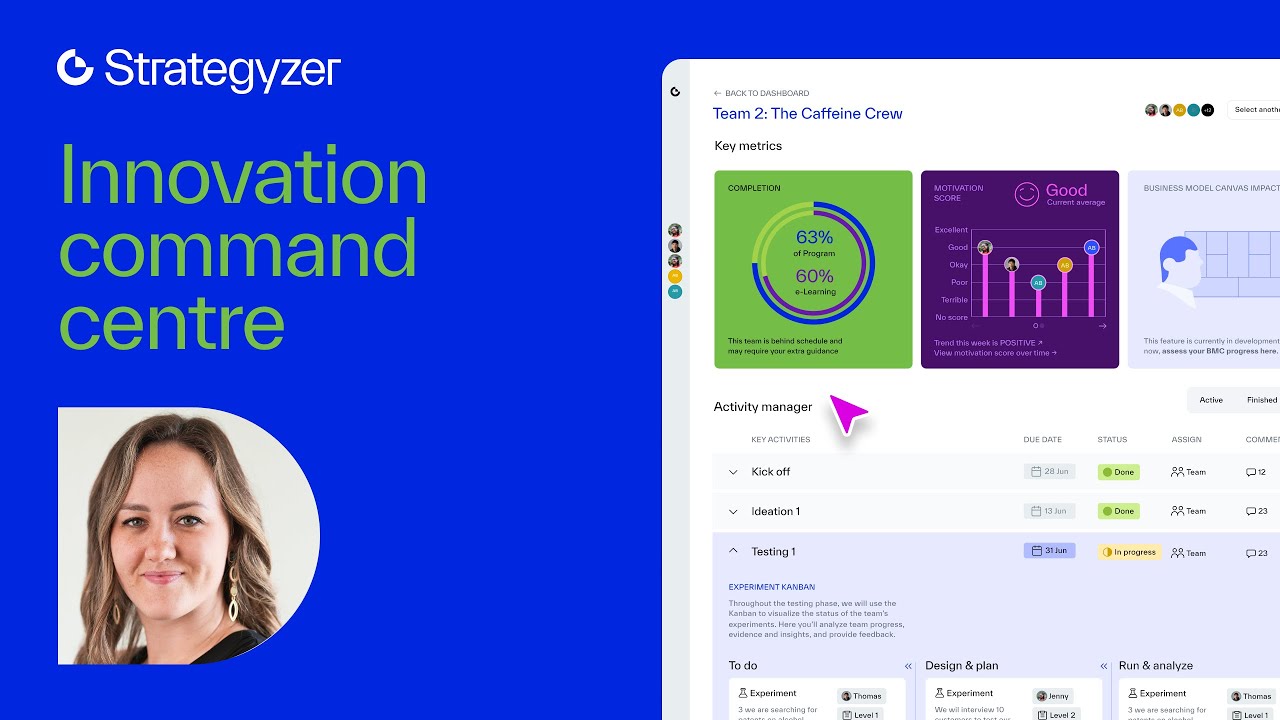
The playbooks for delivering world-class meetings, workshops, and events

The playbooks for delivering world-class meetings, workshops, and events

Machine-readable: Markdown · JSON API · Site index

Поделиться Telegram VK Бот
Транскрипт Скачать .md
Анализ с AI

Оглавление (12 сегментов)

Segment 1 (00:00 - 05:00)

Today we're going to um share with you a webinar around playbooks for world-class meetings, workshops and events. Um and we have with us today Alexander Oststerelder um Tendai Vicki and myself Carol Hill um from Strategizer. We're going to have three main sections today in this webinar. The first one um Alex is going to talk about tools structure and facilitation. Um I'm going to share a little bit about a workshop playbook. uh a story about that and Tundai is going to talk a little bit more about strategy after last uh the last webinar. I think we had um some good feedback there. Um some interest in that. So you're going to continue that conversation. Um just a bit of housekeeping for everyone. Um please do um engage throughout um add your comments into the chat. Uh we have a Q&A section at the end of the webinar as usual. Um so if you would like your questions considered for that please um just put that in the Q&A um it helps us to filter those really easily. Um recording and presentations will be available a couple of weeks within one or two weeks. Um and uh please just check your inbox, LinkedIn and strategizer website for updates. Okay. Um Alex, do you want to speak to this before I hand it over to you for the menty? — Yeah. So maybe just you know what led to kind of even this uh webinar is we were asking ourselves the end of last year what is strategizer really about what are we really good at and it's actually this combination of going into a company and running worldclass sessions going from meetings like a strategy meeting to workshops we'll give a couple of examples of that all the way to events And that's kind of what we do. And I think you know you're going to see more if you want us to help you fix your strategy events. You're a lot of events that exist right in meetings. Well, get in touch with us because we kind of got boxed in a corner, I think, around innovation and growth, but what we really actually do is fix all of these sessions. And that sounds a bit crazy. Um, so we're always a bit careful about, you know, how we talk about it. So we'll you'll see after this session, does it make sense? Um but uh just bit of a an intro and cliffhanger maybe because it sounds very abstract and you have to go through one of these sessions to actually understand what it's about. So we're going to show as much as we can. Um but get in touch with us if you want us to fix some of your uh strategy meetings, big sessions. I'm going to talk about one that we did at Honeywell that we can actually talk about. So you'll see what this is about. Bit of a cliffhanger. — Perfect. and then I think it's over to you, Alex, for the first minty. — Okay, let me just quickly share my screen. Unfortunately, I'm not in my studio today because I need to fix it, but uh this should work. So, QR code still here. Otherwise, I'm sure we're going to post it in the chat. Um just get let me close this one here. Um let's get started. And this is before we get to a competition just very quickly who is here today. So maybe give us a bit of an idea. Um just enter who you are. Okay. I'm going to just reload this. Excellent. So a lot of innovation leaders and what I'm going to talk about in my section is actually a little bit about growth. We're using a word differently. I think innovation is we're seeing the word being used less and more and more strategy and growth. Okay, quite a few consultants. That's great. Business leaders. Awesome. So, I hope we have a little bit something for everybody because what we're going to present applies literally to every good business session from certain type of meetings to workshops to events which make things a lot clearer and align. — Cool. — Nice. — Good. Thanks, Carol. Back to you or do I take over? — Over to you. you've got the first section. If you have any sorry and questions, please just pop it in the Q&A. Thank you. — Okay, so I'm actually going to just stay in sharing my desktop because I am going to share another menty a little bit later on. So first section um a little bit around the right tool, structure, processes and focused facilitation because that's actually what we do at Strategia and we want to share more of that. So it's it's really about how we do it and we're going to transmit as much as we can. So

Segment 2 (05:00 - 10:00)

what do you do when you have a question you're like what is a good meeting and I'm not sure I hope this is not in the way of everybody here. Okay so I went to chat GPT what's a good meeting workshop event like what's world class. So, first thing you go and kind of see what does it spit out and what came up here of course is great question. Chat GPT always kind of tells you you're great. So, you have to fight against it a little bit. But, um, what is really clear is that worldclass meetings don't happen by accident. And when we say meetings, it's meetings, workshops, and events. They're really designed end to end. And that's what we want to share a little bit here around how to do that. really the best practices. So, kind of summarizing um I'll dive into this in a bit, but what came out here of Chad GPT is and I maybe did direct it a little bit in the right kind of direction because we've been doing this now for a while around this first topic is tools. Start with an outcome and then what kind of tools do you need to have to get to that? We're going to get to those visual tools in a second. It's not just, you know, business small canvas or so. It's a little bit more complex than that, but it's about designing what outcome you want to have and then the visual tools, exercises, and structure that get you there. The second one really the steps. So, we call it structure, sometimes we call it steps or a series of exercises that you complete with visual tools all the way from putting up sticky notes to building canvases to get to the right results. And that's really something we pay an insane amount of attention to before we actually run the session. That's the preparation. And then the last one really the facilitation of how do you do this to actually get to the results and a lot of that is also energy management and participation. So not just having one or two people talking but getting everybody to participate. So that's kind of the overview. Now, what I really want to get into is visual techniques, step-by-step uh desired outcomes and the facilitation there. So, let's start with the visual tools. So, when I say visual tools and you're in a strate strategizer session, you probably think business model canvas, but it's a bit more complex than that. So, before I want to go into the tools, I want to make very explicit why are we so obsessed with visual techniques and tools. So, I already added the word techniques because visual facilitation techniques are just as powerful as the tools per se. Slightly different angle, but if you don't use those systematically in your sessions, you won't actually get to results. You get to blah blah. And that's what we're kind of fighting against. So, I just when while preparing for this webinar, I searched a little bit what we already had. Uh we did a 2017 blog post on this whole idea that if you do not use visual facilitation tools, you'll end up with a lot of blah blah. And some of you might remember our no blah card kind of inspired by the no software stuff from uh the you know software as a service movement. And if we go into that asking well why what do visual tools concretely help us do first one is very simple it goes from abstract talk to concrete artifacts and that could be hey what's a business model what's a corporate culture or what do we like what do we dislike and you put up sticky notes that's getting away from just talking and I'm really serious about just talking because we talk way too much what we really want is concrete artifacts and I'll get a little bit more concrete sounds very conceptual. Um how do we use those? Then the other one and we learned this with the business model canvas. It really creates a shared understanding a shared language. Putting up sticky notes, putting up a business model canvas, putting up a value proposition canvas creates that shared language and we can talk about that shared understanding. So going from just talking towards making that thing visible, visual and shared. And when we use these visual tools, we can facilitate participation of all people, right? So we don't just want one person presenting like I'm doing just now. We want participation. And we're actually going to do a little bit of that with the menty um as well. and then just adding the kind of structure without killing creativity because we could put bullet points into a word document or Google doc but that kills kind of the collaborative aspect. And then the last one, speed. With visual tools, you work at least 10 times faster if you use them

Segment 3 (10:00 - 15:00)

well. Okay, so that's the why. Why do we need to use these visual tools? Now, let me just show you. This is a picture two weeks ago at the Strategizer boot camp. We all went to the mountains, Mount Pilatus for a week. And you can see here for every single step that we created the facilitation process, we had visual tools where they were working here. They needed to rank themselves on uh strategizer principles. And you can see there's a slider here where they would go either to the left or to the right. So we immediately created that shared understanding. could have just been a blah session, you know, how do you perform on strategizer principles, but we wanted to make it very shared, very visible, so you can actually see how you're performing compared to your peers. So, we now always do this on the strategizer platform and in even in a physical setting because it's so powerful to get that shared understanding. And if you have these artifacts and you thought them through before the session, I can guarantee you alignment will go through the roof. So here's another session where people were talking about corporate culture um in tendi session and transformation and it just became a lot more concrete. So we need to do that kind of homework. So now talking about visuals, we need to talk about one of our good friends and strategizer coach as well. Um if we can get rid of those hands up there. Yeah. Um Holar Neil's pole who talked a lot about visuals um in the context of strategizer but we also kind of helped him write his book on creating clarity. So when we collaborated on this we asked well what does that actually mean when we say visual tools? So I'm getting a little bit more concrete and we'll get ultra concrete in a second. They're actually a whole series of visual tools. One is visual techniques. Using sticky notes to put up an opinion, idea, or to vote on things, make things tangible. Okay, that's number one. Number two, templates, not as sophisticated as maybe a canvas, but simply a template that get us to share an understanding. So, value scenes would be one. That's basically a story board. Very simple way of using storyboards. Analytical tools are also very visual. You know the Boston Consulting Group matrix where you have the cash cow and so on. They're not visual kind of inquiry tools like a canvas but they're also visual tools and they allow you to kind of make sense of the world. And then we have the visual inquiry tools like the business model canvas. And then we have visual techniques presentation techniques uh like here I'm using animation by putting up one sticky note or one bullet point at a time. So if we get concrete and look at what this means when we design a session we need to ask what kind of visual techniques are we going to use. Many of you use domocracy right that's putting up sticky notes for ideas and then you put dots on the ideas you like. Putting up 10 dots on your favorite ideas and then one dot maybe on those that you like less. That's a visual technique. We need to design those into our sessions into our meetings and workshops. templates take here from the grove. David Cibet, one of the inventors of the visual movement. These are maybe less kind of thought through than a canvas, but they're very powerful because they create that shared language. Then we have analytical tools which are, you know, all the 2 by twos are not design tools like a canvas. their analytical tools or one that we used um at uh Honeywell and you'll see that in a bit is the strategy canvas by Kim and Mob the blue ocean strategy book where you compare your strategy or your differentiation to that of a competitor that is a analytical tool it's not a design tool per se and then you have what you know from us you have the inquiry tools like a culture map is a small canvas value proposition canvas and then you have the visual presentation techniques. So these are the different kinds of tools. Now going and putting that together, we actually did this at the boot camp. We asked people to kind of understand visual tools so they could design better sessions. Now let me get concrete how we would weave these things together in terms of steps so that you get to an outcome. And what I'm going to use here, it's actually a very concrete example that we're allowed to talk about is the work we're doing with Honeywell around their growth symposium. So about a year ago, a little bit more than a year ago, uh Sesh uh senior VP, CTO and president of Honeywell connected enterprise, he brought us in. He wanted us to bring strategizer thinking and tools into Honeywell. And the context in which we

Segment 4 (15:00 - 20:00)

started were their growth symposiums. So they run four growth symposiums around the world and the idea here was to get teams around their ideas to really test where to play and how to win to use kind of Roger Martin's words and I'll show you the design of that because we really went step by step through this. So growth symposium was really about you know kind of getting their ideas sharper and reduce the investment risk by testing. So first thing is there was pre-work to be done. So leading up to a growth symposium. So there was one in uh Europe, one in the US, one in uh China and one in India, the teams had to do pre-work. So here you can see on the strategizing platform we have the stepbystep approach. So if I click on this actually it will bring you to the steps that the team had to go through. So a team would sign up to the playbook for the growth symposium and they have a whole series of pre-works section one customer ecosystem map customer profile etc. So if I go back I'll show you kind of what that pre-work was. They had to bring these visual artifacts to the session. That's extremely powerful in terms of preparation. It's not just about agenda who needs to be there but what do they need to bring? So in their case, they needed to map out all of the customers, users, and decision makers. They had to create one customer profile, one value scene, which is a storyboard of how they create value with their technology. They had to create a business model canvas for their project, a financial prototype, very simple, and they had to map out the known unknowns. That was their preparation. We did that over about a month. Then they came into the session and in the symposium. So if I go back quickly just here um to show you um what was in that playbook at the growth symposium. So they came in with a couple of things and then this is the first slide that we showed them said okay you're coming in with your artifact now we're going to explain this explore exploit. How is managing your company different from growing? And then we'd go into customer focus, value proposition focus. They would make a first presentation based on their artifacts. We call that pitch one. Then they had to rework the financial prototype, pitch two. And then they would rework their presentation and they would present to a highlevel panel of the senior leaders at Honeywell. So now what does that mean? That during the session, you've seen what they came in with. So the visual artifacts that they brought into the meeting. It was a session with about uh 14 teams. Then we showed them how they would actually end the day. What was that pitch? Again, very visual. We would get them to present um uh five things. First one, what's the big idea? And all they would do is present three sticky notes. And we'd actually do it from my computer and just zoom into these. Then next thing, they wouldn't present a customer profile. They would actually just present the three uh main areas. So top two jobs, top two pains, top two gains and then the evidence of you know what do they have today that proves that they understand the customer. Same thing for their value proposition, storyboard, key differentiator and the evidence. The evidence is what they rework at the session in um the workshop based on the artifacts that they already brought. do the same thing for the financial model and at the end they would show the unknowns. That is the visual that they presented at the end. So when we run a session, what we pay insane attention to is all of these visual techniques and artifacts and what they need to present. And that's kind of what we want to, you know, give to you with the playbooks that we're making ultra accessible today. And last piece, you don't do this with 14 teams without facilitators in the room. So we were a team of four facilitators and ultimately Honeywell is going to take over and facilitate this on their own because we're giving them the playbooks for a session like this so that they can do it on their own. Now you can do it without facilitators by just having the visual tools and the steps on the strategizer platform but it's more powerful um if you have those experienced facilitators in the room at the same time. So now that was um a little bit around the idea. So, if we can now get everybody to menty back to menty and uh I think you if you go to I'm going to close this one. If you go

Segment 5 (20:00 - 25:00)

to menty. com back to where you were before and you enter the code um 8896473, we are going to relaunch the menty competition. So I'm seeing players here. Okay. — So this one's a competition, right, Alex? — right? Because we didn't just want it needs to be a little bit competitive. And this is actually a another facilitation technique. Quite visual as well that we use all the time. In particular, when there's senior leaders in the room, it's extremely powerful. Don't just ask for people and their opinion. Actually make it a competition when you want to teach them something. So — players ready? — Yes, let's go. I think that's quite a bit. So first question, speed matters. So faster you answer. What type of visual tool is this that you see on the right hand side? Stack ranking. Is that a visual technique? Is that a template? Is that an analytical tool? Is that a visual inquiry tool? Visual presentation technique or concept or framework? Just added that one. This one's easy to get started with. Okay, very clearly a visual technique, but these are techniques that you need to design into your meetings. You'll go faster and you'll make things concrete because often these are things that people just do blah around. Not very good. Okay, so now let's look at quarters five forces and I'm immediately going to launch the question because otherwise you have too much time to think. What type of visual tool is orders five forces 1985 still used quite a lot visual technique template analytical tool visual inquiry tool and we didn't go deep on the explanations right this is not just about visual tools this session okay it's an analytical tool because it allows you to map these competitive forces now we believe that today you can be the force so it makes a bit less sense to kind of just map the environment, but still in some context it makes sense. So, is it also a concept and framework? Some people will say of course it is, but it's an analytical tool that allows you to understand context and make sense of the world. Definitely not a design tool because you can't design the five forces like you can design a competitive strategy. Okay, so let's have a just quick look who is leading. Okay, we have here Mark. Mark, so in the chat, you now there are two more questions. You now have a target on your back. Okay, so you didn't win yet. — So next one. — Down mark. — There you go. — A few more players entering. — Okay. So we have strategy maps by Kaplan and Norton, which is a very powerful visual tool. So is this a visual technique? Is this a template? Is this an analytical tool? There's a visual inquiry tool. This like a business model canvas. Is it a presentation technique? Okay. So, it's more sophisticated than a template. So, what we usually say, and again, we're it's not about visual tools per se. A visual inquiry tool is a lot more theorybased and more sound than just a template. and Caplan and Norton's you know the the um balance scorecard they've done a lot of conceptual work around that and they turned it into a tool so this actually is a very powerful tool that inspired the business model canvas so this is a visual inquiry tool is more sophisticated than a template are things that you whip out you know in five minutes you don't have the theory to kind of support it okay last one very powerful thing here visual thing the Galbre star model that you can use in your sessions. But the question is, is this a visual technique? Is this a visual inquiry tool? Does it allow you to design something? Is it a presentation technique or a concept framework? Again, we didn't explain everything, but got a lot of smart people in the room. It's definitely a concept. So you would goes deeper in maybe in the strategy you would use the business small canvas which is the visual inquiry tool but it's basically a concept that allows you to make sense of the world. It's not an analytical tool you don't have enough there to kind of analyze right so very powerful concept and within the pieces of the concept you could have um frameworks. Okay let's see if Mark made it and stayed ahead looks like. Okay lost a couple of points not even on the board anymore. So we have Paulina. Paulina is the winner.

Segment 6 (25:00 - 30:00)

— Awesome. — Incredible. Congratulations, Paulina. Alex, could you say a little bit about why it matters for people to know the difference between these different types of things? — Yeah. So why it matters is that you know in particular sometimes and I'll stop Just stop sharing here. Okay. So why it matters is that the visual inquiry tools are very sophisticated design tools where you actually design a strategy to together. You probably want to use something a little bit more, you know, sound than just a template to do that because often people say, "Oh, these are the five 10 different important things that we need to discuss. " and then they just kind of put boxes on a thing and they call it a canvas and then it becomes a wagadoo canvas where you just don't have sound work. So you need to really think what are those visual tools that you need to use. Sometimes there are no tools and you it is okay to whip out a template keep it simple there's a whole lot of art to it and then the visual um techniques are in between right the process of how to do these things. So worldclass facilitators a lot of you are worldclass facilitators and you say oh so what is Alex showing us here it's actually then the design and that's where I want to hand over to you Carol and then tendai to show you how we design this into sessions but you first have to be a master of these visual techniques before you can even be good at designing a meeting because the designing a meeting requires that you're a worldclass you know facilitator and worldclass facil facilitators understand these tools. So with that over to you Carol. — Perfect. Thank you very much. So I think you know to sum up what Alex was saying it's really ensuring that you know you have world-class facilitation skills but also you understand what tools to use at the right time so that you can design these sessions that are going to help your participants get to the goals that they would like to achieve. So, I'm going to share um a story with you about a workshop that we designed recently for um an organization out of London. Um and so, I'll just start by saying I started the workshop with a simple virtual um session um to get to know the participants a little bit um to ensure that we're all aligned on the goals and people knew what to expect on the day. And in that first session, I could already see that we had a few things that we needed to work on um that I then wanted to address with the key stakeholder. And the bulk of that was really something that we see a lot. It wasn't quite this bad. This is a bit of an exaggeration, but there were a lot of talkers in the room. And I think Alex has already talked about the blah blah card, but that became um really obvious. And so having that first session, the virtual session a few weeks before we had the face-to-face full day session was helpful for me to kind of understand what we were going to get ourselves into and how we could ensure that we're um getting people moving in the right direction. So a couple of things that were really obvious um to us some pain points that we wanted to solve for was that this particular group went down a lot of rabbit holes. there was a lot of talking being done, talking in circles without really a direction. Um, and also the feeling that everybody needed to say something even if it was the same thing. Um, so there are better ways to kind of get to agreement than everyone um continuing to repeat themselves. Um, the second was that nothing was really captured. Um, so um that was kind of a pain point. How do we get um all the inputs um put together um and shared for everyone um for afterwards? Sorry, I'm just distracted by the point Tendai made. His favorite phrase is rabbit hole alert, which I think when I first started working with Tendai back in 2017, rabbit hole was something you probably told said about me um every time we chatted. But anyway, so back to the story. Also, no road map. So no real direction as to where um where uh they needed to get to and where they were going to go after the workshop. So to address the rabbit holes uh the first thing that we did was ensure that we looked at some rules of engagement on how we were going to work together um for the workshop itself. And the first one was really around being considerate um and using the blah blah card which for many cultures can be a little bit strange. So going into London, having worked in England, I kind of know that maybe this isn't something that's going to be so comfortable for English people to kind of put a card out and call each other out um if people are going down rabbit holes or talking about something that is not um focused enough. So we addressed this together and we ensured that everybody was in line with this um and okay to do this. Um I forgot my blah blah cards, but I always carry Lego bricks with me. Um, so we

Segment 7 (30:00 - 35:00)

used red bricks. And so what it became was um this idea that you were going to redbrick someone by holding up a red brick um every time somebody said something that was um off a tangent or um going on into too many details that wasn't uh focused for the conversation. The second was staying focused um and using um time boxing. So really giving people um uh letting them know how much time they were going to spend on an activity and trying to stick to it as long as we were getting to results. Um and then the third was being present. So we were using the platform so everyone needed to have a laptop. Um but we were very clear that people were meant to stay focused during the workshop, not to be multitasking and doing emails at the same time. So um the focus really was we weren't going to have all the answers on that day and we didn't want to focus on perfection. We just wanted to make progress and get started which was really important um for the folks in the room. So that was the first thing. Um, now when we were looking at how we can capture everything, what we did was uh used our digital playbooks, which meant that I didn't need to take pictures of all the post-its on the walls everywhere and um and then write it up into a big uh report, but we had everything in a platform in a playbook um that um the participants could uh easily add their ideas at the same time as well. So the first activity as an example was around ideiation. We used trigger questions for the teams to kind of think about how they could um come up with some new ideas based on key issues that we'd agreed on ahead of time. Um and um we didn't have to have each person go one by one and share um as soon as people were putting their postits into the playbook. That meant that other people could see what they were doing um and they could add to those ideas. Um and so obviously it means that we could do this much more quickly. um everyone was on the same page and it was captured at the same time. Um another example here was that we had um napkin sketches uh and I stole this activity from something Alex had done um a couple months ago, but coming up with some big bold ideas. Um and for this particular one, we actually had the teams because it was a full day workshop, we had the teams do this um on paper. they were standing in their different corners and then we took they took their own photos of it and uploaded it into the playbook. So, we used a bit of a hybrid there so that they could we could keep the energy up, get people moving around, get some blood flowing um and but still have it captured in the playbook really easily and succinctly. And then the third one of the third activities we did um to capture all these ideas was once we had ideiated we'd done some dot voting um and then we prioritize the ideas into a very simple kind of um target um image. So these are the ideas we want to pursue now. shove for later. And these were the ideas that we want to bin. Um and then we continued to work on the ideas that we had agreed um we would pursue now um for the rest of the workshop. Um we then carried on with fleshing out those ideas by mapping out the business model canvas for each of those ideas. Um we did a few other things ended with a couple of um designs to test key assumptions um that they could do work on after the workshop. So, we captured all of those things right in the actual playbook. when it came to a road map or really understanding where they wanted to go to um in the workshop and what was going to happen afterwards. Again, um we looked at in the um how we could actually reuse what we'd done during the day to create their own workflow um for coming up with new ideas and getting them to the point where they could start working on them and they could have their teams working on them. So, we um did this together um and it didn't take very long. I'll show you what that looked like in a moment. Um and then we also um ensured that we captured any of these ideas or actions with owners, the first small step they would take and some deadlines so that we could really show um everyone could be really clear on what was going to happen after the workshop which can be a real um something that people often miss I suppose in workshops is having a great day on the workshop and then leaving with no clear idea of what's next. So really just to sum up the the key thing here was um avoiding people going down rabbit holes by ensuring that we had focused conversations um moving from nothing being captured to really having a everything in a digital platform um and then from going to from no road map to actually this was the

Segment 8 (35:00 - 40:00)

result of new process that they'd created um really having a clear idea of what's next. So for this particular team on the one day um they came up with um I think three to five different ideas that they wanted to focus on in this first quarter. Um they came up with a full process on how they wanted to work through those ideas and they had actions with a road map on what they should do for 2026. So that was all done the first week of January um off to a good start. So that's just an example of uh one workshop that we worked on. Um and I'm going to hand it over now to Tendai. Just quickly um before you move on, right, I think the key takeaway when we were reflecting on what strategiz is really good at is the step-by-step approach, right? So, you know, when I look at visual platforms, there's a lot of visual stuff and there are tons of templates and so but what we started to do on the strategizer platform is actually designed the playbook. So, you see the step-by-step approach, right? So what you walked us through were those steps that show up in a timeline. And if I take Honeywell as an example before some people were asking what about the pre-work the teams had to each single team had to prepare those artifacts. So they were guided through the playbook remotely with instructions and with workspaces to go through that. it'd be much harder on you know the conventional visual platforms because you don't have the guidance steps so the playbook aspect those steps are crucial in addition to just in quotes those visual tools right so the other aspect I really want to emphasize and you were showing this a little bit is the visual artifacts are reusable these are data objects right that you want to take and you want to reuse it's not just a dumb visual thing so I just want to emphasize the steps is actually what makes that difference pre-workshop because it was a question like do you get people to prepare this? Yes. And that's where as a facilitator you need to make sure that they actually do the homework and if they don't well you didn't do your job to push them or to get the leadership buyin to actually make this happen, right? So we can't go with oh we're just going to do things in the workshop. We could but then you just need to have an additional day. So I just wanted to emphasize that and I do think we have a visual activity. No. Um, Carol, you want to skip that one before we go to 10day? Denn, what do you say? — So, so before we move on, Alex, I want to ask you to do one last thing before we then do the menty that Carol um almost forgot to run the uh so there's a question in here about are you working hybrid or do you translate? Do you do things out physical first then put them online? I'd love for you to show share a screen and show that picture again of the boot camp so people can really see like the way we work which is that everyone is logged in and everyone is on the strategizer platform and they're working on the same playbook together and sometimes we put a big screen where they can see what they're doing while they're working on their own laptops. Right. So that would be cool if you could just quickly show that so that people really see what we're — Yeah. — Thanks. Thanks for pointing that out, Tendai, because this is a big one that we actually needed to get our coaches on board with this as well is that um physical doesn't mean you shouldn't be using these visual, you know, digital tools because media breaks don't work. If you put it on sticky notes, it's never going to end up. And these are actually not just dumb visual tools. These are often data objects. So you can't actually do in the physical analog world what you can do with digital tools. So what we do is every single session and this is why it works so well and um I couldn't share for confidentiality reasons but we had the 15 teams at Honeywell. We had the same setup. Each team has a table has one big screen and they're participating with their laptops as well. So they're actually doing the work. Is it um as powerful as physical sticky notes is actually more powerful. So, we insist on this and we got all our coaches on board. We only run sessions like this. We do not do physical sticky notes anymore because it doesn't actually work the same way. Um, so this is a real change and you can have people who are actually not in the room participate as well with this. Um, when you have uh like 14 teams or so, you might want to figure out the right setting for this. But when you're everybody in a room or in one meeting room, hybrid is the way to go. But we always do digital first and then everything else like you do not sometimes we have flip charts for some things that you want to draw but they immediately put them into the digital spaces. That's what we designed the whole platform for. So that we can get to real results immediately down to what we're trying to do is generate some of the presentations automatically. There's a little bit of tech gimmicky there that we need to kind

Segment 9 (40:00 - 45:00)

of wrap our heads around, but it has to be digital first in a physical room. And of course, when you're remote, then it's even more mandatory. Like remote with blah is like the death penalty to any productivity. — Yeah. Super cool. So, let's go to that final mentee from from Carl's session. And I think Alex, maybe if you share your screen, the — question was — the number one blocker for Sorry, Carol. Go ahead. — Yep. I'm not sure of the exactual the exact wording. Um am I sharing still or no? — Yeah, the menty. No, right now you're not sharing. — Okay. Sorry. So I thought I was there. — Yeah. And people started responding — the preparation there. So we spend you know for a one-day workshop we'll spend a week of preparation um because you need to have that. So if you can't if you don't have time to prepare, don't do the meeting, right? That's I think that's kind of what the way we look at it. And obviously for smaller meetings, um you can't always do that. But anything that's important, you need to actually have probably six days of preparation for a one-day workshop. Um and then the rabbit holes, that's facilitation, right? — Exactly. Yeah. — I love the rabbit holes thing. It even started a conversation about Alice in Wonderland on the chat. — I fascinated. All right, cool. So, in the interest of time, maybe we can move on and I can take over the screen here and just quickly talk through um uh the the strategy playbook that I've run a few times. So, I'm going to share my desktop. Um is it me sharing right now? — It's not me. — Is it Can you see what I'm sharing? Is — strategy playbook? — All right. Great. play. — Exactly. No, it's okay. Right now, I'm just going to start like this and I just want to say something which is fascinating, right? Which is ever since I started working at Strategizer. — Are you sorry then? Are you deliberately not sure? — Yes, I'm deliberately not. Okay. — Yeah. So, ever since we started working strategizer, there's this illusion that we create, which is the number one illusion is the illusion that we're charismatic when we're actually not that charismatic. We're pretty shy kind of reserved folks. And actually it's just the structure and the planning of the of the workshops and events that that we run that armor gives us a chance to really do things that are interesting. And we also have quite a few tricks that we can pull once we have that kind of technique of facilitating. So for example, one of the tricks that we often say is give me six to 10 teams in your organization. As long as they're telling us the truth, we can tell you exactly where they are on their journey towards finding a business model that works. And that's something that's planned. Sketch the business model, outline hypothesis, use the scorecard. And so it looks like magic, but it's really just the whole preparation and planning and structuring and the use of the right tool uh for the right conversation which then takes us to the conversation around strategy. So the first thing I want to ask is again if we go back to the mentee I would like to get a sense of like you know how do strategy conversations often happen in your organizations. So if we skip to the next slide, what I really care about is for all of you to kind of like move the meter up and down and kind of think about how well do leaders balance these two dimensions of going from high level vision to implementation details like how balanced you know are leaders in these in these conversations or are they leaning too heavily on one side and leaning too heavily or on another because I think that's one of the biggest challenges we see when we're trying to facilitate these sessions, right? So what it's looking like here is that there's a bit of weight towards uh high level vision, right? So high level vision seems to be like where the heavy weights of the conversation which makes sense in terms of strategy. What I was expecting to see Alex was two bumps. One bump on high level vision and another bump on implementation details. Right? because that's the experience that I've had when I've been working on this. So now I can start to um share my slides properly. So so the experience that I've had is unstructured conversations that are covering different topics at different levels of granularity at the at the same time. And this is the experience I had when I was working with this organization where they'll be moving up and down between high level vision. Somebody says something about something that's important in the portfolio. Somebody picks up a product and says I like this product. We should be taking it to this market. Um then somebody says no no I think that we should be competing in this particular region. And then somebody says something else that's at a different level of granularity. And exactly as Alex was saying, you know, you start

Segment 10 (45:00 - 50:00)

moving up and down these levels and then the conversations just actually go nowhere. So that's so that's one thing. And then another thing is sometimes when you're talking strategy, you could be actually applying the wrong tools. So if you're doing a strategy only based on financial data, it's really hard to use this data to think about what to do in the future because if you're thinking future, you have to have different types of conversations, right? So when we when I was planning this session, it was for a large pharmaceutical company and we were trying to prepare a session on how they can start thinking about the strategy and I did a first observation and I saw them moving up and down levels of granularity. So we started planning a much more structured session where we used a set of tools that are you know appropriate for that. So the first tool was a way to look at the business from a top level right what's actually happening in inside the business. So we took the portfolio map and that's what we used for that. And then we needed a way to think through coming up with different strategic moves and options. And so we leveraged the business model canvas but we leverage business model canvas in a different way. We use the various elements of the business model canvas in terms of forming these epicenters around business model innovation. So you can have the resource epicenter, the customer-driven epicenter and the financriven epicenter. And then we use those epicenters to come up with trigger questions for them to write down any strategic options or strategic moves they actually want to make. And then once they have those strategic moves, we needed a way to start to map and prioritize those strategic options. So we borrowed this tool from Mark Gruber and Sharon Tal called the opportunity navigator where you can sort of map these strategic opportunities in terms of their potential and and challenge. And you can also actually use a scorec card to kind of to kind of score these opportunities as you as you map them. So you stack these tools and now you have a way of having the conversation. And then the next thing that you want to do then is then organize these tools into a series of exercises, right? And that's what we do then when we create the playbook. You organize the tools into a series of exercises. And so with the portfolio map, we can have a conversation about where we are as an organization, what's happening in the world around us. And if we look at our exploit portfolio, we can see even after using a disruption risk scorecard that this organization, this farmer organization was facing significant disruption in generics and this was a red ocean market. Another thing that they were also seeing in their in the in their business was that they were seeing now that you know more innovative medicines were now viable in set markets like Japan or Canada right so now we're using these tools to have the these exercises where you can have these high level conversations which then allows you to start thinking as an organization again facilitating the conversation say what do we want to do well if we want to sustain ourselves in the exploit we can't compromise on margins to drive revenue growth because actually that will end up hurting our business. So, that's a strategic choice that they've made. The other strategic choice they made is they can afford to take short-term losses in the explore portfolio while they drive long-term growth because they want to grow their share of those new markets. So, now they've made those kinds of strategic choices, we can then say, okay, using these as our guidelines, how do we then start, you know, you know, thinking about the future? Well, we can start thinking about the future by either doing a business model shift in our existing business or actually using the business model epicenters to think about how we can create new ideas, new new strategic options, new business models, new value propositions. So, we did both shifts but just for this I want to just focus on the business model epicenter as an example of an exercise where we pick one epicenter say okay let's use our resources as the epicenter. How do we generate um ideas, strategic options that we can use um while leveraging our key resources, right? So then we give them trigger questions, right? Could we create more value for our customers by performing new activities? How could we leverage our IP in markets where IP protection is difficult, right? So you start thinking about that from a strategic t uh standpoint. Uh can we work with strategic partners in a way that doesn't limit our own ability to build our own capabilities in these new markets? So again you start coming up with these strategic options and as you generate these strategic options you eventually need to make strategic choices and so you can then map these options on the opportunity navigator um in terms of you know is this a gold mine is it a moonshot is it a quick win or is this questionable and a questionable opportunity is something that's like really difficult to do but also has low potentials like why would you ever do that right and a gold mine is something that would be very easy to do and is also got very high potential. So these are choices that you can then start to make and then you can then decide what do you want to pursue now, place in storage or just lock away and what do you want to keep open

Segment 11 (50:00 - 55:00)

for exploring in the future. And we were helping them um make these decisions. And so just to wrap up here, you can see that the way we structure the exercises and the way we facilitate the exercises is to help people manage focus, levels of gran uh granularity and also managing people's energy. Right? So you know we we want when we're talking about what is a what is the company's current strategic position, we use the portfolio map focused conversation. When we have when we're trying to generate strategic options, we use business model epicenters and trigger questions as a way to sort of inspire conversation. And then when we want to give feedback on those options that people have generated, we can use a visual technique like Dono's hats, right? where you know you can use a white hat to ask questions, you can use black hat to say what you don't like, yellow was positive, and a green hat to say um to talk about um the improvements you want to make. When you ask people to just give feedback, people can just talk all over the place. But if you structure say you start with the black hat, you go to the yellow hat or you can ask cl clarifying questions the conversations go faster and actually create more value uh for the people that are engaged in the conversation itself. And then finally uh in terms of prioritization we then say okay now that we've given feedback and everything let's now start um you know using the scorecard to prioritize or even using dot voting to you know to prioritize these choices so we can see what we want to actually do next. So you can go from high level vision to implementation details and do it in a structured way without having to jump uh between these various levels. So that's how uh we tend to run a strategy playbook. And I just want to say again um if you really want to work with us to level up your workshops, events and meetings, please do get in touch because we really want to sort of start to bring some of these techniques to to you know to folks all over the world. So looking forward to hearing from you uh and and working with you on anything you are up for. Um and now we can move to Q&A and see if anything is else is going on in the chat. Over to everyone. — Thanks Carol. — I wanted to just um add to what you said about you know like contacting us and and it's not just that. So what we do really well is run these sessions in corporations but we also have a vision of democratizing these things. So one of the things we're just trying to catch up with. So I have to kind of slow down maybe on promoting this. So that's why we don't have a slide specifically but we want to make all these sessions accessible in our playbook library. We're a bit slow to implement simply because of the corporate demand. But these things that we do for the biggest companies on the planet, some really well-run companies, we actually want to make them accessible in our playbook library on the Strategizer platform and for, you know, peanuts if you want for 300 bucks, which corporations pay more for the design and everything, but it's also because they're custommade. But so we really can make a difference inside companies but we want to bring that to the entire world so that you can run the same kinds of sessions that we run you know every day in corporations. We want to make this accessible. We're just trying to catch up. So 2026 has been a year where we need to adapt our product and catch up. But ultimately you stay tuned you'll get connected to this. — Yeah for sure. Um, are there any questions that — There's um a question for Alex um in the Q&A which was unless you've Have you answered it? Hold on. Where did it go? Um, — it's gone. I answered it. So — Oh, you did answer it. Okay. All right. Let's see. — So, there was one around alignment, you know, where a leader believes it doesn't, you know, asks continuously for a strategy and the team believes they have a strategy. So my answer was very simple. Do a visual alignment session and you know start putting up sticky notes. What's missing? — Because you it sounds to me like it's exactly one of those things. You do don't have a visual tool that defines what you both mean as a strategy as number one. And so I think these alignments happen. The more you have visual artifacts that you agree you know on as teams and leaders um the better you get right. So, one of the things I think at the companies we work at, the leaders are just blown away how clear things become with these visual artifacts. And if you remember the pitch that the growth symposium teams needed to make, they were very simple. Well, guess what? These this simple pitch was perceived as 10 times clearer than the very complex slides that teams had to explain everything and and nothing in the sense that there's too much there. So we underestimate actually how

Segment 12 (55:00 - 58:00)

these visual artifacts when you make them super clear and simple alignment goes through the roof and we don't have these we don't use these enough. So leaders and teams need to agree is this what we call a strategy. Yes. No. It's like a sign off. Um and it shouldn't be you know a 20 deck slide thing. So because that's too abstract. — Yeah. And it shouldn't be just a conversation because people say, "Okay, let's meet. " And then they walk into a room and then they just have a conversation about whether they have strategy or not. And then no one can remember the thing that was said 10 minutes ago because there's no visual road map of capturing anything. And it's just yeah, let's just not have just random conversations. Let's also try and structure the conversations through exercises and visual. — And can I just like I want to put this back up because I don't think that we talk about this enough. Um, when we say blah blah is not a joke, right? And people actually love it. And Carol, I love how you implemented this with notes. But going from what you just said, Tendai talk to concrete artifacts. And an artifact can be, you know, the domocracy. We voted on what is our top priority, but it could also be some kind of shared understanding like a strategy. Well, do you have a strategy map? business model canvas? Do you have whatever else? So if you do these things um with visuals, I can guarantee you your session will get better. Alignment goes through the roof. What happens often is we believe we're aligned because we talked about it. But you know the famous what is it Bernard Shaw quote? You know communication famously you know I don't remember the exact quote. I always forget this stuff but communication you know is not what was being said that this is not a quote. This is my free interpretation of it. It's, you know, what what's being heard, right? So this maybe somebody can type the quote some smarter people than me or with better memories, younger and fresher or somebody can look it up. But that is key and visuals actually improve communication 10x. And again, doesn't just need to be a canvas tool. Most canvas tools are also not super well designed, but um yeah. to all. — So I think we're going to put up the MPS. Um yeah, there we go. So if you could let us know, you know, whether you got any value from this, we really take this very seriously. Um so we really look forward to your feedback there. — And a big one is like this topic would require an entire master class, right, on the visual tools aspects. and we called it maybe was a little bit baiting with calling it you know we're fixing meetings um but we can give you know a little bit of that and looks like the feedback also says but these are really things we want to share over time — the hard part is it's experiential right it's hard to talk about it you have to live through it to see the difference and many of you have um it makes a phenomenal difference like — great — cool brilliant — thank you everyone for attending and spending this time with us. We love talking about this. We could go on and on, but thank you everyone for joining us and thank you Carol for facilitating it. — We're also good at blahla, right? That's probably why we're good at visual tools. We don't come with blah blah. — Facilitate ourselves. Keep us focused. — All right. Thanks everyone. — All right. Thank you everyone. Have a good day. thanking and

Другие видео автора — Strategyzer

Ctrl+V

Экстракт Знаний в Telegram

Экстракты и дистилляты из лучших YouTube-каналов — сразу после публикации.

Подписаться

Дайджест Экстрактов

Лучшие методички за неделю — каждый понедельник