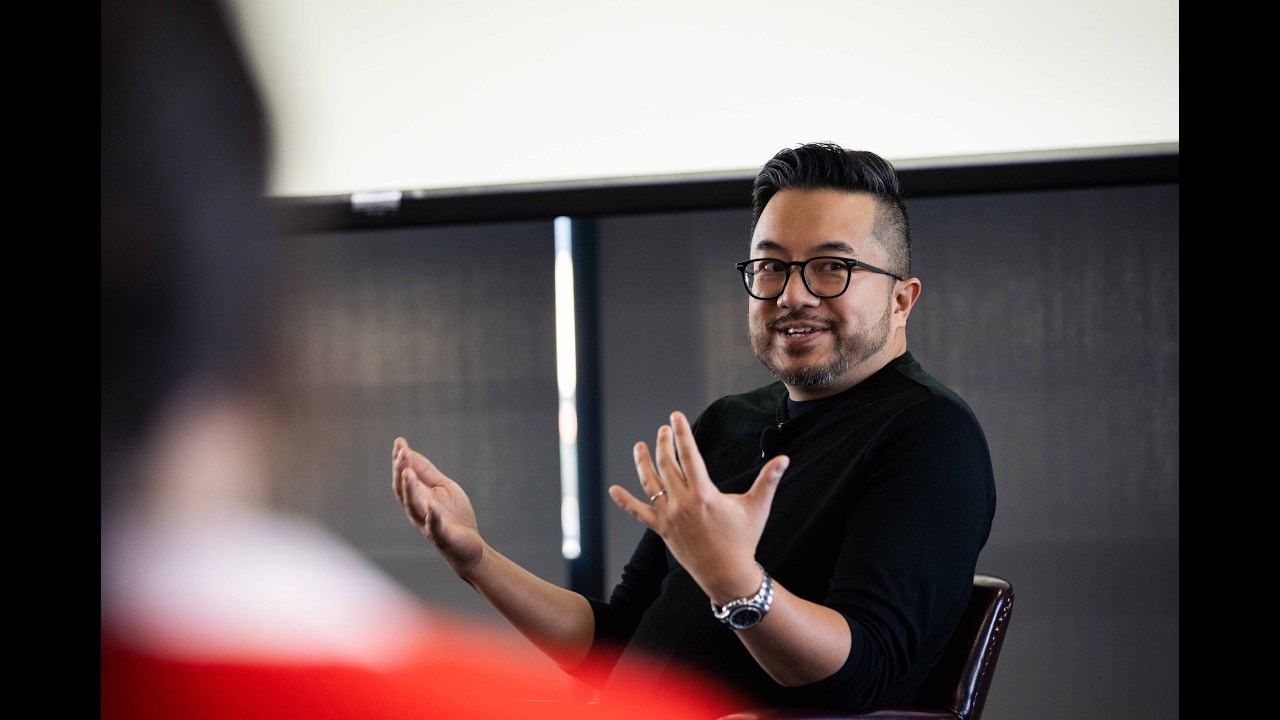
Super excited today to have Jane Marie Chen back in our classroom with us. Jane is a friend and a classmate from the Stanford Graduate School of Business. And she is the co-founder of Embrace, which is a little tiny startup that actually got funding from Basis, which is the business association for Stanford entrepreneurial students to get going to build an infant incubator that has saved over a million babies. She is so incredibly well recognized across so many different forums, the World Economic Forum, Forbes, you know, 30. Um, and she just wrote a book called Like a Wave We Break. And I'm so thrilled she's here to share that with you today. All right. Well, Jane, welcome to the entrepreneurial thought leader series. What a pleasure to have you back. — And I want to point out Rahul Panicker here is here, my co-founder. — OH, GOODNESS. — WOW. OKAY. This is really cool. Thank you. So, we were part of the original Stanford class in 2007 and we moved to India together and — he's been on this whole crazy journey. — Well, that means you were pitching to basis. — We were pitching to basis together. Yep. — Well, let's start with that and then we'll come back to this incredible journey you've been on. Um, what was it like to be at Stanford with this, — you know, con like this concept, right? Early concept and this was part of uh design for extreme affordability. — Yeah. Right. And you pitched um at the basis competition and you got a little bit of seed funding you and Rahul. — Yeah. — Uh what would you say to if you could go back in time to I think it was 2008 like — if you could tell yourselves something what would you tell yourselves — in that moment? You mean like as we were starting Embrace or — Oh gosh, what would I think what I just covered in my presentation that it's — the journey is more important than the destination. You know, I remember my high school chemistry teacher said that to me and I absolutely think that's true. It's not about the outcome in the end. It's everything that you learn, right? And the growth that you experience and the people that you meet and the connections that you make. All of that is far more important than the outcome. And I think there are many moments along the years where I lost sight of that, — you know. But Rahul used to say this to me all the time. He would say, "Don't take yourself so seriously. The universe will go on without you. — Everything does take a life of its own. " Right. You know, you imbue it with purpose and then exactly it becomes alive and takes on a life of its own. any before we move on any sort of if people in the audience are looking to maybe pitch to basis any tips on how you succeeded — any tips R thinking um — I think what was authenticity — authenticity all right that if you're pitching to basis I think you landed $35,000 — we landed $35,000 and I'll tell you guys the way this started we actually um first won an elevator pitch competition at Stanford that gave us our first $2,000. So, we got really excited and as a team we started applying to all these different business plan competitions around the country. Uh for that the whole year, it was my last year at the GSB. We did that. We lost every competition, but we didn't let it stop us. We kept going. Um the week before graduation, I still I didn't have a job. We had no funding. But finally on the same day we landed the basis competition, we also won the Echoing Green fellowship for social entrepreneurs and that gave us our first little bit of money to run with it. And so I think if you have an idea you believe in just be persistent and don't take no for an answer, keep moving forward with it — and be authentic and bring your prototype to whatever pitch you're doing because I forgot mine and Rahul had to scramble one together very quickly. So — incredible. Take it till you make it. Hadn't made it. — Oh, fake it till you make it. And what was it? — No. So, being authentic flies in the face of fake it till you make it. — Okay. Being authentic flies in the face of fake it until you make it, right? What a treat. I wish you were here with us. Isn't that crazy and awesome? — Okay. So, I know that it was a journey for you also to become the CEO, right? You really had to see yourself in that role. I think a lot of our students in the classroom here are potentially looking to step into a role of being CEO. Any reflections? I know you've had some incredible lessons already. You know, it's really being part of the journey, not necessarily the outcomes, you know, and I know you also learned how to surf as part of rounding out your life. Maybe some reflections on, you know, if you could step back into being
Segment 2 (05:00 - 10:00)
a CEO again, like what would you do? How would you do it differently? How would you approach it? — Um, sure. Well, I think I was just so nervous being a firsttime CEO for many reasons, but being at Stanford, I had total imposttor syndrome, right? I was like convinced that I was the admissions mistake. Um, and so when we had this idea and we divided roles and I decided, you know, we decided that I would be the CEO, I felt like gosh, who am I to be the CEO, right? And there were very kind of few female CEOs in particular at that time. And so my vision of a CEO was someone who was like so composed and buttoned up and had it all together all the time. And that's really what I strove for. — And then I remember and I told the story in the book, but um my first year in India was so overwhelming, you know, just the issue we were working on was so emotionally challenging and we faced so many setbacks along the way. But I remember in a team meeting I started crying and afterwards I was mortified. It was all men reporting to me at that time. But afterwards, my head of operations approached me and I'll never forget this. He said, "Jane, thank you so much for being vulnerable — because when you're vulnerable, it gives us all permission to be vulnerable as well, — you know, and he went on to tell me how exhausted everyone was and how they were afraid to admit that because I held such airtight composure. " You have a chapter called airtight. And so that really woke me up to the fact that leadership is really about authenticity. Going back to Rahul said, it's about authenticity which requires vulnerability which requires that we feel all of our feelings, right? And so I teach a leadership class now and I teach this concept of feeling your feelings. And there are some — students in the class who are like, well, why what's the importance of that? You know, feelings are for home and work is a different thing. But actually there is so much wisdom to our emotions, right? So how do we tune into — and let that guide us in our decision- making? — 100%. And I loved what you said about as a leader, as a CEO by giving yourself the permission to share how you feel. Maybe it's not all the time, but you know, really thoughtfully at the right moments, uh being choiceful about it, you're giving permission to everyone else to feel. Yeah. And to do anything great, we're going to run into walls. We know that, right? You know, if we're going to achieve the moonshot of, you know, saving a million babies, we're going to run into countless obstacles along the way. So, you know, we're emotional beings and we have to process those feelings as individuals, as a team. And I had a second a coach who used to say, if you don't process all that stuff, it's just going to leak out the sides like a lot of FUS, right? So you got to process that stuff with yourself and uh with your team and give permission to your team to go through — those emotions. — Yeah. — Um so let's go there. I I want to tie you know the intensity that you brought as a CEO uh to your journey of healing. And I thought what was deeply um interesting to me was the fact that resilience is not surface level. So, as entrepreneurs in this room, we talk a lot about what does it mean to be resilient. Uh, you had to actually go pretty deep into the work. You worked with some amazing people along the way, including the author of The Body Keep Score, right? Um, maybe we could take a little time sort of exploring how do you begin that journey? How do you approach it? And I think one of the important lessons for us here is the earlier we can start that journey, the more well equipped we are, not just at the surface level, but at the very deep level. — Yeah, I think that's absolutely right. And I think this comes back to your earlier question of what I would have done differently. — Um I think through most of that first 10 years at Embrace, my mantra was embrace first, me second. So take care of the company first, get the company to where it needs to go, and then I can focus on myself, right? And at the end of that 10-year period, I was so burned out. I mean, I had a mental and physical breakdown. I could not work anymore for a year. And up until that point, — I thought I was invincible. You know, if I was tired, I kept going. I did not listen to the clues that I needed to take a break desperately, — right? And to me, that felt like failing. M — and so when the company shut down 10 years in, I was really brought to my knees and I had to take that break. I had no choice, — right? And so I threw myself into healing and I but I had a very type A approach to it. I had my spreadsheets. I had like all the different modalities I wanted to try. If something didn't work, I would pivot to the next thing. — Um and I just tried it all. But I think there are a couple things I learned in the process. one um reading The Body Keeps the Score by Bessel Vanderolk was really life-changing for me — and it taught me about the science of
Segment 3 (10:00 - 15:00)
trauma, — right? Trauma is not something that happens in your past that you just keep in the past and that's what I had thought for most of my life. Trauma actually rewires your brain and your nervous system and so it's the way you bring the past into the present — and it affects every part of your life. And it is also so prevalent and it's something many of us don't want to talk about, right? But 70% of Americans have been through at least one major traumatic event, — right? And so instead of burying it, how do we actually address it? And that starts with acknowledging and feeling. So the first thing I say for people who want to kind of go down this path and go on a healing journey is to take that moment to pause. Right? We live in this society that's about doing or escaping. We feel something painful and we immediately try to escape that. And so what does it mean to pause and sit with that, you know? And I think that happens through the power of community. — And I'm so grateful for the friends, the teachers, the healers I've worked with that created a safe enough space for me to go back and revisit some really painful emotions. Right? So it's the first step is as simple as pausing. Um and then the second thing I will mention is one of the things that really changed the game for me was um a practice called internal family system or parts work. And uh this is based on this premise that all of us and I talked about this a little bit in the talk I gave but this is all we all have a multitude of parts. — So you Emily may have the — control freak or the perfectionist, the overachiever, right? the inner critic, but you also have parts that carry painful emotions like shame or rejection, abandonment, — right? And so this practice is about really developing that compassion for ourselves such that we relate to these parts of ourselves differently, right? We thank them for the role they have played in our lives and we learn to, you know, truly love those parts of ourselves that are experiencing pain. So this is um I I'll show a QR code later, but I've developed a free exercise for people who want to try this that's based on this framework and it's been one of the most helpful things for me. — This is so good. Uh I will share a little bit behind the scenes. I do talk to the different parts of myself and they all play a role. Anger plays a really important role. It's protecting us. Same thing. Anxiety plays a role. You know, anxiety Emily, right, has a really important role in helping me through obstacles along the way. they sort of are able to help me see, you know, all the scenarios that could happen, right? And so even the negative emotions that we have are really critical and it's acknowledging their role in our lives and not pushing them away and and sort of helping them through, — right? — I want to touch upon one more topic that's associated with this, which is achievement dysmorphia. You talked a little bit about that in your book and I think, you know, you talked about you brought up the imposter syndrome being here at Stanford students — and I I want to play with this idea a little bit. Um because I think it impacts a lot of us, right? You know, we're like, "Oh, we got an A. Moving on, right? " Or, "Oh, I just like raised, you know, $10 million. Moving on to the next, you know, round, right? " So, how did she go about sort of really acknowledging your achievements as they truly are? — Yeah. I think it took a long time for that to happen, right? That I had such a skewed um self-perception because I had this kind of feeling of unworthiness. And I see this with so many high achievers, right? That because of some wounding or some inner sense of unworthiness, we go out and we try to prove more and be more and do more, — but the goalpost keeps moving, — right? I'm curious here, who ever who here has ever felt like you weren't enough? — Raise your hand. — Okay, so like 90% of us. Yeah. If not 100% of us, right? And this is probably some of the highest achievers. — Totally. — Right. But we continue to feel that way. And this is what I learned in my journey is that it doesn't matter what you do externally until you find that sense of worthiness within. — Nothing out there is going to give it to you. And this is what I know true resilience is now. Right? Because when we have that inner sense of worthiness that is unshakable, that is what gives us the courage to go out and take risks and fail and know we're still going to be okay, right? Right. We brush ourselves off and we keep going. — That's right. — Yeah. So, my definition of resilience has completely changed over the years. — That's incredible. Well, I do want to leave some room for questions. So, I'm going to ask one last closing question. Normally in this class, we ask, well, what would you have told yourself when you were 20, but I think you know, you have this beautiful chapter in your book that I encourage everyone to read uh about connecting with your seven-year-old self. I'm actually curious what the I don't know
Segment 4 (15:00 - 20:00)
how old you'll be in 2045, but if you could talk to the Jane of 2045, right, 20 years from now, what would she say to you? — Um, — well, I think I I had did a meditation retreat like four or five months ago before my book launched. — And as I was sitting there, this is at Spirit Rock in Marin. I had the most beautiful visual and it was this vision of me writing an endless wave and being so in flow with the ocean and my elements and just you know being in a state of joy and what I realized in that moment was that it's not about what I do it's how I want to do it. — Yes. — Right. So it's not about this next chapter like the exact mechanism of what I'm going to do it or how it. It's like the it's the way I want to do it, — right? Which is from a place of flow and joy and ease as to as opposed to, you know, the constant pushing and striving and grasping that was happening, right? And again, I loved the work we were doing. It was so meaningful to me. Um, but it was also incredibly challenging and I don't think I found many moments of ease in those first 10 years. — Oh gosh. — So that's what I would say to myself to remember that feeling of being in flow. And I'll tell you guys one more story. Something I've really learned is the power of it's great to set goals and then there's some something really powerful about surrendering, right? And letting go and so giving something your all and then realizing it's not all in your control. So leading up to my book launch, I only had one copy of the book. And a month before my launch, I threw it in the ocean. — Yeah. — And it was kind of this beautiful act of surrendering and letting it go and realizing that, you know, I'm going to let the wave take this message to where it needs to go. — I love that so much. That infinite wave. I hope you surf it. — Thank you. Well, with that, uh, we're going to enter Q&A, but before we do that, uh, we're going to start with, uh, having a few folks queue up. — Thank you so much for coming up here today. You did an amazing job sharing your deeply personal and relatable stories. Um, it's definitely difficult to go through that kind of trauma. And I really love how you use principles based decision- making in a lot of your like thoughts and decisions. And so I kind of wanted to ask, what are some things you do in the immediate present when emotions or uncertainty begin to kind of blur your judgment? — That's a great question. Um, I think this comes back to like taking that moment to pause. Do I have a meditation practice? And finding that time, 10 minutes a day, five minutes, whatever it is, right, to sit with and allow those emotions to be there rather than, you know, trying to resist or push them away. So that's really important. And then getting in my body, that's a daily practice for me. So I moved to Honolulu last year so I could surf every day. And uh that is my self-care, but I do practices throughout the day that kind of help me stay grounded and be in my body. And then just the practice of like listening to those cues, right? Listening to uh when you want to do something, when you don't want to do something. Something a really uh useful practice I've learned is something called a whole body yes, — right? So, as you're making decisions, when are your head, your heart, and your gut, when is gut all align? — So, if you think about like something you really wanted to do, like seeing a friend or going to a movie, like taking a trip, what did that feel like in your body? — Anything that doesn't feel like that, you have to question, do I really want to do this? And the more I've been able to tune into that, the better make decisions that are aligned with who I am, right? and that plays a big part in my overall wellness. — Awesome. Thank you so much. — Yeah, thank you. — Thank you, Porsha. — Hi, I'm Carlos. I'm a data science freshman. Um, especially at SIL in Silicon Valley and at Stanford. I think tech entrepreneurship is really big right now. Um, what do you think the role is for social entrepreneurship and nonprofit work especially in such like a techsaturated field here? Yeah, I think we were facing that back, you know, 20 years ago as well, but I think there is a huge role for it and especially now with what's happening in the world. I think there is an even bigger role for it. Um, so if that is something that you are excited to pursue, you know, I think by all means follow your heart and that's what I encourage the most to people, right? that the decisions I have been the most proud of are not necessarily the ones that have made sense intellectually, but the ones where I've really followed my heart to do something. So, I think there is a special need for social entrepreneurs in today's environment.
Segment 5 (20:00 - 25:00)
— Uh my name's David. I am a sophomore and I'm undecided as of now, but I'm deciding between data science and MSN. Um, but my question was obviously through Embrace and that journey you were able to um come to terms with your past and help move forward through that, but I was wondering if there were any other unforeseen benefits that came from Embrace that maybe were very unexpected or maybe not even necessarily — connected to — to Embrace, but just some sort of benefit that came from — Oh my gosh, — that journey that was — so many unexpected. — Oh my gosh, so many. I feel like embrace was where I really discovered who I was in so many ways, right? And part of it was uh what Rahul said, fake it till you make it, right? Putting myself out there and just going for it and and learning, wow, I can do this, right? I can be a leader. I can run this organization. It was really um helped me build up a lot of confidence to know that I could do this thing that could really touch people, right? And so that was such a beautiful thing. And I think one of actually was just talking about this on Guy Kawasaki's podcast today, but we were talking about kind of some of the things that happened that I didn't expect. And so it wasn't just about saving babies, but the number of students who approached us over the years saying thanks to your example and thanks to us watching you do this, we were willing to do something courageous or something that helped others. We were willing to start our own social enterprise. like that has been an unexpected um result of this and I think in some ways that's even more powerful uh than the lives embraces saved. — Awesome. Thank you. — Thank you so much for opening up your story. Um, I'm cheer from Japan and in Japan we have a hierarchy of like test scores and it's really hard to get out from this mental of being perfect and being afraid to fail. — Yeah. — How were you able to change from that mindset? — Yeah, — that's such a great question. I think actually being at the design school and learning design thinking was a big part of that because in design thinking it's not about failing it's about experimentation right and every time you fail you get to learn something and try again and so that was one of the first experiences that I had where I really kind of reframed failure into learning instead opportunities for growth um but I think definitely in Asian cultures there is that sense of fear failure here and you know you have to do everything exactly right and it and frankly it prevents people from taking risks. So now when I think about doing something scary it's I think about it in two ways. One am I going to learn from this regardless of whether I succeed or fail right? And two, coming back to this idea of resilience, like putting out this book is the scariest thing I've ever done. And I don't think I would have the courage to do that did I not have an in innate sense of worthiness such that regardless of how it's received in the world, — I'm going to be okay. Right. And that is really what allows me to take risks. — And how did you cultivate that innate worthiness? — You'll have to read my book. Yes. Hi, I'm Kendall Johnson. I'm a senior. I really appreciated your talk and the focus on the importance of um the work that you do with yourself. I think that's um a topic that's often overlooked. My question for you is I think there are people that come into Stanford knowing that they want to be leaders and then there are also people that learn through experience or that learn through doing the work on themsel that they are meant to be leaders. So I'm wondering what your advice would be to that second group of people — uh advice from what perspective like — from um your perspective of your experience on your work for like the work with yourself. — Oh okay. Yeah. I think um whether you know you want to do something or not or what that path is for you, I think doing that inner work is so critical, right? And I think especially for those who like don't know exactly where they're headed as you come to know yourself more. Um you'll have a better idea of of a like what that is and how to navigate that, right? And so that's kind of looking at our patterns, our shadows, the things that trigger us, the thing that that brings bring us joy. I certainly did not have that level of of self-awareness, I think, when we first started in certainly as a Stanford student. And so developing that kind of deep sense of self-awareness will help guide you. And then it's less about coming back to what I said earlier, it's less about that exact destination, but more how do you want to live your life?
Segment 6 (25:00 - 30:00)
out your values, right? and that will bring you to where you need to go. — Thank you. — Hi, my name is Nathan. I'm a first year master student studying design at Stanford. Um I actually deeply related to your story of uh burnout and how these things kind of manifest. I spent the past four years running operations for a startup here in the valley. Uh and now I'm using Stanford as my Indonesia. I am curious um having now on the other side of this healing journey, what kind of the big takeaways in terms of your intrapersonal healing are you're now applying to your interpersonal successes? — Yeah, that's such a great question. Um I think that the way I approach my work is so different. the way I also approach relationships whether they're personal or professional um there's more of a awareness and compassion towards others right I don't know if I was a compassionate leader back in the day Rahul but I'm noticing now with the folks that I work with just kind of checking in more being more in tune right I think the more we're able to have compassion for ourselves the more we could extend that to others um a term that's that I hear a lot these days is this concept of psychological safety, right? And this is this famous Google study looking at what is the number one most important determinant of the highest functioning teams — and it's psychological safety, right? The ability for someone to come to work and be their full selves to take risks and fail knowing that that's okay. Is that how you would characterize it, Emily? — 100%. Yeah. I think uh we miss out a lot if we don't give people psychological safety to speak up because often times it's when we surface many different perspectives that you sus out the challenges that you might have not seen right as a singular person. So right — I love what you said about that. — So if that that's so important and yet as leaders how do we create that for our teams — if we don't have that within ourselves. — That's right. — Right. And that is why that inner work is so imperative. And I look at some of the leadership in Silicon Valley now or even in our in our country and I see a lot of people operating from a place of woundedness, — right? And when that happens, we tend to act from a place of fear, control, ego as opposed to a place of of love and compassion and shared purpose. Right? So that I think it's not only for to ourselves and envir the people around us but to our society as a whole that we do this work. — Thank you so much. — Yeah. Thank you. — We'll take one maybe two more questions. We'll see how we go. — Um hi, my name is Patricia. I'm a master student in electrical engineering and this previous question somewhat encroached on mine. Um but a lot of the past speakers have stressed the importance of surrounding yourself with the right people. And so I wanted to ask you um how you decide who you want to surround yourself with and maybe even you know back then it seems like you and your co-founder have had a good relationship thus far. Um — we've had our moment — how you made those decision or you know how you make those decisions but both back then and how you look at it now. — Yeah. Well I'll tell you how our team came together at the D school which is very interesting. Um it was all done through body language. So the day that teams were chosen, there was no speaking. People just kind of walked around each other and through body language these teams for came together. And I wasn't even in class that day. I just got thrown into this amazing teams. It was like pure serendipity. Um but to your question of like now what's important for me, I would say the number one most important thing for the people I work with and close friends are is their dedication to personal growth. And I'm really only interested in surrounding myself with people who are committed to that path. That's great because then we get to learn together and grow together. And those are my most fruitful and deepest relationships. — That's really insightful. Thank you. — Yeah. Let's do one more. — Hi. Um I'm Arnov. I'm a freshman here from the Bay Area. Um studying MSN. So you talked a lot about like your self-worth reinvention journey in Indonesia which kind of happened like later on in your career after company took off. So as someone who's younger who's like who like is obviously interested in traveling and knows the importance of this. Um is doing a journey like that something that I should be thinking about right now or something I should worry about later on in my career? Oh, I advocate it now and then again in 10 years and again in 10, you know, as often as you can. But I think so long as there's kind of that interest to do that introspection that will guide
Segment 7 (30:00 - 30:00)
everything. I wish I had the foresight and the wisdom to do that when I was younger. So I highly recommend you do that. And again, feel free to visit all the things that I did. I put on a resource page so everyone else could access it. — Thank you. — Yeah. — Hey, thank you Jane again for coming back. Thank you for having me — and uh we will see you in class next Wednesday. It will be Steve Cousins who is the director of the Stanford Robotics Center. Thank you again.
![Jane Chen (Embrace Global) - Doing the Inner Work [Entire Talk]](https://i.ytimg.com/vi/r4nRLflRSVw/maxresdefault.jpg)
![Brendan Foody (Mercor) - Agentic Data and the Future of AI [Entire Talk]](/thumbnail/NUNyK6P6q8s.jpg)
![Tracy Chou (Block Party) - Founding a Mission-Driven Startup [Entire Talk]](/thumbnail/AzIvPB1c8lg.jpg)
![Kit Rodgers, Ben Jun, and Paul Kocher (Cryptography Research, Inc.) [Entire Talk]](/thumbnail/4lH6fwDBODY.jpg)
![Harry Tannenbaum (Mill) - Setting the Goal at Delight [Entire Talk]](/thumbnail/SyLEXYKdqc0.jpg)
![Elizabeth Weil (Scribble Ventures) - A People-Centered Journey [Entire Talk]](/thumbnail/mHYO5Vj7pBw.jpg)