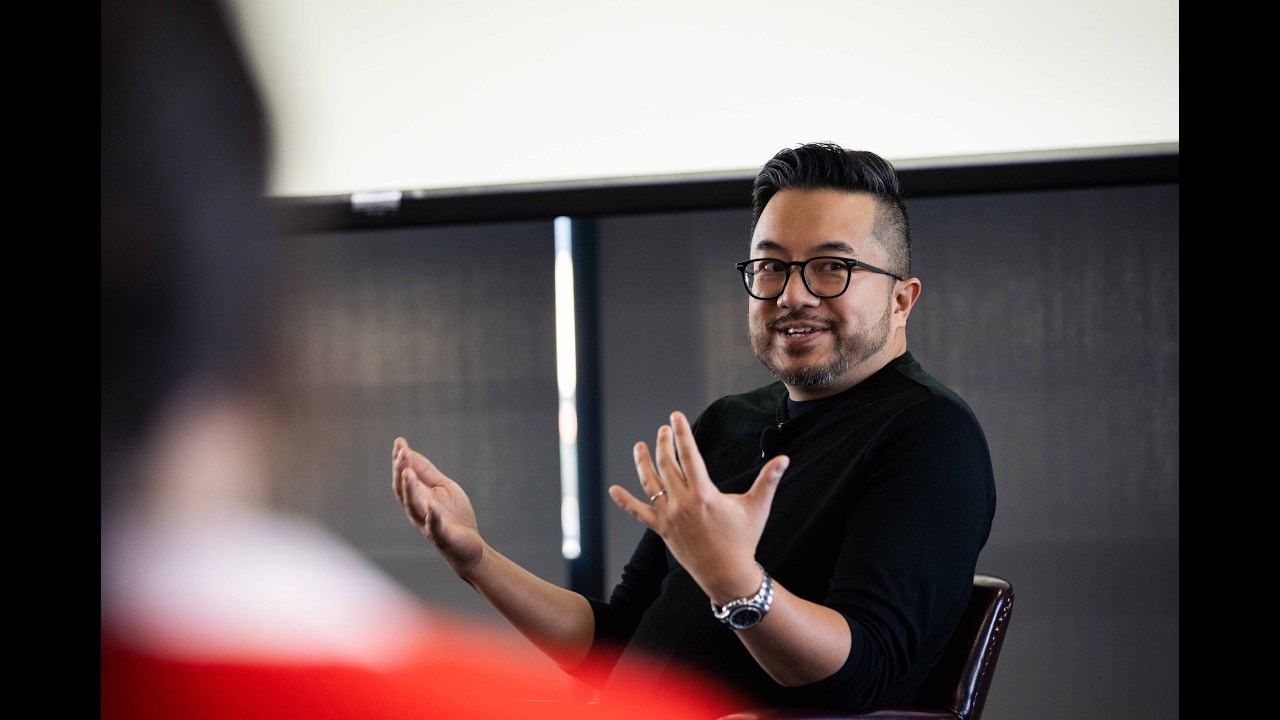
(upbeat music) - Welcome, everybody to the inaugural Entrepreneurial Thought Leader Seminar for fall 2025. (audience applauding and cheering) As you guys know, ETL, or the Entrepreneurial Thought Leader Seminar is brought to you by STVP, the Stanford Technology Ventures Program, and BASES, the Business Association of Stanford Entrepreneurial Students. I am Ravi Belani, a lecturer in the Management Science and Engineering department at Stanford. This is not just the inaugural of the fall of a typical quarter of ETL, which is a celebration on its own. It's also the inaugural of a once in 100 year event. This is the centennial of the School of Engineering, and so this quarter we're gonna be showcasing all speakers that have Stanford roots. When Emily and I were planning this quarter, we knew that we wouldn't be able to feel the full spirit of the centennial. Things would be incomplete if we couldn't have our inaugural guest today kick us off. And that's because with today's keynote, Dr. Tina Seelig, is gonna be the most visited ETL keynote speaker that we've had. I don't believe anybody has spoken at ETL more than Tina will have after today. And more than that, Tina's not only keynoted four times, and we'll show you those put that up on the screen. But also, Tina has hosted ETL and has been present at ETL for 20 years. Tina is the godmother of ETL. Tina ran ETL for 20 years. So this is really less of an introduction of a ETL keynote as it is me facilitating a homecoming of the one who stewarded ETL for all of these decades. Tina got her PhD at Stanford in neuroscience, and now Dr. Seelig has moved on to become really a bestselling author, and educator, and innovator, and all things around creativity and innovation. Currently, Tina's official role is Tina's the Director, the Executive Director of the Knight-Hennessy Fellowship, which is the largest endowed fellowship of its kind. And it cultivates and supports a multidisciplinary community of graduate students from across the university. And Tina's also the Emeritus Director of the Stanford Technology Ventures Program, where she's been the Executive Director, the Faculty Director, and a Professor of the Practice in the Management Science and Engineering department. Every time that Tina has come to ETL for a keynote, it's also punctuated a moment when she has launched a book. And she has authored 18 books. Many of those, a dozen children's books, but many also bestselling books in the realm of creativity and business, including, and you can see here from Tina over the years, and the different books that were representative of that era, starting with "What I Wish I Knew When I was 20". How many people are within two years of 20? (audience laughing) Okay, so Tina wrote that book for you. So if you haven't, check that out. Check out "What I Wish I Knew When I was 20". "Ingenious"," Creativity Rules". And now in 2025, we're also celebrating the launch of a new book, "What I Wish I Knew About Luck". And so joining us today to talk about luck and engineering luck in your lives, please welcome back Dr. Tina Seelig. (audience applauding) Wow. I am so passionate about helping people reach their goals and bringing their dreams to life. And I see so many people leave those opportunities, leaving them on the table. I see them walk right past opportunities that other people would see and seize. So I'm here today to help you see and seize more opportunities. So let's start though with a couple definitions, because I think people make a mistake when they think about luck. So, fortune. Fortune are things that happen to you. You are fortunate to be born in a certain place and time. You are fortunate to be healthy. You are fortunate to live in a certain place. It's quite different from luck, because luck is something that you have some agency in controlling. This is a very important distinction, and one we're gonna come back to throughout this talk. Whenever you talk to someone about luck, one of the first things they say, is a quote. Luck favors a prepared mind, or fortune favors a prepared mind. Have you heard this before? Absolutely. The question here is, what the heck is a prepared mind?
Segment 2 (05:00 - 10:00)
What is a prepared mind? Another quote that people often use when talking about luck, is the harder I work, the luckier I get. Have you heard this before? My father used to say this almost every day. I mean, I can't even count the number of times growing up that my father would say, oh, the harder I work, the luckier I get. But the question here is, what is that hard work? What is the hard work and what is the prepared mind? Now, the quote I wanna give you is a little different. Luck is like the wind, and you need a sail to catch it. If this is the case, and luck is like the wind, and you need a sail to catch it, then there are lots of ways to respond to it. One is, you can stay indoors. Windy outside, I stay indoors, I shut the shutters, I don't even wanna pay attention. All those opportunities blow by, I don't even see them. Or you can be a wind vane. Wind vane, okay, I see those opportunities. Oh, it's over there, it's over there, but you don't do anything about it. Or you can be a hot air balloon. Responding to the things that happen, but not really having any agency. You know, letting the opportunities take you where they may. Or you might be a windmill. A windmill, you are catching that luck, harnessing it, turning into energy. But it's right there. You're not gonna move anywhere. Or you can be a sailboat. A sailboat goes out in search of those opportunities. If you want to be a sailboat seeking and seizing opportunities and to making yourself lucky, there are several things you can do. First starts with building your ship. You gotta start So I'm gonna share with you three things that you can do to build your ship. The first one is knowing your core values. And I'm gonna start with a cautionary tale, a cautionary tale that happened to me. You see, when I graduated from Stanford with my PhD, my first job was with a brand new startup med tech company. And after a couple of weeks at this company, I'd started right after I graduated, after a couple of weeks at that company, the CEO of the company said to me, "Tina, I'd love for you to go to a conference, "a conference that is in Chicago "and it's being hosted by a company "that's kind of a competitor. "And I'd like you to go there, "but please don't say you're Tina Seelig "from this company. "I want you to say you're Tina Seelig from Stanford. " And I said, "Sure, no problem. " So I packed my bag and I got on the plane, I went to the conference, and it was a pretty small conference. There might have been 50 people in the room. And I'm very curious, and of course, I was very familiar with this technology. So I'm asking a lot of questions. And they started getting suspicious. So as I'm coming out of the meeting the second day and walked into the elevator, I was followed by two people. And as soon as the elevator door closed, one of them reached over and pushed the stop button. And they turned to me, backed me in the corner and said, "Are you a spy? " I just melted. I melted because I realized, oh my gosh, how did I get myself in this situation? They had called the company because they were suspicious. I was coming from Stanford, and their competing company was here in Silicon Valley. Most of the people were, you know, potential customers of theirs. And they lived in the Midwest. I mean, I clearly stood out, and I was asking lots of questions. So they called the company and they said, "Is Tina Seelig there? " And the receptionist volunteered, "Oh yeah, no, no, she's not here. "She's at a conference in Chicago. " So I essentially, with my tail between my legs, left the meeting. But I sat there wondering, what happened to me? Why did I end up in that situation? I ended up in that situation 'cause I had not taken even a minute to think about my values and what things I would say yes to, no to. And I wanna tell you that this is something that's critically important to build your ship, is to take your time to think about what those core values are, so that because your core values are like your ballast at the bottom of the ship holding you steady so you don't get knocked over. You need to think about, you know, if you do this, how would you feel it was on the front page of the New York Times? Do you have a personal board of advisors you can go to say, hey, does this smell right? And you also should always be in a situation where you can walk away. So, the second thing you wanna do
Segment 3 (10:00 - 15:00)
is you need to know what story you're telling about who you are. We all have a story in our mind of who we are in the world and what we can and can't accomplish. I had such a poignant experience about 10 years ago, I was in class with a group of students who were in a fellowship program, and I had them do aspirational resumes. Right, what did I hope to achieve? And these students were all in the same program. Several of them had the same major. They were all really good students. And one of them said, "I wanna be the president of my home country. " And the other one said, "I wanna be a product manager. " And I thought, both of these are really reasonable things to aspire to. But they were so different. The stages on which these students wanted to play out their life were so different. And I realized it's the stories they had inside their mind of who they were, and what they could accomplish in the world. We are constantly being told stories by other people about what we can accomplish. And we're telling those stories ourselves. There's a game called the Status Game, and maybe some of you have played it. It's a game where you take a deck of cards, and everyone gets a card. You don't look at it, but you put it up on your forehead, so everyone else can see it and no one else can. So if you've got a King, or a Queen, or an Ace, people treat you with like your royalty, like you're a King or a Queen, or an Ace. If you're a two, or three, or four, people treat you as if you are very low status. Do you think it takes very much time for you to figure out what status you are? No way. Within just a few minutes, if at most, you realize what your status is, 'cause people are treating you this way all the time. And this happens all day long in our lives, right? Here I am up on the front of this room. Boy, that gives me a lot of status, here you are all listening to me. But there are times when like I might be at the World Economic Forum in Davos, and I'm in the back of the room, and everyone else is way more important, right? And I'm very, very low status. So depending on where we are in the world, we have very different sense of how we belong there. But people are telling us all the time, even explicitly what we can and can't do. When I was in college, when I was a sophomore in college, I took my first neuroscience class. And in this class, my professor, Professor Schwartzbaum, he gave us an assignment. It was a very creative assignment where we had to come up with an idea of how we would design some experiments for a part of the brain that we didn't know what it did. And I got my paper back from him, and on the top it said, "Tina, you think like a scientist. " At that moment, I became a scientist. It was the most amazing thing. Like I literally, I'm a scientist. And it really affected the way I saw all opportunities. And I'm sure that my going to graduate school and getting my PhD was very much predicated on the messaging I got from this one professor when I was a sophomore in college. So it's very, very important for you to think about the stories you're telling yourself, the stories other people are telling you, and how they're shaping the size of your ship, right? So you're gonna build your ship, you have your ballast at the bottom, but what's the size of your ship? Is it something small? Is it something big? What does it look like and where is it gonna get you? And third, you need to understand your risk profile. This is really important. I'm gonna ask you, how many of you are risk takers? Okay, lots of you. But that was actually a trick question. It was a trick question because risk is not binary. It's not either or or. There are so many different types of risks. There are social risks, getting up and giving a talk to a big room. There are emotional risks, you know, telling Emily how much I care about you, okay? There's intellectual risks, you know, tackling a big problem that, you know, that's really daunting, trying to cure cancer. There are physical risks, jumping out of a perfectly good airplane. Financial risks, starting a company or investing in the stock market. Political risks, speaking up when you might get a response that might be uncomfortable. So you need to know your risk profile. But you know what's so interesting, is oftentimes the most interesting and important things in your life are gonna take place just outside your comfort zone, right? Is you're gonna have to learn how to, oh my gosh, I'm afraid of public speaking. No, get up and figure out how you're gonna stretch to get up and give a talk. Or you know, you need to go somewhere that's gonna be a physical stress for you. You know what, how do you stretch? And the way you do it is to be prepared, right? Most people who take these risks, don't do it with the idea that it's gonna be risky, right?
Segment 4 (15:00 - 20:00)
Entrepreneurs try to squeeze the risk out of all of the ventures. No one's gonna jump out of a perfectly good airplane unless they really make sure that parachute is packed properly, right? Nobody is going to invest in a company unless they've done their due diligence. So you need to know your risk profile, see how far you're gonna push, but take the time to prepare. So now you've got your ship built, you got your values, your ballast, the size, you know how far you're gonna go. Now you need to start building your crew, recruiting your crew, and getting people on your team. Because guess what? You are not ever gonna get lucky by yourself. You need to have other people who are on your team. I say luck seldom sails solo, okay? So how do you get other people on your team, and get them engaged in helping you reach your goals? The first thing is to ask. Ask people for what you want. Now this might seem simple, but a lot of people are afraid to do it. In fact, I just had a call with a student literally an hour ago who wants to reach out to a bunch of people to potentially collaborate. And we had a whole discussion about how you actually ask for help. And one of the things is you make yourself easy to help. I learned this from Heidi Roizen who has spoken about this on this stage. One of the most profound things I've learned from Heidi is how do you make yourself easy to help? First of all, you have very simple, easy asks. I told the student, send an email that's no more than four sentences. Who you are, what you're working on, why you wanna talk to them, and a tiny little one or two minute ask. Can I ask you a question? Something simple. What do you think about this idea? One sentence. The tendency is to wanna go and give someone a long, long document with, give them all the information. The likelihood you get a response goes down with every sentence you add. Ask for very small things. But the other thing is you also have to ask a lot of people. The likelihood that you get a response is low. Because if you're at the beginning of your journey, it's unlikely that everybody's gonna say yes. So you need to ask a lot of people. I think about back when I was first got to California, before I started graduate school, I wanted to get a job as a research assistant in a neuroscience lab. I wrote letters to every single neuroscience faculty member at Stanford. I had a brochure, it was back, nothing was online. There was no online. I wrote letters to everyone, letters in an envelope with a stamp to every neuroscience faculty member, included my resume. And I got letters back from every single one saying no, except for one person. One person who passed my letter onto someone else, to someone else. And then I got a phone call saying, hey, would you like to work on this project? I was on the original team. I said, of course said yes. Original team testing the oximeters. Do you know what oximeters are, right? We all use 'em for, now people carry 'em around in their purse, make sure their oxygen saturation is up to par. But this was invented at Stanford, and I was ended up becoming on the original team testing these. I would never have thought of that opportunity, but the door opened because I reached out to probably 50 people asking for someone to hire me. So you need to ask a lot of people, and you need to make a very simple ask. And that is the way to start making some more luck, and to bring people along. The next thing is to help other people. You, of course, know the expression, what goes around comes around. I mean, that sounds easy, but how do you help other people? Look and find out what it is that you can do for them. Often it's the easiest thing that would be easy for you, but incredibly valuable to them. A story that I was talking to someone I met recently, his name is Near Al. And he told me a story about how he used to, in his youth, was teaching, wasn't teaching, was selling solar panels. And he would go door to door knocking on people's doors, seeing if they would wanna buy solar panels. Well, most people didn't wanna buy solar panels, and or their house wasn't appropriate. And a lot of 'em said, you know, I'm actually in the market for a heat pump. Well, he noticed when he was going to all these houses, that there were a number of houses who had heat pumps that had just been installed, and that they had done a really good job. So he said, "You know what? "I saw that there's a guy who's been putting in heat pumps "in the neighborhood, and I would recommend him. " So this guy who was putting in the heat pumps reached out to him and said, "Hey, I understand you're referring people to me. And he said, "Yeah, you know, these people wanted heat pumps. "They didn't want solar panels. " The guy was so thrilled, you know what he did? What did he do? He said, "Well, listen, I talked to these people
Segment 5 (20:00 - 25:00)
"many of them want solar panels. " So they started recommending each other, and their business soared. And you might wonder how I met this guy, Near Al. Well, he'd reached out to me because he was writing a blog post about luck in sales, and he wanted to borrow some of my material, put a graph in there. And I said, "Sure, I'd be happy to help you. "But I'd love to chat with you about luck in general "'cause I'm working on this book. " And he told me all these stories about all the things he does to help other people. And that how the incredible waves of a good fortune that continue to come back to him. And honestly, we now email each other almost every other week with some way that we are helping each other reach our goals. So it starts with asking for help, but also helping others. And third is appreciation. It is one of the lost arts is people actually showing appreciation. The fact is, if someone is doing something for you, they're not doing something for themselves or doing something for someone else. And yes, it's really great to feel gratitude, to feel good at the end of the day about all the nice things that have happened. But if you don't close that loop by showing appreciation, you have missed an enormous opportunity to build goodwill. If you ask someone for something and you do not say thank you and show appreciation, the likelihood that they do something for you in the future goes down precipitously, and you just won't even know. When I was in college, I told you about my Professor Schwartzbaum, who had said to me, "You know, Tina, you think like a scientist. " Well, 20 years later, when I was here teaching, and I started teaching here at STVP. I thought about him and the impact he had on me, and also his amazing teaching ability and how he really had influenced me. So I wrote him a thank you note 20 years after the class. Now I don't know if he got it. I didn't even know if he was still alive. But I sent the note, and then 20 years later, last year, I got a letter from his granddaughter and she said, "I just wanna let you know that my grandfather "just died at 95, "and at his funeral, my father," her father, read an excerpt of my letter. And you realize that message that I had written 20 years earlier in response to his teaching 20 years before that, had traveled through time and been so meaningful. I think you can never underestimate the value of showing appreciation to those people who have done something meaningful for you. So now you have your ship, you got your crew. Now, what are we gonna do? We're gonna hoist our sail. And how do you hoist the sail? Well, I'm gonna give you three ways. First of all, you're gonna experiment. You have to try lots of things. Think you're on your ship, right? You're moving the sail in different directions, seeing if you can catch that wind. And these experiments are really important because you often don't know what's going to happen unless you try. One of my favorite examples is my friend, Katherine Emery. Katherine actually used to work here at STVP, and then she went off to become a photographer. She's the most amazing photographer. Her work is so moving and touching. She captures people in this wonderful way that brings them to life. And she was, had a fabulous photography practice in business in San Francisco. But during COVID, one of her family members got sick, and really they needed to restart their life and do something different. So she and her family picked up and moved to rural Maine, and she now needed to start her life over again. And she had to think about what she was gonna do. So she made lists of projects she could work on, and ways she could make money for her family. And a list of about seven organizations that she'd really love to work with that were in Maine, in the community. But she didn't know anybody. She thought, how can I experiment? What can I do to try? So she asked a number of organizations around, you know, restaurants and community centers, if she could just set up a little pop-up station to take portraits. And three places said yes. So she said, I'm gonna take portraits, I'm gonna charge people $50, way less than she would normally charge. And the organization, she gave free photos to anybody who worked there. She did this for several days. Now she had some photos that were of the community members, and she sent an email out to her daughter's school.
Segment 6 (25:00 - 30:00)
Only people she knew. Sent an email saying, "Hey, I'm doing portraits. "Send anyone my way who would like one. " She ended up with 42 people reached out. She started taking pictures, and taking pictures. The next week, fortunately, one of those organizations she had on her list posted on the online bulletin board that they were looking for a professional photographer. Nine people recommended Katherine. And within the next month, all seven of those organizations reached out to her. And now her photography business is booming. And it all started with doing some little experiments. The next thing you have to do is to build on success. If I have one luck superpower, it is this. When you get your foot in the door and have one little success, you just keep pulling on those ropes, right? The little thing that you do that gets you in the door, right? When I got the research assistant position, when I, before I was a graduate student, as soon as that job was over, I started knocking on doors and get my next job, and my next job. And then my advisor, my future advisor said she'd support me as a PhD student, right? You get your foot in the door, and then you keep building on those opportunities. One of my favorite stories of this is a young man named Oliver. So Oliver reached out to me in December. He was living in Japan. And he said to me in the email, "Tina, I saw your TED Talk on luck. "And I was so intrigued. "I think I'm pretty lucky, "and I would like to become a luck coach. " And I said, "That is such a great idea. "Wish I thought of it. " And he said, "I'd like to chat with you. " "You send me four sentences, okay? " And I said, "Sure. " So I hopped on a call with him, and we had a great conversation. I helped him with some ideas. And afterwards, what do you think he did? What did he send me? He sent me a thank you note. But he didn't stop there. Not just a thank you note. He sent me a document with all the ways he could help me with my book. Now nothing that was on his list was exactly what I needed, but I thought, you know what? I'm so intrigued. I'm so impressed by his initiative that I hired him as a research assistant for my book. And he helped me find, you know, social science research that supported a lot of the things that I was writing about. But while we were talking and working together, he kept telling me stories of all the ways that he makes himself lucky. And he ended up with a practically an entire chapter in the book all about him. Here's some things that he does. I mean, he's just great. He had moved to Japan after graduating from college. He wanted to do something new, start all over, see what he could do for a couple years. He had no job, he had no friends, he had no money, but he just made it all happen. He would go hang out at a coffee shop, and then he'd meet some nice people. He was talking to young folks who, gosh, I wish they could be my friends, but you know, I probably won't see them again. He'd said, "You know what? "I'm having a barbecue this weekend. "Would you like to come? " He wasn't doing, like he just made it up on the spot, but of course they came, they became his best friends. He would walk around town with a big umbrella. And it rains often. And when it rained, he would go up to somebody, "Would you like me to walk with you in the rain? " And some people thought he was nuts, okay? I don't know how many of you would walk with him if you wanted get wet. How many you would walk with him? Some of you. Okay, yeah, you don't wanna get wet. And he'd walk with the person. He ended up making new friends, and even went on a date with someone he met walking with an umbrella. Who knows what happen. The key is, don't just leave things. When something good is happening, see if there's some way that you can build upon it to get you to the next level. And third, bounce. Everything you try is not going to work. You are going to fail. I fail almost every day. I do something that a mess up every day. Ta-da, okay? I keep a failure resume. Very, very active failure resume, all my biggest screw ups, personal, professional, academic. And the best thing about keeping a failure resume is that you are much less likely to repeat that failure because you take the time to codify it, figure out what you learned and not do it again. But the thing about failure is fascinating. We each, remember I told you, we each have a story we tell about ourselves, a story. We also have a mental model about what happens when we fail. We have a mental model of what happens when we fail. I want you to think about what the bottom is made of
Segment 7 (30:00 - 35:00)
when you fail. When you hit bottom, boom, what is it made of? Is it concrete? Is it rubber? Is it burning lava? Is it a black hole? Is it a trampoline? I'm not gonna go around the room and ask everybody. But it is an amazing thing how many people think that when they fail, they literally are falling into a black hole, and life as they know it will be over. If you fail a test, you're gonna, I mean, really? You know, if someone doesn't answer your email, that's a disaster. We so catastrophize things when they don't work, that what happens is people are afraid to experiment, afraid to try anything because they're afraid that if they fail. And so it's really important to think about the story you tell yourself about what happens when you fail, and rethink it if it's getting in the way of your accomplishing what you wanna accomplish. How many people here, like you could be honest with me, how many people like it's concrete, or a black hole, or something terrible they think of when they fail. Some people, yeah, exactly. How many people, it's a trampoline. You hit bottom and bounce back, okay? It's really important to figure out how do you reinforce the idea for yourself, that failures, unless you're actually gonna die, unless, you know, like don't get on that motorcycle without a helmet. You know, like, don't do that, okay? Some things, you know, don't pick up that dangerous snake. But most things are not that dangerous. And to think about how you can bounce. So here are the three major pieces of this puzzle. How to build your ship, recruit your crew, and hoist your sail. But there's one more thing. One bonus thing that's very, very important. Luck is a long game. Luck does not play out over minutes, or hours, or days, or even months. It plays out over years and decades. So 20 years ago, my family and I went on a Stanford alumni trip to Costa Rica. This was going to be the most amazing winter family trip to Costa Rica. And it was a complete and total disaster. The team that had scoped out the trip scoped it out during the off season, and it looked perfect. But the trip happened over the holiday, and it turned into Girls Gone Wild. The pool had a bar in it, open 24 hours. The drinking age was very young and they were not monitoring it. There was an ocean right there that seemed pretty dangerous, especially combined with this alcohol. People were furious on the trip. They were terrified that their kids were gonna get hurt. This was not what they had signed up for. And many of the people on the trip got so angry they left. Some of the people screamed and yelled at the woman who was leading the trip, who had certainly not been involved with planning it. She had just been leading it. I made the decision to try to be as supportive as I could. I know what it's like to run something that doesn't go as you had hoped, and that things sometimes just turned south. So I tried to be as support as I could. And you know what, when we got back, you know, tragedy plus time turns into comedy, right? At some point, it was like we all survived. Flash forward 15 years, and I am in discussions about my current job leading Knight-Hennessy Scholars. And the person who was on the team evaluating me, one of the people, is the person who led that trip. Now I did not remember, I didn't even recognize her. It's 15 years later. I didn't remember her, but she sure remembered me, and she didn't tell me until several months later after I was hired that she had led that trip. Of course we both were like, oh yeah, that was just horrific. But she said to me, "Tina, I was so taken with how compassionate and helpful "you were", and the decision I had made to be, you know, on their team as opposed to, you know, critical of them. It was an amazing thing because I had no idea. And I realized that if I had behaved badly
Segment 8 (35:00 - 40:00)
on that trip 15 years earlier, do you think I would've gotten that job? No way. And so luck is a long game, and the choices you make today determine the choices that you will have in the future. So you get to choose every single day. how you wanna engage with the opportunities in your midst. Do you wanna stay inside? inside and sort of block the wind out and not pay attention? Do you wanna look at it passively? Do you wanna let it take you where it takes you without much agency? Do you wanna harness it right here, right now, everything I can do in this moment, in this place? Or do you wanna seek it out and look for the winds of luck? The important thing to remember is that there is a big difference between fortune and luck. Fortune is the things that happen to you, the things are out of your control. And there are a lot of those things in our life, right? There are lots of things that happened. They're like, wow, who knew that was gonna happen? But we have so much more agency than we might think in creating the luck in our lives. And I invite each of you to be a sailboat, and to catch the winds of luck. Thank you very much. (audience applauding) - Thank you, Tina. So we're gonna try and experiment. - Let's do it, let's do it. - We're gonna try to catch some knowledge. - Let's see if we can catch some luck. - And we're gonna try see if we can catch some luck, catch an innovation. So we're gonna do our first cold call for ETL, which is Patricia S., I think. Yes, you're gonna be the first, and the second is gonna be the person who's sitting in G7. Patricia, kick us off. - [Patricia] Hi Tina, thank you so much for coming to talk to us today. And we wanted to ask, you know, we know you wrote a lot of books over the last, I think, 25 years. Is there anything that you wrote in the past that you no longer agree with or believe in necessarily? - Oh, that's so interesting. What do I not believe in anymore? That's so funny, because someone asked me a question recently. I'm kind of turning, I'm multitasking thinking about the answer, but someone asked me a really funny question. They sent me an email and said, what do you wish you didn't know when you were 20? I thought that was like really interesting question. So you can ponder that about your life. I think things are much more complicated. You know, I grew up hearing the harder I work, the luckier I get. And I interpreted it things like, you know, oh hard work, like do well in school. But I realized over time, so if you look at some of my early writings, I will write about it as just hard work. But then over time I realized, oh, there are so many more things that qualify as hard work, and if you look at my books, you'll see that I have a propensity to try to parse things. My last book, "Creativity Rules", breaks apart Imagination, creativity, innovation, and entrepreneurship. And sort of, I try to break them apart. I think so much in the world of innovation, entrepreneurship, we conflate a lot of terms. And so this is one of the things that's happened over time as I realized that things are actually much more nuanced than I thought at the beginning. Thank you. - [Ravi] Next question. - Okay, all good. No, no, okay. (audience applauding) - [Ryan] Hi, my name's Ryan, and the question I had was, who do you think the most influential mentor you've had in your life has been, and what role did they play in your journey? - Okay, so the question, I don't know if you heard, who's the most influential mentor and what effect have they had? You know, I actually think, I'm not one who has heroes, and that's just like, but I do think you learn something from everyone. And so if you're really paying attention, you can learn, you can learn from the worst boss you ever had, what not to do, right? You can learn from your spouse, you know, how to have constructive conflict, right? I mean you can have, you know, if you have a disagreement, like over time, you start learning these things. So I think you can learn from everybody, as opposed to saying like, pick one person. I think if you have a mindset that you can learn something from everyone, then you're much more likely to learn something new every day. - [Ravi] That's great, next question. We'll do a one clap applause. - Yeah, no problem, no problem. (audience applauding) - [Ravi] Okay, next question. - [Bethany] Hello, my name's Bethany. I absolutely loved your talk. Thank you so much. But I was just curious if you believe the three steps to building and sailing your ship is inherently sequential. Like could you be at sea already capturing opportunities and still building your ship?
Segment 9 (40:00 - 43:00)
- Absolutely. I mean absolutely. I think this is all woven together, and no matter where you are in your journey, you can start building these skills. So this is absolutely something that is a work in progress. You can extend your, you know, if you push your risk profile, now all of a sudden you can go further. If you really, you might be stretched in your values where you're like, wow, I have to really think about this. So I think this is definitely a work in progress that you can be building these skills every single day. Great. - [Ravi] Awesome. (audience applauding) (Tina laughing) - [Speaker 1] Hi, Tina. Thank you so much for the talk. I really appreciate it. I think it was really eye-opening to see about this idea of the manifestation of luck. One question that I had, you mentioned stories about like personal qualities, and how like being kind and nice to each other in the long run turns into business opportunities. One question I have is, do you think the supply is everywhere? And if so, how do you get over the idea that like, because in society, certain people are considered to be, quote unquote, fake, and only are nice due to these business opportunities. So what is your response to that and how do you think as people who are genuinely trying to be nice can like make sure that other people don't think they're just being fake? - Well, I think, you know, when, first of all, I wanna challenge the idea of manifesting luck, 'cause this is not about manifesting. This is actually a lot of stuff you do. This is not just sitting home and saying, oh, I wanna be lucky and I'm gonna manifest. That you actually, this is all these sort of actual things you need to do in your life. I also think that if you're very transactional, and people know it. They know it. And a lot of it has to do with helping other people. You know, the more you support other people on their journey, the more likely they're gonna help you. And it comes often way down the line. You know, if you help me with my math homework my freshman year, it might be that years later, you reach out to me, and I'm like, oh gosh, you were such a mensch, that was so great. Of course I'll make an introduction for you. So often there's data that shows that often when someone does something for you, and the reciprocity years later is often much bigger. So you often get much more than you put in. - [Speaker 1] Okay. - Thank you so much. - You bet. - [Ravi] We have 30 seconds, so we have to make the question really quick. And the answer's gonna have to be like one sentence. - [Speaker 2] So how do you select your luck? 'Cause there are so many Stanford-- - How do you select your? - [Speaker 2] Your luck. Or like how do you select, there are so many opportunities at Stanford. - How do you decide what you wanna be lucky in? And that's a really good question. - [Ravi] Two sentences. - Oh my goodness. You know, try lots of things and see what works. You know, that's it. - I mean, you know, try something, and maybe that's a direction that works. - And on that note, try something and see what works. I think that is actually a fantastic note to end things on. We're gonna end this ETL. Please join me in thanking Tina for such a fantastic, inspiring talk. (audience applauding) (calming music)
![Tina Seelig (Stanford University) - Catching the Winds of Luck [Entire Talk]](https://i.ytimg.com/vi/P9rqjxLaQOY/maxresdefault.jpg)
![Brendan Foody (Mercor) - Agentic Data and the Future of AI [Entire Talk]](/thumbnail/NUNyK6P6q8s.jpg)
![Tracy Chou (Block Party) - Founding a Mission-Driven Startup [Entire Talk]](/thumbnail/AzIvPB1c8lg.jpg)
![Kit Rodgers, Ben Jun, and Paul Kocher (Cryptography Research, Inc.) [Entire Talk]](/thumbnail/4lH6fwDBODY.jpg)
![Harry Tannenbaum (Mill) - Setting the Goal at Delight [Entire Talk]](/thumbnail/SyLEXYKdqc0.jpg)
![Elizabeth Weil (Scribble Ventures) - A People-Centered Journey [Entire Talk]](/thumbnail/mHYO5Vj7pBw.jpg)