Memorising Everything for A-levels // Cambridge Student
13:44

Memorising Everything for A-levels // Cambridge Student

Ray Amjad 11.09.2021 23 388 просмотров 1 139 лайков обн. 18.02.2026
Поделиться Telegram VK Бот
Транскрипт Скачать .md
Анализ с AI
Описание видео
📷 Follow Me on Instagram: https://www.instagram.com/theramjad/ === Other Videos === - Organisation: https://youtu.be/0Po_vkB25RE - Learn to Use Anki: https://youtu.be/Pn9IbAfpwuw - Learning New Content: https://youtu.be/jabwH0vXvpU - Using Anki for A-levels: https://youtu.be/95qKUwnMtA0 - Series on "Studying Effectively for A-levels": https://www.youtube.com/playlist?list=PLTiA09lKvQngUUDDDO-IEsCoNXF_eWVkz === Timestamps === 00:00 - Introduction 00:31 - Examples of Bad Flashcards 01:48 - Active Recall & Spaced Repetition 04:04 - Why Digital Flashcards are Better 06:04 - Using Flashcards on Anki 09:04 - Tips for Making Flashcards 11:24 - Tips for Going Through Flashcards 12:52 - Flashcards AREN'T Everything! 13:32 - Conclusion
Оглавление (9 сегментов)

  1. 0:00 Introduction 136 сл.
  2. 0:31 Examples of Bad Flashcards 296 сл.
  3. 1:48 Active Recall & Spaced Repetition 476 сл.
  4. 4:04 Why Digital Flashcards are Better 516 сл.
  5. 6:04 Using Flashcards on Anki 714 сл.
  6. 9:04 Tips for Making Flashcards 551 сл.
  7. 11:24 Tips for Going Through Flashcards 381 сл.
  8. 12:52 Flashcards AREN'T Everything! 157 сл.
  9. 13:32 Conclusion 46 сл.
0:00

Introduction

hey everyone and welcome back to the channel if you're new here my name is ray and i just finished doing my second year of physics here at cambridge and in the summer of 2019 i achieved 4 stars at a-level now i largely attribute this to being able to do past papers to practice applying all the content i was learning and also memorizing all the content using flashcards now before you click off the video thinking that flashcards don't really work for you uh stick with me here because i will explain what a good flashcard is and what you were using probably weren't even flashcards to begin with and just like some dodgy revision cards anyways timestamps will be in the description down below so do check those out during the video now
0:31

Examples of Bad Flashcards

most people when they think of flashcards is that uh you just have like a sheet of paper or some card of paper and you write the name of one topic on one side so let's say you write electrolysis on one side and then on the other side you just write like a bunch of stuff or basically everything you know to do with electrolysis and the idea that people have in their head is that when they're just like going through these flashcards uh well so-called flashcards that is uh they just look at the front side they think about electrolysis for like a few seconds then they flip over to the back side and read the back side or they just may not have anything written on the backside on the front side at all and they would just like have the back side and just flip through the chords just passively re-reading them which is no different from just rereading your class notes or rereading a textbook the only difference is like it's just in a different form and it's just easier to carry around now these are really bad flash cards and i don't even call them flash cards i call them like cue cards or something like the tv presenters with cue cards um and this is not entirely what i mean when i think about flash cards a more effective flash card a hat always has a question on one side and usually one fact or concept on the other side rather than having reams of like sentences and text about everything to do with that topic it focuses on one specific concept or one specific question rather than say the whole topic of electrolysis so i will be
1:48

Active Recall & Spaced Repetition

showing some examples of good flashcards later in the video but for now i want to speak out why you should be using flashcards and that comes down to two key principles active recall and space repetition now these are the two most powerful learning techniques as determined by educational psychology after say hundreds of papers like literally there are hundreds of papers written about this and showing that these are the most effective ways to learn material now active recall in short is making a conscious effort to actively retrieve information from your brain as opposed to like passively rereading material on another side of these cue cards and this is the most important thing that's lacking for people when they're just skipping for a deck of cue cards or what they think of flashcards and that's probably why they don't think it works for them because the more times you try to actually retrieve some kind of information from your brain uh the more likely you are to remember in the longer term because the synapse connections between those parts of your brain like strengthen and the like signals travel faster between these connections and stuff um so like over time you just gradually begin to recall the information much faster which is really good for the exam because you want to be recalling the information as fast as possible rather than having to spend about a minute to trying to think back to the lesson every time you start a new question so meanwhile space repetition is based on the forgetting curve which dictates how much of your retention of something changes over time after first learning the material so gradually it decreases over time quite quickly and then if you review the material at just a right moment then it will jump back up to like a high retention and then the rate at which it decreases will slow down and each time you review the information and it jumps back up the rate decreases even further such that you have to be reviewing the information less often um to like remember it for basically just as well now by spacing out your reviews well you can basically achieve the same grades if not better but with a fraction of the time involved because you're reviewing the information as least often as it needs to be reviewed so for example if you review some piece of information then you may have to review like a day later and if you get it right then maybe three days again then like seven days later then like about maybe 15 days later and then maybe even 30 days later and the time interval between reviews gradually increases each time you get the information right which is what space repetition is kind of all about
4:04

Why Digital Flashcards are Better

now if i did make some effective paper flash cards with like a question on one side and then like some concepts or some diagrams or like facts on the other side then that would be all well and good and i could be going through the flash cards and using active recoil to actively retrieve the information from my brain and strengthen those synapse connections but it's really difficult to incorporate space repetition with each of the flashcards because you may be getting some flashcards right and other flashcards wrong and then you sort of have to separate them out and like come back to the ones that you're doing wrong more often and come back to the ones you're getting right less often which can become quite cumbersome if you're using paper so i would highly recommend using digital flashcards because they have like algorithms which basically decide that hole for you and now later in the video i will be talking about in my digital flashcard app of choice but a few more reasons why you should be using digital flashcards is because they're much easier to make and because you can add new information correct some mistakes on the go much more easily and you can go on google images and like find a few images rather than having to draw diagrams yourself and basically yeah they're just vastly easy to make and also with digital flashcards because you can study on your phone you can also study in short bursts so you can study during like five minutes when you're free like commuting to school or waiting a queue or something or like even five minutes when you're like waiting for dinner to be ready or something and basically all these small intervals added throughout the day and by the end of the day like you've done a whole hour of flashcards but you haven't even realized it and because it's on your phone you can be sort of lying back on the couch or you can be lying in bed and then going through flashcards on your phone uh without having to like be hunched over at a desk with like most normal revision now there are a bunch more reasons why digital flashcards are better but trust me i've been doing this for like four or five years and like they are really good and one of the best parts is say that if you made flashcards for the whole of chemistry then you don't really need a study timetable of deciding when to come back to certain topics because the flashcard app decides it for you based on which flashcards you were getting right and which ones you were getting wrong and then you'll sort of notice trends in which ones you are getting wrong and you can either like correct those mistakes or like go back and read like understand that material or something um so it basically tells you what you should be coming back to more often and every day so now my digital flashcard
6:04

Using Flashcards on Anki

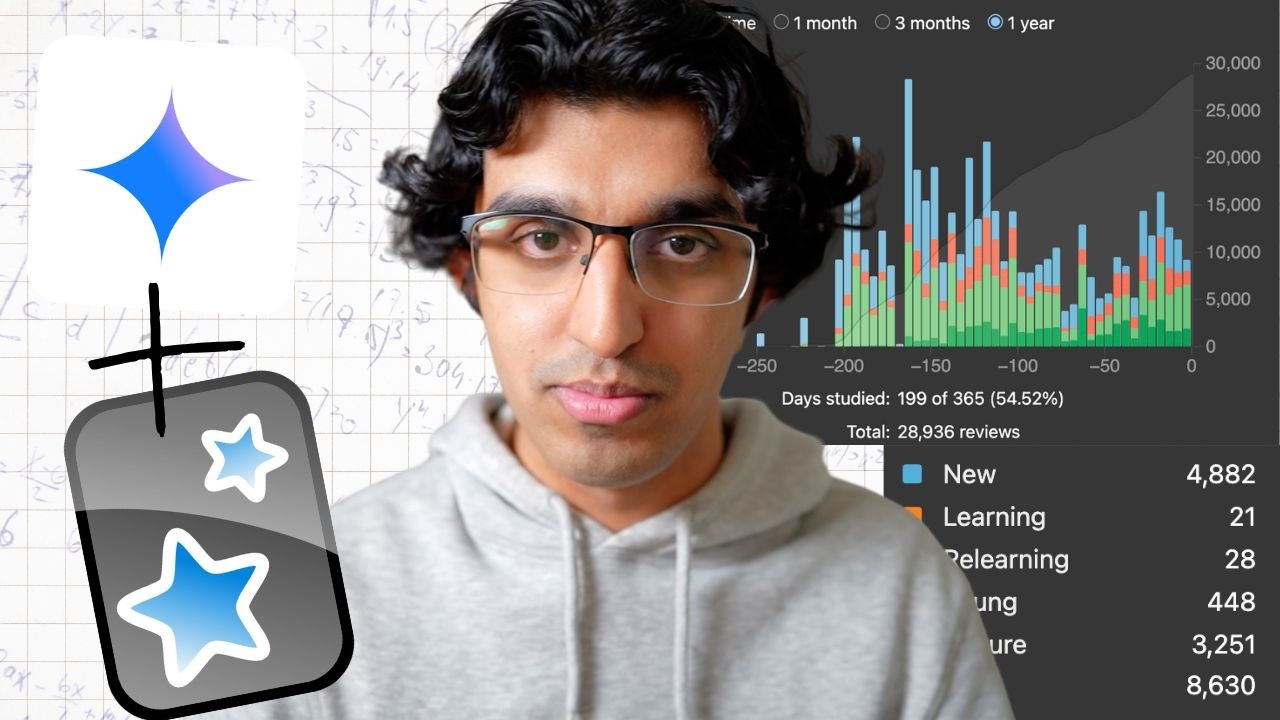
app of choice is anki but i won't be explaining how to use in this video because i already have a video on how you can learn to use anki in under 15 minutes and i think it's the best flashcard app because it has the most amounts of features it's most powerful you can download tons of plugins and stuff and to like enhance your cards it has space repetition built in and for free unlike quizlet which i think has active recall because it has flash cards but you have to pay to space repetition which isn't great and basically anki is fantastic so you can see here i have uh four main decks one for each of my a-level subjects and then some sub-decks in between as in like chemistry and verb mass now you can see if um i have all these flashcards due like hundreds due because i haven't been over my a level flashcards for like two years now but if i go to one of these decks say like the foundations of chemistry deck um and i press study now then you can see some of these flashcards come up so like define both cation and anion so if i define like okay cation is a positively charged ion and an ion is negatively charged and then press show answer then you can see like i have the answer or the fact on the other side which is like just a simple statement and then i have a like a little mnemonic uh at the bottom like remember as cats make you positive which works for me personally because like cats are nice um but if they're not for you then and they make you feel negative then this flash card unfortunately doesn't work for you or mnemonic so anyway you can see i have four buttons on the bottom again if i got it wrong if it was hard to remember then you'd come back in less than 10 minutes if it was quite easy to remember then i'm pressing good and come back in a day um and if it was like basically trivial to remember you i can press easy and come back in four days so i can even press one two three or four uh respectively and if i press four then that's gonna come back to me in four days now under flash card what is the relative atomic mass of a proton nutrient electron so it's like uh one one over one eight three six and if i press show answer then it that comes up and i can even do the same thing so let's say that was pretty hard for me to remember i just press hard and then it come back to me ten minutes and define isotopes then i also have this facts on the other side and i've bolded some words which are the words that the exam board really wants to see like they want to see same element but different number of neutrons and when i'm recalling this flash card because this is a definition i basically have to recall the words in bold and when i'm recalling a concept so if i try to find a concept right now so i had quite a few concept based flash cards and for maps so if i can come back to further maps i can see how is the diagonalization of a matrix useful with like a derivation like that's sort of a loose concept i have in my head which i explained to myself and they're not going to be testing me on this precisely but you sort of get the idea like these flashcards are either based on like one particular facts or one particular concept but i also have a much more comprehensive video on how you can be using anki files and how you can like tag flashcards and then like split flash cards up in custom study decks and review ahead and like use a bunch of the neat features which is all in a using anki video linked above somewhere right now so do check that out as well after you've learned to use anki to begin with
9:04

Tips for Making Flashcards

so as for making flashcards themselves i sort of had a process by which i went through my class notes and then i went through some other material online and then i like combined this all into flashcards so i also have a video up on that which is called learning new content which you should check out as well and hopefully that gives you an idea how you should go about making these flashcards to begin with and making them effective too but when you first introduce to the idea of flashcards it can be quite easy to just end up making flashcards about everything and every single like factor concept and like when you're working for your textbook or a cgp revision guide or something like that you end up making 20 30 flash cards all on one page and then you have like dozens of more pages and by the end of it you may end up with like over a thousand flash cards just for one subject now this is like quite a bad thing that you can end up doing and because you end up with way too many flashcards so there are a few things to keep in mind you want to have closely linked information all on one flashcard so try to remember either one fact slash definition or one concept per flashcard so you can put like multiple amounts of information on one flashcard um say for like a reaction you can have like the diagram for the some equations you can have the reagents conditions all the one flash card they don't have to be split across many different flash cards so to give you an idea if i go back to anki and press browse and i go to my chemistry deck you can see in two years of a level chemistry i made about 558 flashcards in uh two years of a-level physics i made 490 flashcards uh maths two years of maps i made 50 flash cards and two years of feather maps i made 250 flash cards so like if you're doing a lot of chemistry and within the first two months you've already made like 600 flashcards then you're probably doing something a bit wrong because i made 560 flashcards in two years so do keep that in mind when making them just don't make flashcards on literally everything and obvious things either because there's no point making a flashcard on like what is the relative charge of an electron and writing like -1 on the other side because like you're doing a level chemistry and that information should just sort of be obvious at that point or if information slowly begins to become obvious because it's like one of the foundations and then i would just end up deleting flashcards like a few months later because i'm like this information is obvious i use it all the time especially when it comes to maps and say like differentiation i don't have to make a flash card i'm like okay you should like pull the power down and then reduce it by one or something because you just end up doing that so much that you just don't need a flash card on it so as for
11:24

Tips for Going Through Flashcards

going through flashcards themselves i will mention a few points here so when going through flashcards and anki say on your computer or your phone when you sync it to your phone actively you try to engage with the flashcard because remember that the more effort you put into recalling what's on this on the other side of the flashcart the more those synapse connections will strengthen when you are able to record the material so don't worry if it's taking like 20 30 seconds to record the material because if you are able to recall after 20 30 seconds then those connections are made much stronger as a result so don't give up on recalling flashcards after like five seconds but then again if you generally can't remember the other side then just flip over and try to think about why you couldn't remember it maybe it's like poorly worded or you don't understand the material as well as you thought and do speak out loud as much as possible so when i was on my commute to school doing flashcards and i would kind of like whisper the flash cards like the answers into my breath or i just sort of move my lips um or like when i was in my room i would actually say the answers out loud rough and sing it in my head because it can be quite tempting to just end up mocking a flashcard is right and because you sort of had a loose idea of what the answer was in your head and then you're just like oh well that was right anyway and it depends on how strict you want to be as well so for definitions i was usually pretty strict for myself and i had to get like the definition close to word for word but for concepts i could sort of loosely explain the concept to myself and as long as like there was a major floor in my misunderstanding on the concept i would just mock his rights anyways you can watch more of my video about using anki fight levels which is linked in the description down below so do check that out but i would want to emphasize a few points finally focus on
12:52

Flashcards AREN'T Everything!

understanding rather than just making flashcards and everything because first you should understand a piece of information before making flashcards like otherwise you'll just be memorizing that information and you'll find it really difficult to apply to exam questions if you don't actually understand it and secondly flashcards aren't a replacement for like basically everything else you still have to be doing past papers to practice applying the knowledge and exam questions and topic tests and stuff like that flashcards are just useful for helping you remember the information which you can then apply in those tests and you can retrieve the information from your brain much more easily and complete the test faster they're not basically the replacement for all sorts of revision in the end for me flash cards and doing past papers and exam questions made up about 95 percent of my the revision i was doing now if you want to learn a
13:32

Conclusion

bunch more about like studying effectively then i do have a studying effect on the playlist which is also linked down in the description and above someone right now so do check that out but um i guess i'll see you next time for now bye

Ещё от Ray Amjad

Ctrl+V

Экстракт Знаний в Telegram

Транскрипты, идеи, методички — всё самое полезное из лучших YouTube-каналов.

Подписаться