How Uber matches drivers in real time.

How Uber matches drivers in real time.

Machine-readable: Markdown · JSON API · Site index

Поделиться Telegram VK Бот
Транскрипт Скачать .md
Анализ с AI

Оглавление (1 сегментов)

Segment 1 (00:00 - 01:00)

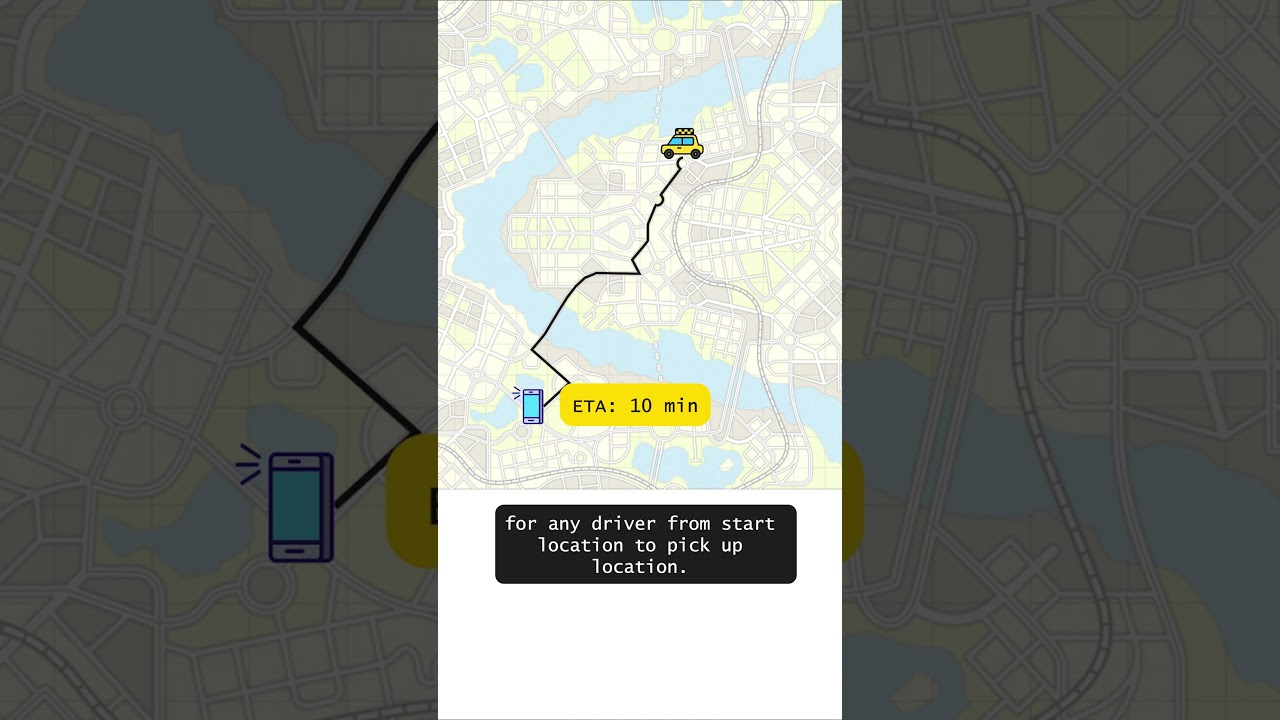
This is how Uber matches riders to drivers in real-time. The main idea behind driver matching is to reduce overall wait times, meaning if 2 Riders <-> 2 Drivers, we connect them in a way that minimizes average wait time. For efficiency this is done in batch, where multiple riders are connected with multiple drivers. But as we increase the batch size, the maximum latency for the request goes up, which could lead to poor user experience. So Uber limits its matches to small geographical locations. They do this by sharding the 2-D space into hexagons. The benefit of this is that they have an approximate radius (as compared to a square) so nearby drivers can be found more effectively. It also has a hierarchical structure, meaning the prefix of the hexagon can be used effectively to shard the query. Recent developments also use AI, where Uber predicts the ETA for any driver from start location to pick up location. Internally, the features are passed through a transformer, which performs self-attention. This helps the system calculate fares and plan deliveries more effectively. Uber also uses a RL model which predicts for demand spikes, routing vehicles towards that region, leading to shorter wait times and better pricing. Overall, the system solves a complex supply and demand problem where pricing, user experience, and efficiency are core concerns. This system helps Uber complete 38 million trips every day. You can find more details in the System Design course at Interview Ready. Thanks for watching.

Другие видео автора — Gaurav Sen

Ctrl+V

Экстракт Знаний в Telegram

Экстракты и дистилляты из лучших YouTube-каналов — сразу после публикации.

Подписаться

Дайджест Экстрактов

Лучшие методички за неделю — каждый понедельник