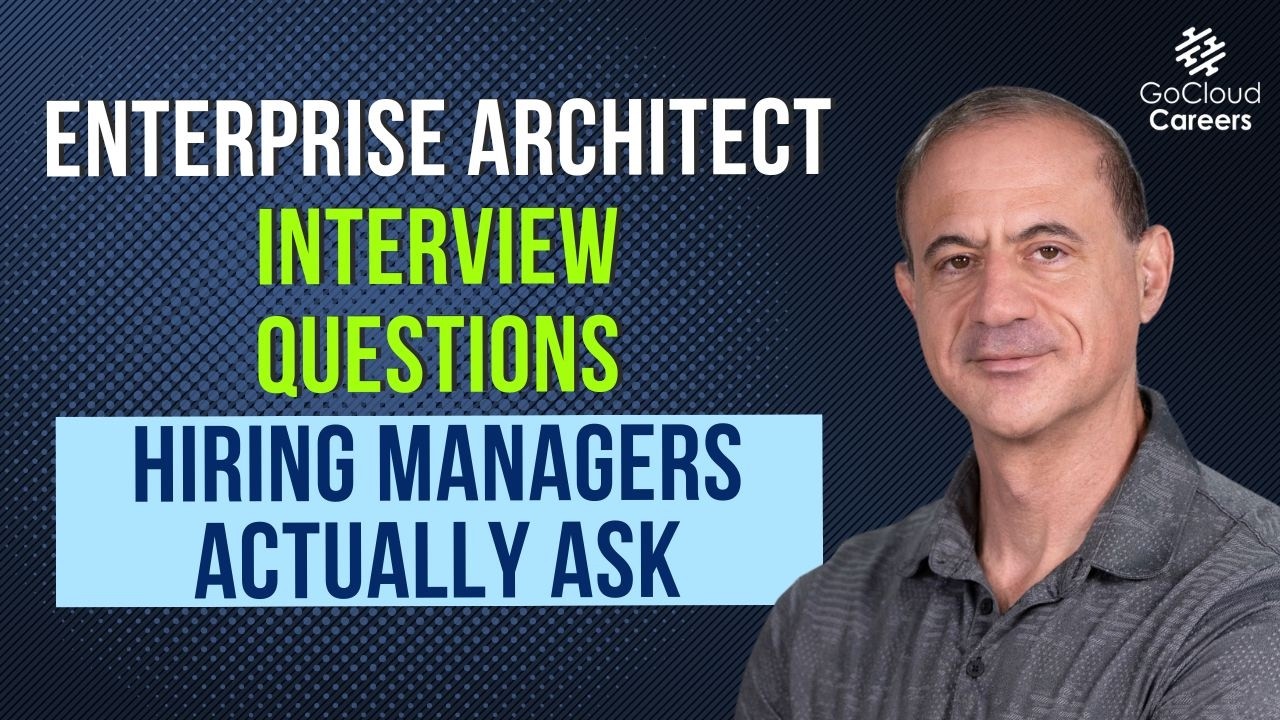
Are you looking for enterprise architect interview questions? If so, this video is for you. Hi, my name's Mike Gibbs. I'm an enterprise architect with a little over 25 years experience. And today I'll be making a video on enterprise architect interview questions as well as chief architect interview questions. And I'll be bringing you five of them. The first question we're going to discuss today that you commonly and see on enterprise architect interviews or chief architect interviews is how do you build trust with executive stakeholders? And I'll tell you how I normally answer that. I would say for me, the key to build executive trust is staying relevant. Being consistent and delivering real business results. Now, for me, that first step is to truly understand the executive stakeholders and their priorities. So that means I'm going to start by spending some time with leaders across the organization, whether that be the CEO, the CFO, the CIO, business unit executives, for example. And I need to understand what they're trying to accomplish. What are their goals? And that goal could be something like revenue growth or enhanced operational efficiency or improve customer experience, for example. But I need to know that because that's the starting point of the architecture. Now, the second step for me is making sure that whatever architecture we create is business relevant. And when we communicate that with the executive stakeholders, we stay business relevant. For example, when I present architectural recommendations, I'm not going to lead with the technology. I'm business outcome. I'm going to make it clear how this architecture will improve. For example, time to market or what is it about this architectural reduce operational risk for that business, or what is it about this architecture that may reduce the organization's operating cost, or how will this architecture create new revenue opportunities? Now, the third component, realistically speaking, is being of trust is really delivering results. So when we make sure that our architectures consistently translate into successful outcomes, whether that be systems that scale to the businesses need platforms that enable innovation or initiatives that deliver measurable results, then those architects start to trust the architecture team when they see that architect, that enterprise architect, the chief architect as a strategic partner, as opposed to a technical advisory function. The next enterprise Architect interview question will be how do you handle conflicts between business stakeholders and technical teams? That's another common thing that happens in our role as enterprise architects, but also an enterprise architect. Interviews. So conflicts between stakeholders and technical teams are extremely common. They often or because people view problems from different perspectives, the technology team and the business team, the business leaders are typically focused on speed or market opportunity or customer outcomes. And technical teams are typically focused on stability, scalability, long term maintainability, which is a gap there. So my role as an enterprise architect is to bridge that gap between the business and its needs and the technology teams. So the first step is really ensuring that both sides of the equation and the business teams and the technical team understand the real business objective behind the initiative. Because often we find conflict occurs because, you know, the business teams are thinking about one thing, and the technology something completely different. Now the second step is really facilitating a discussion with the teams around the trade offs, for example, because every architecture decision is going to evolve with various trade offs. Maybe it's speed versus stability or cost versus scalability, innovation versus risk, security versus usability. So we have to have these key discussions, where we really talk about the real tradeoffs, because my role is to make sure that those trade offs are clearly understood. And that way leadership understands all the trade offs so they can make informed decisions. You know, after that, I try to work very carefully with both the business stakeholders and the technical stakeholders. And at that point, we take our architecture team and we try to craft some type of a solution that will balance the short term needs that we have right now, along with long term sustainability. I've always view my role as an enterprise architect as more of a translator and a mediator, because I have to ensure the business gets the outcomes that it needs, and at the same time, make sure that we, the organization, has a healthy technology environment. So the third Enterprise Architect interview question this week will be, how do you translate complex technology topics into business language?
Segment 2 (05:00 - 10:00)
Here's how I would typically approach this. Here's my approach to translating complicated technology to executive communication. First thing we have to do is find the language of our audience, because that's really what it takes to translate. And that language could be executive or technical. But the first thing we need to know is know the language our audience speaks up. The second set is really compelling. The price of making sure that we know what each party cares about, knowing what that executive audience were to care about versus that technical audience. The third component of being able to translate things is to be prepared and knowledgeable. So you have the ability to explain complex things very simply. So those three things are really critical. And once we know the language of the audience, what each party cares about, and we can explain things simple. Now it's up to us as an enterprise architect to really explain it simply in the language that our audience wants to hear, and that our message addresses what that audience actually cares about. For example, executives don't want to hear about infrastructure components or APIs or container orchestration platforms. They want to understand business value, financial impact, risk management, for example. So instead of explaining the technology itself, I typically explain what the technology enables. For example, for cloud computing, I might say cloud computing enables us to launch new digital services faster, better scale our business systems and be more agile to adopting market conditions. The next question for the Enterprise Architect interview or the Chief Architect interview would be how do you influence executives without direct authority? While it's a big part of our role? So I would answer something like this. I would say influence comes from relevance, relationships, trust and execution. So for me, I try to stay relevant. I try to communicate to the stakeholder in a manner that's relevant for their needs. For example, if I'm going to communicate with the chief financial officer, in financially relevant terms as well as executive relevant terms. Secondly, as I take the time to build relationships across the company, relationships are a currency. When it comes to influence, and for me, I'm going to build relationships. I'm going to nurture those relationships, provide value where I can to further enhance those relationships. Because architecture is a relationship business. The next thing I'm going to do is I'm going to make sure that I build trust and I maintain trust. So what really goes into trust some of it is capability and competency. So I work really hard to stay competent. I'm constantly upgrading my skills, even though I've done this for over 25 years, because expertise and competency are needed for trust. Secondly, I do what I say. If I make a commitment, I honor it. And I always communicate authentically and openly and honestly with the client, and I make a point of staying fair and unbalanced. I don't have a technology vendor. I care about what the outcome is for the client. I always discuss trade offs and make them clear. And the last key is I deliver results. I have a track record, and I have a brand on my ability to drive results. Now, the last question that we will have for the enterprise architects and the chief Enterprise architects in this video is how do you manage competing priorities from multiple business units? Now, I would answer it something like this. I would say competing priorities are going to be inevitable in a large organization, because every business unit has important initiatives, but resources will be very limited. Now, prioritizing investments is going to take a structured process as we truly need to understand the investment and the initiative that we're talking about and what kind of results that initiative or investment will actually produce for the organization. So to prioritize investments, we're really looking at to determine the expected value of each and every option that we have. So in order to work with that, the first step is really ensuring that all initiatives are going to be evaluated against enterprise level strategic objectives. So a project that directly supports the company's highest strategic priorities would naturally receive a greater emphasis. The second step of portfolio management really looks at evaluating the initiatives themselves. So I typically evaluate the architecture or the initiative based upon a couple of categories like strategic alignment, the actual business value, the value to the business, how much the architecture would reduce risk, what the impact to the operations of the organization, and, what type of resources the new architecture requires. Do we have them? Do we need them? Can we not afford them? What have you and that why?
Segment 3 (10:00 - 11:00)
By doing so, I'm really creating transparency around why certain initiatives should move us forward sooner than others. Now, the third component of this, as will the architecture, will support multiple business units simultaneously. Generally speaking, there's preference if it can support multiple business units simultaneously. Now, that doesn't mean we don't fund things and only impact one department, but we really need to evaluate the opportunity as well as the opportunity cost of funding this versus, say, something else. And that way, by using a framework like this, it's a prioritized framework that I like to use. It's clear and transparent. It makes it much easier to manage competing demands across the enterprise. I hope you enjoyed this video on Enterprise Architect. Interview questions. If you'd like to become an enterprise architect, or a cloud architect, or a security architect or an AI architect, we hold two weekly architecture webinars per week where we go over what we do in the role. The skills you will need for the architect role, how to get hired for the architect role. How to get people to come to you for the architectural, what certifications you might need, what kinds of things you need to learn. And I host these architecture webinars live and free on zoom. You're free to ask me any architecture career question you may have, so please sign up for one of our free architecture webinars. I'd love to meet you. I'd love to discuss architecture with you. Answer any kind of question I can help you. The link to sign up for the Free Architecture webinar is in the description of this video. There's also other free things for you in the description of this video that should help in your architecture career. Now, if you enjoyed this video, please give it a like. Subscribe to our channel and hit the bell to be notified of new videos, and maybe send this video to others that are trying to build an architect career like an enterprise architect or career. For example, this is Mike Gibbs signing off for now and I hope to see you in another video or a free zoom webinar. ID love to meet you. Take care.