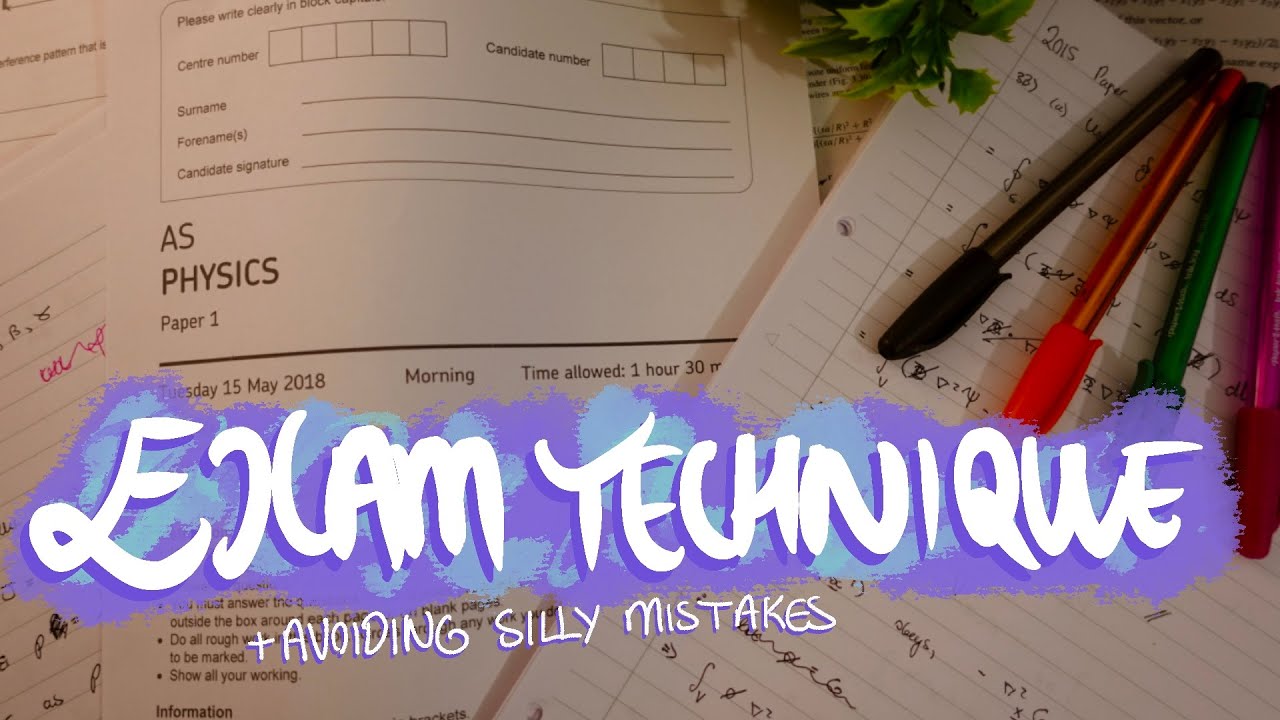
Exam Technique & Avoiding Silly Mistakes | Studying Effectively for GCSE's & A-level's
17:07

Exam Technique & Avoiding Silly Mistakes | Studying Effectively for GCSE's & A-level's

Ray Amjad 27.03.2021 6 623 просмотров 308 лайков обн. 18.02.2026
Поделиться Telegram VK Бот
Транскрипт Скачать .md
Анализ с AI
Описание видео
📷 Follow Me on Instagram: https://www.instagram.com/theramjad/ Watch the series here ➔ https://youtube.com/playlist?list=PLTiA09lKvQngUUDDDO-IEsCoNXF_eWVkz === Links === - Richard's article on 'Stop Making Stupid Mistakes': https://artofproblemsolving.com/news/articles/stop-making-stupid-mistakes === Timestamps === 00:00 - Introduction 00:15 - Staying Calm 03:04 - Dealing with Algebraic Mistakes 04:34 - Misreading the Question 07:34 - Thinking for a Second 09:36 - Focused and Diffused Thinking 10:48 - Coming Back to Questions 12:24 - Being Specific 13:36 - Having a Mistakes File 15:44 - Being Well Rested 16:21 - Keeping Track of the Time 17:03 - Conclusion
Оглавление (12 сегментов)

  1. 0:00 Introduction 51 сл.
  2. 0:15 Staying Calm 682 сл.
  3. 3:04 Dealing with Algebraic Mistakes 312 сл.
  4. 4:34 Misreading the Question 645 сл.
  5. 7:34 Thinking for a Second 468 сл.
  6. 9:36 Focused and Diffused Thinking 256 сл.
  7. 10:48 Coming Back to Questions 363 сл.
  8. 12:24 Being Specific 257 сл.
  9. 13:36 Having a Mistakes File 443 сл.
  10. 15:44 Being Well Rested 123 сл.
  11. 16:21 Keeping Track of the Time 168 сл.
  12. 17:03 Conclusion 14 сл.
0:00

Introduction

hey friends and welcome back to our series and studying effectively for gta's a levels in this video we will be discussing exam technique and ways of avoiding silly mistakes in exams as always time stamps will be in the description down below so do check those out during the video
0:15

Staying Calm

so the first bit of advice will be about tackling the main cause of why i think many people make silly mistakes during their exams and that's to do with being too stressed whilst i think that uh having a little bit of stress over your exams can be a good thing in ensuring you're preparing well and actually getting work done i think that too much stress by telling yourself that this exam is a matter of life and death or decides your entire future or something else as crazy or ridiculous as that can cause you to perform worse that's because going into exam you can get so caught up in how important you think the exam is and you keep thinking about that fact rather than actually thinking about the questions in the exam essentially you're taking away some of your mental capacity during the exam by focusing on other things that won't help you perform any better so ultimately rather than thinking about the exam questions you may just end up spending more of your time thinking about what will happen if you fail so for me personally i found it helpful to reframe my attitude of worrying about how important the exam may be so you're treating it more of as a game i thought if the exam is more of a time to show off all the hard work and effort that i have been putting in over the last few months and trying to get a new high score of sorts it was more about thinking let's see how well i can do rather than oh i gotta get this question right that question right and everything else right so basically i just treat exams as more of a game or a challenge and i think that having this more playful approach to exams can go a long way in helping you focus and one important advantage of doing this is that you can stop yourself from getting into a panic frenzy during the exam which is the last thing you want to be doing because panicking can lead you to go crazy jumping from one question to another question without actually completing any question until the next thing you know the exam's over and you've answered maybe half the paper and i've experienced this myself a few times as well and it's not a great feeling so i find that for myself at least treating exams as more of a game which i'm playing to get a new high score can help me focus on the questions at hand and eliminate all of the worries now all that was my attitude during the exam to help me stay calm as for before the exam for money into the exam hall and sit down then individuators will be handing out papers and reading out the rules and regulations and stuff you generally have about five to ten minutes where you'll sat at your desk just waiting i find that can be rather tempting to let your mind wander onto the same thoughts which i mentioned before especially since you have nothing to focus on during that time as the exam hasn't yet started in that case i find it helpful to focus on my breathing and just in breathing exercises where you breathe in for some number of seconds for your nose and then breathe out through your mouth i didn't tend to worry too much about how many seconds i was doing breathing in for five or out for five or breathing in for six and out for four i don't worry about that because i think as long as you're consistent then that goes a long way in helping you ensure a consistent supply of oxygen to your brain and body which helps you feel calmer and more relaxed and whilst i'm not sure how true that is from a medical standpoint i have still found this to be useful and to be the case during the exam now for math heavy subjects
3:04

Dealing with Algebraic Mistakes

it can be particularly easy to make algebraic mistakes and have them completely ruin your answer or prevent you from gaining as many marks as you would have and personally for helping me tackle these mistakes i found an article titled stop making stupid mistakes on the os problem solvings blog to be rather useful for this in the article the author richard mentions that a key habit to develop when practicing questions at home is writing more clearly if your work looks like chicken scratch and is all over the place then you will end up misreading numbers messing up on negative signs mistaking one variable for another and so on putting in a little bit of effort when practicing exam questions make sure your writing is more legible and more clear can go a long way in helping you to avoid mistakes in the future and even when it comes back to looking back on your work during the exam because you won't spend time wondering what enough this says personally i found out writing more clearly and slightly bigger to be quite effective in making sure i can read my work more easily and especially when doing long multi-step algebra problems when i'm copying one line to the next i won't accidentally mistake a negative sign for a positive sign or mistake one variable for another variable or something like that and this also helps when you have to go recheck some of your answers at the end of the exam you will be able to quickly read through your answer to see what you've written so far and find mistakes more easily by writing more clearly so rushing writing in italics and small and having numbers and letters look quite similar in your handwriting can all be sources of error when trying to do questions quickly another thing
4:34

Misreading the Question

that richard mentions in the blog post is that a big source of error is a misreading the question and of course the best way to beat this is to read the question more than once there's pretty much no way about it but i think considering when you reread the question can be quite helpful what i like to do is that i would read a question at least twice and underline anything particularly important if the question was quite long and after starting the question and being a few lines into my working out or an essay i would double check and reread the question to make sure i was actually answering the question itself and not the question i wanted to answer doing this usually helps me to pick up on any errors for example if i realize that an equation seems too difficult to solve for the number of marks this question is worth a few lines into a question or if i'm getting some kind of strange negative sign rereading the question and gain a few lines into a question would help me realize the mistake i have made when maybe copying something down or writing something from one line's end of line then finally after completing the question i would read the question once more to convince myself i have actually answered what i was looking for now repeated re-reading can seem like a lot of time to spend but making a habit is quite useful and practicing enough you will find yourself being able to reread much faster and without having to actually think about it and if you weigh up if you spend another 10 to 20 seconds rereading the question it's much better if you do that at the start of question then when you're say five minutes into answering the question and you realize that you misread something doing this was especially important for me because i find that through doing many past papers if i only read the question once and finish the exam early then went back to re-read the questions to make sure my answer fit them for some reason i would make little changes to my answer when rereading it and would still lose marks on those questions despite having reread it i then figured that it would be much better for me to take a bit longer to reread the question before answering it to make sure i'm actually answering it right first time even if it does take me a little longer to complete the exam at least i would have still gained more marks that way and to stop me skin reading the question and actually slow down and digest it properly i would often read the question whilst moving my pen across the page i think that slowing down a little can be especially important for longer multiple questions where some piece of information you were given in say party 10 minutes ago may be useful in parts e or something and often for these questions i would go back and read an early possible question if i find myself stuck so yeah rereading a question is useful but it's important to consider when you reread the question and generally i read the question twice at the beginning once ensuring the question itself and once again after completing the question also i know that some people find it helpful to check off the command words from the question as you complete them for example if a question's command words or states inscribe then underlining those two words and then after you've completed a question you can check that you've stated it and then take it off and then check that you've described this definitional uh concept or whatever and then take that off as well now one
7:34

Thinking for a Second

especially bad habit for me was that i would often dive straight into a question without thinking too much this led me to make an effort after reading the question to pause for about 10 to 30 seconds and just think to myself about the best way to tackle this question sometimes in especially difficult maths questions there may be a long way and a shorter way to get to a solution one may be more algebra heavy have more messy fractions and cause problems in your answer whereas another way may be more cleaner and neater so if instead of thinking for a few seconds i just started writing the first solution that came to mind and somehow reached a dead end i wouldn't be able to get myself out of this dead end because i closed my mindset possibilities by going with the first thing that comes to mind whereas if instead of writing the first thing that came to mind i had kept on thinking then i would have realized that okay this is a method i can use but let's keep thinking is there anything else i should notice here is there anything that can make this question simpler to tackle or is there some kind of trick at play here and if i couldn't think of anything else then they would just go with the first method that came to mind but usually i would realize that there's something else at play here in this question which would make my answer more correct and sometimes thinking for a few extra seconds was useful in helping me figure out the question more easily and find a faster way of doing it and some other times i would just uh have no other idea and would just use the first method that i thought of often i find that in many cases when i use a first piece of information that came to mind then i would not be able to answer the question properly or i would miss some crucial piece of information or miss a trick that was in the question that would have made it simpler i find it much more helpful to pause and think from anywhere to 10 to 30 seconds and in some cases even a minute before tackling the question i think they're completing one question then rushing straight into next without having any room for thinking can cause you to miss some important details and it goes back to the logic that i mentioned before if you spend a few extra seconds just thinking a little bit more about the question then you may save yourself a few minutes by solving the question in a much faster way or by just not getting stuck and on a
9:36

Focused and Diffused Thinking

relevant point i think that you can apply focused and diffuse thinking during the exam too like i said earlier in the series using diffused thinking when doing difficult practice questions can be useful because it allows you to make connections beforehand and often when those same connections are required for some questions in the exam it can help you solve the questions faster however it may not always be the case that you have made every single connection beforehand hopefully your exam practice will have made you better and faster at making connections but you are still need to use diffused thinking sometimes in exam so often for any particularly challenging questions in the exam if i was stuck and could see no way to solve it i would often relax use diffuse thinking look around the room drink some water and generally let my mind wander and even doing this for 30 to 60 seconds may be enough for me to figure out the question or even get a second round of energy to tackle the rest of the exam i often left the most difficult solved questions for the end and ones that would take me maybe two to three minutes to figure out what was going on as i found the goal at the beginning of the exam to be to gain the most amount of marks by doing the questions which i can do most easily which were mainly the questions similar to the ones i had done before now this
10:48

Coming Back to Questions

brings me on to another point which is when to come back to questions generally if i find myself spending too long on a question and there are more marks to be gained elsewhere or if i'm unsure on my answer then i would put a little squiggle next to the left of the question as a reminder for me to come back to my recommendation usually is that the aim of the beginning of the exam is to gain as many marks as you can by doing as many questions similar to ones you haven't canceled before now this doesn't mean you should give up on a question and move on in five seconds of starting it or something but it means that if you get stuck and you have no idea what to do anymore or you get an answer but you don't think it uh you think you made a mistake or have already spent too long on this question then it's better to put a small squiggle an extra question and move on now if you finish the exam and find yourself with time left to spare to check your answers then you know the most important questions to come back to are the ones that you put squiggles next to so you would go back and check those answers first because there are more marks to begin there than elsewhere so i would often come back to each of these school gold questions first and try to resolve any issues i had with them whether it be uh completing the question after being stuck or hunting down where some missing negative sign wants to and this is where some of what i previously mentioned before about focus and diffuse thinking comes into play distracting yourself from a question that you're stuck on by doing a potentially easier question later on in the exam and then coming back to the original question can help you to figure out where you got stuck and maybe help you find any mistake and maybe whilst doing the easy question your brain figured out how to do the harder question in the background
12:24

Being Specific

now another important point is that you should try to be as specific as you can when doing exam questions for example if you're given a chemical reaction and you have to explain whether it's a reduction or oxidation reaction then you will have to mention electrons are lost or gained and if you can easily figure out how many electrons are lost or gained then you might as well write that number down as well because that could be a marking point or if you know that a product is formed during a reaction and you know that it's specifically a white precipitate then write down the fact that it's a white precipitate rather than just writing a precipitate is formed because a keyword white could be a marking point or if you're using difference in bond trends as explanation for some questions rather than saying that x and y have different bond strengths you should use comparative keywords like x has stronger bonds than y rather than just saying they're different basically my suggestion is that if you know of any extra detail that takes little to no time to work out and include then include it as it may well be a marking point and the examiner will see that you really know your stuff and won't be as hesitant to give you the marks but ultimately i found that in most cases as long as i explained my reasoning well enough using detail then i was hitting most of the marking points anyway
13:36

Having a Mistakes File

now arguably the most useful thing i did was that i kept a mistakes file on google drive for each of my subjects and split it up by the main topics in the specification after completing a marketing past paper i would add any mistakes that i made on that past paper onto this file and learn from those mistakes now there are generally two types of mistakes that one makes during an exam uh one is to do with not using the keywords that the mark scheme is looking for despite understanding the topic as a whole and the second is just general silly mistakes if my understanding was right but i didn't use the keywords and the marketing wanted to then i would write these onto the mistakes file i had and when i had some time say on the weekend then i would go through this mistakes file and make adjustments to my flashcards and make and add those keywords onto my flashcards by making them bold and whatnot and after making the necessary adjustments i would remove the bullet point and i would mostly be left with any of the selling mistakes that i made which i can't really add on to flashcards and eventually after doing a few more past papers i would spot trends and mistakes that i commonly made out of habit and then i would try to take the appropriate steps to reduce the chances of making those mistakes for example if i noticed i kept messing up on quickly resolving forces in a level maths and physics then i would make an effort to draw cleaner and less cluttered diagrams so i can see more easily how to resolve forces or i would consider finding a way to make resolving forces easier like the technique that the educational youtuber science shorts mentions in his videos then i would even remind myself of these common mistakes i make before doing any practice questions or my mock exams and even my real exams i would know exactly what to look out for during the real exam all that said do bear in mind that examiners don't expect you to use exactly the keywords in the mock scheme and have the exact same answer as a mock scheme does if your answer is similar or you use synonyms and put the overall messages the same then you may still get the marks in that case but knowing the keywords a mock team likes to use and using them for yourself is better because it means that examiners are less hesitant to give you the marks now my
15:44

Being Well Rested

final suggestion is to make sure you're well rested i know that everyone says this all the time and it's easy to just ignore this and still pull it all night anyway but hopefully by now you will have learned enough uh useful revision techniques like acting recall space repetition getting the bigger picture and everything like that and you will have realized that studying over the long term is much better than pulling out all nighter but most importantly don't pull it all night before your real exams as you need to make sure you're in top form and can think clearly being slave deprived will already set you behind many other students who have slept adequately enough because they can think
16:21

Keeping Track of the Time

more clearly now finally i would use a time function on a small cheap wrist watch and have it resting on my table during the exam generally do remember that normal watches are allowed but not small watches i found this timer function to be useful because in my exams at least there was no countdown timer at the phone front on a projector or something they just wrote down the start time had a clock and wrote down the end time so rather than looking up and mentally having to work out how long is left of the exam using the small analog clock at the front i would use the stopwatch feature on a smaller cheap watch of mine and i would instantly know how long i had left during the exam i think being able to find out how long you have left quickly is especially important when it comes to making sure you're not spending too much time on one question but yeah that's
17:03

Conclusion

pretty much it for this video and i'll see you in the next one

Ещё от Ray Amjad

Ctrl+V

Экстракт Знаний в Telegram

Транскрипты, идеи, методички — всё самое полезное из лучших YouTube-каналов.

Подписаться