Getting the Bigger Picture | Studying Effectively for GCSE's & A-level's
13:07

Getting the Bigger Picture | Studying Effectively for GCSE's & A-level's

Ray Amjad 18.03.2021 3 008 просмотров 136 лайков обн. 18.02.2026
Поделиться Telegram VK Бот
Транскрипт Скачать .md
Анализ с AI
Описание видео
📷 Follow Me on Instagram: https://www.instagram.com/theramjad/ Watch the series here ➔ https://youtube.com/playlist?list=PLTiA09lKvQngUUDDDO-IEsCoNXF_eWVkz (If my neck movements appear odd, it's because I slept in an awkward position the night before so it hurts lol) === Links === - 25 Ways to Educate For the Bigger Picture: https://www.opencolleges.edu.au/informed/features/educating-for-the-bigger-picture/ === Timestamps === 00:00 - Introduction 00:26 - The Problem Faced and the Bigger Picture 01:40 - Why It's Useful 04:08 - How to Implement It 05:39 - Examples of the Bigger Picture 10:04 - Using YouTube to Acquire the Bigger Picture 11:04 - Final Thoughts

Оглавление (7 сегментов)

  1. 0:00 Introduction 87 сл.
  2. 0:26 The Problem Faced and the Bigger Picture 268 сл.
  3. 1:40 Why It's Useful 516 сл.
  4. 4:08 How to Implement It 343 сл.
  5. 5:39 Examples of the Bigger Picture 944 сл.
  6. 10:04 Using YouTube to Acquire the Bigger Picture 221 сл.
  7. 11:04 Final Thoughts 448 сл.
0:00

Introduction

hey friends and welcome back to our series on studying effectively for gcses and a levels in this video we will be discussing an idea which i will refer to as getting the bigger picture and how we can use this idea to stop us from feeling overwhelmed and obsessing over minor details we will discuss what it means why it's useful and finally ways of implementing it anyways as always timestamps will be in the description down below so do check those out during the video
0:26

The Problem Faced and the Bigger Picture

so before we look at what we mean by getting the big picture i think it's helpful to consider the problem we face many of you will have experienced that when you first learn a new topic you may feel overwhelmed because there are so many small details that you have to memorize and maybe you're looking over a textbook or revision guide you feel overwhelmed with the amount of information that you're presented with and thought that you had to know every single piece of information inside out but maybe after a few weeks or months when you're more confident with the topic and are practicing exam questions you may realize that hey there's only a few key principles here that everything boils down to and that most of the textbook revision guide was just waffle and that it was just distracting you from these key ideas just being able to figure out these few key principles from each exam question you're doing allows you to do each successive question much more easily this is essentially what the bigger picture is it's first figuring out what on earth is going on then worrying about the smaller details later the smaller details will click into place once you know understand and appreciate the big picture if you do this the wrong way around and start focusing and obsessing on the smaller details too soon then you're likely to spend the next few months or years of your gcse a levels or even your university degree just stumbling along and losing the frost of the trees so before explaining
1:40

Why It's Useful

how to get a bigger picture what's going on i think that keeping in mind the bigger picture is useful for a number of reasons firstly it can help you tackle any feelings of confusion that you have which is quite good because feeling confused is a really irritating feeling when you're first learning something because you just don't see how all the pieces fit together and how to make the connections between the exam questions that you have to do and the content you're learning in class secondly it's great for helping you realize what's actually important in that subject or topic especially at university you often find a few key principles keep popping up over and over again throughout this course and a few of the courses and just understanding these few key principles makes everything so much easier to understand when you look back on a topic or a module then you may realize that hang on there's only a few important ideas at play here and that everything else just depends on these important side is if you know these few key ideas then it helps you figure out everything else much more easily thirdly it also means that you can decide what to make flashcards on much more easily and allows you to remember your flashcards in the context of the topic you're learning about once you understand the bigger picture then recalling the details in your flashcards becomes significantly easier and begins to feel more like logic rather than root memorization and finally i think it gives you some direction when you're doing exam questions especially the difficult exam questions you may have experienced somewhere you have had no idea what was going on or even where to begin knowing a concept understanding the motivation behind it and ultimately having a big picture understanding of what's going on can help you make progress on these more difficult questions and recognize what part of the subject a question fits into which allows you to recall those parts of the subjects for that question this was especially useful for me because close to exam time i had a big picture understanding of many of the a level topics in my subjects and it helped me to see whether i cared about something or not some of my friends would even come up to me with a textbook and complain about some small sentence in the textbook and how it doesn't make sense to them and often i would tell them not to worry about these minor details because they're mostly irrelevant i would encourage them to step back think about what the goal they're trying uh the textbook is trying to achieve in this chapter and what the few key principles are in this chapter this helps them stop obsessing over like minor sentences in textbook and obsessing over understanding every single sentence inside out and shifted their focus towards getting an overview or a overall understanding of the chapter through boiling the whole chapter down into a few key ideas now
4:08

How to Implement It

that you have an appreciation for why big picture understanding is useful i guess it's worth discussing some strategies to help this bigger picture understanding develop i will be using a few examples here but the difficulty with using examples in a video like this is that i can't have an example for every single subject and every single topic that will make sense to everyone watching i just picked a few examples of where having a big picture understanding is useful for both gcse and a-levels some of them may be obvious to you but not so much to others which is why i will be focusing on how to get this big picture understanding so whenever i learn a new topic i wouldn't focus on the small trivial details but would instead step back and ask myself questions such as what on earth is going on here why are we doing this what problem are we trying to solve what part of this feels confusing and what feels surprising can i boil this topic down into a few essential ideas that will tie everything together if so what are those essential ideas are there any patterns do some ideas keep coming up over and over again does anything here seem random or arbitrary if so can i find the motivation behind this asking yourself these general questions and finding answers to them can help you develop a big picture understanding you can of course come up with your own similar questions but the key thing is that these questions should be tapping into the underlying essence of what's going on even asking a friend or a teacher whether such and such a thing will ever be relevant or come upon the exam can be useful in helping you sift through the garbage and figuring out what's relevant or even asking your teacher or friend whether they can summarize a topic down into a few essential ideas or sentences can go a long way in helping you understand now let's look at
5:39

Examples of the Bigger Picture

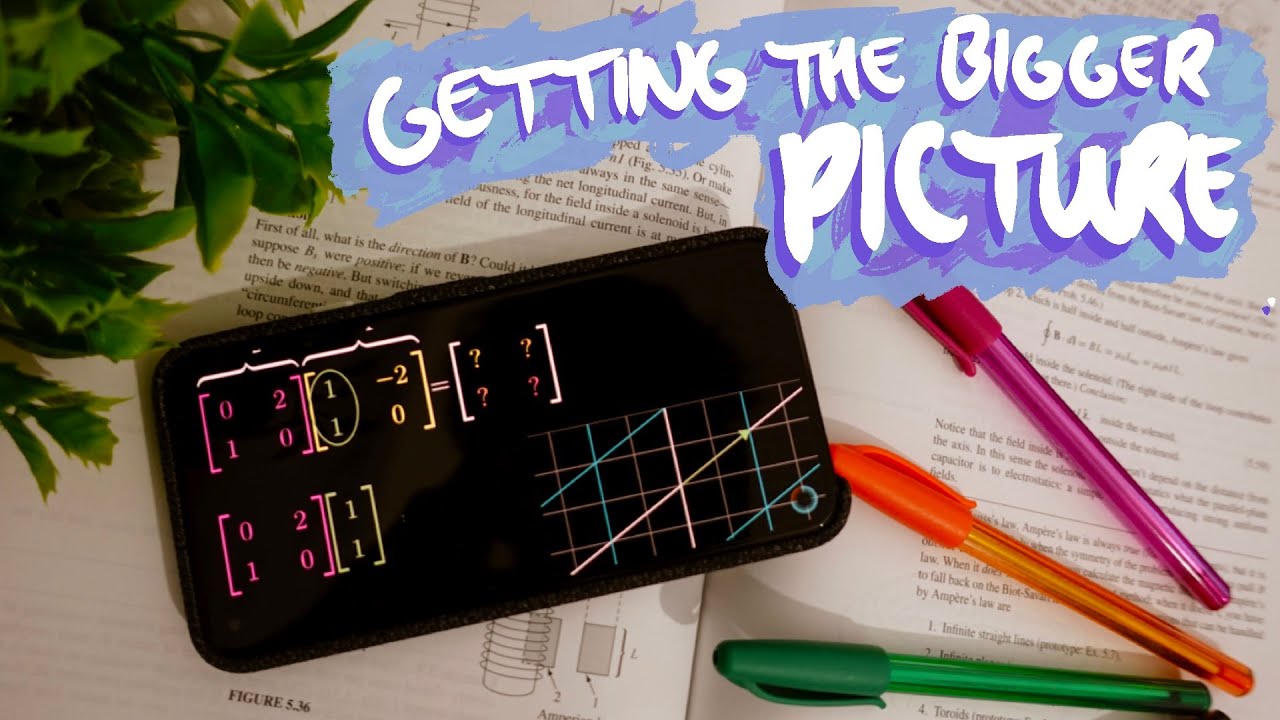
a few examples do bear in mind that some of these may not make sense to you because you don't do these subjects or haven't learned about them yet but do bear with me here so i think the simplest example that i can possibly think of is when solving simultaneous equations when you first learn about the topic you're often presented with a procedure where you have equation one and equation two and you multiply one by a factor and another by another factor and then add or subtract them to find a value for x and then substitute this value back into one of them to find the value for y and only after learning about this procedure do you learn that the geometric interpretation of this corresponds to in section two lines so i think that losing yourself in the details of what factors to multiply or divide by or whether to add or subtract here can cause you to just treat this as more of a step-by-step uh procedure for solving the problem rather than add something that just sort of makes sense if you step back and consider it from a high level picture you'll think to yourself hang on so i need to find where these two curves intersect their functions are y in terms of x and just mark out a path for which this relationship between y and x holds true but now i have another relationship that i want to hold true as well so if i rearrange for y and substitute this into the other equation then it only makes sense that this will give me values of x for which both relationships hold true so that means after substituting i can just solve for x and these are the values of x which will hold true for both relationships and if instead of substitution i'm multiplying by numbers and adding or subtracting them like i was before then this is essentially just substitution in this guys although in this case it is easier than substitution because i don't have to deal with annoying fractions and this is essentially the big picture understanding i have when it comes to solving simultaneous equations then just think about geometry you'll realize that you may not always get a value for x when you substitute say the equation of a straight line instead of a circle and you'll think to yourself hang on so what does this mean if i'm not getting any values for x this that then must mean that this straight line does not pass through the circle at all then the same geometrical approach extends to 3d where you consider planes and spheres and secting and you'll get more possibilities and like instead of getting a point of intersection you'll get lines of intersection and stuff like that so just having a big picture understanding of solving two simple simultaneous equations helps you to appreciate what's going on with more complicated cases as well so my favorite example where having a bigger picture understanding comes in useful is for a level further maths i remember when first learning about the topic of matrices we were learning about rotation matrices and i was wondering why on f is it defined like that why is a rotation matrix around the x-axis this and the rotation matrix on the y-axis that and so on and i also asked myself why do we care about the determinant what does it even represent now these were all questions that i had and even asking my teacher about them she didn't have much of an idea of what was going on either because she was just used to teaching it the way it is so i decided to go home and i ended up finding a free blue one brands essence of linear algebra series on youtube in which he introduced his idea that a two by two matrix simply can be thought of as a transformation of basis vectors in other words a column of the two by two matrix are simply new basis vectors in terms of the normal i and j basis vectors so this means that if i apply a matrix instead of x y coordinates then we're essentially expressing these coordinates in terms of the new basis vectors and if we do this for several points then we can form a shape and then each point will be expressed in terms of the new basis vectors which may deform the shape so this idea that columns in matrices representing basis vectors makes a whole topic on matrices makes so much more sense it makes sense why we define the rotation matrix to be like that why the identity matrix is just a bunch of ones on the diagonal uh why diagonalizing matrix works why the determinant represents changes in area and why a singular matrix should have a zero determinant and it even makes sense why matrix multiplication is even defined like that so the entire topic on matrices makes sense when you understand the fact that matrices are just transformations and basis vectors and this is my favorite example of how far reaching the idea of having a big picture can be so despite this interpretation of matrices not actually being taught on the a-level course in this much detail just watching the series and developing this big picture understanding of the whole topic made every matrix question that i ended up doing so much easier because i actually knew what was going on behind the scenes if you want to call it
10:04

Using YouTube to Acquire the Bigger Picture

that now this brings me on to important point which is that in all my years of schooling by far the best place to acquire this big picture has been youtube even at university i still use youtube regularly before watching a lecture i often watch a short video of someone explaining the main ideas of a topic and whilst they may not go into as much detail as the lecture when i start watching the lecture or reading the handout then everything makes so much more sense to me because i can see how all these small pieces of fitting into a big picture and this makes so much more sense than if i didn't bother rereading it in advance i find that there are many good educational channels on youtube that can explain the big picture quite well and explain what you're doing while you're doing it and address many of the questions that i mentioned before for you sure you may not think that you nailed the topic perfectly after watching the video because you still may not feel confident on many of the small details but it sets you up really well for when you go to your lesson or look at revision guide or something for understanding these smaller details in light of the bigger picture
11:04

Final Thoughts

so ultimately whenever i learned a new topic i tried to focus on the big picture first and then look at how all these small details click into place like i said before getting this the wrong way around can make you feel like you're stumbling through the topic always confused with what's going on and losing yourself in all these minor details i find that the bigger picture strategy is especially useful for concept heavy subjects like maths and physics and the other sciences some students sort of understand that this is a thing and often recommend to each other that you should read ahead before your lesson so you can see how all the details being taught in the lesson fits into a bigger picture but i find that giving this process a name and understanding your intentions here and why it's useful can be much more helpful and make sure that you're more proactive in acquiring this big picture but like i said before i generally find that youtube videos help me understand the big picture much more easily than textbooks or revision guides do as a latitude just dive into all these small details first and can often lose you then just making a few notes on what we're doing and trying to achieve and why we're doing it and whatnot before turning them into flashcards to kind of help me to remember this big picture do bear in mind that it may not always be possible to develop a big picture understanding of a topic as it may take you to some degree level content and in many cases it's better to just memorize some of the details but hopefully you should be able to tell the difference between when you can and cannot formulate a big picture understanding of the topic and sometimes it may be too time consuming or difficult to develop a big picture understanding of every single topic in your course so i tended to focus on the largest topics or the ones that i struggled with the most to understand and do questions on so ultimately when you learn something new take a step back to figure out the bigger picture what's going on and your life with that topic will be so much easier also if you're a teacher watching this and find this interesting i want to know how you can improve your lessons for educating for the big picture then i would highly recommend checking out the article that i linked down in the description below anyways that's it for this video i hope that you found it useful and i'll see you next one

Ещё от Ray Amjad

Ctrl+V

Экстракт Знаний в Telegram

Транскрипты, идеи, методички — всё самое полезное из лучших YouTube-каналов.

Подписаться