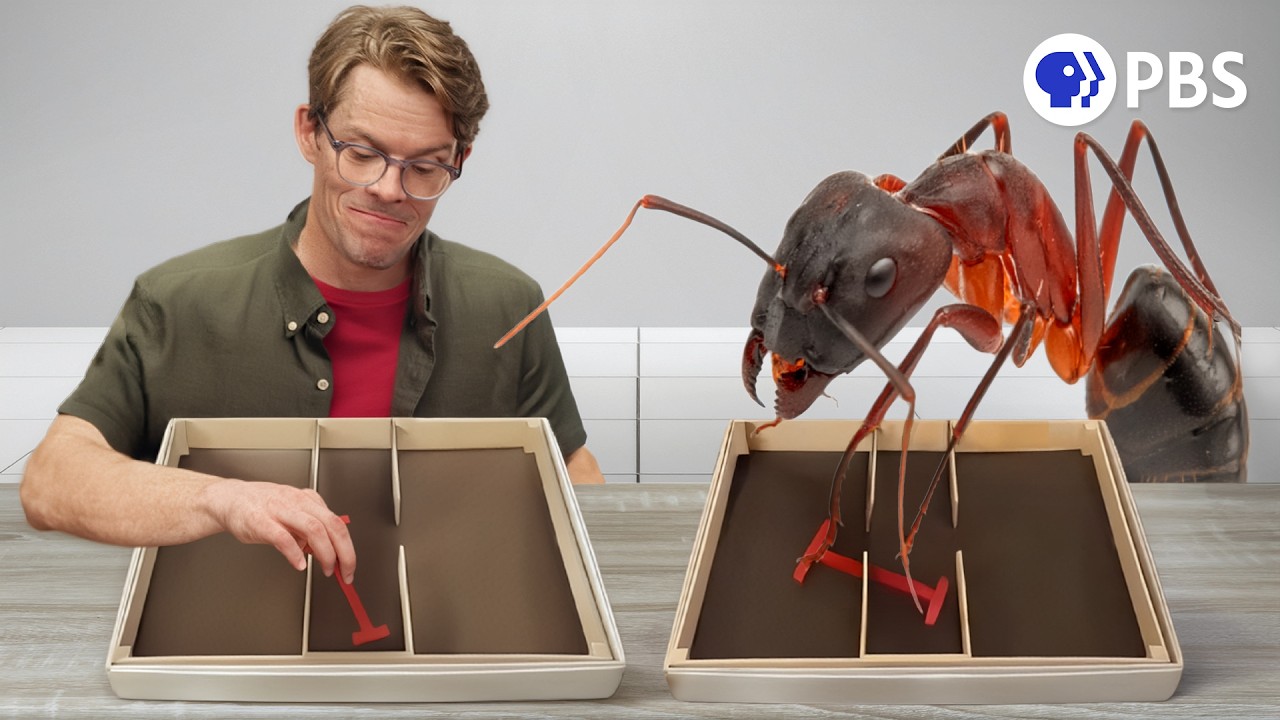
- Thank you to AnyDesk for supporting PBS. Every intelligent animal on Earth has a brain. And bigger brains usually mean more intelligence, more neurons, more memory, more processing power. So you wouldn't expect that ants, each with a brain made of just 250,000 neurons, could beat humans, with brains of 86 billion neurons, in a problem-solving task. Except that's exactly what happened when scientists gave them both this. It's known as the piano mover's problem. To solve this puzzle, this oddly shaped load must be maneuvered in a specific way across an obstructed path. Individual humans can solve this pretty efficiently. - Uh-oh, uh-oh. - Even if it takes a few tries. - [Camera Operator] We ran into another roadblock. What happened? - I had it, I had it for a second. Okay, we're getting somewhere. - Oh, oh. - Oh, we did it. Take that, ants. - But give a group of people this puzzle, tell 'em they can't talk, and something weird happens. The bigger the group gets, the worse they get at solving it. But now give that same puzzle to a swarm of ants. Surprisingly, the more ants you add, the better they do. As a human, this is awkward, because an individual ant is pretty dumb. But it turns out that groups of ants are capable of solving surprisingly complex problems, like building bridges that adapt to traffic, or choosing the most efficient path over an obstacle, despite the fact that no individual ant understands any of this. This is evidence of a different form of intelligence, swarm intelligence. And it challenges much of what scientists thought they knew about being smart. Because if intelligence usually lives inside a brain, where does an ant colony keep its intelligence? (inquisitive music) Hey, smart people, Joe here. All over nature, we see individual animals come together in tight groups. Herds, flocks, hives or schools. And without any leader telling the swarm what to do, stunning and complex group behaviors emerge. It can sometimes feel like the swarm itself is alive, like it possesses a mind of its own. And many of the most impressive examples are found in social insects like ants. Now, when humans play tug of war, something strange happens. Individuals in a group typically pull less hard than they would if they were playing alone. We tend to slack off a bit. And the group is less than the sum of its parts. But in weaver ants, the opposite is true. They use their impressive strength to bend and glue leaves into giant enclosed nests high up in the tree tops. Their secret, the ants divide labor in a unique way. Some act as anchors, while others only pull. When researchers measured the forces created, each ant on average contributed more pull than it could if it were working alone. Unlike in human tug of war, the whole is greater than the sum of its parts. A phenomenon scientists call super efficiency. Now, in the piano mover's puzzle, most humans can solve it after a few tries. - [Camera Operator] Oh, we hit a roadblock. - (laughing) Phew. - [Camera Operator] We did it, okay. - Pretty unsurprising for the supposedly most intelligent animal on Earth, but when more humans are added and individuals are prevented from talking or seeing facial cues, we seem to resort to selfish movements and pulling, which quickly results in worse efficiency compared to people solving it alone. What surprised researchers was that not only can groups of ants solve the puzzle at all, the more ants you add, the more efficient they become. In fact, in head-to-head competitions, a swarm of just 80 ants can beat a group of 16 people. In the wild, there's likely no organism that demonstrates this group super efficiency better than army ants. Army ants are wandering hunters that live in colonies that can easily reach hundreds of thousands of individuals. They're almost constantly on the move in search of prey, only stopping periodically so the queen can lay more eggs, surrounding her in a giant 3D structure made of alive ants. But when they are on the hunt, these ants can travel hundreds of meters a day. Covering those distances is a challenge when you are the size of a raisin, especially in the jungle, when a fallen leaf can create an obstacle dozens of times bigger than you are. But army ants have a clever solution. They build bridges with their own bodies for their comrades to walk on top of. Not only do these extend across gaps, they also automatically widen when traffic is heavy and narrow when traffic is slow. Human engineers have yet to build a bridge that can do that. So how can these ants achieve such complex engineering
Segment 2 (05:00 - 10:00)
when each individual is so dumb? - I'm trying to understand why ant colonies are smarter than human societies sometimes. And the example I like to give is that there is no traffic jams in an ant colony, despite them having very, very tiny brains. - Like Simon, humans have been intrigued by social insects for millennia. 2,300 years ago, Aristotle reasoned that ants and bees were political animals. His term for social creatures, they create and share some larger common good. For the next 2,000 years, people believed these social animals achieved their goals by following the orders of a single leader, like a king or queen, which was surely influenced by the fact that most humans lived under those political systems. But in the 1700s, experiments by a Swiss beekeeper named Francois Huber revealed that a hive's actions are not governed by the queen. She's just one of many individuals with a specialized task. Instead, group behaviors emerge from individual members of the colony interacting with each other and interacting with their environment according to simple rules. Instead of the old idea where one wise individual determines the actions of the whole group, group behavior emerges from individual actions, despite no individual even understanding what the group's goals are. The group's problem-solving ability is spread across thousands of insects, each following simple rules in response to its local environment. What scientists now call swarm intelligence. - When we say, "Intelligence," when we say, "A collective behavior is intelligent," what do we mean by intelligent here? We studied it from the point of view of problem solving. How does a system solve the problem? And the problem for a system is typically understood as something that limits its adaptive value. I need to reach food because if I don't get that food, my adaptive value is gonna drop very quickly because I will starve and not be able to survive and reproduce. - According to this definition, if an individual can solve a survival problem better than chance, they qualify as having some form of intelligence. If a group can solve a problem better than chance and without a central leader telling the group what to do, that group has swarm intelligence, flocks of geese self-assemble into a V shape that slices through the air, providing a lift advantage that's more efficient than a single goose flying alone, despite no individual telling the others what to do. That's swarm intelligence. Schools of fish dazzle and confuse predators by sensing their neighbor's movements and synchronizing their motion in a large group. That's swarm intelligence too. Even the way as humans, without anyone telling us what to do, unconsciously organize into lanes when walking in crowded spaces, that is also a form of unplanned emergent swarm intelligence. Of course, not all group behavior is swarm intelligence. Sometimes animals just hang out, which isn't particularly smart or dumb. And sometimes we even see cases of swarm stupidity. Ants, for example, follow pheromone trails left by scouts in order to locate food. But if this system glitches, it can cause what's often called a death spiral, where ants will be trapped following chemical instincts until they die of starvation. Evolution and natural selection reward species that can solve problems which help them survive. Swarm intelligence does this, but it wasn't until recently that scientists figured out how it actually works. In the 1980s, computer programmer Craig Reynolds argued that we can't claim to truly understand a swarm's behavior until we can accurately reproduce it in a computer simulation. For his first experiment, he decided to tackle flocking behavior in birds. The strategy used by many species to deceive and confuse predators. It's a behavior so beautiful and impressive that it led some bird watchers to claim it was evidence that birds were telepathic. Needless to say, this is not the case. Watching birds fly, Craig asked, "What are the main rules each bird follows that end up giving rise to the flock? What cues do birds use to stay in formation and move in unison? What dials can be tuned, either by evolution or by swarm members learning to change their behaviors? And what happens when those dials are turned? " Craig tested his hypothesis by making a computer simulation called BOIDs or the bird-oid algorithm. What he found is that flocks form automatically when each individual follows simple local rules governing just three different variables. First, how badly the birds want to be near other birds. Second, how far they want to be from their nearest neighbor to avoid collisions. And third, how badly individuals want to fly in the same direction as their neighbors.
Segment 3 (10:00 - 15:00)
He later added a fourth variable, visual range, since the better each individual can see, the easier it is for large flocks to form. But rather than publish this work in a prestigious biology journal, Reynolds presented it at a computer graphics conference in Anaheim, California. But somehow biologists took notice, and his 1987 presentation is now hailed as the birth of a new field of scientific study, swarm intelligence. Today, Simon applies the tools of time-lapse photography and BOIDs-like computer modeling to understand swarm intelligence in army ants. As we glimpsed earlier, when these ants encounter an obstacle, they have a special trick to keep moving. They shorten their path by building bridges with their own bodies. Here they're patching a gap between leaves, and here they're on a track with an adjustable corner. And to most humans, it's obvious that a straight line is the shortest path between two points. But do ant swarms know this too? When Simon introduced this zigzag pathway for the ants to navigate, he knew that a bridge from joint A to joint C would be ideal, but this gap is too wide for the ants to construct a bridge. In response, the ants did something surprisingly intelligent. They started filling in the elbow with a small bridge at joint B, and then they worked their way down. This is a brilliant solution to a rather complex problem. But how do they do it? What rules do ants follow to decide when and where to form and disassemble a bridge? (inquisitive music) Careful observation by Simon and other scientists revealed the ants' tricks. If an ant follows just four simple rules, that seems to be enough to create this complex group behavior. Rule number one, slow down when the terrain gets rough. Rule number two, if the ant in front of you slows down, walk on them. It's a bit rude, but it's what they do. Rule number three, if you get stepped on, freeze and brace yourself. You can even hook legs with a neighbor if needed. Rule number four, when you're no longer being stepped or pulled on, pause for a moment, then march onward. That short pause, the fact that army ants don't crawl outta the bridge as soon as they're not being stepped on turns out to be surprisingly important. Without it, ant bridges usually disassemble too quickly to really be useful, along with physical traits, such as hooked feet, powerful mouth parts, plus strong joints and exoskeletons that can withstand heavy foot traffic, these four rules are essentially all that army ants need to start building living bridges. It's estimated that at any moment, 20% of a colony is locked in bridges. And since any ant stuck in a bridge isn't available for other tasks, this is a costly habit. But the advantage it provides to the colony and to the egg-laying queen is clearly worth the sacrifice in the eyes of evolution. So how did those ants solve the piano mover's problem? These ants seem to communicate simply by how hard an individual is pushing or pulling in one spot. That's one rule. And when the ants run into an obstacle, they slide along it rather than reversing course and bouncing around randomly. That's rule number two. Simply by being persistent and responding to force, this results in a super efficient method for exploring many possible solutions, and allows groups of ants to quickly converge on the correct path rather than bouncing around inefficiently. So where does an ant colony store its intelligence? (upbeat music) It's not kept by any one individual. Instead it's spread through thousands of individuals, each following simple rules in response to local cues. These rules can be figured out through careful observation and tested in computer models to make sure that we can replicate what we think we understand about the natural world. And scientists are applying this knowledge to solve human problems. Simon's working with city planners to design better traffic systems that will create fewer traffic jams, and designing a self-assembling robotic conveyor belt system for use in construction sites and disaster relief situations. When you think about it, the human brain itself is a collection of individual neurons, no single neuron aware of its purpose or any larger goal, just simply responding to local signals. But the result is you, the greatest intelligence in the universe, at least that we know of. Stay curious. And thank you to AnyDesk for supporting PBS. AnyDesk was created to provide fast, secure, remote access, whether you're working from home, on the road, or managing systems across multiple locations. With AnyDesk, you can remotely access computers and servers directly, enabling secure file transfer without relying on consumer cloud storage.
Segment 4 (15:00 - 16:00)
And if you're working on servers or older systems with remote server monitoring and CMS access, you can control dashboards and monitor web servers directly from your phone or tablet. Plus it's available across all major platforms and has backwards compatibility with older systems in case your data's running on legacy systems. AnyDesk is available for personal use. But if your research requires a lot of global coordination, AnyDesk offers custom-tailored business plans. To learn more about AnyDesks, go to anydesk. com/besmart, or check out the link in the description. And as always, thank you to everyone who supports the show on Patreon. We could not make these videos without your support. In a world full of AI slop, we want you to know that "Be Smart" is and always will be a handmade product of real human brains. Pretty intelligent ones too. If you'd like to help us keep making this show and join our super intelligent hive mind, well, you can check out the link down in the description. All over nature, we see. (babbling) Uh. My phone's ringing. I can't talk to you right now. There we go, all right. (table smacking)