2-Minute Neuroscience: Brown-Séquard Syndrome

2-Minute Neuroscience: Brown-Séquard Syndrome

Machine-readable: Markdown · JSON API · Site index

Поделиться Telegram VK Бот
Транскрипт Скачать .md
Анализ с AI

Оглавление (1 сегментов)

Segment 1 (00:00 - 01:00)

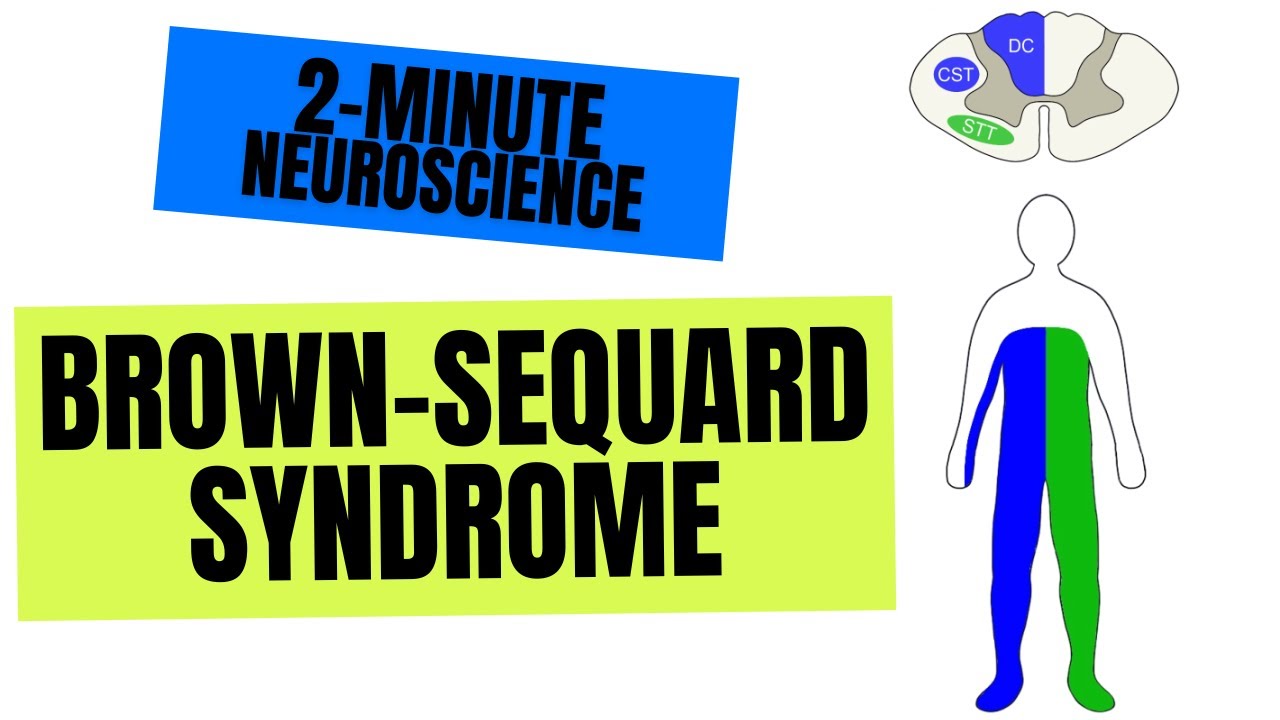
Brown-Sequard syndrome is a rare neurological condition caused by damage to one side of the spinal cord, a situation referred to as hemisection of the spinal cord. This type of damage results in a distinct pattern of deficits due to the way different nerve tracts travel through the spinal cord. Brown-Sequard syndrome involves weakness or paralysis below the hemisection on the same side of the body as the damage, because the spinal cord damage affects the corticospinal tract. The corticospinal tract carries movement signals from the brain, and it decussates–or crosses over–in the brainstem before continuing down into the spinal cord. The corticospinal tract on one side of the spinal cord is thus carrying movement signals intended for the same side of the body, so when it is damaged those signals can’t reach that side of the body below the injury, leading to weakness or paralysis on that side. Damage to one side of the spinal cord would also result in deficits in touch, proprioception, and vibration sense below the hemisection on the same side of the body as the damage. These deficits are caused by damage to the dorsal column, which carries these types of sensations up the spinal cord from the same side of the body. Although the pathway does cross over, this doesn’t occur until it reaches the brainstem, so spinal cord damage to the pathway causes deficits on the same side as the damage. Brown-sequard syndrome also causes deficits in pain and temperature sensation due to damage to the spinothalamic tract. The spinothalamic tract fibers cross over soon after entering the spinal cord. Thus, the right side of the spinal cord is carrying pain and temperature sensations from the opposite side of the body. Therefore, pain and temperature deficits in Brown-sequard syndrome are experienced on the opposite side of the body below the hemisection.

Другие видео автора — Neuroscientifically Challenged

Ctrl+V

Экстракт Знаний в Telegram

Экстракты и дистилляты из лучших YouTube-каналов — сразу после публикации.

Подписаться

Дайджест Экстрактов

Лучшие методички за неделю — каждый понедельник