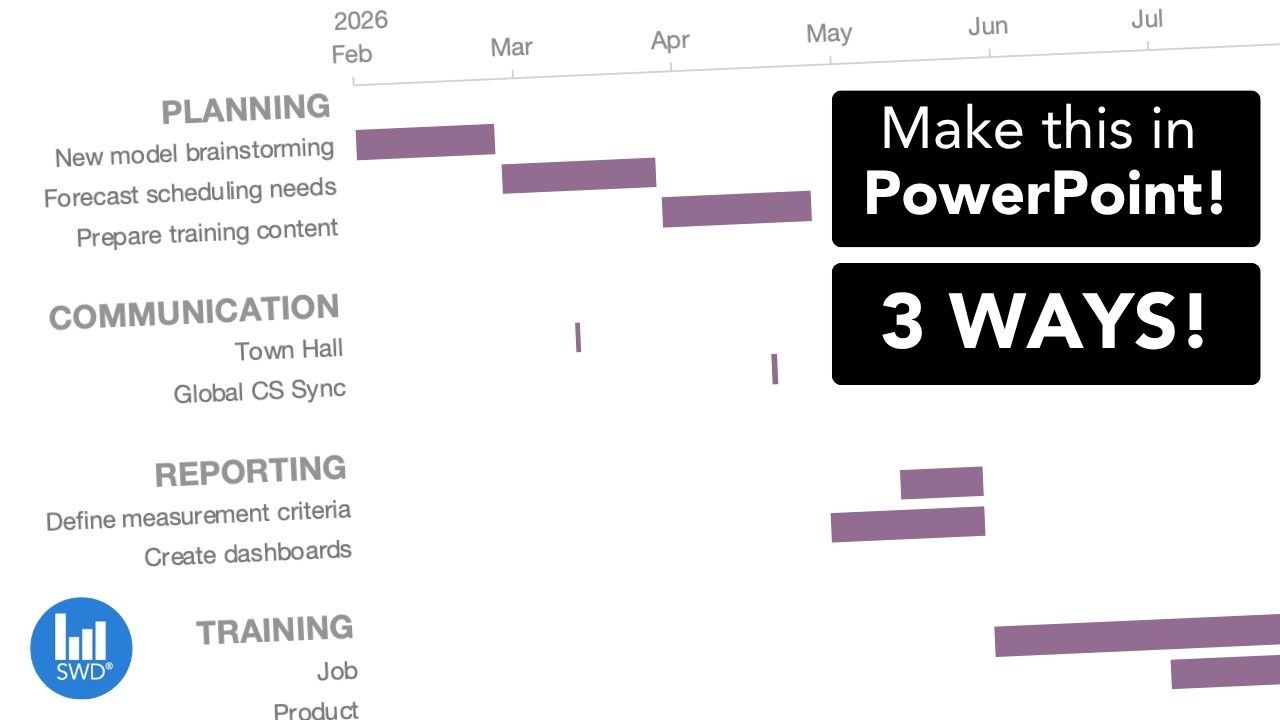
I want you to imagine that somebody sent you these six slides. How would they make you feel? I know the first time that I scanned them, I felt both overwhelmed and confused at the exact same time. Now, the most common reason that presentations don't work out, is because folks don't spend enough time planning, thinking critically about the people on the receiving end, what they care about, exploring different narrative flows, and truly defining what success will look like. This is the exact topic that I dive deep into in chapter nine of our brand new book, Storytelling with Data before and after. I share all of the strategy and thoughtful planning that I have to do to turn these six slides into something that is truly actionoriented. Now, in this video, I'm going to share the results of that thoughtful planning and what that presentation could have looked and sounded like. Let's jump in. We are quickly approaching the launch of our brand new customer service model. In fact, we are just one month away from that go live date. So, I'd like to have an open and honest discussion today about where we stand. Now, we'll start specifically by reviewing why we need a new approach to customer service in the first place. And then we'll take a look at the project timeline and discuss where we are today with regards to go live and answer the very important question, are we ready? So, let's start with the first item on the agenda. Now, it's easy to forget what our goals were with this project, but to put it simply, our current approach to customer service doesn't work. It doesn't work for our employees, and most importantly, customers. Now, in a recent employee survey, one customer service representative shared, "Things are frustrating right now. I don't feel like I'm helping customers as effectively as I should be. " This sentiment was further supported when we started to look at our customer satisfaction scores. So to break this down for you, we'll look at satisfaction scores across a couple of different dimensions. Along the vertical axis, we have satisfaction scores from our customers that recently interacted with the team. And this is the proportion of folks that feel positively after interacting with us. And you can see that overall our satisfaction score is right around 84%. We have incredibly high standards on this team and our goal is always to be at or above 95%. Now, we can break down these satisfaction scores by the time that it takes to resolve a given ticket. And when we do this, I'd like you to notice two things. First, the longer it takes to resolve a given ticket, the lower the satisfaction scores tend to be. This is evident by the decreasing bars as you scan from left to right. I'd also like to call out that even when we resolve a ticket quickly within 24 hours or 48 hours, the scores are still below that minimum threshold of 95%. So, what this tells me is that our approach isn't working. But our new plan will. Our new plan is a massive departure from what we know today. We'll take the entire customer service department and divide it into two highly specialized teams. It will have better staffing which will enable us to provide faster and more effective responses to our customers. But doing this takes time. So I want to shift next to the project timeline. And I'll admit when I look at this, we were a bit ambitious when we first embarked on this project. We actually estimated it would take approximately 9 months if we started in February. Now we divided all of the tasks necessary to complete this overhaul into four main phases. We've got our planning phase, communication related tasks, reporting updates, and most importantly, all of the training that would be necessary. Now, we are well into this effort, which means we have already completed the first three phases of this project. And I am happy to report that we were able to adhere strictly to this project timeline for phases 1 through three. But that means we are currently in phase four, all about training. And our training phase is divided into three highle modules. We have on the job training, product knowledge as well as skills training. And according to this timeline, we should be within that third module. Unfortunately, that isn't the case. We severely underestimated how long it would take us to complete that first module. This is largely in part to the increased call volume that the representatives are facing on the floor, impeding them from actually completing their training. A more realistic timeline means it would take us approximately five months to complete that first on the job module as well as an additional two months needed to complete the second modules product knowledge and skills training. So just to quickly summarize where we stand within this fourth module, we are currently about 60% of the way through the first module and most of the team still needs to complete their second and their third training modules. Good news is that these final modules are much shorter to complete in duration. So coming back to where we started, I know
Segment 2 (05:00 - 05:00)
folks are concerned and as the project manager, I am also too concerned, which is why I'm recommending that we need to strongly consider delaying go live, take the rest of the year to fully train our staff. That way we can start the next year with our brand new model and ensure that our employees and our customers are both happy. Now, if you enjoyed that transformation and you like learning via examples, then you are going to love our brand new book, Storytelling with Data Before and After. It's co-authored by myself and colleagues Cole Naspck and Mike Cisneros. And together, we share 20 examples of how we helped our clients transform their business communications. I'll leave links in the description below if you want to grab yourself a copy. And if you have any questions about the book, be sure to let us know in the comments.