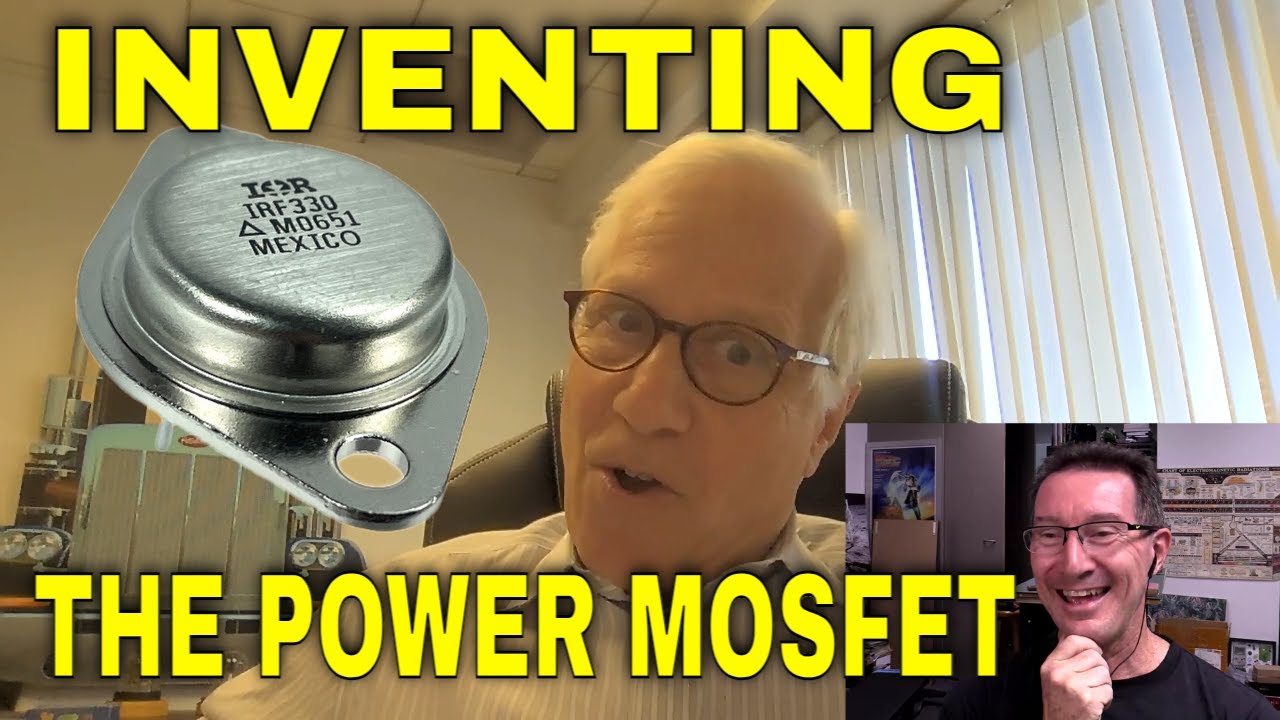
Welcome to the Amp hour. I'm Dave Jones from the EE log — and I'm Alex Leo from uh efficient power conversion. — Thank you very much for joining us, Alex. This is going to be really interesting because I'm into history of um silicon companies and um a lot of people will not have heard of um efficient EPC, efficient power converters and we'll get into that. Um but can you tell us about your background because they might know you better as uh the former CEO of International Rectifier which was founded by your father and grandfather. — Is that correct? Correct. It was founded by my father and grandfather in 1947 and I joined them just after uh getting my PhD in 1977. So this is my 50th year in the business. — Uh and uh you know try to match that for a moment. — A long time in there. — That's impressive, — right? And uh my first challenge was to build a better transistor. and uh my friend from graduate school Tom Herman and I um came up with something that's now called the power MOSFET uh and we developed that uh in the you know last couple years of the 70s and um that was uh you know really replaced the bipolar transistor and it was the beginning of my journey to constantly you know find better ways to do power conversion um so I was an R&D engineer international rectifier eventually I became head of R&D then and manufacturing And sales and marketing. Then I became CEO. So it was a kind of a progression through the range. — When did you become CEO? When did you join C? — 1995. — 95. Okay. Yeah. And that end and that ended in 2007 when you formed efficient power converters. — That's correct. uh started EPC in November actually the end October of n of 2007 and we launched our first product in June of 2009 and actually went into mass production in March of 2010. So um you know since then uh you know we've filled out the line with hundreds of parts and many generations of technology iteration but the main thesis was number one uh make better power devices using GAN silicon and then number two is progress from discrete transistors into integrated circuits. — Uh and so we've been on that journey uh for you know what is about 18 years now. And uh that's the strategy we started with. It's still a strategy. — Awesome. Well, we'll definitely get into the GAN stuff um because that's what you guys are doing now and that's what everyone's talking about these days, GAN power transistors, how efficient they are, etc. Um can we go back to the um international rectifier days, you invented the hex fet? — Yes. — Well, actually before that the power MOSFET um we had the basic patents on power MOSFETs in general. Uh there were MOSFETs that conducted power before us, but the power MOSFET um as it became, you know, commercially viable was really a development that just very few of us were involved in. And our patents over the years brought in almost a billion dollars in royalties. So we were the only ones with basic patents on MOSFETs, now long expired. But uh you know, the HexFet was just a follow on to that. Um and uh it was one of those late night uh epiphies — uh where Tom Herman gave me a call at 2 in the morning and said, "Hey, I got an idea. " And uh you know, we went from there. Of course, there are others involved, but Tom and I were kind of the core element of most of that, — right? So, can you explain what makes the hexfet different to a regular power MOSFET at the time? start with like what made a power MOSFET different from a just a regular signal MOSFET and then what makes a headset different — difference was you know um and uh maybe I'll give you the background here as well is um you know bipolar transistors were the dominant force in those days and bipolar transistors were used for a whole host of things you know from driving motors to uh making power supplies and they were very limited um in speed — they're also fairly delicate. They had a safe operating area problem and they also had limited gain. So, you know, it was a little bit more challenging. — They were delicate. Bipolars were — Very delicate back then. — Oh, because they've got the reputation these days of being, you know, robust, solid, as opposed to FETSS which are, you know, not as robust. No. — Wow. — No. the well I mean maybe a low voltage
Segment 2 (05:00 - 10:00)
but at high voltage they had a glass pacivated trench around them and that glass cracked and it was a problem. Um, so, um, when I came to work at the International Rectifier, my marketing, uh, um, boss was a guy named Bill Collins. And he was a grayhaired gentleman, very wise and very smart. And, um, you know, I knew him for the rest of of his life, and he was became a very dear friend. But he came in and I remember the very first day I'm starting, I'm just right, you know, like fresh out of graduate school. What do I know? Nothing. And he came in very stern and he said, "What's the definition of an engineer? " I kind of looked at him. Not quite sure. Said, "An engineer is somebody who can do for 50 cents what any damn fool can do for a dollar. Now get to work. " — And he's right. — Oh, love it. He was right. Yeah. — it was true. and it became, you know, almost a little bit of a motivating force. — Now, um, a couple of weeks in, and it was just a couple weeks in, it was between December 26th and I guess February 8th, 1978 was exactly uh, how long it was uh, in that period. Uh, he came to uh, you know, to me in my desk. I was in a you know, communal area and said, "I know what we want to do. " Well, what's that? 400 volts, 1 ohm. — And — which was a big deal. 1 ohm was hard back then. — Yeah. Well, it had never been done. And 400 volts, that was a high voltage device. And 1 ohm. — And of course, I asked why. He said, well, because 400 volts, 1 ohm means that you can make an ACDC switching power supply using a single-ended flyback topology. Said — if you can do that, you can get that business. So, you know, Tom and I went about doing it and actually were able to fairly quickly achieve that. Uh, when I say quickly, we launched our products in November of that year. Um, and uh, those products were not hexfets. They had a racetrack and I remember drawing it on a uh on a drafting table, every little line, every little line over and over again to make this huge 200x scale. um uh design uh and um and we launched that in um in November. Um, but one of the problems was in uh July of that year, we got our very first uh run through. And uh in that time, Tom and I and a couple other people, we would actually run in, we were working in the fab 24 hours a day. And the first ones didn't work. And they weren't 400 volts 1 ohm. They were 400 volts 2 ohms. — Oh, no. — You know, that's Bill Collins was very, very strict about these things. says, "Well, it's not a product. " So, we ended up — So, so Tom and you know, after kind of going through the five stages of grief, we went back to the drawing board and Tom pointed out um that I'd made a mistake in one of my dimensions — and instead of a 15 micron separation between these two these two openings, I'd made 10 microns. And just to give you an idea, that was the scale of one little tick on this huge Myar sheet. — But it meant throwing everything out, — starting over. You know, it's not the sort of thing that was even that obvious. — Um, but he figured that out because he went backwards from what was wrong with the device and said, "Well, so, oh Jesus. " So, um, you know, kind of going through the five stages of grief. And I remember I was I was, you know, obsessing on this thing. What do we do? you know, how do we start over? It took six weeks of drawing of that thing day and night. It was just incredibly difficult. — Um, and that was without taking any holiday going 12, 14, 16 hour days. So, you know, I was facing that and how can I make a November launch date. Um, and I remember fairly clear I was going underneath a bridge, you know, here in Los Angeles, uh, a freeway actually. And all of a sudden an idea came to me. Uh it was July 22nd to be specific. And that idea was — You remember the date? Okay. — Oh, I remember the moment. Um you know it was one of those flashes — and um you know the the uh the idea was to inject extra charge in that too narrow region which would in effect make it look wider to the electrons. And that became one of the basic inventions uh of the MOSFET. It worked not the first but the second time that we tried it. Uh and
Segment 3 (10:00 - 15:00)
immediately the device went from 2 ohms down to 7 ohms. It was even better. — Oh, nice. You and now you have a product — product. — You have a viable product — just in time. — How did you inject the charge into there? How — for those who don't understand that? — Yeah. But the idea that you put charge there was the innovation because that was, you know, kind of new thinking. So we were very fortunate. We got it out in November. Um and it became a hit pretty quickly in November 1978. Uh and um I remember you know lots of people wanted these things that were lined up all over the place. And one of the early um uh applicants uh for you know samples was um Apple — Steve Waznjak wanted it for a power supply that would go inside of his um Apple what turned out to be the Apple 2e but also fairly quickly after that um IBM wanted it for uh their power supplies for their desktop computers. And that became one of those crossing the chasm moments because the single-ended flyback uh wide ranging ACDC power supply became a standard. They made millions of those um computers all over the place. Initially they were very standardized on our MOSFETs. Of course eventually everybody else came into the business but by then we had a whole barrage of uh patents and by June actually by February so we launched it in November and by February was when uh Tom came with this idea of you know why don't we just make a cell out of this instead of a racetrack. We figured that was about three times higher density. Uh and so by interesting — 1979 so that's only eight months later — we launched the hexfed and that became because of the 3x difference in d size that became commercially um obvious against the bipolar transistor — and that was the IRF130 wasn't it the first — well the very first part was the IRF 100 at 100 volts and the IRF 300 at 400 volts uh the very first hexfets were the IRF130 uh and the IRF uh 330 both in those famous TO3 cans which — now you can — look it's very obsolete. So what made you choose the hexagonal pattern? Because other manu So you guys had a patent on the hexagonal thing. Is that right? And other manufacturers couldn't copy the hexagonal. They had to use some other pattern. Is that — And many of them did. But the reason we use hexagonal um was that if you look at a hexagonal pattern like a beehive, you notice the hexagons are offset, right? And every angle in a hexagon is 120 degrees. Um, so if you look at depletion in high voltage, this depletion region spreads out like that. It perfectly meets right in the middle. So you always have the lowest possible electric field. If you have squares that are aligned like this, then you always have a hole in the middle, which is a high electric field point and cause premature breakdown. If you have offset squares, you still have 90 degree angles and that extra curve lowers the breakdown voltage. So, we figured that out uh way before anybody else. And then people were imitating it was squares and you know it just wasn't quite as good and they couldn't charge thing. And you know by you know maybe mid to late um 80s well mid 80 1986 we started getting people that were imitating our devices uh and um but we had you know free reign until then. — Right. Yeah. I can remember using the hexets back in the mid to late 80s and they were like wow you know nothing else touched it. It was — it was fantastic. Yeah it was gamechanging. So IR had the um market sewing up fairly much. — Yeah. Well, look, our market share, you know, we built a huge factory. We all this stuff, but, you know, over time there were big contenders, you know, comp competitors in there. All the Japanese jumped in. Uh, Motorola, which had a huge share of the bipolar market, uh, was finally came into MOSFETs, but late. Um, you know, Seammens was making them. Um, gosh, we had RCA, General Electric, um, Hula Packard. Uh it was just a long list. Uh and — paid fits. — Yeah. — Really short period of time because they could not compete. — Yeah. They stopped pretty quickly.
Segment 4 (15:00 - 20:00)
— But we had, you know, NEC, Matsushida, Toshiba, Hitachi, uh Oki Electric. Um they all jumped in on this. Uh at one point there were about 42 competitors. Uh and uh we wound up licensing 25 and about 17 fell out. — Wow. And they're all merged or gone now, I guess. So, — well, you know, they're in different embodiment. I mean, Infinion is a very powerful uh company and that's the spun out of uh out of Seammens. — Um so, but I think that's kind of the only one. Motorola pretty much died now. There's on semi but it's not really a factor in this business. Um so really Infinine is the survivor of that and eventually they're the ones that bought international rectifier. — What have been the major innovations in FETSS transistors over the years? Your power MOSFET was one, hexfet was another. What other technologies have there been that were like really major huge stepups? Because like one two ohms is like one ohm for a FET is like was low back in the 80s but now it's like no it's nothing. — Yeah. I mean now we're talking micro ohms for the same size die. So yeah it's very different. Um so you know first step you know power MOSFET. Second step I would say you know most people would agree hexfet was a big step forward. I think the third step was in the um later 80s was the IGBT. uh and that is really a variant of a FET in that it trades the lowresistance N plus substrate with a P substrate. — Uh and all of a sudden it acts kind of like a bipolar transistor and a MOSFET and at high voltages that results in a lower effective on resistance. So high voltages started to be addressed with IGBTs. Um but not to be outdone by that you know uh um Seammens now infinon developed something called Kumos. I'm not cool. — Oh yes I remember the cool moss. Yeah. Well they're around still. Yeah. Kumos. Yes. — Right. And it said that to us. What was that? — Very well was a very smart thing. And what it did was um it's now called a superjunction fat is they actually put multiple levels of uh grown silicon or epitexio silicon and on each level they would define you know openings. So the you created these columns of ptype semiconductor that were almost vertical. Uh and so it caused the conduction to go down this way through that sort of through that tunnel and in when you were blocking the tunnel basically depleted and closed off. The net effect was you could go to much thinner silicon and you would get two 2x maybe even 3x improvement in the onresistance for a given area. And that was a real big step forward and again now the MOSFETs were competing against IGBTs at higher voltages and you know that that tension was going on there. Uh so that was I would say that then you know the next one was probably trench moss uh which was pioneered by viche in the like 1994 time frame. — Yep. — And that got — Yep. When it came — Yeah. And that started replacing the hexfet style which was a planer device started replacing that slowly slowly. And today virtually all MOSFETs are trench uh MOSFETs. — So you know that was the obsolescence of the hexfet concept. Although the hexfet concept and that planer fetron concept still is the dominant form of um IGBTs and of silicon carbide. — So it's still — that was another innovation, wasn't it? Silicon carbide. Well, then we get to sil carbide and silk carbide showed up as a diode in the late 90s and then in the early as started showing up as a transistor um and then you know and it starts started a process to replace the IGBT uh because it's really in the same wheelhouse. It's higher voltages. It's faster switching, but it's not blazing fast. But at high voltages, you don't care about blazing fast because it makes too much noise when you switch, you know. — Yes. Oh, of course edges. Yeah. If you're switching 600 volts in, you know, super fast, — right? And — have all sorts of issues.
Segment 5 (20:00 - 25:00)
— In 1999, Japanese researchers figured out how to grow gallium nitrite as a thin layer on top of silicon. Um and that I learned about in the early as uh and um that switched on a light bulb because it told me that um you can overcome the cost problem of a compound semiconductor. And you know just to bring out what that cost problem is you know the silicon is very cheap and it's actually very cheap because well it's heavily toled right there's a lot of capital investment but fundamentally it's cheap because the bond between silicon atoms isn't very strong. Okay so you don't have to put a lot of energy into the system to create the crystal. Now silicon carbide has a real strong bond. That's what makes it a wideband gap because it's hard to peel an electron off that band uh off that bond. So that's what makes it wide gap. It also makes it expensive because the energy of formation is a whole lot more than silicon. So you can't really ever have a silicon carbide crystal that'd be as cheap as silicon. Doesn't matter what you do. So but what about gallon nitrite? It's also wide band gap. also has a stronger bond. But if all you do is you lay a micron thin layer on top of a standard silicon, you don't have that cost of growing the crystal. So that was a big light bulb. Gallium nitride also has higher electron mobility. Um gallium nitride because it's a wide band gap means you can bring high voltage terminals closer together without a spark you without breaking down the crystal, without pulling that electron off. So you can create smaller dimension devices um in high voltage than you can in silicon. Uh and also it has a miraculous thing called a two-dimensional electron gas which is a quantum mechanical gas that scoots along the surface and allows you to make very efficient lateral devices but so much more efficient than a vertical silicon device. um you know a MOSFET than it could ever dream to be. Theoretically 6,000 times more efficient. So there's a lot there. — Wow. Um, you said quantum gas. How does that I've never heard that term before. — Yeah, it's a beautiful thing. It's called a two-dimensional electron gas or two deck. Um, it was first um I'll say theorized in the '9s and then experimentally verified. Here's how it works. Gallium nitride as a crystal. It's a wartsite blend crystal. But what that means is it's polar crystal. And if you have something polar, it means that if you bend it, it generates a charge. Okay? If it's not polar, doesn't matter what you do. Silicon is not polar. So you bend this thing and it makes a charge. So what you do in gallium nitride is you grow gallium nitride crystals, a thin layer on silicon, and then you put a very thin layer of something that squeezes the surface. In this case, aluminum gallium nitride. So it squeezes that surface with you know the intensity of a hetererojunction which is you know that is very intense. So intense that it generates 6 megs per centimeter electric field and it does that really over an extremely small just a few angstroms uh distance. So now you have this huge electric field. What that does is it sucks every electron that it can think of up to the surface and hits this very intense field and it squeezes the electrons so much that they actually become quantum mechanical and in that sense they become a unified electron gas. Um, and because it's no longer individual electrons but it's a an electron gas, it has much higher mobility. Right? you're now dealing with a very different transport mechanism than electron hopping from sight to sight. This is just everywhere all the time anywhere. Um and uh so that allows gallium nitride to be extremely efficient as an N you know an N type uh transistor. Uh there's no equivalent on the P side. So there is an equivalent but it's not very good. So you really don't have PT type GAN as a result. So anyway, so 2007 I I realized that silicon now MOSFETs was really just a game of cost. Uh and cost is won by the person with the deepest pockets. Um and that's not so much fun. So uh I started uh EPC on the idea that
Segment 6 (25:00 - 30:00)
we can make gallium nitride transistors and then integrated circuits that can do power conversion more efficiently. And that's how that happened. — Wow. So, how do you just decide to start a semiconductor company? Like, did you use your own funding? Did you get external funding? Because I imagine it's not a cheap enterprise to just go, "Oh, I'm going to start my own semiconductor company. I'm Well, you probably could do it bare bones, but — No, I mean, necessity is a mother invention. So, you know, in 2007, I got into a you know, sideways with my board of directors and they fired me. So, I got fired. — Oh, they did? — Yeah. So, I was without a job. — Uh, and Wow. It was Yeah. I mean, it was a terrible story. They did it based on very false pretenses. Somebody wanted to take over. It was a real bad, nasty story. But here I am out there, you know, uh, 50some years old and, um, without a job. Um and so I thought what is the best combination of my skills uh and knowledge and you know throughout my career I I've never not been a device physicist and an engineer. You know I may have been a bureaucrat but I always kept up on this stuff. — Awesome. — Um so I went back to hitting up the books and relearned all my device physics. Uh spent nights and days and all this. Um, and I came up with the thought that what we can do is we can if we can make gallium nitride in a standard silicon foundry side by side with silicon wafers, it would take very little capital to get going. — So, no one had done that before. — No, they not only that, but when I suggested it to the first couple of foundaries, they said, "You're crazy. We're not going to let gallium into our silicon fab. That's a contaminant. " — Oh, okay. Yeah. So, oh no, we're not going to do that. Um, so, you know, I got my bag in hand and I keep going around. But then I went to a person who I'd done business with for several years uh who actually owned Foundaries. His name is Archie Wang. He's a very brilliant. He's a device guy from the beginning as well. And um I talked to him and he had kind of an older 6-in fab that was maybe running down on usefulness. And I suggested him that he let me run my gallium nitride wafers in there. And he said, "Okay. " As a matter of fact, I remember in the meeting, the very first meeting in Taiwan, he said, "I'm in. Let's try it. " — Um, — awesome. And — and he's been my partner ever since. Uh, and, uh, he's been a phenomenal partner because we never had venture funding. It was just him and me. — Um, — wow. Okay. So you were just doing you were designing this yourself and just using his foundry. He was the part. — No, I wasn't designing myself. I had colleagues. We hired people. — But I'm saying in terms of writing the checks, it was, you know, Archie and me. — Uh and still is. — So wow. And you know so um and so you know me and my co-founders which is Bob Beachch and Joe Cow they've been they were co-founders they took a huge risk by leaving international right to fire to go uh you know leave with the uh you know the fired CEO um — so you're the traitorous three in instead of traitorous eight. And now you went straight. — They kicked us out. It wasn't that we went. — Uh so they had nothing to uh to fall back on there. So um so we started, you know, doing this thing in Archie's foundry side by side was so was working pretty well. So then Archie said, "Hey, I want to invest in this. " And he did. and it became an investment partner and we grew together and um you know developed more and more product but it's certainly a lot cheaper than building from scratch a wafer fab. So uh we were able to do it you know much less expensive than you might have thought otherwise. And um over the years we moved not moved but I added to our foundry an 8 inch foundry that's Vanguard International. Uh they're doing a great job. We have so we have two foundaries now. Uh and then we started building integrated circuits and a higher and higher percentage of our product line is now integrated circuits. — But what do you mean by integrated circuits? What because as far as I know you only manufactured GAN power transistors and that was it. — What are the integrated circuits do? So eight years ago you know first of all power conversion uh most power conversion my estimate is 80% of power conversion um has a sub element that is
Segment 7 (30:00 - 35:00)
a half bridge that's a high side and a low side fat they have drivers and then they have a level shift and that's how almost everything's done you have full bridges you have three-phase bridges for motors you have all that bridge so the thought was well let's integrate a bridge um and in 2014 we integrated created a half bridge. Um, and then in 2017, we added all the driver circuitry and the level circuitry, level shift circuitry, uh, and protection circuitry. And that became a hit product, particularly with, uh, motor drives. And today, you know, a large number of those humanoid robots use our integrated circuits for all the motors and uh, and stuff like that. So that became um a thing and you know again half bridg is used for a lot of stuff. So we're making half bridges that work in audio amplifiers, DCDC converters, humanoid robots, uh drones, all sorts of things. So that's become a significant business. Now in parallel um we also started u making rad hard devices because fairly early on um based on again experience from international rectifier um I had been an engineer developing radiation hard transistors when I was still an R&D engineer um and I recognized that gallium nitrate had some unique properties that would make it virtually impervious to so we developed a bunch of radiation hard stuff and now we have radiation hard transistor the radiation hard IC's and you know all the new satellites are using it uh we have you know a large market share up from nothing five years ago uh and you know eventually it'll be 100% share — can you explain how the radiation hardened works you said it's basically immune by design or how does — partially by design and partially intrinsic so in a power MOSFET um and in any MOSS device you put it in space and the weakest element is the O the oxide uh because silicon dioxide traps electrons. So when you have gamma radiation um which is basically electrons or even charged protons um they all will trap in that oxide and the more that trap the lower and lower the threshold voltage goes until it goes below zero and it becomes a nonfunctioning device. — Oh so it's a buildup thing. It builds up. — Yeah. Well, that's one point. — Interesting. — Second problem. Second problem is that um if you have a massive element like a neutron or proton or gold or some other heavy element, xenon, whatever, and they come crashing into your device, um it cracks the crystal. It's like a bowling ball, you know, cracks the crystal. It's called displacement damage. Um and uh the good thing is that GAN has a very strong chemical bond. So it withstands that much more than silicon does much way beyond the horizon of these satellite lifetime. Um so that's a second thing which you know is intrinsically better. And the third thing is that if you design it right, when one of these charged particles comes screaming on through, it doesn't create a spike in electromagnetic radiation or in spike in the electric field which can destroy the device. That's a lot of design involved in doing that. So by solving those three problems, we created devices that are, you know, they're basically they're not the thing that's going to fail in your satellite and you don't need shielding to to do it. So they become very popular. — How much of the satellite market do you have? How much as far as power semis goes? What? Well, so we have about 30% of the MOSFET business, which — which used to be 100% infinon and it was based on designs that I did back at International Rectifier. So those are kind of old designs that were now uh now obsoleting. Uh and uh you know it'll eventually go up to you know they'll be legacy satellites that'll use MOSFETs forever. Uh but you know anything new is going to use K. — Fascinating. So um people think um GANs are associated with high voltage stuff but that's not true. They're lower voltage like you know two 300 volts maximum are they not? — So if you look at the market for just say power MOSFETs for a moment um 75% of that market is less than 200 volts um and only 21% is greater than 400 volts. So there's a little slice there between 200 and 400 but it's very insignificant. So the high voltage stuff which you hear about because you're a
Segment 8 (35:00 - 40:00)
consumer um is actually you know about 21% of the market. And why do you hear about it? It's because everybody talks everybody knows about fast GAN chargers which was a you know a brilliant thing by Jean Sheridan and Navas absolutely brilliant um where they found this uh this niche that could then bring GAN to the forefront of people's minds. So now people know about GAN and that's great. In the meantime — it's it's actually branded everywhere. It's like a big GAN on the side of, you know, your phone charger or whatever. — Brilliant. It's brilliant. And but that market, that 600vt market, very small fraction of it is a premium market. And now because so many people jumped into it, it's very small. It's a premium market because it's just a commodity. There are a bunch of people selling it and nobody really cares about the performance. They only care about the price. So that was my experience at international rectifier with 600 volt MOSFETs and IGBTs is nobody cared about performance. They just wanted a lower price. So when I started EPC I said I'm not going to do that. I'm going to go to where everybody when I was making MOSFETs everybody was saying I want something faster and I want something smaller. So, our business started off and stayed in the 200 volt and under range, which is a performancedriven market. It's also 75% of the MOSFET market, not 21%. So, it's the much bigger market and a much higher percentage of that is a premium performance market. So, that's why our margins are above 50% uh and we're growing very rapidly. Um, and I think that we have a defensible position uh, competitively as well. — Have you ever encountered um, like I believe there's lots of fake GAN marketing out there because like as you said like the consumer market's caught on that oh if it's got GAN on it means oh it's super good, super efficient, whatever charges my phone faster but people will slap. Have you found that people slap like GAN on the side of things and they're not really using — GAN char? They haven't done that with our stuff because our stuff tends to be in AI servers, humanoid robots, drones, and and satellites where people the consumer isn't really exposed. So, it doesn't need that fake branding or even real branding to get the emotion, you know, because it's the emotion. I got something cool. I got a GAN charger. — Yeah. — Well, what's cool is it's small and and compact. The fact that it's GAN is really irrelevant to the user, but if it becomes an emotional connection, they'll buy it. — Yep. Exactly. How many competitors are there in the GAN market? How many manufacturers out there of GAN true GAN transistors that compete with yours or at least their GAN? — I don't even know how many there are in the uh higher voltages, but I'll name a few of them. And then in low voltage, we only have two and that's Infineon and Inoscience. But in the high voltage you have um Infinion, Inoscience, ST Micro um uh Na'vi um Power Integrations um oh gosh, you know, Rome, uh Anchora, keep going. You know, they all go on and on. — Um and they all go after high voltage because, you know, it's the thing that has the brand on the side of it. So, it's a shiny metal object that you can be attracted to. But we've stayed in an area and there are only two competitors and they really are nowhere near as high performance as our devices. — So, um we can get the — So, there's no Asian competitors. There's no Chinese companies like making or attempting Oh, Inosciences. Okay. — Yeah, it's Chinese. They were started with government funding. Uh the purpose of imitating us. uh and u you know we've uh definitely taken them to task with our patents and we're locked in uh patent battles uh in a couple of different countries. So it's um you know — how hard is that in China to how hard is it to enforce your patents in China? Is that a difficult I've heard it can be difficult. — So I'll make a statement that will probably be somewhat shocking. The hardest place to enforce your patent is the United States of America. — Really? — Yeah. China, Japan, Germany, they are all much easier. — Really? — And Yeah. And it's really uh um something that I think as a country we need to come to grips with because that it didn't used to be that way. It's
Segment 9 (40:00 - 45:00)
become that way in the last — 15 20 years. And the reason is because people can challenge patents in multiple forums, multiple times. So they can sue you over and over again. So we won in the ITC and then we they sued us in the uh what's called the patent PTAP or patent and uh trademark uh appeals board. And then uh they came after us in the customs office and federal court. So it's like this multiple jeopardy and even when you win there's an appeal and even when there's an appeal there's another appeal and then they can sue you again. — No same thing. — Um yeah you can do it over and over again for the same thing. There's no double jeopardy thing. — Um now we're trying to keep the law changed — and there's bills in Congress and there's also executive orders are being propo uh proposed um to make it you know single jeopardy. you know, pick one form — and do it once. Yep. — And in China and Germany and Japan, it's that way. Uh so, um it it's just much simpler. — Wow. I didn't know that. — Yeah. — That is fascinating. — It's terrible. And it also is biased towards large companies, not foreign companies so much, but if you're a big company, you're not an innovator anymore. So the last thing you want is some little guy with a patent to mess up your business. Um so just throw a bunch of money at it. Just try over and over again mess it up. — Yep. — So you know the large companies are resisting this um streamline process. — Well you guys are doing like you mentioned AI data centers and stuff before. Um obviously they're a massive scale now and they need massive efficiency in their power because everyone like they have to you know start up you know dedicated power plants just for uh these AI things and you guys are doing stuff in that area — and you got some um screenshot stuff to share as well. — I've got lots of stuff to share but um let's just set a background. So, you know, we're right now being driven a lot by um by Nvidia. What Nvidia wants, you know, drives a lot. Uh and there's a good reason. I mean, they're clearly way out in front. Um so, we started um uh putting our FETss onto Nvidia boards via module makers in uh 2019. Uh so, there's a fairly good chance that if you use AI, the electrons go through our parts. So, we've been on those boards for a long time. our share of that market is expanding. Uh and um that's a really wonderful area. And why is because GAN saves about you know 10% of the energy on the board — versus a power MOSFET. So now I'll give you a little bit of a you know kind of throw some numbers out this year. This year meaning the in the last 12 months uh we are consuming 500 terowatt hours of electricity for data centers for AI a terowatt hour — just so we can get — yeah just so chat GPT — just so we can get cat videos and yeah — yeah there's that too but um and look it's it's valuable stuff in the end we just don't know how to quite optimize the value But it cost $150 million for a terowatt hour. So 7 500 um terowatt hours is 75 billion. You save 10% of that 7. 5 billion. So there's a good mark. That's just on the server board. — I don't think you charge enough for your can power chips. — Well, yeah. I mean, we can talk about that. People don't pay enough is the problem, — right? But um — unbelievable. — So this is going to be a GAN world. I mean forget the MOSFET. It'll take some time. But as you go from Blackwell to Vera Rubin to Fineman, the power per GPU goes from 1,400 watts to 4,400 watts in a Fineman. Okay. So whoa, that's a lot. Now just to give you, you know, kind of ideas. Well, you know, if you're, you know, got a bunch of these finemans in a server uh rack, that server rack might be a megawatt. Okay. Kind of scary. — That's just mad. — Yeah. The size of a refrigerator. — And that's of course the goal because you got to get them very close together to communicate efficiently and you know why make a big thing if you can make a small. So now Nvidia is saying, "Well, the best way to get a megawatt to a server card is at the highest possible voltage. " And they picked 800 volts. Maybe it'll go higher in the future. Um, and so the game is how do
Segment 10 (45:00 - 50:00)
you get 800 volts to a uh a board efficiently? And there are about four different ways of doing it. And when I say efficiently, you really want to think about the whole thing to the GPU. About four ways to do it. And I don't know which way it's going to work out. And it may if it works out one way, it'll maybe change to the others. Um, so one of them is go 800 volts and go down to 12 volts on your board and then go from 12 volts down to the point of load. Um, and that's two stages, right? So here is an 800 volt to 12vt — converter. And this is uh let's see. Can we see that? I'm not sharing screen. I'm just sharing my picture. So, you can see that up front. It's 5,000 square millimeters. It's 8 mm thick, which is very important because these server boards are so close together. — It's 6 kilowatt. — Okay. — Kilow. — Yeah. So, you know, that's a lot of kilowatts, right? — It's that that's 500 ampers output. But you know how big it is? How much input goes into these little uh 800 volt leads? — Seven and a half amps. — Seven which is fine. Which we can go through a pin header which is why you can just go straight through. — Yeah. — Right. — Yeah. So, so you know, you go through these you get 800 volts DC coming out of something called a sidec car, which is this big um you know, solid state uh rectifier with mo probably silicon carbide. And this bus comes out with 1,200 amps of 800 volt stuff. And then that goes to a rack and then it breaks up into eight and a half or seven and a half amp um little little things that do this and you have these on the board. Two, three or four of them on the board. Uh and it's crazy. It's absolutely crazy. U but it's driving new topologies and that's what's fun about it. Um because if you do 800 volts input, well what device will do that? So somebody will come out and say well you can get silicon carbide 1200 volts. Yeah, but do you really want to switch a 1200volt device um uh in order to convert it to 12? And the answer is only if you have a transformer that big which doesn't fit — that big. Yes. Otherwise, no. No, you can't use a little PCB planer transformer or whatever. No. — So there are various options but all of the options involve going to a multi-level topology. Uh and the favorite one which I think most of the successful reference designs um use something called ISOP which is inputs in series and outputs in parallel. So here what you have is eight stages. You can count them, you know, there's one, two, three, and each stage is just a 100volt input device and a 12volt output device. — Uh, here's — what I was going to ask because your GANs can only do like 100 200 volts. They can't do the 800 volts. So, — yeah. So, you do eight stages at 100 volts and you connect those in series and that's 800 volts. Now you take the outputs which are all 12 1/2 volts and you connect them in parallel input series outputs parallel. And what happens is you now have a extremely efficient um eight stage converter like 97 something% efficient. Uh that can be very thin. — Wow. — Yeah. Because each stage is running at a megahertz. So it's very small. uh because it's running at a mehz not conducting much voltage only 100 volts across that. So you can't do that at higher voltages. Um and um the other um the other advantage is that these eight stages can be rippled so that they reduce the output ripple. Um and you know one way of looking at it is you know in everybody's used to having devices in parallel to share current or multi-phase power supplies to share current. This is just a multi-phase device sharing voltage. Uh it's very simple control. It's autobalancing because the transformers force the inputs to be 100 volts because all the outputs are 12 1/2 volts connected through transformers. Um, so I think this will be a very popular topology — with the uh switching frequency there. What is the tradeoff? Why 1 MHz? Why not two? Why not five? What are the trade-offs as you go up in frequency in your particular design? I think in an
Segment 11 (50:00 - 55:00)
LLC that's a you know inductor coupled um uh converter which is a nonisolated uh converter um that connects the input to the output in a at a variable ratio. So it doesn't regulate but if you put eight of them in series you can isolate it. So it becomes an isolated 800 volts u but each of these little things are not isolated between the primer and the secondary side. So um this LLC is um uh optimum at about a megahertz or 1. 2 meghertz before you get into uh losses both in the transformer and in the feds. So it's kind of an optimum uh thing. And a lot of people ask well why is you know 100 volt per stage the best? And the answer is that there's a lot of um theory that shows that um lower voltage devices connected in series particularly somewhere in the 200 volt or 150 volt range are more efficient in terms of silicon area as well as figure other figures of merit than higher voltage devices. So it's uh you just need to be able to compensate uh for the cost adder of having more stages and you know that is a you know again that's something that we believe is already done. Some people are still questioning it — right. So you are you using planer transformers on that board? — Yeah — we didn't see here here's just this is a sing this is a single planer transformer. — Oh that's like side. — Yep. That's what it looks like on the back. And we actually put our rectifier fats right on that transformer board. So you see four of them there. — Oh yeah. Can see it on the bottom device. — How many So how many uh turns in that? How many layers? For those who don't know what a planar transformer is, it's basically using the actual PCB as the winding core. — Yeah. So it's 8:1. It goes 100 volts down to 12 and a half. — So what is the tradeoff with the plan transfer? Have you did you look at like wound ones, wound transformers? Did you try those or plan R just — did not. — Is there any downside to it or you know if you want to squeeze in eight mm height, you're going to get a planer transformer. Uh so — yeah, of course. Okay. So it's a height thing, — right? — Right. That's for the racks and stuff. Is it it's got to go into a one rack unit high thing or half a rack unit or how does that work? The racks today in Blackwell are 54 mm centers. That's called one U. You've probably heard the one U uh but the racks in the Ver Rubin are half U or 27 mm spacings. — Okay. — And they are water cooled. So you have to have a cooling plane. Uh and then your server board and that's got to fit in 27 uh millimeters. Is there any uh is there any cooling plane on the back of your actual converter board or is that — Yeah, these devices are all uh connect to a cooling plane. — Oh, okay. Right. And that's just what one big heat sink that goes on top or — Yeah. — one big copper sheet with then water channels in it and whatnot. Yeah. Okay. — That's the way it's been communicated to us. Whether or not they change that, I don't know. I also said that's one of several things under consideration. The other ones are going from 800 down to 6 volts which is even more challenging. Um and a third one is to go 800 volts down to 50 volts um on the rack. Uh and then a fourth one is to go 800 volts to 50 volts on the board. So there are various different things. Uh ISOP topology works for all of them. Uh and um so I really think that we'll probably see some form of ISOP topology addressing all of those or whatever becomes dominant. And why did they decide at first to go to 12 volts on the board? Because that's kind of like the de facto standard that I mean I assume there's nothing on those server boards that actually works at 12 volts. It's just then localized DC/DC converters to drop down or — Yeah. So it interfaces with their current architectures which today go 48 down to 12 and for some people it's 48 down to six. Uh and so those folks want a 800 down to six converter. Um and the reason is that you want to keep that voltage as high as you can so you don't have load line losses getting to your GPU. There's a lot of current. I mean GPUs are taking 2,000 amps. So you know it's a lot of current running through there. — That's just nuts. So, so your board is six six. Yeah. Let alone what we need in, you know, a couple of years time. Um, so your board is six, — your board is six
Segment 12 (55:00 - 60:00)
— six kilow. 6 kilowatt. Look at it. That's just crazy. — Oh man. So, is there any um other stuff you wanted to share like um screen share or — Well, I I'll share some other things. I mean, you know, our IC's are getting real popular, so we're going onto a lot of robots. Here's a shoulder joint, a shoulder motor control. — And you see those three shiny things? Those are IC's. — Yep. — And that So, they're either half they're either a half bridge or a full bridge or — they're a half bridge each. So, three of those makes a three-phase Russ's DC motor. But in our next generation, we're actually integrating all that into one chip — and shrinking it dramatically. So, you know, you don't even need three chips in the next generation. — Uh, as well as a bunch of the shrubbery will be in there. So, this is uh, you know, — the shrubbery. Is that the shrubbery? You mean the actual passives around it or — Yeah, the passes, the current shunts. That's shrubbery. — Shrubbery. That's a great term. I love it. Shrubbery. — That's all it is. Terrific. It's the easy stuff. So that's that humanoid robot is a big part of our future uh as a humanity, — right? — And of course coupling it with AI makes both uh good news and bad news, right? — Exactly. So all of the major humanoid or not not just humanoid, but there's, you know, the robot dogs and there's all sorts of, you know, we're in a robot future. So they're telling us um are all the companies using your GANs because they're the best? — Well, the good ones are. The not so good ones aren't. — Right. — It's just as simple as that. — Yeah. — Oh boy. So have you seen any of this humanoid robot technology firsthand? — I've seen most of them. Yes, I've seen — Oh, okay. And are they do you think they have the future that everyone's claiming? Yeah, I sure they do eventually. It's just a question of when. — Because the robots that you see in the flesh, if you will, a little creepy to say that, but those robots are nowhere near as good as the videos that you see, — right? — And really what you're seeing in those videos are uh robots either being teleoperated or using sub routines. They've got sub routines that you trigger a sub routine, but it's not really AI in any uh useful way. — No, no. The hardware is there, like the robotics hardware is so impressive these days. It's absolutely incredible. All the actuators and stuff they're doing, the articulation stuff, but yeah, the AI is the, you know, the actual intelligence to drive the thing is going to be the sticking point. — Yeah. Uh the mechanics, I think, will become fairly straightforward. I think GAN is the best way to do those mechanics for a lot of reasons. Uh, and you know, many of these robots have hundreds of our parts on them. Uh, and I think that will continue. — Hundreds. Oh, yeah. Cuz you got the fingers and joints and — Yeah. It's crazy. — Yeah. Wow. So, what is your most popular GAN? What is the big seller? Like, do you actually have one in particular? Well, the big sellers right now are the 100VT primary side to an LLC and the uh 40 volt secondary side. Part numbers are 2361, 2367. Those will be 100volt and then 2366 on the secondary side, 40 volt. And then our big sellers for humanoid robots are 23, 102, and 104, which are those integrated power stages. What total volume are you guys doing these days? — Well, we're doing millions per month. Uh we're private companies, so we don't give a whole lot of public information, but Okay. Yeah, fair enough. Very rapidly. — Yes. — Very rapidly. And u you know, and our key areas are, you know, humanoid robots, artificial intelligence, um uh autonomous machines in general, and space electronics. And I think all of those are pretty important in our future. — Yeah, they're going gang busters. They're huge. So, the future is bright. Um almost too bright because one of the things we lament in the industry is oh god, somebody's being bought out by somebody and it's just everyone gets like there's so few left. There used to be, you know, all of our favorites are now being gobbled up. I assume you guys are going to be a target sooner or later if you haven't had a tap on the shoulder already. Um maybe you can't talk about that but — our advantage is we're a small company so we can iterate quickly. You know we're in our seventh generation we're
Segment 13 (60:00 - 64:00)
you know getting ready our eighth generation and we're uh you know starting on our ninth generation when other people are still struggling to meet our fifth generation. So um you know I think that advantage of fast cycles of learning when a technology is relatively immature uh is a fundamental advantage. Now once it matures it becomes a cost of capital game and the minute it basically you better be a big company or you're dead. — Yes. — So lessons learned from my past and I — Yeah. — I noticed that you guys have in your portfolio have pretty much a demo board like an a demo board for each part. Is that right? That like an eval board — and stuff. We have eval boards for not only every part but anything you can imagine. Uh let me give you an example here — because your markets I'm just going through your markets that you've got on the you've got automotive data center robotics industrial aerospaces defense consumer medtech and communications. It's like — wow you've covered — but you know we've got also you know all these demo boards for humanoid robots. Uh, so now you probably can see it coming up. There you go. — Oh, there we go. Got it. — So, there's our Da Vinci guy, right? — Company confidential, folks. Company confidential. You're going to have to sign an NDA. — Uh, I'll I'll wave it for this because, you know, there's arms. Uh, there's there's, you know, arms and uh there's fingers and then there's torsos. And each and every one of them not only has a device on our road map, but they all have reference designs for every single joint on — every single one. You can get the demo board, reference design. Are they available in CAD format so that you can just pull it straight — in Altium files? They're available in Digiike Key. Uh we try to make it as easy as possible. Here is an example. I showed you one earlier. This is available on Digi Key. Uh, you can buy this. — Oh, it is great. Yeah. — How much is that? — Um, I don't know. That's a good question. — Find out. I'll put a link down below. — It's a lot of money, but it's worth it. — It's worth Oh, the Eval boards seriously are worth the money. E. And you're generally not expensive. You know, 50 or 100 bucks or something. It's not. — Ours are more than that, but Yeah. — Right. Okay. — I'd like them to be that cheap for somebody, but they're not. Um but uh you know and look uh you don't need many demo boards uh to figure out how to make your robot work. So that's the goal there. — That is fantastic. Well, I think our amp hour is up. Alex, thank you very much for joining us. This has been fascinating. We've had history. We've had um semiconductor physics. We've had um and industry stuff. — What fun. I mean, this is what I love to do. They say that if you love what you do, you don't work a day in your life. And that's the way I look at it. — Exactly. Oh, that's that is good stuff. Um, where can people follow you personally? Like are you on X or LinkedIn? — I'm on LinkedIn. — You can follow me on I'll put the link like do you publish articles or stuff like that or — Oh, all sorts of stuff. We do blogs and articles and uh podcasts and uh you name it. And uh you know we uh we do what I call darken the digital sky with information. — Oh well that's ominous. EPC folks. — Darkening the digital sky with EPC. — That should be your slogan down the bottom. Darkening the digital. Oh boy. That is great. Well thank you very much Alex. This has been absolutely fascinating. Thank you for your time and for inventing the hex FET and the power MOSFET and — everything else. Goes without saying. Um, that's just — it's been a joy. It's been a joy the whole time. — Awesome. Thanks, mate. Awesome. — Thank you very much, Dave. — Catch you next time. All — righty. Bye.