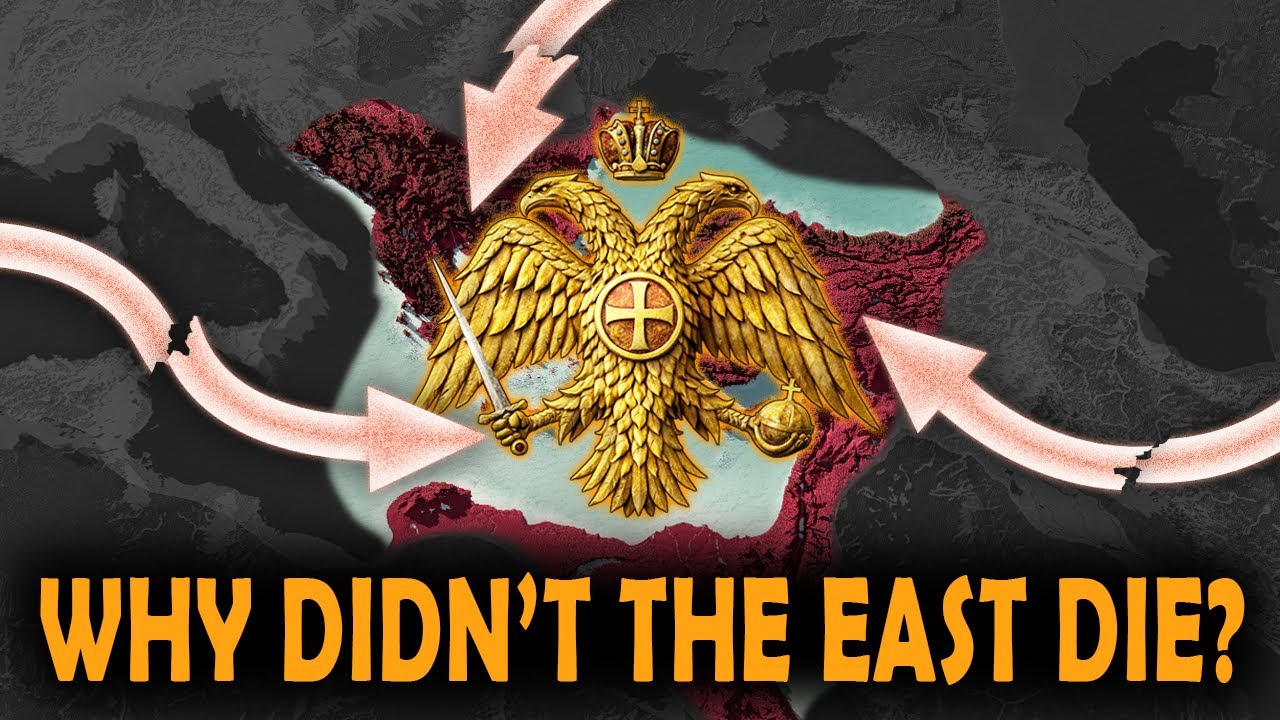
Why Eastern Rome Didn’t Die together with the West?

Why Eastern Rome Didn’t Die together with the West?

Machine-readable: Markdown · JSON API · Site index

Поделиться Telegram VK Бот
Транскрипт Скачать .md
Анализ с AI

Оглавление (4 сегментов)

Segment 1 (00:00 - 05:00)

By the late 5th century AD, the Roman Empire had been in a gradual state of decline for a long time, leading to the collapse of its western half under the weight of civil wars and internal power struggles, which in turn exposed it to attacks by foreign enemies or led to imperial territory simply slipping out of the empire's effective control. But while Rome may have fallen in the west, the empire was still very much standing in the east, which now became the center of the entire Roman world, from where it would carry on its name and legacy for another millennium. The reign of Zeno. The man with the dubious distinction of being the first Roman emperor to rule the Eastern Empire as the sole center of Roman power was Zeno, who came to power in early 474 AD after the death of his 7-year-old son Leo II, who had briefly succeeded the late Emperor Leo I before dying of disease. From the beginning of his reign, Zeno was plagued by internal strife between his commanders and would have to constantly be on guard against possible rivals. Indeed, at around the same time as Romelus Agostto was being deposed by the Germanic leader Ogoair in the west, Zeno was deposed in a civil war by the usurper Basilicus in 475 AD, who reigned for a short while alone until the emperor reclaimed his throne the following year. Shortly afterwards, he received a delegation from Odoir returning the imperial regalia to Constantinople along with a message that no further emperors would be needed, signaling the effective end of direct imperial rule in the west. This moment has in the past been seen as the fall of the Roman Empire. While the East carried on as a supposedly completely different entity, an entity we have termed the Byzantine Empire, named after the Greek colony of Baantium, over which the imperial capital of Constantinople was located. However, the inhabitants of Baantium continued to view themselves as Roman citizens and their nation as the Roman Empire or Romania, a Greek term which originated in the 4th century AD. This Greek influence had further reinforced modern perceptions of it as a very different state from the Roman Empire of antiquity, contrasting it with the traditional Romans and their Latin language and supposedly different culture. However, we should remember that the eastern provinces of Rome had long been a center of Greek language and culture where the Romans inherited a highly helenized series of communities giving the region a very Greek character even during its time under Roman rule. And while the Greek characteristics of the east would become more pronounced as it became the sole center of Roman rule, even this was gradual as the empire retained its recognizable late antique form and character in the immediate aftermath of the fall of the west. Being Roman was also not specifically tied to the Latin language or culture or the empire's old heartland of Italy, but had instead long since evolved into a political identity to which people of any extraction could subscribe to. Thus, while most of the Eastern Roman Empire's inhabitants might not have used Latin as their main language and came from varying backgrounds, they still saw themselves as Romans and the citizens of the same empire, which had risen from humble origins as a small community in Italy. This was still effectively the Roman Empire and not simply a medieval offshoot or successor state. Now, one might wonder then, how did Rome's eastern half survive when the West did not? Since we started this channel, we have been obsessed with historical maps. Since some of you might like maps as well, we created a few products for you. Highresolution downloads and museum quality prints. Go to knowledgeia. co and have a look. If you want to own one, use my code in the description below. Now back to the video. During the fifth century AD, when the Western Roman Empire had been constantly racked by civil wars and other internal power struggles, the Eastern Empire, by comparison, was relatively stable until the reign of

Segment 2 (05:00 - 10:00)

Zeno. Even after retaking Constantinople, the new emperor was often challenged from within, such as in 479 AD when the general Marcian led a coup in the capital itself that nearly led to Zeno's death before another general loyal to the emperor intervened with his own troops and convinced most of the rebellious soldiers to switch sides, leading to Marcian's capture and downfall. Another pressing issue was the Ostrogoths. They were the descendants of the Goths who had not followed Olrich into the Western Empire in the early 5th century and chose to remain settled in the Eastern Empire as well as Goths who had formerly been in the service of Attilla the Hun and were then resettled in Panona. They received regular payments in exchange for their services and the Ostrogoths settled in Thrace would become heavily Romanized and connected with imperial politics. The Ostrogoths themselves were not entirely united. And during Zeno's reign, there were two significant Gothic leaders who rose to power and competed with one another. These were Theodor Strao, an ambitious man who had helped Zeno retake Constantinople, but who quickly proved to be problematic to control, and another man confusingly also named Theodoric, who had recently risen as king over one of the Ostrogothic groups. In addition to the politicking between these two leaders and their own individual overtures to the emperor, Zeno himself was trying to play the Gothic leaders off against one another. In 481 AD, Strao died in a riding accident shortly after rebelling against Zeno. And in the aftermath of the ensuing power struggle amongst his followers, most of them sided with the young king Theodoric. For several years, Zeno was engaged in a back andforth rivalry with the Ostrogothic leader before in 488 AD, an agreement was finally reached. Back in the old Roman heartland of Italy, Odoakair was still in power over his own kingdom. Zeno had agreed to support Odoair's rule of Italy if he officially recognized Julius Nepos as emperor who had been deposed by Romelus Austoto and forced into exile in Dalatia. Odoair had minted coins in Nepos's name but his rule was effectively not recognized and Italy remained in the control of the Germanic king. Theodoric had been for some time contemplating an invasion there and would now do so. But with the official sanction of Zeno, who may have cared little which of the two barbarian kings ruled Italy, Theodoric was granted the titles of Patrickus and Magister Militum by the emperor who agreed to support the Ostrogoth's invasion. After which Theodoric would then rule Italy in the name of Rome. The Ostrogoths then marched westward, first defeating the Gapedes, who were barring their path before invading Italy proper in 489 AD, where they gradually started to make progress against Odoair's forces. In 491 AD, Theodoric even sent messages to Zeno asking for imperial regalia and recognition of his rule in Italy after prominent Italian senators started to approach him following his victories. He would never receive an answer, however, as Zeno was by then in poor health and would in fact die the same year. Still, the campaign against Odoer would go on and by 494 AD, Italy and even the valuable island of Sicily would be brought under Ostrogothic control and Odoakair was executed soon after surrendering. The Ostrogothic kingdom under Theodoric on the surface appeared Roman in many ways. Theodoric kept the old Roman administrative system also preserved under Odoakair intact and Italy retained its distinctly Roman character even after the Goths conquered the region. Theodoric also had initially good relations with Zeno's successor, the Emperor Anastasio, who even supported the Gothic king by confirming Zeno's grant of the title of Magister Militim to him. Famously, Theodoric even referred to his kingdom as a copy of the only empire in a letter to Anastasia, thus appearing differential to Roman authority. Nevertheless, as Theodoric's power became more entrenched over time

Segment 3 (10:00 - 15:00)

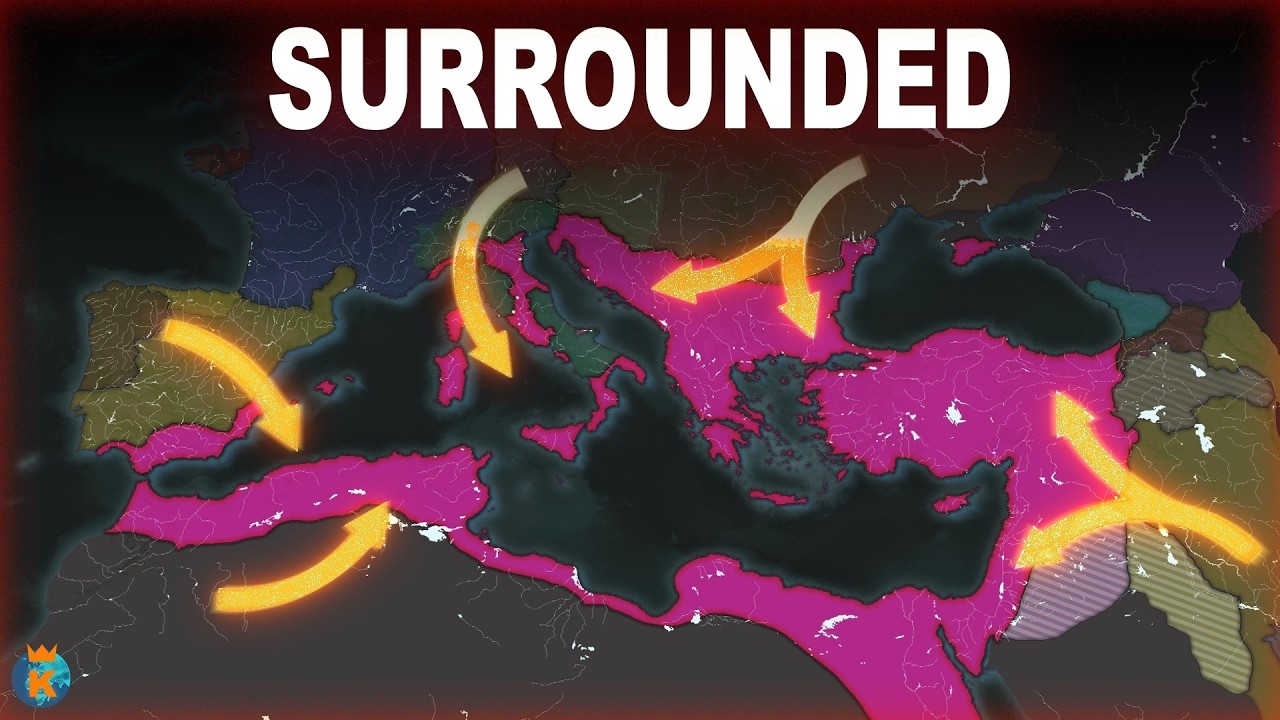
his relations with Rome also decreased. And however Roman the Ostrogothic kingdom may have been, it was ultimately still a foreign power now ruling over former imperial territory. The reign of Anastasius. The new Eastern Emperor Anastas meanwhile was faced with internal strife early into his reign. He came to power in 491 AD with the support of the empress and Zeno's widow Ariadne. A decision which seemingly threatens to plunge the empire into civil war. As Anastasius was staunchly opposed in Zeno's old home region of Isoria. Fortunately for the new emperor, the rest of the empire stood behind him. But the Isurians still stubbornly fought on for several years before they were defeated in 497 AD. After which his reign proved marketkedly more internally stable than that of his predecessor. Anastasius proved to be a capable emperor and his reign is most notable for his efforts at reforming the empire's administrative system and attempts to tackle religious disputes between different sects of Christianity which remained a controversial issue during his time. Anastasia managed to greatly ease the burdens on collecting and distributing tax revenue and cut back on imperial expenditure on what he considered to be too lavish pursuits and even sold off some of Zeno's clothing money which directly went into the state's treasury. He also abolished a deeply unpopular tax on the empire's poor and insisted on taxes being paid in money rather than in kind with other goods, which had long been common, while also restructuring the system of Roman currency with three new denominations of gold, which would become the new basis for many centuries to come. Over the course of his reign, Anastasius would be able to gather an impressive £320,000 of gold for the treasury, leaving the empire well funded. It was also during the reign of Anastasius that tension with Rome's old rival to the east, the Persian Empire, would once again simmer in the year 502 AD when the Persian king Cavad demanded money from the Romans to help with the defense of the Caucus. When Anastasia refused this blunt demand, the Persians launched an invasion into the Roman- held portion of Armenia, which had been partitioned between the two empires in 383 AD. The attack caught the Romans by surprise and initially the Persians fared well in the war, capturing the cities of Theodosopolis and Amida and threatening Asia Minor. However, the Romans were able to regroup quickly and already recaptured Theodosopolis by late 502 AD and Anastasia sent a strong army to the eastern frontier to repel the Persian invasion. This led to a series of hard-fought campaigns in Armenia and Mesopotamia. But between 508 and 505 AD, the Romans would be able to successfully push the Persians back and retake their territory. The Romans and Persians then negotiated a 7-year truce the following year with both empires at their traditional boundaries. The Romans then began to build a new forward base for future operations against the Persians at Dra, a location which was soon to prove significant and the ongoing rivalry between the two empires. At around the same time, the Ostrogoths attempted to expand their power westward in 504 AD by moving into Panonia, where they clashed with the Gwbees and soon after also came into conflict with the Romans, who sensed opportunities of their own to regain territory lost during the fall of the West. A peace treaty was negotiated in 510 AD, which recognized Theodric's rule of Western Panonia Sakunda. This proved to be the last notable foreign conflict during Anastasia's reign, who would die in 518 AD. To conclude, the Roman Empire in the East had not suffered from the same number of civil wars as the West did during the fifth century, which had played a key role in weakening the empire's defenses and the gradual loss of its territory. The east also benefited from the long rule of two capable emperors, Zeno and Anastasius, in the immediate aftermath of the fall of the west, which gave the Romans strong leaders, enabling them to respond well to internal and external

Segment 4 (15:00 - 15:00)

threats. Emperor Anastasius proved to be especially effective of the two as his economic reforms and good leadership left his successors a prosperous empire with its frontiers stable and secure. Thus, the Roman Empire would continue to live on and remain a formidable power. But the rest of the sixth century would carry with it many challenges, both old and new, for it to contend with.

Другие видео автора — Knowledgia

Ctrl+V

Экстракт Знаний в Telegram

Экстракты и дистилляты из лучших YouTube-каналов — сразу после публикации.

Подписаться

Дайджест Экстрактов

Лучшие методички за неделю — каждый понедельник