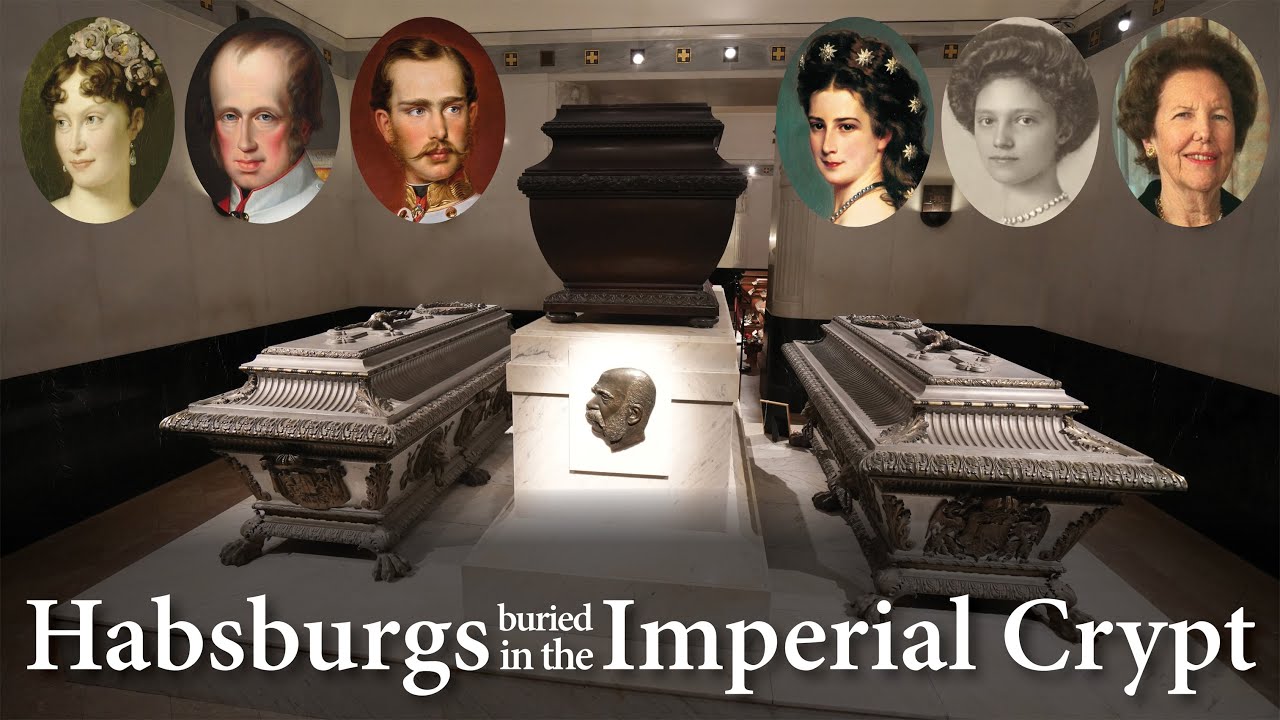
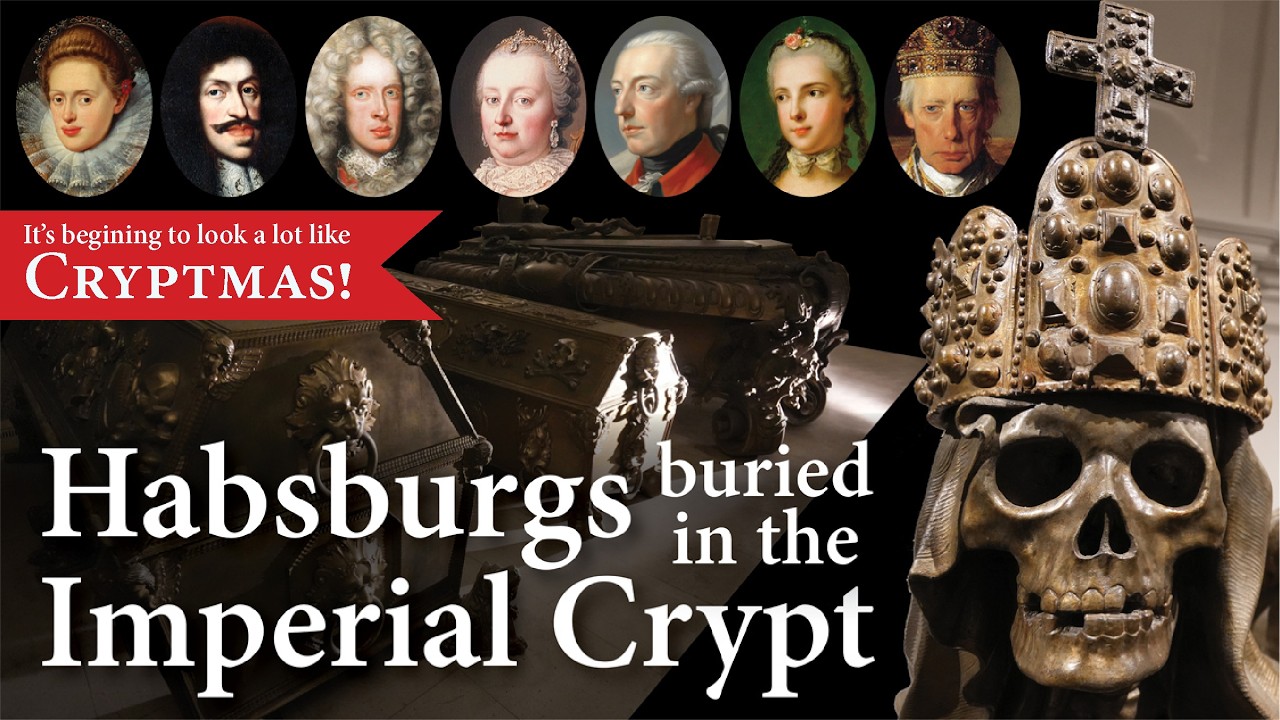
Hapsburgs buried in the imperial crypt part two 1800s to 2023. Death is called the great equalizer. And while everyone must die, if you're a Holy Roman Emperor, eternal rest comes with some elaborate bronzplated perks. Since 1633, dearly departed members of the Hapsburg dynasty have been interred in an extensive catacomb beneath the Capushian church in Vienna, Austria. There are 150 people or at least parts of people buried here including 12 emperors, 20 empresses and 15 other monarchs as well as one Protestant and one devoted governness who wasn't a Hapsburg at all. Let's explore the 10 burial vaults of the Imperial Crypt. dig up the past and find out which Hapsburgs are spending eternity together. Recently, I had the opportunity to visit the Imperial Crypt and exume some of its secrets myself. In part one, we explored the oldest six burial chambers, the Founders Vault, Leupold Vault, Carl Vault, Maria Teresa Vault, Fron's Vault, and Tuscan Vault, and met the dead emperors, empresses, and other royals interred there. Now, we'll continue our winding way through the catacombs and visit the four relatively new chambers of the imperial crypt, meeting Emperor Ferdinand I, Maximleian Emperor of Mexico, Maria Louise, Empress of France, Emperor France Ysef, Empress Zeta, and many other Hapsburgs. The Ferdinand vault was completed in the mid 1800s in time to receive the remains of Ferdinand I in 1875. His parents France II and Maria Teresa of Naples and Sicily were double first cousins. After centuries of inbreeding, the Hapsburg gene pool was pretty shallow. Ferdinand suffered from hydrophilis, neurological problems, including epilepsy, and a speech impediment. He was also demanding and imperious. His intellectual disabilities and 20 seizures a day made it impossible for him to rule and a regency council ran the empire. Nevertheless, he was married to Maria Anne of Seavoi. The court physician thought it unlikely that he would be able to consummate the marriage. When he tried, he had five seizures. So, not a great wedding night. In 1848, revolution broke out all over Europe with people demanding an end to monarchy. Suddenly, having an unstable emperor who didn't actually rule was not a good look. Ferdinand was instructed to abdicate in favor of his 18-year-old nephew, France Ysef. The exemperor spent 27 years in blissful retirement and died at 82. His wife, Maria Anna, spent her time doing charity work in Prague. She died at 80 and was returned to Vienna to be buried below her estranged husband. Only these two neocclassical sarcophagi, the emperor on a stone plinth and his wife directly on the ground are visible in the Ferdinand vault. However, inside the walls of this chamber are concealed the coffins of 37 lesser Hapsburgs. They were moved out of older vaults, so the crypt would appear less cluttered. Their placement is based more on how they fit into the wall than how they fit together as a family. Pier A contains Alexander Leupold, one of Emperor Leupold II's 16 children. At 22, he decided to light a fireworks display to impress his sister-in-law. But the first rocket landed in a pile of gunpowder, which exploded, killing the prince and his servants. His sister, Maria Amalia, died of pneumonia on Christmas Day at the age of 18. Their niece, Louise Elizabeth, the only child of Emperor Fron II's first wife, Elizabeth, lived just 16 months. Fron II's son, Ysef Fron, died of yellow fever at 8. His younger brother, Yan
Segment 2 (05:00 - 10:00)
Nepomuk, died at three. Two children of Archduke Carl Ferdinand, Marie Elanor and France Ysef, both of whom died in infancy. Archduke Leupold Ludvig was a general and admiral during the Austroprussian War. He never married and lived to 74. Archduke Robert Ferdinand died at 10. Pier B contains his elder sister Maria Antonia who became abbis of theian convent in Prague. She suffered poor health and spent every winter in Khan where she died at 25. Emperor France Ysef's only sister Maria Anna who died of epilepsy at 4. Arch Duchess Maria Cararolina was engaged to be married when she died at 23. Ferdinand Salvatore and Rainar Salvatore, both children of first cousins Archduke Carl Salvatore and Princess Mary Immaculate of Sicily. Caroline Ferdinandanda died at the age of nine. Sophie Frederri was the first child of Emperor France Ysef and Empress Elizabeth. Upon her birth, her grandmother took her away from her mother. was not allowed to breastfeed or care for her baby. She begged her husband for help, but he refused to stand up to his mother. When Sophie was two, her parents and her baby sister, Jazella, got away from the palace on a holiday to Hungary. But both daughters fell ill with a stomach virus, possibly typhoid. Jazella recovered, but Sophie died in her mother's arms. returned to Vienna in deep despair. Her mother-in-law blamed her for her daughter's death, and the rest of her children were taken without opposition. wore a bracelet with her first daughter's portrait for the rest of her life. Pier C contains two of the nine children of Archduke Ferdinand, Duke of Tesshan. Natalie who died at 14 and Stephanie who died at 4. Maria Anna like her elder brother Ember Ferdinand was born intellectually disabled and with facial deformities due to centuries of Hapsburg inbreeding. She was kept out of the public eye at Herendorf Palace where she died at 54. Maria Caroline married her first cousin Archduke Rhina Ferdinand. They had a happy childless marriage and were the most popular Hapsburgs of their generation. Maria lived to 90 and was the last surviving great grandchild of Maria Teresa. Maria Louisa was the daughter of Maria Karolina, Queen of Naples and Sicily. She married her double first cousin Ferdinand III, Grand Duke of Tuskanyany, and they had six children. Napoleon forced them out of Italy and they fled to Vienna. there. Maria Louisa died at 29, giving birth to a stillborn son who is buried in her arms. Ferdinand III, now 52, married 25-year-old Maria of Saxony. She was widowed 3 years later and lived the rest of her life in Italy. She died at 68 and was buried near her late husband's first wife. Maria Antonia of the two Sicilles was famed for her beauty. Her first cousin, Liupold II, Duke of Tuskanyany, proposed and they had six children. She loved the art scene in Florence, but a revolt in 1859 forced them off the throne. She was widowed at 56 and retired to an Italian-style villa in Austria. Her youngest and favorite son, Johan Salvatore, renounced his imperial titles to marry a dancer, Millie Strubel, and travel the world. In 1890, the newlyweds were caught in a storm off Cape Horn in South America and their yacht disappeared. Maria Antonia refused to accept that her son was dead, and she was scammed by several people, promising false information and even claiming to be the missing Duke. Yan's remains were never found, so could never be placed in the Imperial Crypt. Maria Antonia spent her final years in anguish and died at 83. Finally, Caroline Louise, a 4-year-old daughter of France II. Pier D contains Maria Antonia's second son, Carl Salvatore. During his military training, he took an interest in firearms. He invented and patented numerous guns, including the first self-loading pistol and machine gun. He died of natural causes at 52. His wife, Mary Immaculate of Sicily, was known for
Segment 3 (10:00 - 15:00)
her beauty. Carl celebrated the birth of each of their 10 children by giving her a pearl necklace. Empress jokingly called the couple the pearl divers. Mary Immaculate died at 54. three of their children, Albert Salvatore who died at 25, Maria Antonia who died at 16 and Hrietta Maria who died at two are buried in the same pier. Their grandson Leopold Marie Alons fought in World War I. After the Austrian Empire was abolished, he fled to the United States in 1930. He was part of a scam to steal a diamond necklace from his cousin, Alanta Maria Teresa of Portugal. Liupold spent 12 days in jail for the crime. He may also have worked as a secret agent for the Nazis. In the 50s, he tried his luck in Hollywood. The Archduke scored a few minor roles, then retired to Connecticut, where he died at 61. He was cremated and an urn containing his ashes was returned to the Imperial Vault. Archduke Ernst was a soldier who fell in love with a Hungarian noble, Lara Bashena. His cousin, Emperor France Ysef, forbid the marriage, but the couple lived together anyway. When Arens died at 71, his four children tried to claim his estate, but the Austrian court refused. Ailund was the daughter of King Ludvik the 1 of Bavaria. She married Francis V, Duke of Morina, but he was forced off the throne by the Italian unification. Adul died in Munich at 91. Caroline Leopoldin was the one-year-old daughter of Emperor France II. Her baby sister, Amalia Teresa, was buried with her. Ludvig Salvatore was in love with his cousin, Arch Duchess Matild. But after her tragic death, coming later, he never married. Instead, he traveled the world on his yacht, studying nature and writing books about insects. He purchased a large plot of land on the Spanish island of Mayorca, which is now owned by actor Michael Douglas. He died at 68. Maria Teresa was the daughter of Miguel I of Portugal and the third wife of Archduke Carl Ludvig. They had two daughters but were unhappy. After Empress left court, Maria Teresa gained considerable influence and acted as hostess for her brother-in-law, Emperor France Ysef. She was close with her stepson, France Ferdinand, and looked after his children after he was assassinated. Maria Teresa died at 88. Archduke Ysef Ferdinand Salvatore was a soldier in World War I and an early airplane enthusiast. In 1938, he was arrested by the Nazis and sent to Dhau concentration camp. He was later released, but he died in 1942 at the age of 70. Now, let's climb out of the wall and into the spacious new vault. This addition was built in 1960 along with the installation of air conditioning and dehumidifiers throughout the crypt to preserve the tombs and remains. A workshop was also installed to repair damaged sarcophagi. 23 Hapsburgs were moved out of older tombs and into the new vault and grouped in three loose themes. The first theme, bishops. Leopold Wilhelm, son of Emperor Ferdinand II, held several bishop Ricks, was grandmaster of the Tutonic Order, governed the Netherlands, and was a prominent art collector. He died in 1662, age 48. Carl Ysef survived the childbirth which killed his mother, Empress Maria Leopoldin, as he already had two older brothers. He was created prince Archbishop of Ol, but he died of illness at 14. Charles Ysef, Prince of Lorraine and Prince Archbishop of Tria, was a skilled politician who helped his cousin Carl V 6th get elected emperor and participated in negotiations to end the war of Spanish succession. He died of smallox at 35. Maximleian France was Maria Teresa's 16th and youngest child. At 24, he became grandmaster of the Tutonic Knights, then archbishop and elector of Cologne. He was a lover of music and an early patron of Ludvig Bon Beethoven. The composer planned to dedicate his first symphony to his first patron, but Maxmillian France died before its completion at the age of 45. His nephew Rudolph Yan, Prince
Segment 4 (15:00 - 20:00)
Archbishop of Ol was a student and friend of Beethoven. He was appointed a cardinal. He died of a cerebral hemorrhage at 43. Second theme, Carl, Duke of Tesshan and his family. The third son of Emperor Liupold II. Carl joined the army at a young age. He was the victor of the battle of Aspern. He was a successful strategist and military reformer and was considered one of Napoleon's greatest foes and an Austrian hero. At 44, he married 17-year-old Henrietta of Nasau Valberg. Despite the age difference, the couple were very fond of each other and the marriage was allowed even though she was a Protestant. She popularized the Christmas tree, a Protestant tradition in Austria. Her seven children were raised Catholic. While nursing them through scarlet fever, Henrietta caught the disease and died at 32. There was controversy about burying a Protestant in the imperial crypt, but her brother-in-law, Emperor France, ended the argument, saying, "She dwelt among us when she was alive, and so she shall in death. " Henrietta is the only Protestant in the imperial crypt. Per Hapsburg tradition, her heart and viscera were placed in separate urns for burial elsewhere. But the monks at the Hofborg palace and St. Steven's Cathedral were not so accepting of Protestant intrails. So Henrietta's organ was placed in the crypt. Carl and Henrietta's eldest son, Albertch, Duke of Tesshan, followed his old man into the military and was inspector general for 36 years. But he was not so brilliant and spent most of his time lamenting the good old days and holding back progress. He refused to leave office even when he was blind and his horse had to be led by a servant. He died at 77. His wife Hildigard Louise was the daughter of King Ludvik the 1 of Bavaria. She died at 38 from lung disease. With them is buried a son, Carl Albert, who died in infancy, and a daughter, Matild. Her cousin, Ludvig Salvatore, was in love with her, but her parents insisted on marrying her to Ombberto, Crown Prince of Italy. The wedding never took place. While attending the theater, 18-year-old Matild snuck a cigarette. Her father, who forbid smoking, suddenly appeared, and she tried frantically to hide the cigarette behind her back. It fell into the folds of her elegant gauze ball gown, and the fabric burst into flames in front of her horrified family. Matild died a few days later from her injuries. Her tragic death was mourned throughout the empire, and thousands attended her midnight funeral march. Three more of Carl and Henrietta's children are buried nearby. Carl Ferdinand also joined the military and was more successful than his brother. His daughter, Maria Christina married Alfonso I 12th and became queen of Spain. Rudolph Frs died 2 weeks after his birth. Wilhelm was also a military man and grandmaster of the Tutonic Order. He died after falling off his horse at 67. Also in the new vault, Marie Louise was Emperor France II's eldest surviving child. She was 15 when Napoleon forced her father to dissolve the Holy Roman Empire. Four years later, France made peace by handing his 19-year-old daughter over to the 41-year-old French emperor. Despite the age difference, Napoleon and Marie Louise got on well. She enjoyed being Empress of France and gave birth to a son and heir. But Napoleon's fortunes changed dramatically. He was defeated by the Sixth Coalition, which included his father-in-law. He was exiled to the island of Elba, where he died. Marie Louise's 4-year-old son briefly succeeded his father as Napoleon II, but the coalition victors refused to acknowledge him. He died of tuberculosis at 21. No longer an empress, Marie Louise still made out okay. She was granted the duche of Parma in her own right. She ruled there for the rest of her life, married two men she actually liked and had three more children. She died of plurals at 56. Third theme, relatives of the last emperor. As the younger brother of disabled emperor Ferdinand I France Carl was on the ruling council but he was unambitious and ineffectual. He married Sophia of Bavaria, daughter of King
Segment 5 (20:00 - 25:00)
Maxmillian I. She was called the only man in the Hofborg. She had a close relationship to Napoleon II and there were rumors that he was the father of her second son, Maxmillian. During the 1848 revolt, Sophie persuaded her husband to give up his right to the throne in favor of their eldest son, France Ysef. Thus, Sophie became the power behind the throne. She died of pneumonia at 67. A stillborn son born in 1840 is laid next to her. Her second son, Maxmillian, married Charlotte of Belgium, but they had no children, likely because he passed veneerial disease on to her. At 32, Maximleon was invited to establish a new monarchy by becoming emperor of Mexico. His claim was based on his descent from Charles V, Holy Roman Emperor and King of Spain, who sent concistadors to sack the Aztecs back in 1519. Maxmillian and Charlotte traveled to Mexico, but their foreign regime was not popular and lasted only 3 years. Civil war broke out. Charlotte escaped, but Maxmillian refused to leave. He was executed by firing squad at 34. His body was imbalmed and taken on a tour of Mexico. After 6 months, it was returned to Vienna and placed in the imperial crypt. His brother, Archduke Carl Ludvig, married Margareta of Saxony. While on a trip to Italy, she contracted typhoid and died at 18. Next, he wed Maria Anuniata of Borbon to Sicilles. They had a happy union and four children, but she died of tuberculosis at 28. Third wife, Maria Teresa of Portugal, outlived him. During a trip to Palestine, he drank water from the Jordan River. It gave him typhoid and he died at 62. Next in the line of succession was his son, France Ferdinand, who became heir to his uncle France Ysef. He and his wife Sophie were assassinated in Sievo in 1914, an event which famously sparked World War I. The couple were laid to rest not at the Imperial Crypt, but at their home, Arch Deton Castle. France Ferdinand's rival throughout his life was his younger brother, Otto. He was far more popular, and his elder brother feared that he had designs on the throne. Otto married Maria Yosfa of Saxony and they had two sons, but Otto was frequently unfaithful and fathered numerous illegitimate children. He contracted syphilis and receded from public view. He lost his nose and wore a rubber prosthetic. He died at 41. His longsuffering wife, Maria Yosfa, survived him by 38 years. She nursed soldiers in World War I and advised her son, Emperor Carl. She died in 1944, age 76. Also in the new vault are Archduke Leopold Salvatore and his son Rear Carl. He fought in World War I and after the fall of the Hapsburg Empire, he worked as a taxi driver in Vienna. He died of blood poisoning in 1930, age 34. The France Ysef Vault. In 1908, as part of the Jubilee celebrating his 60 years on the throne, Emperor France Ysef ordered the construction of a new mausoleum and chapel. France Ysef succeeded his disabled uncle Ferdinand when he was just 18. He wed his beautiful cousin Elizabeth Aavaria and they had three daughters and a son. He was obsessed with her, but she kept her distance. She was bullied by her mother-in-law and struggled with the expectations of court and her own mental health. She spent much of her time traveling while France remained in Vienna, though she did return home to encourage him to sign the treaty creating the dual monarchy of Austria, Hungary. The couple's only son, Crown Prince Rudolph, also struggled with mental illness. He was a bonvant and behaved recklessly and promiscuously. He had an unhappy marriage with Princess Stephanie of Belgium and passed syphilis onto her, rendering her infertile. His doctors prescribed opium, cognac, morphine, and mercury, which further affected him neurologically. In 1889, the emperor and empress hosted a family dinner. Rudolph excused himself early to travel to his hunting lodge in Meerling. The next morning, his valot found he and his mistress, 17-year-old Baroness Mary
Segment 6 (25:00 - 30:00)
Vetera, dead in his bedroom. It was determined that he had shot her, then shot himself. The murder suicide was covered up and Mary's family snuck her body away. It was claimed that the crown prince had died of an aneurysm as victims of suicide were not permitted to be buried in Catholic crypts. Elizabeth was devastated and wore black for the rest of her life. In 1898, the 60-year-old empress was out for a walk in Geneva, Switzerland. A young man stumbled into her, then took off. The empress collapsed. She had been stabbed in the chest with a 4in needle file. The young man was an anarchist who hoped to assassinate any royal he could find. Elizabeth briefly regained consciousness and was asked if she was in pain. She replied, "No, what happened? " Then drifted out again, never to return. Her body was returned to Vienna where France Ysef wept over her. The inscription on her coffin reads, "Elizabeth, Empress of Austria. " And when the Hungarians complained and Queen of Hungary was hastily added, heartbroken by so much loss, Emperor France Ysef carried on for another 18 years. He died of pneumonia at 86 and was laid to rest between Elizabeth and Rudolph. The Crypt Chapel. France Ysef was succeeded by his grand nephew Carl I. He and his wife Zeta of Borbon Parma were crowned in 1916. Carl tried desperately to preserve the empire. He secretly negotiated with the allies hoping to end World War I. But when Austria lost the war in 1918, he was forced off the throne and into exile. The family went to Switzerland where Carl made repeated attempts to reclaim his thrones. The stress caused two heart attacks. He was exiled even further to the Portuguese island of MadiRaa. There he caught a cold which developed into pneumonia. His last words to his wife were, "I love you so much. " He died in 1922 at the age of 34. Carl's remains were laid to rest in the Church of Our Lady of the Mount in Madiraa. Numerous attempts to move him to the imperial crypt have failed. Instead, the last Habsburg emperor is honored here only by a bust. Ceda lived another 67 years and raised their eight children. Austria eventually made peace with the remaining Hapsburgs and Zeta and her descendants were allowed to return. She died in 1989 age 96. Her massive funeral in Vienna was attended by dignitaries and 200 members of the Hapsburg family. Her heart was interred in Murray Abbey, Switzerland next to the heart of her husband Carl so that they could be together in death. Two of their sons and daughters-in-law are buried in the crypt. Former Crown Prince Otto considered himself the rightful emperor from the age of 10 as his father never officially abdicated. He fiercely opposed the Nazis who in turn sentenced him to death. So he fled to the United States. After World War II, he returned and was elected to the European Parliament in 1969. He published several books on history and politics and was one of the architects of the European Union. He died in his sleep in 2011 age 98. He was laid to rest with his wife Regina of Sox Minan who had died the year before at 85. Their son Carl von Hapsburg is the current head of the Hapsburg family. Carl and Zeta's fifth child, Carl Ludvig, attempted to fight for the US in World War II, but his free Austrian battalion was disbanded before they saw action. He married Princess Yoland Delenya in 1950 and they raised their four children in New York City where Carl worked for the Rockefeller Foundation. He died in 2007 aged 89. Yolanda lived to the age of 100. She died in Brussels in 2023 and was the last Hapsburg laid to rest in the Imperial Crypt. If you enjoyed this video, please like, subscribe, comment your thoughts, and check out my other history videos. You can also join my Patreon to support my work and get early access to all of my
Segment 7 (30:00 - 30:00)
multi-part series. Thank you for watching.
Другие видео автора — History Tea Time with Lindsay Holiday