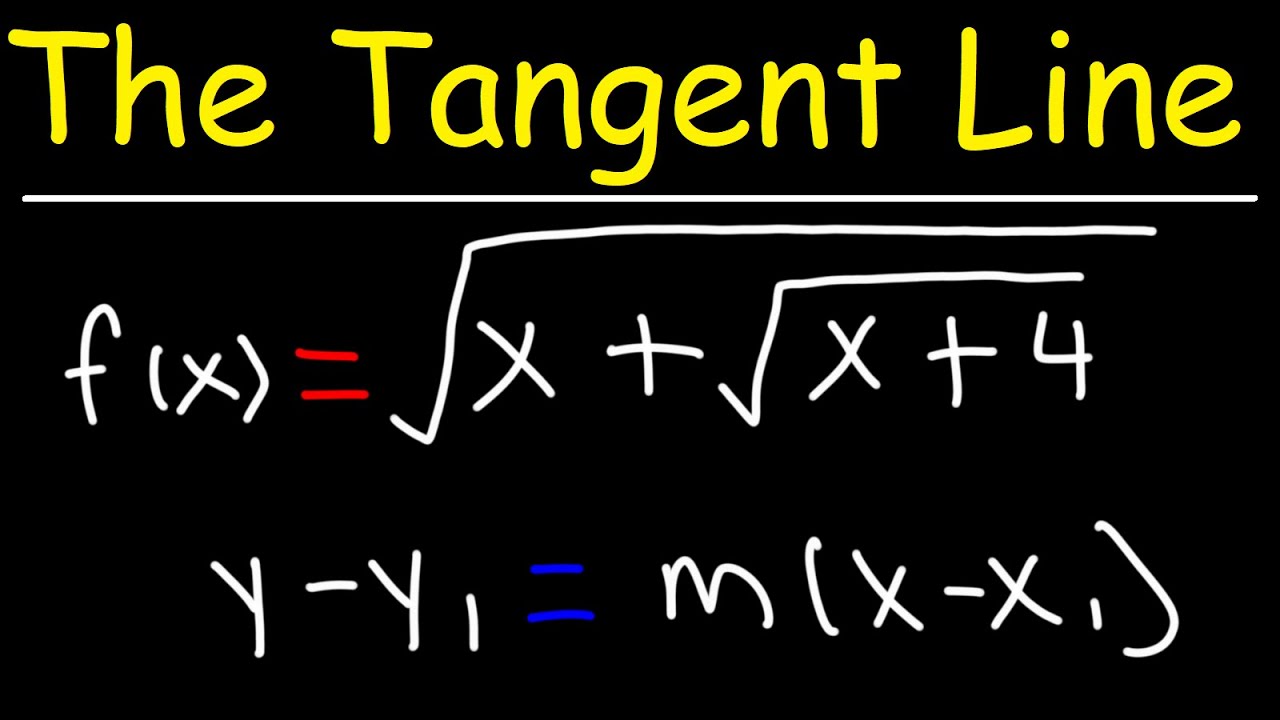
Finding The Equation of the Tangent Line of a Composite Radical Function Using the Chain Rule

Finding The Equation of the Tangent Line of a Composite Radical Function Using the Chain Rule

Machine-readable: Markdown · JSON API · Site index
Поделиться Telegram VK Бот
Транскрипт Скачать .md
Анализ с AI

Оглавление (2 сегментов)

Segment 1 (00:00 - 05:00)

Number 40. Which of the following represents the equation of the tangent line of f(x) at x= 12? So in order to write the equation of the tangent line, we need two things. We need the slope and we need the point. We have the x coordinate of the point. Now we need the y-coordinate. So the y-coordinate is going to be f of So let's replace x with 12. and we'll get that value. Now 12 + 4 that's going to be 16 and the square t of 16 is 4 and 12 + 4 is 16 and the of 16 is 4. So when x is 12, y Now to find the slope of the tangent line, we need to find the first derivative and we need to evaluate it at x= 12. So we got to find the instantaneous rate of change at x= 12. So let's begin by rewriting the function. We can rewrite it like this. The square root of x + 4 is x + 4 raised to the 12. And then this whole thing is also raised to 1/2. So what we're going to do is we are going to use the chain rule version of the power rule. The derivative of u to the n is n u n -1 * u prime. So in this case n is 12 where u is everything inside of that inside the brackets. and then n - 1/2 - 1 is - 12. Now we need to find u prime. U prime is the derivative of what's inside. The derivative of x is 1. And the derivative of this basically we can use this formula again. It's going to be 12 x + 4 and then 12 - 1. That's - 1/2 times the derivative of what's inside. The derivative of x + 4 is simply one. So that's frime of x. Now we could plug in our x value at this point. But just in case you were to get a problem like this and you need to simplify it, I suggest that we simplify this particular one. So right now here we have a negative exponent. We're going to move this to the bottom. So it becomes positive. And here we have a negative exponent. We'll move this to the bottom of just this fraction here. So we're going to have a fraction. On that fraction we have in the numerator a one and then we have plus we have this one and we have a two on the bottom. Now this is going to go on the bottom of this fraction. So we can change the negative exponent to a positive 1. So it's going to be x + 4 to the 1/2. But we can convert it back to its radical form. and simply write it as the square of x + 4. Multiplying it by 1, we don't have to worry about that. Now, on the bottom of the larger fraction, we do have a two here. And this negative exponent will become positive. And when we change it back into radical form, all of this will be the same as what we have here, the original problem. So that is the square root. So that covers the - 1/2 when we bring it to the bottom. And then inside of that we have an x. And then when we put this back in radical form, it's plus the square of x + 4. So that's frime of x in its simplified form without rationalizing the denominator. I want to try to do that for this problem. So now we need to evaluate it at x = 12. So this is going to be 12 + 4 over 2 12 + 12 + 4. So we know that 12 + 4 is 16 and the of 16 is 4.

Segment 2 (05:00 - 06:00)

And the same is true from here. 12 + 4 is 16. The square root of 16 is 4. So we just get + 4. Now 2 * 4 that's going to be 8. The square of 16 is 4. So right now I'm going to multiply the top and the bottom by 8. So 8 * 1 is 8. And then 8 * 1 over 8. The 8 will cancel. We'll just get 1. Here we have 2 * 4 which is 8 * another 8. That's going to be 64. So we're going to get 9 / 64. So that is the slope of the tangent line which is equal to frime of 12. So now using the point slope formula we can write the equation of the tangent line. So this is x1 and y1. y1 is 4. The slope is 9 / 64 and x1 is 12. Notice that this corresponds to answer choice a. We have y - 4. 9 / 64 is in front of x and we have x - 12 and next to that. So that's going to be the answer.

Другие видео автора — The Organic Chemistry Tutor

Ctrl+V

Экстракт Знаний в Telegram

Экстракты и дистилляты из лучших YouTube-каналов — сразу после публикации.

Подписаться

Дайджест Экстрактов

Лучшие методички за неделю — каждый понедельник