Scientific Notation

Scientific Notation

Machine-readable: Markdown · JSON API · Site index

Поделиться Telegram VK Бот
Транскрипт Скачать .md
Анализ с AI

Оглавление (4 сегментов)

Segment 1 (00:00 - 05:00)

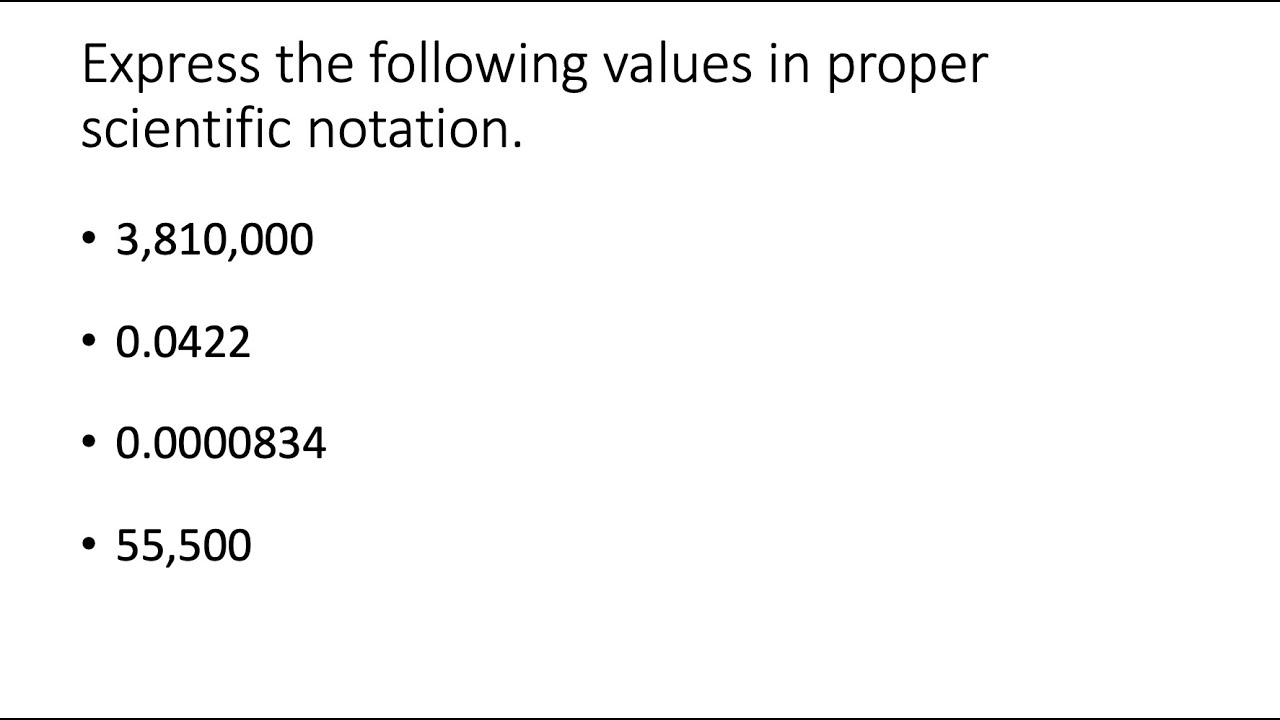
welcome to the chemistry solution this tutorial is on scientific notation the reason why we would use scientific notation is because it really helps us to simplify writing either really large or really small numbers and so the basis of writing a number and scientific notation so we would write a number here that has one digit to the left of the decimal point so it's going to be something between one and like nine point nine nine something like that but only one digit to the left of the decimal point the other part of scientific notation is we say that's times tend to the raised to a certain power and so this exponent B is an integer it can be a positive value or negative value but it tells us how many spaces and in which direction to move the decimal point to convert our number from scientific notation to standard notation there are a lot of different ways that people teach scientific notation and a lot of them involve rules that state if the exponent is this and the decimal points move to the right and if it's this the decimal point is moved to the left I think that we can simplify it more than that so this is the rule that I'm going to give you for scientific notation and the power that we're raising that 10 to that exponent and so if your exponent is a positive number then we know that our number in standard notation is going to be greater than 1 and so that's gonna involve moving our decimal point to the right but we'll do some examples and I'll show you this but I like to remember that if it's positive your number is greater than 1 if your exponent on the other hand is negative that means our number is going to be smaller than 1 and so that would tell us that we need to move our decimal point to the left but I think this might be a little bit more intuitive than trying to remember right and left just remember okay if it's positive your numbers larger than 1 so you're gonna have to move the decimal point in the direction that gives you a number larger than 1 and if it's negative the number is smaller than 1 so you're gonna have to move your decimal point in a direction that gives you a number that's smaller than 1 okay so the very first thing that I want to look at some values here and I want us to go through this list and determine which numbers are actually written in proper scientific notation okay so looking at this first example here I have a number I have only one digit to the left of the decimal point times 10 to the again it doesn't matter what this integer value is here so I'm going to say that this is correct however if I look at this second example here I have a zero here that doesn't really count as having a number to the left of the decimal point this number here has to be between one and nine so this would not be correct scientific notation so I would say this is incorrect same with this third example here notice now I have two digits to the left of the decimal point that would also not be correct scientific notation so I'm going to say incorrect and both of these examples down here are fine one digit to the left of the decimal point your exponent can be positive or negative it can be very large small so both of these are correct okay so now that we've just kind of reviewed what's proper and what's in proper scientific notation that let's look at some values here and write these improper scientific notation so let's look at this first one so this first one here I want to write the first part of my number in scientific notation with one number to the left of the decimal point so I'm going to write three point eight one so I put that decimal point there so I have just one digit to the left of the decimal point now it's up to you if you want to include those zeros in your answer or not generally those are just space holders so we can just write times 10 to the and what we want to look at now is how many places did our decimal point move so in this original number the decimal point would be right here and notice we moved it to right here in between the 3 and the 8 and so we moved the decimal point one two three four five six places from where it was originally to where we put it now because we know this number is larger than one I know my exponent is going to be positive and I move the decimal point six places and so that is home coming up with this exponent six here okay let's look at this next example so again you want the first part of your number to have one digit to the left of the decimal point and that digit can't be as URL so I'm going to write four 0. 22 times 10 to the very first thing I'd notice here is that this number is smaller than one so I know my exponent is going to be negative and then as far as the value of that exponent let's see how far our decimal point moved so it started out

Segment 2 (05:00 - 10:00)

here we now put it in between the four and the two so we moved it one two places so if I were to write this number in scientific notation it would be four point two times ten to the negative second okay looking at this third example again one number to the left of the decimal point so eight point three four times 10 to the and I know that exponent is going to have to again be negative because this number is smaller than one okay I put the decimal point here between the eight and the three it originally started out here so the decimal point moves one two three four five places so this is going to be eight point three four times 10 to the negative fifth and last number here right the first part of my number with one digit to the left of the decimal point so five point five times 10 to the notice the decimal point originated here I now put it in between the first two fives and so I moved it one two three four places and I know my exponent is going to be positive because this number is larger than one okay so now hopefully you're just a little bit more familiar seeing a number in scientific notation and having some idea of what that is going to mean and standard notation so you can write any number in scientific notation notice the examples that I gave you here weren't super small they're super big you can still write those in scientific notation generally when you have numbers kind of in this range here you'll see kind of a mix of you'll see numbers that are written just in standard notation and also numbers that are written in scientific notation where scientific notation comes in really helpful is if you had a number say like this it starts to get really tedious to write out all of those zeros or if you had a number that was very very small something like that now it's hard to write and keep track of those zeros so when we see really large numbers and really small numbers this is where scientific notation becomes really useful but you will see it in just moderately large numbers and moderately small numbers as well just for fun if you wanted to write these numbers in scientific notation this one here would be six point two five one times ten to the 15th and this number here would be one times ten to the negative ninth okay so let's look at some numbers now let's go backwards and in scientific notation and convert them to the standard form so this is generally a little bit easier for people so what you're going to do is you're going to start out by writing your number I'm just going to write two seven I'm going to leave out the decimal points right now I noticed I have a decimal point starting here and this 8 is gonna tell me that this number is much bigger than 1 and that the decimal point will if have to moved from here 8 places so I'm going to start adding in some zeros here so moving the decimal point from here in the 2. 77 to here that would be two places and then I moved it another three four five six seven eight places my decimal point would end up here so if I were to write two point seven times 10 to the 8th in standard notation I would get something like this if you want to add in some commas that might help you recognize this number but 277 million okay this number here are six point two one times 10 to the negative third again I'm going to write six to one and I know the decimal point is gonna have to be moved from here three places but notice that this negative sign here tells me that my number is smaller than one so I would move it from in between the six and the two one two three places and my decimal point would end up there so this number would be point zero six to one if I were to write it in standard notation okay next one eight to one just moving the decimal point from between the eight and the two I've moved it one two places I need to move it another three four five I'll put my decimal point right there so 820 one thousand and last one nine point three two times 10 to the negative fourth I will have to move my decimal point from here one two three four and I knew to

Segment 3 (10:00 - 15:00)

add my zeros in front because this negative number means again that I have a number that is smaller than one okay so hopefully that was a nice little review of scientific notation the other thing that I get asked a lot is or that students have issues with is putting these numbers in scientific notation into your calculator and so if you have a scientific calculator most calculators have one of these three buttons ee exp or a times 10 to the something key so you want to look specifically for these keys some of these keys are a second function so you'd have to hit your second button on your calculator which means like this ee shows up above a different button on a calculator but these buttons are cool because what all of them mean I'm going to kind of focus on these two here this one's a little bit unique on some calculators but these two here they both mean times 10 to the something and so if you were to put a number in scientific notation into your calculator let's say we had six point four two times ten to the 24th and I wanted to put that into my calculator how I would type that in as I would type in six point four two I would hit one of these keys either the EE or the exp button generally it shows up as just an e on your calculator so that sometimes throws people off because it says it's button says EE you just need to hit it once and this shows up here that means times tend to that and then you would just put in your exponent so when you're putting numbers in scientific notation into your calculator using these buttons what you're leaving out is this time to tend to the button and it's really important that you don't want to hit any multiplying or ten buttons on your calculator leave that all out because that is all covered by this AE button or the exp button so you're putting in the first part of your term the EE or the exp button and then your exponent what is nice about this is then your calculator recognizes that you're putting in a number in scientific notation and so this is different than when you type in 6. 42 and you would actually type in times 10 to the 24th power what your calculator thinks is you're taking 6. 42 times 10 to the 24th and that's fine until you start entering in multiple numbers in scientific notation into your calculator then order of operations kind of takes precedence and you can start to get some wrong answers so we'll go through a few examples with that if you have this button on your calculator a times 10 to the something key you will use it the exact same way except sometimes this is just kind of a shortcut for you and so anytime you put in a number in scientific notation using this one or if you just kinda want to be old-school and type it all out like this and that's fine too you want to make sure that you put these numbers in parenthesis and then close those parentheses in your calculator so that your calculator knows to take this entire thing as its own number and then to proceed with what our other operations you want to do in your problem okay so I want to go through some examples and I'll try to talk to you maybe about some different common mistakes you might have if you're using your calculator incorrectly okay so when you start to put this first one into your calculator one thing I want to point out is putting in this negative exponent here different calculators do it differently so for our sum you'll type in negative five some you'll type in a 5 and then a negative you do want to make sure generally calculators have a negative button so it's not the same as your subtraction button the minus key so look for that negative button play around with your calculator to make sure that you know how to do that and then when you multiply these two numbers together you'll get eight point four times ten to the tenth so sometimes your calculator will give you a number like this a point four and it'll say e ten all that means is that this numbers in scientific notation and it means eight point for your e is your times ten to the and then this is telling you the exponent on the 10 so you want to make sure that you would then recognize that your calculator is giving you this number but that corresponds to this the other thing some calculators just give you a value that looks like this so eight point four and then there'll be a little ten off to the side and again that's your calculator telling you that this is eight point four times ten to the and this is your exponent ten here so make sure that you report those values correctly okay if you are getting a number eight point four but the rest of your answer says ten to the something else what is

Segment 4 (15:00 - 18:00)

probably happening as you're putting in and extra times ten to then maybe somewhere in your calculator so remember if you're using that EE or the exp key that is already taking into account the times tend to they make sure you just put in your exponent okay let's do this next one with division okay so when you put this into your calculator you should and I'm going to round here so I'm going to get about eight point two eight times 10 to the negative 13 this is where it's really going to be important that you're using one of these exponent keys or that you're making sure that your numbers are in parentheses particularly this bottom number so if you're putting in numbers in scientific notation and you're not putting them in parentheses and you're not using an exponent key what your calculator is going to do is it's going to take this value here it's going to divide by five point eight so that's good but it's not going to divide by the whole thing it's gonna divide just by five point eight and then it's gonna take your answer times ten to the tenth so you'll still get like eight point two eight something but your exponent is gonna be really really off so again just go ahead if you're having issues practice with your calculator a little bit see if you can go through these and get the same answer that I get and check your work here again use the exponent key or make sure your numbers are in parenthesis okay last two just to check make sure you have it all figured out for this one some calculators this is a smaller number so it might just show up is this to 42,000 but you know how to put these numbers in scientific notation now so if you wanted to you could write this as two point four two times ten to the fifth so either of these are correct they're both saying the same thing right okay and last one again I'm going to round a little bit here but I get one point five three times ten to the thirteenth and again if you are not getting that exponent right this is a calculator problem so it's really good to take as much time as you need really to get familiar with your calculator and to learn how to put these numbers in scientific notation to learn how your calculator works because otherwise you're going to be setting up problems correctly as you go throughout chemistry but still getting the wrong answer because you can't put it into your calculator correctly and that would be a huge bummer so make sure again use that exponent key or use those parentheses especially when you're dividing to make sure you get the correct answer with the correct exponent okay I think that about wraps it up I hope that was helpful

Другие видео автора — TheChemistrySolution

Ctrl+V

Экстракт Знаний в Telegram

Экстракты и дистилляты из лучших YouTube-каналов — сразу после публикации.

Подписаться

Дайджест Экстрактов

Лучшие методички за неделю — каждый понедельник