Ionic Compounds: Name and Formula Examples - Chemistry Tutorial

Ionic Compounds: Name and Formula Examples - Chemistry Tutorial

Machine-readable: Markdown · JSON API · Site index

Поделиться Telegram VK Бот
Транскрипт Скачать .md
Анализ с AI

Оглавление (3 сегментов)

Segment 1 (00:00 - 05:00)

hello and welcome to the chemistry solution this tutorial is on ionic compounds determining the names if you're given a formula and determining the formula name this tutorial doesn't go into as much detail as to how to do this the chemistry solution has other tutorials you can watch if you want a little bit more of an explanation this tutorial is focusing mostly on lots and lots of examples so if you get confused as we're going through these examples check out the tutorial for ionic compounds or the naming ionic compounds tutorials parts 1 & 2 okay let's get started name the following ionic compounds remember when you're naming ionic compounds the number of ions in the formula doesn't matter just the identity of your cation in your anion so when we name this first one NaCl you name the cation it keeps its name sodium and you name the anion changing the ending to ID so sodium chloride would be the name of this first compound sticking with the same rules CA 3 & 2 would be calcium cation keeps its name and the anion ending gets changed to ID once again so calcium nitride looking at our third example if formula contains a polyatomic ion remember polyatomic ions always keep their own names there's no changing involved so the name of this compound would be calcium nitrate and so just take a second to look at the difference here between the second and third example nitrate and nitride remember nitrate is the name of a polyatomic ion and so you would need to see that no. 3 group and your formula somewhere and nitride means you have a nitrogen ion and that's why the ending was changed to IDE okay moving to the fourth example we have aluminum sulfide because our anion is just an element once again you change the ending to ID where the fifth example is aluminum sulfate because that sf4 group is the sulfate ion and remember that polyatomic ions never changed their name okay let's name some more compounds up first we have lithium bromide cation keeps its name anion is an element so the ending gets changed to I'd looking at our next example make sure you notice that iron is a transition metal and whenever you're naming an ionic compound that includes a transition metal you need to include a Roman numeral that indicates the charge of the transition metal ion looking at the formula given fe2o3 i know that oxygen ions have a charge of minus 2 and if there are three of them that's a total of minus six that must mean that each iron ion has a charge of plus three so this compound would be iron three oxide and if you look at some of the previous tutorials I've done I go into detail as to how to determine that Roman numeral if you're confused about how we figure that one out okay third example we know the name is going to be manganese oxide but once again manganese is a transition metal we need to include a Roman numeral that indicates the charge on that manganese ion now we know that oxygen forms ions with a charge of minus two and we have two of them so it offset that negative charge the manganese ion must have a charge of plus four so we would name this compound manganese four oxide fourth example we see copper which is another transition metal so again we need to determine the charge on that copper ion now remember the reason that we do this is because a lot of these transition metals can exist as ions with different charges so we need to indicate specifically which ion we're talking about in this case we know that chlorine forms ions with a charge of minus one and we have two chlorine ions in this compound that must mean that copper in this formula has a charge of plus two so the name of this compound would be copper 2 chloride looking at our last example we see that we have silver now silver is also in that d-block on your periodic table Silver's considered a

Segment 2 (05:00 - 10:00)

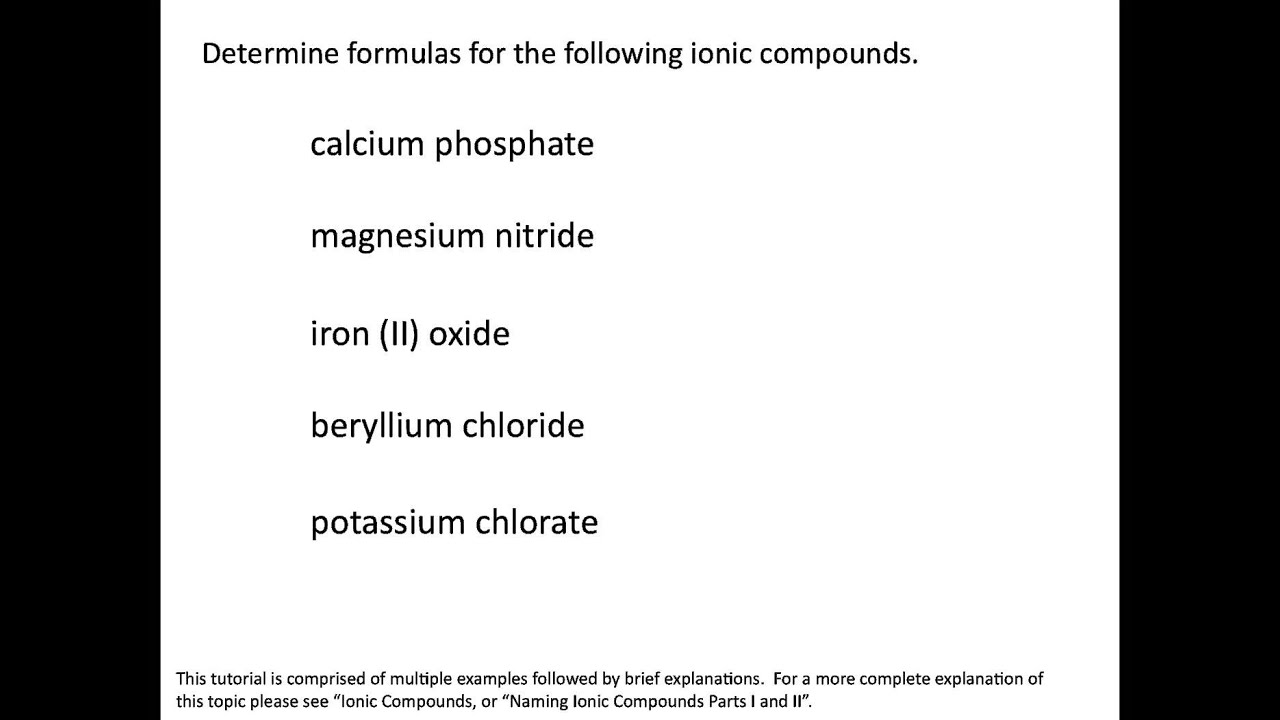
transition metal as well but silver typically only forms ions with a charge of plus 1 and so this is one of the transition metals you don't really need to include a Roman numeral four if you don't want to so we'll just name this compound silver and we noticed that our anion is a polyatomic ion and in this case that polyatomic ion is nitrite so this compound is silver and nitrite again when you're naming these polyatomic ions be careful with your eights and your i'ts these formulas usually only differ by one oxygen so it is easy to sometimes mix them up okay now that we've done lots of examples of determining the names let's do this in Reverse and determine the formulas if you're given the name of an ionic compound calcium phosphate well we know calcium is the easy part we need to determine the formula for the anion and the first thing you need to do is determine if phosphate is that a polyatomic ion or is that an element that's had its name changed now remember if you change the ending of an anion when you have an anion that's an element you change the ending to I'd so if you ever see eight at the end you know you must have a polyatomic ion in your formula the next thing you need to do is determine the charges of your cation and your and ion so I know that calcium forms ions with a charge of +2 phosphate is po4 with a charge of minus 3 so if you want to have a formula where the charge of the cations cancels anions if you want to have a neutral compound we must have three calcium ions and two phosphate ions now I've noticed that another thing that students like to do when they're determining the formulas for an ionic compound is to use the swap and drop method where they take the charge on the cation and swap and drop that for the subscript on the anion and take the charge of the anion and swap and drop that for the subscript of the cation now that's fine and that's a really easy method to use the problem a lot of times arises if you're doing the swap and drop method and you have a polyatomic ion in your formula make sure that you don't change the formula of your polyatomic ion so if you're gonna swap and drop make sure you keep that 2 on the outside of the parenthesis for the group of pl for don't change your formula to see a 3 po2 so the names of polyatomic ions don't change the formulas of polyatomic ions also don't change so you want to make sure that you are signifying that you have two phosphate groups so keep that po4 group the same and then just put the 2 that you swapped and dropped on the outside of the parenthesis there ok moving to the second example magnesium nitride there are a few polyatomic ions that end in ID but nitride is not one of them that means that your anion in this case must be nitrogen the element now we know that magnesium forms ions with a charge of plus two and nitrogen forms ions with a charge of minus 3 so if you swap and drop those charges and put them as subscripts you should come up with the formula mg 3 & 2 ok third example iron ii oxide determining formulas from the names of ionic compounds that contain transition metals is actually really nice because the charge of the cation is given to you right in the name so I know that iron ii oxide means that iron in this compound the iron ion has a charge of plus two oxide is not a polyatomic ion oxide as oxygen where the endings been changed to ID so the oxygen ion is your anion oxygen forms ions with a charge of minus two so if iron is plus two and oxygen is minus two the charges on those ions will cancel each other out so your formula would be FeO now here's another example where you want to be careful if you're using the swap and drop method remember for our ionic compounds we always write them in their empirical formula so their lowest ratio formulas so if you just swapped and drop these charges you would get Fe 2 O 2 that's not technically correct because we want to write the formula in its lowest ratio so if you have the same charge on your cation as you do on your anion then you can just assume that those charges will cancel each other out you'll get a neutral compound with just one of each of your ions fourth example beryllium chloride beryllium forms ions with a charge of +2 chloride is not a polyatomic ion so I know that chlorine forms ions with a charge of minus 1 he should come up with the formula B EC l2

Segment 3 (10:00 - 14:00)

and potassium chlorate again notice the difference between chloride and chlorate chloride is talking about the chlorine ion chlorate is a polyatomic ion so potassium forms ions with a charge of plus 1 chlorate is CLO 3 with a charge of minus 1 so the formula for potassium chloride would be kclo3 okay I told you we had a lot of examples so these are the last five let's determine the formulas for these ionic compounds silver cyanide most of the time you will not see a Roman numeral indicating the charge on a silver ion because silver forms ions with a charge of plus one this is one that you can't really determine from looking at the periodic table so this is one you just need to remember silver is +1 cyanide this is one of the few polyatomic ions that end with ID this is another helpful one to kind of keep in the back of your mind remember cyanide is a polyatomic ion so silver cyanide silver forms ions with a charge of +1 cyanide has a formula of CN with a charge of minus 1 so the formula for this compound would be AG CN zinc oxide zinc is another metal in that transition metal block but zinc typically forms ions with a charge of +2 so again you don't normally see a Roman numeral written in the formula for a compound that contains zinc oxide tells us that our anion is oxygen knowing that zinc forms ions with a charge of +2 and oxygen forms ions with a charge of minus 2 that positive and negative charge from the cation and anion will cancel each other out so your formula is Zn o iron 3 bromide this means that the iron cation has a charge of plus 3 bromine I know minus 1 so your formula here would be febr3 magnesium hydroxide here's another tricky polyatomic ion students see the ending I'd and immediately think this must be an element and they see that hydro in front so assume that this is a hydrogen anion remember that hydroxide is a polyatomic ion it has the formula Oh H with a charge of minus 1 so magnesium forms ions with a charge of plus 2 hydroxide is Oh H with a charge of minus 1 so if I want to have a neutral compound I need one magnesium ion per every two hydroxide ions now here's another mistake people make when they're determining the formulas students often forget to put that hydroxide group in parenthesis with the two outside of parenthesis remember you need those parentheses to distinguish that this formula contains two hydroxide groups if you don't have those parenthesis there then as essentially what you're saying is that you have one magnesium one oxygen and two hydrogen's in your formula so you want to have those parentheses around both the oxygen and the hydrogen that whole hydroxide group just like any other polyatomic ion that you have multiples of and last one ammonium nitrate this is an example of a polyatomic ion that has a positive charge ammonium is so that e/m of the end tends to make you want to look on the periodic table for an element you're not gonna find ammonium anywhere so remember that ammonium is one of the most common positive polyatomic ions and it has a formula of NH 4 with a charge of +1 nitrate do you see that 8 ending that immediately tells you must be working with the polyatomic ion and nitrate has a formula no. 3 with a charge of minus 1 so you have the ammonium with a charge of plus 1 the nitrate with a charge of minus 1 so you need 1 ammonium ion and 1 nitrate ion for your formula so in this case you would have NH 4 and O 3 well I hope those examples helped thanks for watching the chemistry solution if you have any other tutorials that you would like to see done on specific topics please feel free to email me at missy that's mi ssy at the chemistry solution com

Другие видео автора — TheChemistrySolution

Ctrl+V

Экстракт Знаний в Telegram

Экстракты и дистилляты из лучших YouTube-каналов — сразу после публикации.

Подписаться

Дайджест Экстрактов

Лучшие методички за неделю — каждый понедельник