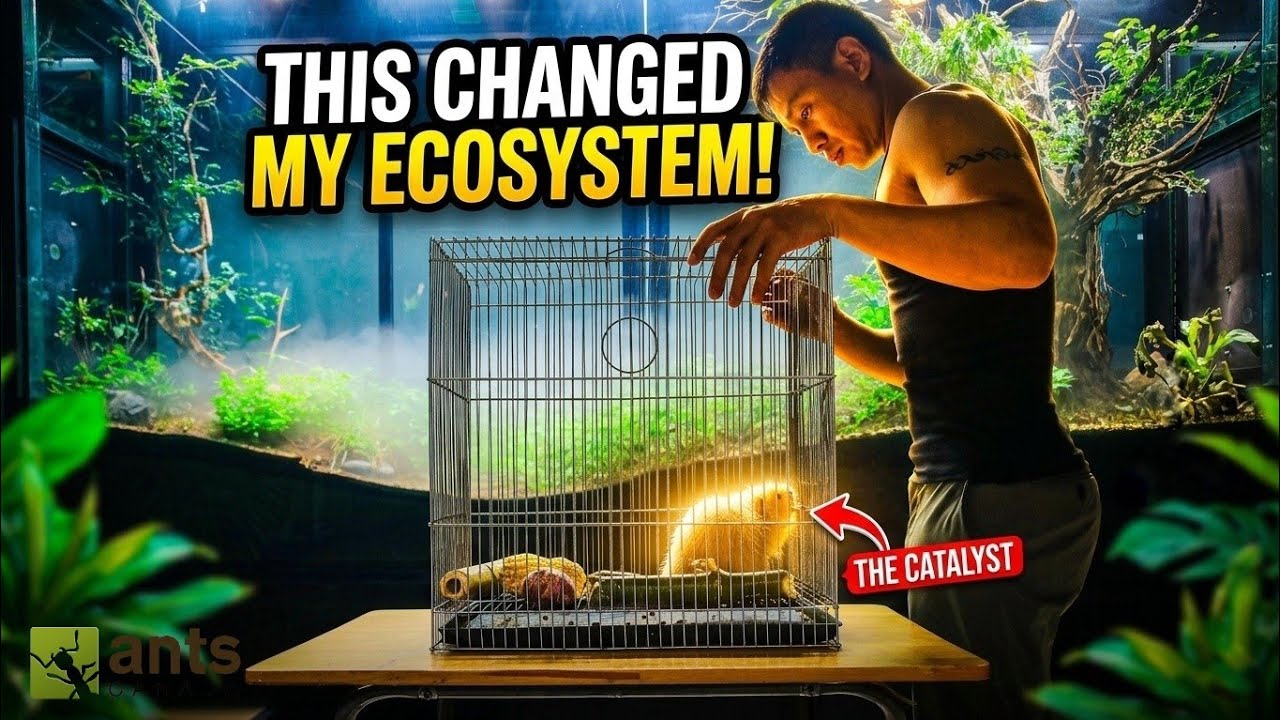
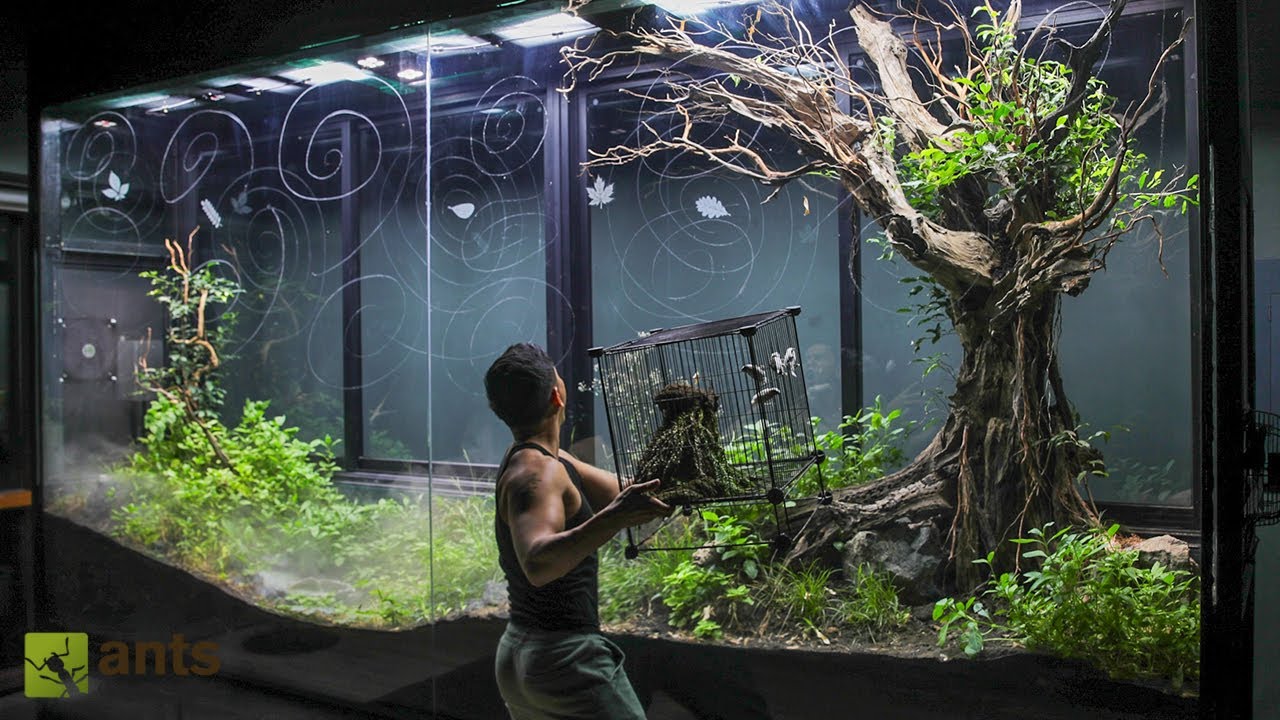
This will blow your mind! I am AntsCanada, Creator of Worlds, the biological engineer of a multi-year operation in my giant Ant Room lab, located in my home, where I’m building an expansive network of ecosystem vivariums: Exhibit A) Pantdora, my 1000 gallon cloud rainforest floor vivarium, which is connected by way of a cave tunnel, to Exhibit B) Hydromeda, a tropical wetlands vivarium, and to a vertical glass bridge of wooden vines ascending up to Exhibit C) Orchadia, a treetop canopy vivarium on the floor above, and through an opening at the back, leading to a newly constructed glass bridge, to Exhibit D) Verdantia, a gargantuan 2,000 gallon tropical Grasslands Vivarium. It’s all one massive connected ecosystem, I call Pantgea, housing a plethora of fungi, plants, and animals, whose purpose is to reveal how ecosystems work in the wild, and speaking of the wild, that’s exactly how things are about to get, and all the Pantgean creatures within, have no idea their lives and home, are about to change forever, with the opening up of their ecosystem to the real world beyond the glass. My heart raced as I stared at the black sticker behind which lay the hole leading to the outside world. This is the moment I’ve been waiting for, which will surely put the viability of our ecosystem to the ultimate test. “Mother Nature, bring forth the creatures that may, for the ecological sanctuary I’ve prepared is ready! ” I removed the sticker, and just like that, Pantgea, which for over two years had been a contained system, was officially open to the outside world. The succession of events that ensued from this pivotal moment in our ecosystem’s story will blow your mind. Please SUBSCRIBE to the channel and hit the BELL ICON! Welcome to the AC Family. Let’s get to 7 million subs in this Season 7 of my Ecosystem Vivarium Series. Thank you for being part of this biological journey with me. Enjoy! “Only those who risk going too far can possibly find out how far one can go. ” This is a quote by TS Elliot that came to mind, as I stared at the open hole to the outside world. I could already hear some of my contemporaries, screaming that I’ve done this. As for me, I’m not worried. Of course, as the engineer of this project, I keep a close inventory of all the species in our ecosystem, and have taken all precautions to ensure such an experiment was safe, ecologically speaking. You see, certain key creatures are prohibited from leaving via a wire filter that keeps them from entering the bridge leading to this chamber and hole to the outside world, like Valentino, my pet Green Tree Python, and Sonny and Cher, the two king quails, all of whom are neither wild animals, nor found naturally in my area. None of the fish or aquatic animals in Hydromeda are native, but they obviously can’t make it to the hole, so they weren’t a concern either. There is one species of feeder roach that can’t climb glass so they can’t leave either. However, any other resident creature in our ecosystem that is both small enough to pass through these wires into the bridge, and climb the glass, to reach this exit to the outside world, is fair game to leave, because they’re all from my area, with the majority of the species in our ecosystem, having hitched a ride into the tanks unbeknownst to me via the decor, which came from the outside, anyway, so they’d just be technically returning home if they left us, but something tells me we won’t be losing a lot of creatures, and you’ll find out why soon. The way I see it, right now this new opening to the outside world would be the ultimate test of our ecosystem’s viability, as native creatures could now leave and enter at will, and discovering any newcomers wandering into our system would be like finding a pleasant kinder surprise from Mother Nature, and just a heads up, I know you guys will love all the surprise creatures coming up!
Segment 2 (05:00 - 10:00)
But having said all that, AC Family, while some of you may be wondering if this is all even a good idea, there’s actually a more important purpose to this portal to the outside world, other than simply a way for new random creatures to be introduced and/or leave our ecosystem. This hole is actually part of an even bigger master plan that will 100% benefit our ecosystem, and it all has been the hardest thing to keep secret until today. So what’s the deal then with this hole, you ask? Well, to understand, let me take you back to several weeks ago, when the idea of this master plan first bloomed into existence. In Verdantia, the grasslands have really begun to produce some truly beautiful flowers. These dainty purple ones are the most common. It’s amazing how synched Verdantia is to what’s going on outside, because gazing out the windows of the Ant Room, I was delighted to see the great news! The most beautiful pink puffball flowers of the monkey pod trees around my home were in full bloom. It’s our dry season, the summer, which where I live means the start of the Flowering Season! In my yard, an orchestra of flowers gloriously announce their return to form with their various shapes, colours, and perfumes at this time of the year. Now, I’m unsure why from an evolutionary standpoint, the plants have evolved to bloom their flowers during our hottest, harshest, and driest season, but my guess is it’s a timing thing, perhaps so that seeds have enough time to disperse before the onset of the Rainy Season in a few months, when the seeds can get the water they need to germinate, or perhaps, the bright summer sunshine makes the colours of all these flowers really pop, as doing so would best catch the attention of some high priority V. I. B. ’s. This was where the big idea began! Along one of the walls of my yard is a line of these peculiar looking flowers. The species is Calathea lutea, the cigar plant. It gets its name from their flowers that kind of look like cigars. I was staring at the flowers one day when I began to notice they were being frequented by some neat visitors: stingless bees, native bees that are smaller cousins of the regular honeybees, that for some reason have evolved reduced, non-functional stingers, hence their name. I was very familiar with them, as I have several hives all around my property, which I’ll show you guys later. These bees will forage as far as 500 meters from their nest visiting a variety of different flowers, collecting nectar and pollen which they use to feed their colony and produce honey. In exchange, the stingless bees help pollinate the flowering plants they visit. Undeniably, bees are quintessential organisms of the world’s ecosystems, and that AC Family, is when the craziest idea came to me. Hmmm… “Hmmm… Something smells different today,” the blue ant thought. It had been foraging the Orchadian canopy this evening but noticed something seemed a bit different in the air. A new tree smell? A different breeze? She couldn’t quite pinpoint what it was, but she knew she should probably alert the colony of the change, back at the nest. Down in Pantdora, Kermit, a male tree frog was up early ready to begin his evening hunt for food. He too could feel a subtle change in air quality this evening. Frog skin is sensitive to changes in air temperature, humidity, and flow. He knew something was up. I usually
Segment 3 (10:00 - 15:00)
see these males hanging out in Hydromeda where they are preparing to breed in a few more weeks, so seeing him here in Pantdora was a bit of a surprise. Kermit was making moves. In Verdantia, Sonny and Cher were preoccupied hunting for crickets. Cher was protein loading in preparation for egg-laying season soon. I knew the two were gearing up to enter their breeding season because I caught them preening each other, a behaviour birds do when in love. These two love birds didn’t know it yet, but a major change was coming to their world, as well, as a result of the new hole. Now in the glass box, our first newcomers appeared. A silent and swift movement on the glass surface caught my eye. It looked like a living fruitfly but it was actually dead, being carried by a black crazy ant. A few tiny insects had already found their way through the hole by chance, and were perched on the floor. This glass chamber was currently dry and unfavourable for insects. Some of the insects that stayed too long, would end up drying to death here, which is likely what happened to this poor fly, now being carried back home to the black crazy ant’s nest to be eaten. In fact, I was beginning to feel like this entire new bridge above was a drying hazard for most small insects, and far too bare and sterile. So far I’ve only seen some black crazy ants and a jumping spider crawl through here since we first opened the bridge up, and I mean, if I were a tiny critter, this 9 meter long stretch of open glass space would be a bit daunting to cross. But, all that was about to change by morning, as I had epic plans to make this space a lot more creature-friendly. My team and I went straight to work. First up, was sawing the logs down to size. When I saw this beautiful piece of driftwood, I knew in my gut that this was the one for our bridge! Then we worked on arranging the pieces into the bridge. We secured the pieces using filler foam. And now for the preparations to this glass box which attaches to the bridge above. You guys will absolutely love what will become of this glass box when it’s done. This is my Bee Box, one of several I keep around my property. Check out the bees! A swarm sits around the outside ready to defend the colony, as well as help climate control it. There’s the opening, highly guarded and a high traffic area. I love watching the bees retuning as well as zipping out the door. Now, I can get in close to the bee hive without troubles, but I still need to be careful not to alarm them, because though they can’t sting me, they can kick into defense mode if provoked, and will willingly get into my ears, nose, eyes, hair, and clothes to deliver a pinch bite. Now, I use the bees to help me produce greater yield with the crops on my farm. Check out the size of my banana bunches! So prolific and it’s all thanks to the bees living just below. Now check this out, guys! You may notice the workers on the roof all have
Segment 4 (15:00 - 20:00)
blobs of liquid in their jaws. This behaviour is known as bubbling or nectar concentration, where they actively dehydrate the nectar they have collected to turn it into honey. You see, nectar from flowers is very dilute, containing about 80-95% water, and to make thick storable honey that won’t spoil, the bees must reduce the water content to around 30%. So the bees regurgitate a drop of nectar from their stomach, known as the honey stomach, and hold it between its mandibles and tongue, exposing it to the air. By repeatedly regurgitating the droplet out and sucking it back it promotes evaporation of the water leaving the bees with a more concentrated nectar syrup. Bubbling is helpful because it also reduces its transport weight, is easier for the colony to manage, and is used to make bee bread, which is a food for their larvae. It even helps with cooling the bee’s body temperature down, kind of like how panting cools down a dog, which is key right now in this summer weather! Perhaps that is also why a mass of them are doing it on the outside of the nest, to assist in keeping the entire nest cooler by collectively releasing nest heat via bubbling. At this time of the year, the bees are the most active, most adaptive, and hardiest, which is why mature colonies ready to start new colonies, will break off part of the colony to establish a new colony with a new queen at a different location. It’s why stingless bee keepers, like my friend Mack here, use this time in the Summers to split their biggest colonies in half and place the removed half into new bee boxes to establish new colonies. In the wild, the bee colonies of course don’t have these bee boxes, but instead, nest in self-made hives usually within cavities of trees or rotting logs. AC Family, behold, our brand new rotting log bridge. What do you think? Let me show you around. This bridge is designed to recreate the falling of a dead tree on a cliff, adjacent to the canopy, whose trunk forms a natural bridge to a Grassland plateau on the other side. See the vision? I just find it looks super zen and peaceful. I love the shape of the wood, with all its holes and crevices. I was certain a tonne of creatures would love to inhabit the various nooks and crannies. The moss growing on it looked magical. There was a bit of soil to establish moist areas within the bridge which I knew the critters would appreciate. So what do you guys think? What should we name this bridge, guys? Let me know in the comments, and I’ll choose my favourite. I was certain that with this new natural space, our resident creatures would be much more willing to wander into and inhabit our bridge, as well as hopefully attract new creatures from the outside inside, and you know what? I was right! At the top corner of Orchadia, a blue ant had found its way to the bridge! Awesome! My heart was so full watching the very first blue ant excitedly explore our new log bridge. It scaled the driftwood then traversed the green fields of moss. For its whole life it had only known Orchadia, Pantdora, and Hydromeda, but today she had found a new fork in the road, taking in all the new sights, new smells, and mapping in her mind the beautiful logscape spanning our bridge. I smiled knowing she would soon head back and report to the colony everything she’d found. In terms of creatures coming into the system, check this out. I noticed a movement on the branch within the glass box and couldn’t believe my eyes! Now you may think this is an ant, right? Well, it’s not. This is actually a spider, an ant-mimicking spider that is totally cosplaying a Polyrhachis ant found in my area. See the “head” of the ant? Those are its jaws! Crazy mimicry! I’ve been trying for years to find one of these guys to add into our forest, and to think all we needed to do was give it an open door to walk through! I placed it back to
Segment 5 (20:00 - 23:00)
explore and hoped we’d see it again soon. Over the next few days, Mother Nature sent more and more kinder surprises through the hole. A beautiful juvenile green locust. I wondered where it would go? Looks like it's headed for Orchadia! Makes sense that being up at canopy level on this top floor of the Ant Room, most of the creatures coming in from the hole will be canopy creatures. I also spotted a jumping spider and a house gecko in the glass box, but I wasn’t sure if they came from the outside or were one of our residents here because they had learned that critters come through that hole and were hoping for an easy meal. At night, I was shocked to discover a male tree frog in the bridge! Again, I wasn’t sure if the tree frog was Kermit, coming to check out our new bridge, or a totally new guest tree frog from the outside, sensing there was an alluring world within the hole. Whatever the case, so far it seemed like this hole just changed the dynamics of this project big time. I hope it can help increase biodiversity in our ecosystem over time. We’ll just have to see! But in case you’ve been concerned about the hole causing a potential loss of biodiversity, especially of some of our more beloved creatures, like the blue ants, possibly leaving us, I’m not too worried, because in Pantgea the blue ants enjoy regular fruit. They don’t eat much of anything else. Also, Pantgea replicates a cloud rainforest and montane system, a habitat that is higher in elevation, with cooler temperatures and hydrating mists, in comparison to the hotter, drier lowland rainforest outside my home. These blue ants happen to come from the local cloud rainforest near me, so I am hoping if they ever do pop outside, they realize how good they have it with us and choose to stay, since Pantgea’s environment better mimics their natural home. I’ll definitely keep an eye on them, no matter what, but from the looks of things, our blue ants seem much more interested in following their antennae, to explore the new and highly intriguing smells of Verdantia. And you know what? There’s actually another reason I’m not too worried about losing life to the outside world; In fact, I suspect very few creatures will want to travel into this lower glass box area after tonight. AC Family, it’s time to share with you the big secret I’ve been keeping about this hole and glass box. I’m sure some of you may have figured out my plans at this point, and yes, it’s a bit crazy, but only those who risk going too far, can possibly find out how far one can go, and this time, we’re going 500 meters outward. “Hey, Mack? All set for tonight? Perfect! Yes, everything is set and ready for their arrival. ” VOTE in my Community Tab to affect this story!