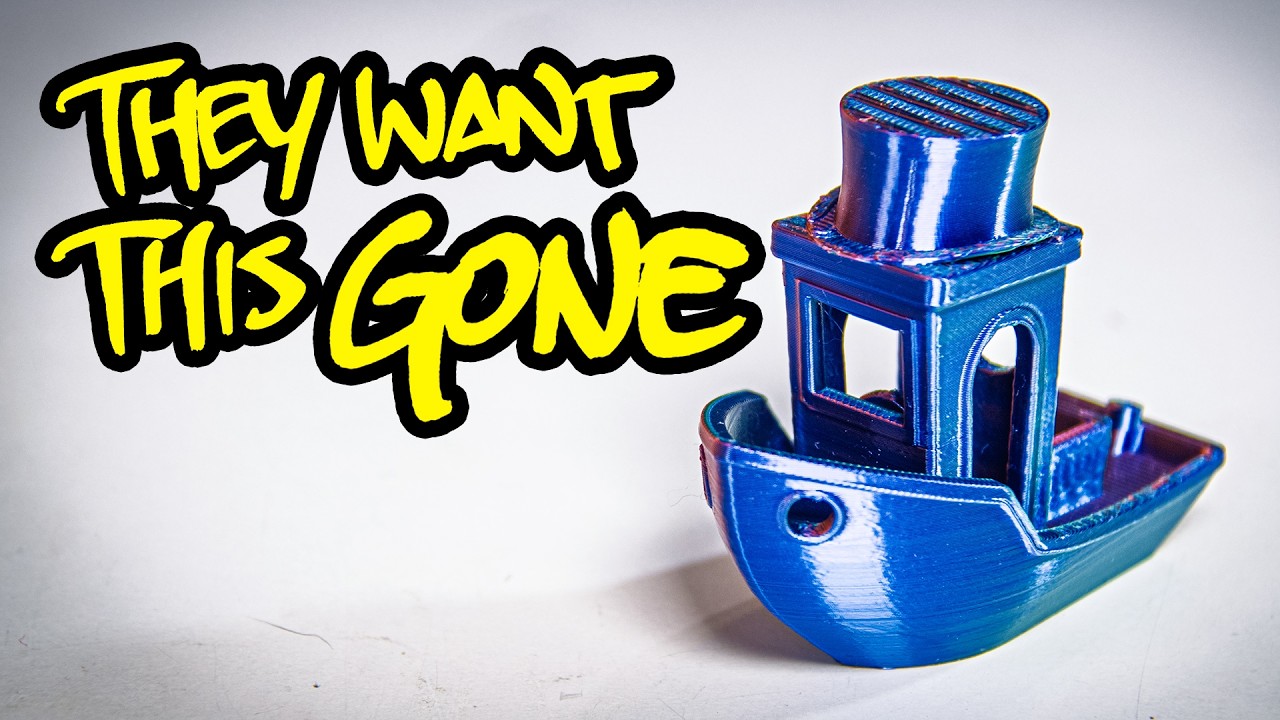
This filament bounces higher than rubber and transforms into squishy foam. This one is so strong and so stiff, it unwinds its own spool. And listen closely, because this filament doesn't just look like cast iron, it also sounds like it. Prototype liquid crystals, Pyrex microsphheres, nigh unprintable mystery material that makes lenses for Wi-Fi. Prepare to storm the wild frontier of additive manufacturing where the map simply reads here be dragons like this dragon made of aerospace superpolymer that withstands a 200 Celsius heat gun while it's carrying an entire printer. I'm Zach Freriedman and these are some of the rarest, weirdest, and most exotic 3D filaments ever shown on YouTube. Welcome to every single filament and welcome to my workshop, Voidstar Lab. It's not Voidar Labs. There's just one lab. We don't need more lab. We have lab at home. Ladies, gentlemen, and cyborgs. Some of these filaments took weeks of research and cold calling just to get my hands on them. Many of these took days of trial and error to dial in and print properly. Most needed special equipment, and a few even destroyed that equipment in the process. Without your support, I would have to fight AI sludge mongers for scraps of ad revenue, and that would barely leave time to check facts, let alone fabricate objects to show you. Makers like you deserve more than a hog trough of raw misinformation. And you get more because Voidstar Labs partners, scientists, assistants, and collaborators keep these lights on. Help me keep squirting exotic filaments instead of a diarrhea deluge of disposable so-called content. Become a patron at patreon. com/sackfriedman. I buy most of my filaments, tools, and parts out of pocket. So, we depend on commercial partners like today's sponsor, Diamondback. They make the ultimate 3D printer nozzle tipped with polycrystalline diamond, the toughest, lowest friction, and most heat conductive material on the planet. And they're all made right here in America with million PSI hydraulic presses so massive they had to construct their factory around them. Except no substitutes and no tariffs. Diamondback nozzles heat up faster, clog less, and print cleaner. You can install one in seconds, and it won't just improve your printer forever. It'll outlast the printer. If your machine taps the nozzle against the plate for mesh leveling, like bamboo and puschia, you don't even have to recalibrate. You just set it and forget it. Nearly every filament I featured in this series was printed on a Diamond Back. The Diamondback's only limit is this nickelplated copper body, which limits the nozzle to 300 C until now. These are prototype high temperature Diamondback nozzles that have never before been seen on YouTube. This brings polychrystalline performance over 400°. It makes a diamond back capable of printing literally anything. These are still pre-production samples, but high temperature diamond backs may have hit the market by the time you watch this. If so, I will put a card right up there, and link in the pinned comment. But odds are you don't regularly print 400° aerospace super polymers. So, the classic nickelplated copper will serve you perfectly. Head to diamondbacknoszles. com or click the link in the description to get the finest, fastest upgrade for almost any 3D printer. Tragically, this episode does put me in the 0. 001% who does print 400 degree aerospace superpolymers. And I lied because our very first filament actually prints of 445°. This is thermoplastic polyomide, the filament that just may be too hot to handle. Don't confuse polyamide with polyamide. Polyamide is nylon, while polyamide is cap. Technically, capton is a polyamide. Not all polyomides are cap. It's a brand name for a specific formula of PI film [snorts] and it's a thermoset which means it won't melt. It just burns. 3D filament that's physically incapable of being printed is exactly what folks expect to see on this channel. But this is a thermoplastic TPI that does melt and ergo print. I am as disappointed as you are. TPI is classified as a high-performance thermoplastic aka a super polymer. Most superpolymers are incredibly stiff, super strong, and resist lethal extremes of heat, chemicals, and radiation. And they all have astronomical print temperatures, almost always well over 350 Celsius on the nozzle, 120 on the plate, 100 in the chamber, which is mandatory, and 100°ree oven just to dehydrate them. But TPI is extreme among extremes. It demands 445°ree nozzle, a 220°ree plate, plus 150°ree oven to dry the spool. Many printers designed specifically to run super polymers can't print TPI, but this printer is special. I will contain my enthusiasm until we finish this filament. As most polymers get hotter and hotter, their modulus or stiffness falls faster and faster. Actually, it's moduli, there are two of them, the stiffistics, but TPI's modulus drops at a linear rate. So, the hotter the heat, the exponentially better TPI becomes compared to other filaments. TPI's gargantuan molecules make it one
Segment 2 (05:00 - 10:00)
of the thickest, most viscous filaments. And because it turns solid almost the instant it leaves the nozzle, TPI basically doesn't warp. The hottest printing filament easily runs aggressive overhangs and long bridges that make regular filaments go saggy. The TPI Beni came out so crisp, I decided to try the cliche articulated dragon that was meant to print in silk PLA. This hellscape of cantal levers and spikes looks phenomenal. And the print-and-place chain links worked flawlessly right off the plate. Even when shrunk to 3/4 scale, this bad boy can lift over 20 lb even as I blast it with a heat gun. Sure, this is like 50 bucks a filament, but like dragons are supposed to resist heat. You can't put a price on immersion. I should probably talk a bit about the printer because without this thing, I would have no chance of printing most of these filaments. This is the Vision Miner 22 Idex, a cuttingedge printer. So cutting edge, it released like a week ago. This is not the printer that's been sitting in my garage for almost a year. I had such a hard time getting that thing into the workshop because it weighs soing much. Remember when I almost killed a task rabbit? Vision Miner eventually called me up to repossess it. Somehow I ended up playing the reverse card and reed them into sending me an even better one than flying out to install it personally. Now that's what we call failing up. Turns out Vision Miner CEO hired a whole bunch of his employees from his Brazilian jiu-jitsu dojo and they could shle 110 kilos down a hallway. No dolly, 2 in of clearance, no sweat. Vision Miner's 22 IDX series are some of the only super polymer industrial printers that can actually run multiple materials. This thing has two 500°ree nozzles, a 300°ree carbon fiber build plate, and a built-in convection heater that brings the chamber to literal boiling. This thing is specifically engineered to print the most challenging and demanding filaments as easily as a consumer printer prints PLA. Although it is far more likely to blow the circuit breaker. Adding 1 and a half kows of pure printer broke the camel's back so hard I ended up with two camels. I had to write the script and run all these jobs from that laptop I bought when my apartment flooded. Vision Miner also hooked me up with a bunch of today's filaments, including this TPI. I showed off a different full spool in the filament tier list, but we had an incident. When I tried to dry the TPI in the toaster oven at 150° C instead of the other filaments 100, the heating elements got too hot. They lit the spool on fire and they melted the whole reel. Remember, I can't put anything on the same circuit as the 22 IDEX or it'll pop the breaker. So, I had to put the toaster oven in the garage. By the time I started smelling smoke, my $250 spool of TPI had become one with the baking rack. Vision Miner came in clutch and shipped me their reel. And they even included some spare parts, which was nice because it turns out there is no other filament that gets hot and viscous enough to actually get the TPI out of the hotend. So, I replaced the nozzle. Then, I realized the clog was actually in the heat brake. So, I replaced the heat brake. I then discovered that I had pushed a piece of the clog out of the heatbreak into the new nozzle and I had to replace the nozzle again. So, is all the it takes to print TPI worth 50% more strength than Ultim 1010 at 170°? Hell no. If PEI isn't stiff enough, you do the same thing you do in any other filament isn't stiff enough, you fill it with some carbon fiber. Polythermide, trade name Ultim, isn't just the holy grail of print surfaces. It's a pair of super tough super polymers with excellent heat resistance and a tendency to absorb water as desperately as I absorb your praise in the comments. I don't believe anyone actually makes any Ultim 1010 composits. Probably because Stuffing Fibers 9085 transforms what's already a great filament into a god tier filament. For the rest of this episode, whenever I mention PEI, I am specifically referring to Ultim 985. Adding carbon fiber to PEI does not raise its glass transition temperature at all. Yet it still makes the part massively stronger when the heat is on. What gives? Carbon fibers are stiff. CFPI is four times stiffer than the unfilled polymer. It might still soften at the same rate, but now it's soing rigid to begin with, even partial strength is already overkill for most applications. But the monkeykey's paw of material science always exacts its price. That stiffness extends to the filament itself. Carbon fiber PEI is a really stiff filament. It is a filament that is soing stiff. I cannot explain howing stiff the stiff ass filament is. How the hell 3DXT managed to wrap something this stiff around aing spool is beyond me. And don't try to explain because I won't believe you. Good luck finishing a print without snapping the filament in at least once. It is a miracle I managed to load it into the hotend at all. But pun joke printer man. Higher number always goodter. Is carbon fiber PEI goodest? — Of course not, my gentle gender agnostic cave person. This is glass filled PEI with a glass transition temperature of 217 Celsius and a tensile modulus of
Segment 3 (10:00 - 15:00)
nearly 8. 8 gigap pascals. It's almost 9,000. PEIGF is the stiffest, densest, most highly filled super polymer I have ever seen. 30% glass. Holy sh Pure PEI is already pretty stiff. And the fact that we can swap a third of it for silicon dioxide and still manage to tug a boat's worth of it through a three foot long filament path is a testament to the sheer power of the Bond large gear extruder. It's not sponsored. I'm just impressed. This glass filled PEI Benie looks absolutely gorgeous and it better. Molten PEIGF is so creamy and viscous. Even with a fully loaded $15,000 printer, I could only run this stuff at a molasses slow 10 mm per second. any faster and the layers would peel apart. Filament would crawl up the nozzle and I would end up with a fragile print in a fiber-filled gigabooger. This benie took almost 3 hours to print. Nobody would ever use this filament if it weren't basically indestructible. PEGF does not wear down. It doesn't soften. It doesn't warp. It doesn't conduct electricity. It doesn't build up electricity, dissolve, react, bend out of shape, or snap unless you really, really mean it. Glass is such a good stabilizer. This is the only superpolymer beni that didn't need custom G-code to nail a perfect chimney. Composite PEI and thermoplastic TPI have phenomenal heat resistance, but they're still not the best. The top spot of Ultra Hot is a technical knockout by polyphenol sulfide. That is the one from the second episode of this series that'll survive a few years immersed in boiling turbentine. But it's really hard to make use of that because it glass transition temperature is a mere 85°. But add a pinch of carbon fiber and PPS now stays stiff till 260C. PPSCF looks different. It feels different. It even sounds different. It's basically an entirely different filament. And yes, I did say sounds different. When you strike PPSCF, it rings. You can even print percussion instruments. I mean, you could do that before, but now they'll actually work. The reason PPSCF sounds like metal is surprisingly hard to research. The ability to release a pure tone when struck is called sonority. And while there's a ton of information about sonorous metals, there's basically nothing about polymers because polymers don't do this. I've got a fever and the only thing that'll cure it is carbon filled polyphenol sulfide. PPSCF is off thecharts stiff, heat proof, and non-reactive, but bring it into the real world, and you'll quickly discover this filament is a glass cannon. It might feel like steel, but give it one good thack, and it literally falls to pieces. That's not to say it's useless. The ability to print things that look, feel, and even sound like cast iron opens up a lot of really, really weird possibilities. However, there is another filament that looks like iron and actually delivers CF peak. Polyther ether ketone is considered the ultra performance polymer to the point where companies like Vision Miner waste a whole lot of billable hours convincing aerospace clients to try literally anything else. But sometimes you just got to take a peek. Carbon fiber makes all the difference. This is the first time I've shown CF Peak on this channel, although I said I did in two past episodes. That sample was a loose coil that I think was actually CFPI that was mislabeled because the stuff on this bool is on a whole other level. This filament is so stiff, so strong, so rock solid, the spool randomly and spontaneously unwinds itself. Yet, the filament never snapped. Even though I printed two allnight dual color prints with regular peak, I have a multiaterial printer that can print peak. I'm going to print multiaterial peak. And if this is how strong the filament is, imagine the print. Fibers affect peak differently than other polymers because poly ether ketone like a suburban witch gurly draws its power from crystals. Peak only reaches peak power when it's crystallized. Each molecule has to get caught up in an existing crystal or hit a nucleation site, a foreign object that triggers a chain reaction. So suppose you spike a semi-rystalline filament with foreign objects, for instance, carbon fiber. You now have tons of nucleation sites growing tons of tiny crystals so quickly the filament doesn't even get a chance to warp. This is carbon fiber peak. Stronger, stiffer, more heatresistant, easier, and more stable to print. All thanks to guaranteed consistent crystal formation throughout the entire print. CF Peak is a monumental improvement on the raw polymer, even though it only contains a measly 10% carbon fiber. Probably the worst caveat, CF Peak destroys hotends. It crystallizes so easily and the carbon fiber clogs so effectively. If you let your hotend idle too long or worse, cool off, there's a decent chance something will permanently jam. During testing, I lost another heat brake and nozzle, and I had a near miss with a lucky cold pull. Let's check out
Segment 4 (15:00 - 20:00)
another flavor of Peak I haven't shown yet. Peak GF20 stuffed with an impressive 20% fiberglass. That's double the fiber, yet every stat except tensile strength is even worse than CFP. Who the hell would want this? People who value their time and money. These glass fibers are more flexible than the other filaments carbon fibers, and the higher filler content more effectively stabilizes the molten filament. So, GF Peak is less likely to snap, warp, or otherwise misbehave during printing. This makes GF Peak a great choice for folks who are selling models. After all, if a print is printing a failure, it's not making you any cash. My first GFP print was weak and flaky, but once I fiddled with the settings, the stuff printed like a dream. Also, weaker layer bonds aren't always a bad thing. They make supports easier to remove. But if you can sacrifice a bit of performance, you're likely better off not using peak at all. Oh, here comes the obligatory alliteration. The polymer's plethora of problems, particularly pertaining to printing, prompted the production of a portfolio of potentially powerful possibilities. The most prominent being PE. Polyther ketone is built from the same raw materials as poly ether ketone. And it too looks like solidified urine. The big difference is PE doesn't need to crystallize and warp to unlock its full strength. So you get to bite both ends of the ice cream cone. CF PEC does exist. You're looking at it right now, but it's basically a straight downgrade in all respects. Pure PEC is already stiff, strong, and easy to print, and crystallization is the opposite of what we want. Carbon's thermal conductivity lets you print CF Peek over 430 Celsius if you feel like it. But why the hell would you want that? Sure, its heat deflection temperature is an astronomical 285°, but its glass transition temperature is 165, which is not that remarkable. Composite PE is just a solution to a problem that was better off prevented altogether. Allow me to show you another benie that's also made of pure peek, but this one has no crystallization whatsoever. This is not a special blend. It's not an alloy. The manufacturers revised the formula of PEC filament to make it harder to crystallize. That's why I'm showing it a second time. They patched the PE. The proportion of ether to ketone affects how aggressively PE wants to crystallize. And the very first PEC filaments were made from a 7030 blend called PEX C. C is not for cookie. It is for crystallizing. And that is not good enough for me. PEX C is meant for machining, not printing. But manufacturers took what they could get. I'm talking like this was like the turn of the century. But the first PEC printing media hit the market like 6 years ago. I'm shooting this in 2025, the future. And we finally have a resin meant to be printed. P A. PC C stood for crystalline. So, what does PE A stand for? We may never know. PECF filament is now a 60/40 blend of ether to ketone that is so much harder to crystallize. It's basically impossible to do it by accident. PK A prints 10° cooler. It runs three times faster, and it looks and works exactly like the original. PE A can still crystallize, but it happens so predictably. You can now anneal PE prints in an oven to potentially make them even stronger than peak. But if you want to see the leading bleeding edge of ultra performance polyether printing, our final super polymer is still in open beta. This is Victrex AM200 precision engineered to finally dethrone peak and ease of printing and raw performance. Although it might actually be peak in a trench coat. AM200's manufacturer calls the product polyerol ether ketone which sounds different but pa is just the family of polymers that includes peak and peek along with unprintable oddballs like paca and pekk. There might also be some plasticizers, fillers and other secret ingredients, but Victrax isn't telling. After all, if they spoiled the secret ingredients, they'd just be ingredients. Peak only reaches peak strength when it's crystallized, and that only happens when it stays within 5 degrees of 150 Celsius for most of an hour. AM200 prints very similarly to peak, but has a generous 25° crystallization sweet spot that sits very close to the printing temperature. This makes it far easier to crystallize in place and less prone to warping while doing so. In theory, AM200 can make cleaner models in theory with stronger structures in theory — and reduce the amount of print parameter chainery — in theory — and post-processing required in theory. — In reality, I could only pull off one of those at a time. And I blame the Beni itself because AM200 crystallizes so easily. Any part that overheats is going to heavily misbehave. And the Beni is a torture test for overheating. The prowl bridge pillars in that smoke stack either have such a thin cross-section or have such aggressive overhangs in terms of thermal performance of challenge level impossible. AM200 is a crotchety canankerous jerk of a filament and while it could eventually eat peaks lunch, it demands a lot of experimentation that is
Segment 5 (20:00 - 25:00)
really painful because it's over 1,300 bucks a kilo. We got plenty of options for handling heat. But what if you want your print to keep things cool? Let's power down the IDEX. switch on the rest of the workshop and try something really exotic. This is form future a Pegasus HGS25, a polyropylene infused with 25% hollow microscopic borosilicate glass spheres. That 25% is by volume, not mass, presumably because hollow glass spheres are mostly air and have a crazy low density. HGS25 sounds a,000% cooler than HGS 2. 5. Bigger numbers, always goodter. As far as I know, it's also the only filament that's filled with something else. Hollow glass microsphheres snip the PB's already low density to an unrealistically light 0. 75 g per cubic centimeter. This makes Pegasus the lightest filament I've ever featured, a record that shall stand for the next 3 minutes and 20 seconds. But glass air and polyropylene are all excellent thermal insulators. So, this watt of balls is impressively bad at warming up. Well, this forced me to print this tiny Pegasus refrigerator at a slugardly 20 mm per second. That printed fridge can actually keep food frozen overnight. Unfortunately, Pegasus seems to be kind of discontinued, though every site seems to think it's only on a 14-day back order. I could only find this reel in the less common 2. 85 mm gauge. But honestly, I'm glad I grabbed the thicker pee. This filament is so delicate, I can't see how the 1. 75 version can survive close contact with a drive gear. Polyropylene is generally super tough and super flexible. But these glass balls weaken Pegasus so much you can tear through these prints like papier-mâché. But no matter how you quantify it, the truth is unavoidable. Balls are stored in the pee. I have another tougher, better foam to show you. But we're going to start with the polymer it's based on. This is PEA polyther block amide. Flexible thermoplastic elastimer with chemical similarities to nylon and oddly enough peak. I have three hardnesses to show you. super soft 85 short a mid-range 90A and a solid 95A. Pea has a satisfying squish that makes all these feel soft to the touch. You know those shorts YouTube keeps trying to trick us into watching? They are an affront to nature. If videos were supposed to be shot in portrait, our eyes would be above each other. The shorts algorithm seems to be obsessed with these 3D printed airless sports balls that get their bounciness not from pressurized air, but from pea's intrinsically high energy return. If you throw a TPU ball at the floor, it just gives up. But try the same with pea and it enthusiastically fires itself off the floor directly into your eye. Almost 80% of the energy that goes into bending PEABA is reimbursed when it snaps back. But Pebba has a second secret superpower. Reversible deformation. Peeba springs back from almost anything. Overwhelming force, thousands of impacts, getting flattened for months on end. It even resists getting stabbed. I hope that's never relevant, but your projects are your business. I think PIBA will eventually supersede TPU and so do manufacturers. All three of these have different brands, and there's like a dozen more to choose from. This brings us home to the PIA foam. Sariah just dropped PIBA air, a proprietary composite that actively foams as it prints. A lot like the Color Fab Varioshore TPU from the Cursed Filaments episode. Foaming filaments contain flakes of serious face, a blowing agent. When the filament melts, the blowing agent releases gas that gets trapped in the molten polymer, inflating solid filament into lightweight foam. The hotter the hotend, the better job the blowing agent does. So, you can adjust your prints density and rigidity on a layerbylayer basis. I use this to print a Nerf ballistic knife in pea air, and it let me make the shaft stiff enough to lock into the spring-loaded mechanism while keeping the blade too soft to punch someone's eye into their prefrontal cortex. Everyone's a these days. A stretchy elastic foam is just more useful than a merely flexible foam. Pebba air also obliterates Pegasus PP as our definitive lightest filament. Solid pebba is only a single gram per cubic centimeter and you can print pea air at 55% foam factor. That ends up being just over a third as dense as PLA and that's nuts and buoyant. By making this benie dense at the bottom and light at the top, I have finally made a benie that actually floats properly. infinite power. A pivot print might feel rubbery, but our next filaments really are printable rubber. SPS isn't just a great all-purpose filament. I would go so far as to call styrene butine styrene the most underrated filament period. It all began in the roaring 20s. The Great War had just been won by tanks, planes, and self-propelled artillery. But these had a dangerous link in their supply chains, the rubber tree. America and Germany raced to develop a viable synthetic elastimemer. And suddenly anyone and their dog could transmute crude oil into car tires. No horiculture required. They still didn't give the rubber plantations back to the indigenous people who used to live there because that would be liberal cu. These efforts produced acryo nitralbutadine and butadine styrene and
Segment 6 (25:00 - 30:00)
the latter is now the most important thermoplastic in our entire civilization. You'd think it would be equally popular for 3D printing, but SPS got overshadowed by ABS, which is just acryo nitral butadine and butadine styrene doing the fusion dance. It's all because early printer nerds used ABS welding rod as makeshift filament. And I will save that story and that banshee for the next installment. Be gone. Acrylo nitrial. Styrene beauty and styrene deserves a spot on every spool holder, including yours. Especially yours. SPS is a thermoplastic rubber, but it's usually formulated to be so hard it's effectively solid. The giveaway is an almost imperceptibly springy surface that you might find oddly familiar. Many plastic products like hand tools are coated with a thin layer of SPS to make them feel softer. And while I cannot stand the feeling of rubberized objects, it's a lot more satisfying when the whole thing is solid SPS. SPS prints have gorgeous walls, breathtaking overhangs, and imperceptible warping. Its interlayer bonds are intense, its tensile strength is impressive, and since it's very slightly flexible, its toughness is magnificent. SPS is also one of the most transparent filaments, and you can make it even clearer by vapor smoothing it with lemonine. And look at that smoke stack. Most filaments go blobby when they overheat, but SPS instead enters a glassy phase that better holds its shape. You don't even need an enclosure, though I would strongly recommend one. SPS is in the same family as ABS, and while it doesn't wreak nearly as bad, it still releases fumes that can mess you up over the long term. But still, SPS is a filament you have to try if you can find it. It is very rare, although I suspect that's only because nobody knows it exists. But if you like your rubber rubbery and your flexibles flexible, allow me to introduce SPS's mutated little brother. Styrene ethylene styrene is SPS that's been hydrogenated, a process that boosts its resistance to chemicals, heat, and UV and dramatically cuts its hardness. Seb is a full-on floppy, flappy filament that really does look, feel, and act like rubber. It stretches, it bounces, it snaps like a rubber band. The works, but it keeps the best traits of SPS, especially its hydrophobia. I'm pretty sure Sebs is the only flexible filament that never needs to be dried. Sit on polyropylene. No one's got the spoons to deal with your [snorts] But Seb's headline feature is its grippy, tacky, high friction surface. You can finally print feet that won't walk, doors stops that stop doors, and wheels actually capable of getting traction. It's a surprisingly rare property in 3D filament, and it has a role in almost every project. However, when you finally print SES, be prepared for a fight. The filament is stretchy, grippy, and depending on the manufacturer, it can be extremely soft. Loading this into an extruder was like pushing rope, and it's way too sticky to slide through any length of tubing. SES theoretically can print over 200 mm per second, but the filament easily jumps off the drive gear and wraps itself around the axle. If your model has a lot of retractions, you may need to print as slow as 25 mm/s. My reel of Sebs also arrived all stuck together and I had to peel off all the filament and rewind it. I am not sure whether it was defective, damaged along the way or it just does this. Sebs and SPS do bond more strongly to adhesives and tacifier, so glue, tape, and decals actually stick harder. Not sure if it was relevant here. Our next selection is a mystery material unlike anything you've ever seen. a filament that is without a doubt the most diabolically difficult thing I have ever managed to print. Feast your eyes on Zetamix epsilon 2. 2, a controlled dialectric polymeric enigma that may or may not have been named by space aliens. Zetamix epsilon is specifically formulated to print microwave wave guides. Basically fiber optics for radio waves. Not basically, literally. That is exactly what it does. Light rays, electric fields, and EM waves are different perspectives on the same phenomena. And if I tried to explain it, I would sound like Deepack Chopra. Just trust the quantum Give me your money on Patreon. Oh no, I do sound like Deepack Chopra. This filament looks milky translucent, but if you could see 300 MHz to 30 GHz, it would look almost as clear as glass. So-called microwave radiation is everywhere in consumer products. Wi-Fi, Bluetooth, and you might even find microwave radiation coming out of your microwave. Ooh, and the 5G chips Bill Gates developed for Satan's dark messiah to control your mind through your Facebook account. Actual nut jobs actually believe that. If only those dangerously psychotic whackadoodles knew how rare it is to find solid materials that don't block ultra and super high frequency radiation, they would have stuck with the queer amphibians. The key property um of the material, not the frogs, is the dialectric constant. very loosely how much a given substance behaves like a capacitor. Zetamix epsilon is engineered to have an exceptionally consistent very low dialectric of only 2. 2. A dialectric constant doesn't have units. It's just 2. 2. RF engineering is a hard magic system. Change my mind. In theory, this filament could print antennas that project BAT signal, lenses
Segment 7 (30:00 - 35:00)
that focus a cell phone, and wires for wireless transmission. In practice, I cannot actually show you a functional wave guide. For one, the dialectric polymer is only half the recipe. I'd also need liquid gallium or another thin metallic coating to make the inside radio reflective. Another problem is I don't know what the I'm doing. I am at least three years of undergrad, two master's degrees, and a research grant short of designing and demonstrating a functional 3D printed UHF wave guide. The final obstacle is Zetamix epsilon is almost unprintable. Listen, I've been very hyperbolic today, specifically visav my ass and pains thereof. But I am not exaggerating in the slightest when I say Zetamix epsilon is the most brutally challenging filament I have ever managed to print bar none. This stuff prints at 290 Celsius at a top speed of 5 mm per second. Heat creep and jams hang over this extruder like the sword of damocles and it doesn't stick to any build surface with any adhesive and trust me I have all of them. The glue stick is a placebo at best. The only thing keeping this boat on this glass is atmospheric pressure. And we got less of that up here in Colorado where I live, not New York. But those are just the warm-up acts for the real problem. Zetamix epsilon is so brittle. I had to load the filament like I was performing laparoscopic surgery. And then I had to pause the print every few minutes to eject the broken filament and load it in again. And that was a lot of minutes because epsilon prints, I'll remind you, 5 mm a second with a maximum 0. 1 mm layer height. So what exactly are these mystery molecules that printers hate printing and EM Waves love riding like a slip and slide? Zetamix claims it's polyolifin, a broad family of lightweight polymers that includes polyropylene, OBC, and HDPE. These are all tough, flexible, and low temperature filaments. Far cry from 300 degree angel hair that cracks like Jordan Peterson's mental state if you ask him to define and this smooth slick print is anything but flexible. Tapping it produces a bright glass-like click. It is extremely hard. But Epsilon does share a few of Polyolphin's most distinctive traits. Terrible bed adhesion, zero moisture absorption, and heavy warping. Epsilon is unlike any filament I've ever seen. Polyolifan or poly anything. So I started at the other end and I searched academic journals for mentions of polyolifan waveguides. The same three letters came up again and again. COC cyclic elephant c-olymers share the same architecture as polyropylene except with funky monomer blocks that multiply their stiffness and really jack up their heat resistance. Eh COC's claim to famous is exceptional transparency and electromagnetic permitivity. Eh, especially in the ultra and super high frequency bands. It's increasingly common in radio frequency research labs because it's good for making wave guides. But you won't see it in consumer products because cyclic olphin c-olymers are very brittle. Zetamixep epsilon is the first and only filament made of cyclic olin c-olymer. It acts nothing like pee because it's really the Zetamix epsilon is cutting edge stuff. It's pretty advanced. Our final filament is even more advanced. It's even more cutting edge. It is in fact so cutting edge, so advanced. This hairy, splintering mess barely qualifies as a filament. This was donated by a viewer, but I couldn't find any correspondence, notes, records, nothing. I am pretty sure they snuck it out of a research lab and slipped it to us personally at Murf 2023. I've been sitting on it because they only provided like 30 g and I wanted to wait till I had a superpowered super printer to increase the odds of actually pulling it off. That day has finally dawned. This is liquid crystal polymer and it is utterly unlike any other filament. Liquid crystal refers not to a specific chemistry but to the material structure. It's got enormous molecules that arrange themselves like a crystal but smoothly slide past each other like a liquid. There are many types of liquid crystals and they all shift between different crystal structures in response to different triggers. You might be familiar with a different LCP that is somewhat more tactile and tactical. Kevlar body armor. Aramid fibers are actually liquid crystals that react to force. By rearranging their molecules on impact, the mesh wastes some of an incoming Freedom Pill's kinetic energy, which hopefully prevents a nasty case of rapid onset lead poisoning. This filament is made of a thermotropic LCP that's activated by heat. As it melts, its molecules form flat sheets that smoothly move over each other. As it cools, they shift into tightly packed bundles like wires in a cable. When molten, it acts like a sheer thinning fluid. The faster it flows, the less viscous it gets. LCP has a weird relationship with extrusion rate. Too high and it splats and looks sloppy, but too low and the print line just sits on top of the previous layer like an Most filaments get more runny when they're hot and they chill
Segment 8 (35:00 - 40:00)
out when they're cold. But even at the same temperature, how fast you force it through the nozzle changes how fluid it is. So, as LCP filament cools, its molecules are rearranging themselves. It causes the filament to warp momentarily but dramatically and gives it a knobbly surface. This is not overextrred. This is just what LCP looks like. You can get smoother perimeters by printing faster and cooler, but it cost you layer adhesion. I printed this hot and slow for better strength. But I could have made this even stronger by ironing every layer, but it would multiply the print time, which is already quite long. LCP is advertised as being stronger than peak, which is true, but disingenuous. LCP is highly isotropic. It's extremely strong in the direction the nozzle traveled as it laid down the filament. LCP spans peak on the XY plane, but it gets completely ranched on the Z-axis. But if you can design your model to fit its quirks and you're okay with its weird print speed, LCP You don't need a convection oven, a vacuum chamber, or hours of dialing in dwell times and crystallization. It's also ridiculously stiff, especially on the XY plane. But unlike other stiff filaments, it's not always brittle. And while it is a very blobby, super sloppy filament, it prints surprisingly fine details with a weird level of accuracy. A final note is liquid crystal polymer is the only 3D printable filament that's fully crystalline. Every molecule in LCP is part of a large repeating pattern even when the filament is still molten. And those are the craziest, rarest, and most exotic filaments I own. But there are more. If a filament is so esoteric, stupid, environmentally hazardous, cursed, and worthless that I haven't already featured it in a previous episode, then by process of elimination, it is some up So, hit like, hit subscribe, and hit the comments to tell me which profane polymer you'd like to see me print next. This is totally not a ploy to make you find me new filaments. It is a completely unrelated ploy. Speaking of manipulating people who really ought to know better, I'd like to thank Vision Miner for letting me borrow the majestic 22 IDEX V4 and helping my ass with the heavy lifting and uh for sending a reel of TPI for completely unavoidable reasons. Vision Miner has their own YouTube channel stuffed with hands-on real world knowledge about the most powerful super polymers. Their videos were an invaluable source for this one. Also got to thank Diamondback for sponsoring this episode and remind you to check for that new high temperature nozzle. They have been really, really good to the channel and they make a truly top-notch product. Links are down there. Finally, we must shout out the patrons. Oh, the patrons. The thing about making videos with projects and science and is that I have to do a bunch of R&D before I start writing or shooting anything. I have to see if I can even make the episode, let alone make sure it's worth watching. Without your trust and support, I would have to play it safe, and I personally would never be able to learn anything new. So, here's to the folks keeping Voidar Lab weird. Each episode I thank three random lab scientists and the fortunate few are Ronan Raven, Chris Hadad and Sarra Mcdenald. Sorry if I mispronounced your name, Chris. Now for our collaborators, those who go above and beyond to keep this channel chooching. Thank you SXP, Zachary Vulpest, Chuck Me Harder Baby, The Suits Ruined Our Fun, Schleppy the Swagster, the Benevolent Misenthrope, Scott Reinie, Gridfight. C, and Turner Z, plus Dylan Grolin, who squeezed in at the very last second. I've hidden their names somewhere in this episode and I just realized I didn't have to use carbon fiber super filament to do it. I could have used literally any carbon fiber filament and it would look exactly the same. Finally, the lab assistants. These absolute mad lads, lasses and ladborgs keep giving themselves ridiculously long names so they have to abbreviate and kill the joke. It's a matter of algorithmic optimization. Has nothing to do with selfrespect. Thank you. Sarah TR Dr. Mrs. Bill M Cam O Aaron S. Sir, Squeaky, Rusty, Flute, Right to Repair, SKL, Agent, Maxwell, Urge Gay, Cow, Kabal, Lydia, Ryro, Renekai P, Blammo, Igore, Joseph, Not Michael, Evan, Tites, Three Raccoons, Make Fascists Afraid Again. I'll always read that one in full. 6A6F, Melvin, Anttox, Clayton E, Zack H, Kevin D, Wuhan, Lost Socks, Cameron M, Roger Pingma, The Great Star Theater, Talon, Quantumly, Sunburnt Cat, Cliff H, Alfinger, Transits, Eric, Pilgrim Labs, Willie T, Kau, Bill S., Iron, Scrotto, Robert C. Shardalos, Tommy the Cune, Zap, Tony G, Brad Cox, Travis H, Mike K, Dez, Armackil, I don't know what I'm doing, Kermit, Travis P, Sticks, Cold Dawn, Ama, Eddie, Good Suck, Spire, VK, Viwatch, Daniel Morgan, MS and Chem Renode, Dale, Chris, Fluffy, DBD, John Baptiste, Onyx, Plague, Rono 99, and Quality Doggo, The Crollster, Paul Gibbs, Craft Computing, Danny Devoid, The Orbital Mechanic, Cullen, Marcy Levelvel, Robert B, Xan Bondock, Bob Dob, The Monk, Kathy and Brandt, John Zobber Reagan ad hoc law and his chaos notice assembled Leaky or Captain Kirks jockstrap crashdoom Captain Max Luck Shane Elmore Nuclear Horsemath Alex
Segment 9 (40:00 - 40:00)
Parn Zack Hlay Zack Spell with an H uh Haley Dr. Lucifer, Morgan, Stern, Farm D, Grug, Walrus, Moonkin, CCH, Reynold, Hughes, Pawsome, Achilia, Aaxi, Trans rights of human rights. I'll always say that one too. Michael, Stormb, Cookie, Cadillac, Jack M, Dan R, Brin, Martin, Titonium, Carrot, Clots, Nova, Michael C, Slippy, and P R D. Thanks for watching. And I'm telling you, buy some SPS filament. This good