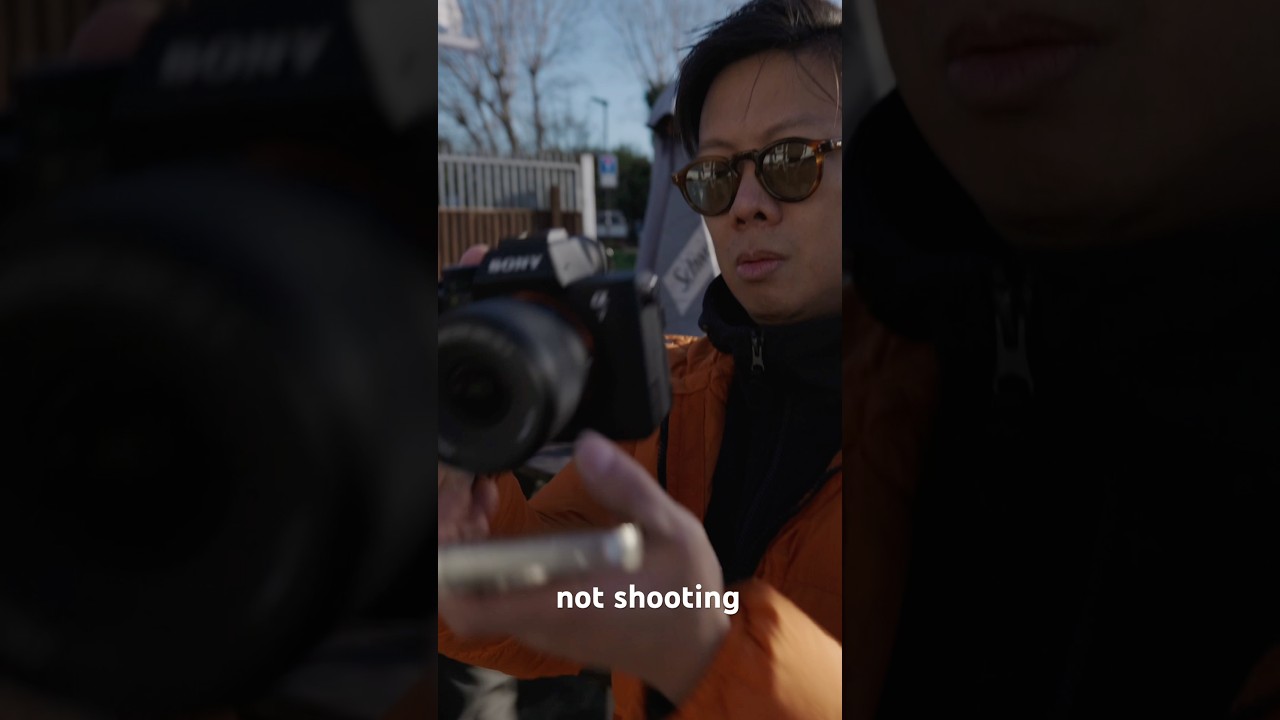
Here's something about the Alpha system that doesn't get nearly enough love. But to convince you to get on board the love train, Minolta lover Dan is here to explain. Pro photographer, you never used Minolta, obviously, cuz it's either Nikon or Canon, right? Yeah. So, why didn't pro photographers use Minolta? It's a really good question. Um I think because they weren't a as trusted and they were and initially when they brought all these out, they started with the 7000 and the 9000 was supposed to be their pro body, but people didn't really rate the autofocus and, you know, and then reasonably quickly Nikon and Canon came with their autofocus. And the rest, as they say, is history. Canon and Nikon reigned supreme throughout the DSLR days. Sony, fresh from a Minolta takeover, wanted a slice of the DSLR market share, but had to think of other ideas and decided to end Canon and Nikon's DSLR domination by making cameras with semi-translucent mirrors to finally eliminating mirrors completely. But Sony's decision to cast the past aside and embrace the future meant some absolute banging lenses have been almost forgotten, but thankfully, they're not completely history yet. That's something perhaps that's kind of a little bit forgotten about, isn't it? It's totally forgotten about. — There is some fantastic glass. I mean, there are some Facebook groups, you know, shout out to those Facebook groups. You know, there's some There's a sort of dedicated following. So, there's a bunch of people who never left. — Well, if you want something with that vintage aesthetic, but you want the convenience of autofocusing, there's not too much choice, is there? I mean, No. Of course, if you buy a Sony lens, you're not going to get that. You'll just get the autofocusing. And then they'll talk about, "Oh, sharpness. We've made it sharp. Look at the MTF charts. " I mean, you've got the new Nikon lenses Yeah. and that new Canon that you just did the Canon whatever 45, which are kind of going a little bit back, but they're really not. And part of it is they can't use the elements and the materials that they used in these lenses. But it's the most vintage lens that you can use that still has all most of the bells and whistles, not all. There's some caveats. But, you know, for photos, not for video. I wouldn't use it for video. When I say vintage, I mean 80s, sort of 90s vintage, not 50s, 60s vintage. Then, that's better because you've now got a 40-year-old lens with eye control autofocus, all thanks to this adapter. Sony brought out the LA-EA1 and the LA-EA2, LA-EA3, LA-EA4, whatever. They had all these different adapters. And to And they all to different degrees allowed you to autofocus with these lenses. But, it's only really now with the new one, the LA-EA5 or the current one, that you've finally got the ability to focus properly with these genuinely old lenses. I love the feel of it moving. Yeah, it feel It positively feels alive, right? Cuz the some of the autofocusing is quite uh clunky, I would say. For those who don't know, it's all through that little screw there, which is not going to focus. I love the face. — [snorts] — Yeah, that little screw there marries with this little screw drive thing. We can do a proper shot. This thing here. And that little thing twiddles. See it twiddling. Um and that focuses the lens. So, there's no motor in that lens. The latest series of Sony Alpha ones, some of them did have motors in, but none of these have any motor in the lens. It's purely driven off that little screw. I wouldn't say that having the AF driven mechanically by the body is a bad thing. It's just noisier. I love it. Nice. That's some jolly fine stuff. Focus is overrated. But, these aren't not sharp. They're very sharp. They just perhaps don't resolve as well as a this current Sony equivalent. But, there's a difference between resolution and sharpness, right? Look, if I was shooting architecture, that's different, right? Or if I'm shooting like a sort of super high-end fashion campaign and it's going to go on a billboard in Times Square, yeah, okay. But even then, you know, you make the stylistic choice to not have like super high-resolving images. Well, you've got to have made the choice to go out there. Like I'm making a positive choice when I take these out to go and shoot in a certain way to try and get a certain result. Right. And if I take a modern Sony lens, you know, it's normally for a different reason. Like I'm more concerned about like nailing focus. It's like I'm vlogging or, you know, whatever. Then that's when you choose a Sony lens. But I love these. I think they give me really nice results. They might not have the obvious vintage aesthetic of much older lenses, but there's a certain smoothness that comes from the spherical optical designs. The whole thing with Cook lenses is not about resolution. Yeah, they resolve in the middle. But they're not quoting you like resolution numbers like crazy. They're looking for softness and falloff but the mid-zone which is, you know, the the bit in transition between here and there. You know, so if something's there, what does that look like? You know, what does it look like here? How does it make your face look in a frame? Those are the things that cinematographers care massively about.
Segment 2 (05:00 - 09:00)
And they tend not to, and again, it depends on the kind of cinematographer at the style of thing they're shooting, but they tend in general not to care so much about the edges. Or if they do have the edges, they want actually want it to even vignette slightly or be slightly softer. You know, all modern lenses, all the Sony lenses, they're all the flat field. Everything is flat. Everything all the rays of light when coming through the lens, you know, they're trying to line up red, green, and blues to everything to be flat on the sensor plane. You know, this will give you a different look in other ways. You know, a warmer coating, you know, that lack of a flat field maybe. Flaring. — Flaring. You know, you're going to see lots of different flares. These flare mostly blue, I would say. Look at the coating on these old lenses. Now, in the cases of those lenses, maybe it wasn't deliberate when they first made them. But we've got used to them looking, in inverted commas, nice. You know, things like flaring. Having flaring, not having it is sort of underrated in photography. In cine, people just get very excited. We met Marcus who's got his entire cine flares website, and he's basically mapped out just about every lens, cine lens, for flaring. — Incredible. I yeah, I do think it's underrated in photography. Um if I was shooting a professional job, I would be worried about flare messing up and going across the face at the wrong time, and that's probably when I'm going to be shooting a Sony lens or a Canon lens or a Nikon lens or whatever. But if I'm out shooting for me or for my own personal work, I kind of like working with flare. Mhm. And also the randomness or you know, it's a very random thing. You know, you can't really predict it a lot of times. That makes it fun. Yeah. And possibly the best bit, they're really quite affordable. — The 20 mil F2. 8 is just a little over 100 pounds, and this zoom lens Dan bought for 10 pounds in a charity shop. You could look at third-party for auto-focusing lenses for less, but this is pretty much first-party and a lot more fun. The big cost, apart from the camera, is is the adapter. So once you bought the adapter, everything else kind of becomes affordable. — What stuff should you look out for when buying these lenses? Some of them might be a bit fungusy, right? Scratches, fungus, obviously look if they've been dropped. Some of them are quite plasticky, aren't they? They're all plasticky, yeah. I mean, that's the other thing that but probably why some people don't like them. So most of them are quite affordable relative to the same focal length Yeah. in a Sony. There's the odd exception like the 35 1. 4 because cinematographers love it so much, and a lot of them convert them to cine lenses. They you know, take them out and put them in a metal thing. They've got crazy expensive, but most of the other ones aren't that bad. One sentence, why should anybody buy this? Because they a vintage aesthetic with auto focus and they aren't that big and heavy. Don't buy it if you care too much about corner to corner sharpness, chromatic aberration for instance, noise, or video. That is a long sentence. Anyway, just as a little bonus, here's a bit of Minolta disco pants funkiness that I wish Sony would bring back. — Perfect pentaprism here. World's worst pentaprism here. But there's something nice about the fact that it is just so butt ugly, right? You look at it actually look it's actually got an alpha logo. That is sweet. That is just kind of a shiny pearlescent white. It's not just plain white. I love the screen up there and it's slightly tilted, slightly angled. I think Sony need a bit of that kind of craziness of old Minolta design. It's gone a bit plain, Sony. You know. We need some of this, Sony. Whip out some of the old Minolta goodness. It's all white, mate. It's all white. — It's all white. Okay. Oh my god. That is amazing. It's kind of weird because when you've got a shop full of really expensive gear — and sometimes it doesn't have to be the most expensive thing that's most exciting.