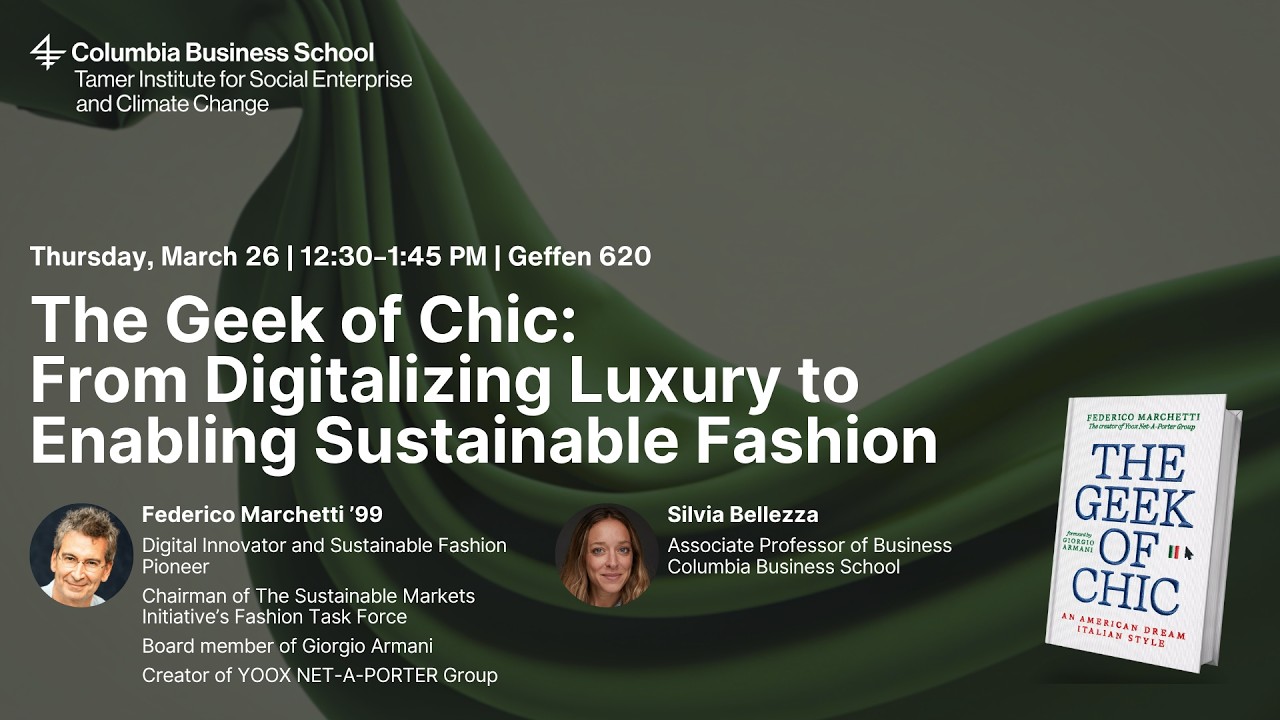
Federico Marchetti ’99, a pioneer in online luxury retail, returned to Columbia Business School to reflect on his entrepreneurial journey and new book, The Geek of Chic.
In conversation with Professor Silvia Bellezza, he shared insights on rethinking risk, the role of persistence in creating “luck,” and why timing is everything — along with his current work advancing sustainability through King Charles III’s Sustainable Markets Initiative.
Hosted by the Tamer Institute, the discussion offered a compelling look at how entrepreneurship, innovation, and sustainability are shaping the future of business.
Оглавление (12 сегментов)
Segment 1 (00:00 - 05:00)
I couldn't be happier and prouder to host this conversation with Federico. So let me tell you a couple of brief things about him. He graduated from here in '99, and the year after, he went back to Italy, and he founded YOOX. Basically, this company, nine years after, went public and became the first tech unicorn in Italy and was that for a while, in fact. And then he oversaw the merger with Net-a-Porter in 2015, and eventually sold the company to Richemont in a transaction that was about six billion. So clearly, a major success. Since 2021, he leads the Sustainable Market Initiatives Fashion Task Force at the request of King Charles III. We're going to talk a little bit about it. And he recently has published this book, just called "The Geek of Chic," and so that's also what our conversation today is going to be about. There are many fun facts in this book about Federico, so I'll tell you a couple of them. For example, he's a Dracula enthusiast and also likes to dress up as Dracula, right? For Halloween. Okay. You still do. I hope so, right? He started his entrepreneurial career selling Mickey Mouse comics on the beach. Yeah. And frankly, one of the most fun fact that stood out to me was also a gift that he gave to King Charles III for his birthday, or I don't know on which occasion. Which was the first time I met him. The first time they met. In Scotland. The gift that he brought to the King was a toothpaste squeezer. Now I have to ask, was it gold, at least? Oh, no. Okay. Metallic. Okay. So, that's bold. There's a reason, because I took a big risk to give a- Is the mic on? Yeah. Yeah, you can hear him? Okay, good. Perfect. Thank you. Can you hear me? Well, first of all, one round of applause. Thank you for being here. So the reason about that gift is because a few months earlier, there was a big scandal on the British press. The "Daily Mail," that is very British press, is a little bit... They love scandals, et cetera. And there was this big scandal that his butler was squeezing the toothpaste for him. Mm. Okay. So that's the- That was an insider joke. So it was a joke that could have been also taken in the wrong way. No? Yes, actually. So with this, you won't have your butler squeezing it anymore. No? Okay. But given that he has a lot of humor, British humor, the King of England, if he doesn't have who does? And he laughed a lot, and so everything started. basically, I broke the ice with that gift. Okay. That's great. Then, yeah, and apparently that led to a friendship that still continues today and a partnership. So we'll talk a little bit about it. I will start with a few questions to Federico, and then we'll open it to Q& A from the audience, if you have questions for him. He needs to leave at 1:40 sharp, and before he leaves, we're also going to run a lottery, and so five of you are going to receive a copy of the book that's already signed by Federico. Okay? So we're going to do that at some point during the event. Okay. So one first question that I have is about this title, which I really like, is very provocative and curious in many ways. However, if I think about you, I remember reading about you in the magazines in Italy. He's always been associated with being this genius of logistics plus the luxury side. So really, the image of a geek or a nerd is really far from what comes to mind in terms of association. So I wanted to ask about this choice of kind of framing yourself as a nerd in the title about your life. So can you tell us a little bit about it? First of all, the book didn't want to be... Typically, the entrepreneurs that have success, they write books that their company buys in thousands. My company, I already sold it, so they didn't buy any book. And I didn't do it for myself, so it's not auto promotional, because there was no reason to promote anything. But I did it for two reasons. One was to leave a legacy to my daughter. I have only one daughter, and one day, when she's going to be
Segment 2 (05:00 - 10:00)
20, 25, et cetera, she will read it, and maybe she will give it to her sons, her daughters, or something to continue the legacy. And the second one, which is probably more important, is to try to give some courage to the young generation, to the entrepreneurs that want to be entrepreneurs. So that's why I'm going around. So I went to Stanford, Kellogg, NYU, and last but not least, Columbia, given that it's my business school, in order to try to instill some courage in going and challenge yourself and have a different perception of risk. Because usually, my colleagues at Columbia in '99, they went to Lehman, they went to Goldman, they went to McKinsey, they went to... And they were talking to me and they would say, "Well, you're crazy to do a startup in Italy about technology. Technology is not the strength of Italy. In Italy, it's only about culture and humanism. Technology, you will fail, you will be jobless, you won't have any money in two years' time. So it will be a disaster. " While for 20 years, I built a company that after 20 years was almost $3 billion in revenues, 5,500 employees. I was still there. I decided to sell. And many of my colleagues at Columbia, they got into, I don't know, in 2008 when there was the big problem with Lehman, et cetera, and so they were jobless. So a completely different perception of risk. In my case, the risk was lower than going to Lehman or going to McKinsey because I was basically shaping my future, and I was in charge of my future. I didn't depend on anybody or any market conditions or subprime scandal or whatever. I wrote the book for this reason, to say, "Guys, you can take some risks. Not a problem. If you have a great idea, if you are determined, if you're passionate about your idea, you can do it. " And it is not something that you will risk anything because it's better to follow your dreams rather than going to work for somebody that maybe you're not so passionate about. The reason Geek of Chic, I cannot take the ownership of the title because it was a big piece on "The New Yorker," in 2013. So eight pages on me, on my company. "The New Yorker," they're very good journalists. Yeah, John Seabrook, right? John Seabrook spent- The author. Yeah. He's a great author... spent one week. He author also books, et cetera. So he's a great writer. Yeah. He has a book that's called "No Brow. " It's an amazing book. Now, the latest is called "The Spinach King" because, now we became also friends, and he wrote these eight pages, and he spent one week with me going around fashion shows, home, work business meetings. So they're very thorough. And he decided you're a geek after interacting with you for seven days. And he decided that, and I accepted it with pleasure. You embraced it. Okay. Sounds good. Thank you. So you touched upon this idea of taking risk. The book also talks a lot about the role of luck, coincidences, sliding doors, and how, in a sense, maybe we can also be proactive in trying to put ourselves in the condition to have good luck. Do you want to tell us a little bit about this concept? Yeah. I would say that probably the fil rouge in the book is, or fil rouge in English is-- Fil rouge is thread Conducting thread. Conducting thread? Red thread- Yes... you can say. Is about risk, courage, and pushing your boundaries, and pushing also the boundaries of other people. Because of many times I convinced people to do things that it was not exactly, like the movie director doing interior design of my homes that he never did in his own life. And basically, the story is that, if you take risks, most of the times
Segment 3 (10:00 - 15:00)
you're going to be lucky. Which is a very, very old Latin proverb from the Romans, is, no? You did the licio class- The, luck... What is fortuna? Yeah. So, yeah. Exactly. Bravo. Yes. Bravo. Thank you. That's the translation of the book that I was trying to remember. Yeah. And it's true. In my case, I really pushed my luck many times. With the merger, I invented the merger with NET-A-PORTER. NET-A-PORTER was my biggest competitor. British, as big as my company, going more or less into the same direction, competing every year. One year it was bigger, one year I was bigger. And I said, "I want to buy it. " So with competition, you can decide so many things. You can decide to try to win, buy it, and it was such a difficult transaction. I tried two times, and it didn't work. But really until the very end, I was about to sign the contract, and then everything finished because the big boss decided that he didn't want to do it anymore at the very last minute. So twice. But I was very persistent, and I tried for the third time and... Which is funny because, in Italy, which sometimes we are a bit pessimistic, we say, which is, if you fail twice, you're going to fail for the third time. It could also be you're successful twice, right, and you're successful three times. Yes. This is a negative take on the... Right? But in my case, given that I failed twice- Okay. You thought it's coming. Okay... it's coming another time. All right. I see In what I wrote to the book, it was on the positive side. Yes. And, while the British, they say third time lucky, which is very positive. Yeah. Third time is the charm, right? charm. So I said, "Okay, let's follow the British, even if I'm Italian. " And I tried for the third time after, it was a long process. It was, I think, four years or five years that trying to merge with Net-a-Porter. And it happened. So these are many other little anecdotes that I tell in the book, like the toothpaste squeezer, or so many. I really pushed my luck all the time. And, I have to say that I've been very lucky because most of the times it worked. So that's why the perception of risk sometimes is, I think it's wrong. Sometimes, you need to take risks even if you think that they are too big risks, but maybe they're not. So that's more or less, in my case, for 20 years of hard work, obviously, there was a lot of hard work. I studied a lot, Columbia, Bocconi, blah, blah. So I did a lot of work, so it was not just luck. But I think it's important for you to know that, sometimes risks are over... How do you say? You think too much of a risk, and sometimes it's not. And kind of connected to this idea of being an entrepreneur, and so taking risk. In the book, you also say that if you want to do it, and this matters for students, you should do it early on in your life. Yeah. Especially you say before 30. Why would you say that? Why would you recommend young people to do it now and right now, rather than kind of wait later on when you have more wisdom as a business person? Because, again, it's about risks in the sense that, if I was waiting too long... Well, let's say, so my daughter was born when I was 40. No, 42. And definitely the energy that I had after the business school when I was 29 to set up and to do the startup is very different. So if you need to work around the clock, and for 15 hours per day during the startup phase, one thing is if you are 29, one thing is you are 30, 42, you have a daughter at home, you have a wife, so you have to find a different balance of
Segment 4 (15:00 - 20:00)
life now between work and family. And so I think that there are times where this perception, this risk, you're less favorable to take risks. Mm-hmm. So I think the best time is when you are around 29, 30, and you're about still to understand what you want to do in life, and you're still probably, you don't have so many kids around you, because it's important also to spend time with the kids. Mm-hmm. And, so in fact, on the first 10 years of my life, I was fully devoted to my company, and I built it from scratch. Imagine, like in Italy, to boost up in technology, which is, I mean, was a miracle. And, if I had a different focus, I don't think I would've been so successful. Mm-hmm. Thank you. So since we're talking about Yoox and the startup, it really it's clear in the book that you saw the potential of the World Wide Web while it still was an infant technology, and you thought about putting together with luxury goods and the luxury industry. So you saw the potential about merging these two sectors, let's say. I mean, one technology and a sector. Today, in the last two, three years, we have witnessed the explosion of another technology that's like LLMs and AI. What are the analogy that you see when you were a student, and the World Wide Web was getting traction, and today, the differences with AI? And also, what does it mean for entrepreneurs now that our company is maybe more, they're expecting that AI will be a revolution, and therefore, they're going to be more open to embracing it. Mm-hmm. Or, because for the World Wide Web, he kind of had to sell it to companies that, "Guys, this is about to happen. It's going to be a revolution. " He managed to convince them to open themselves to the online world. I'm not sure if today's companies are going to be as reluctant to embrace- It's a good question... big technology changes. Very good question. Now everybody here in this class, I'm sure that you bought something online. They're probably buying it now. No, a sweater or a suit, a jumper, a pair of jeans. In '99, when I started, no one was buying fashion online. No one. Didn't exist, fashion online in '99, especially luxury fashion. Maybe probably jeans in America, Gap, maybe it was existing, but luxury fashion, there was no offer. And, that's why the New York Times called me the man who put fashion on the net. So let's say my... I have a few nicknames. The New York Times said the man who put fashion on the net. King Charles calls me his Italian secret weapon because I'm a doer, and so I'm an action man. He loves action, and I'mActually doing many projects on his behalf that are very concrete and tangible projects. And Mr. Cucinelli, who is a designer, Brunello Cucinelli, some of you may know him, defines me, a philanthropist industrialist. So I do philanthropy-... for companies. So I have many nicknames, but this is to say that... Sorry, I forgot the question. AI compared to the World Wide Web and the opportunities. No one was selling fashion online, and so I had to convince all the brands from scratch. But it was better. It was better for me because they were not focused on digital, and so I could approach them and say: "Why don't you do a test? " And for many, many years, they didn't know what was happening. So they'd only websites, information website, so like, I don't know, the page of Armani, the page of Valentino, but with no e-commerce. And they realized that it was going to be a big business only, probably 10 years later. So around 2008 to 2009, they started to say, "Ah, maybe this company, YOOX, is selling so much, so maybe we should do it also on our own. " And in fact, in 2005, I invented an innovation. We did the innovation, which was powered by YOOX, all the online flagship stores, so from valentino. com, powered by YOOX, armani. com, powered by YOOX, bottegaveneta. com, powered by YOOX. So basically, I did 40 of them.
Segment 5 (20:00 - 25:00)
So YOOX was the platform for logistics, customer care, an invisible partner of all the brands. So imagine 40 of them, they were basically the probability of a customer around the world to buy luxury from 2000 to 2020. Most of the times, they were buying luxury from me, from my companies. And now, with AI, it's probably different because now... But I was speaking about this later. I think the fashion industry will be impacted, like every industry, but it will take time. It won't be immediate, the luxury fashion. It will take more time because it's an industry that is not very technology-oriented. Mm-hmm. It's not very data-oriented. More about emotions. It's more about creativity. It's still like that after- So do you think that this means there could be opportunities for entrepreneurs to kind of play the role you did back then, today? Definitely, I wouldn't go into e-commerce for fashion because it's the most crowded industry ever. Mm-hmm. So, forget about it. So don't go, because it's too many players. AI could be something, but it's probably a bit too early because timing also is very important. Timing, when you start something. Now, it needs to be not too late, but also not too early. So I started in '99, 2000. That was basically the beginning of e-commerce. AI for fashion, I think, is still a bit premature. I would go more into sustainability for fashion. It's definitely an industry where there's lot to do and it's happening. Mm-hmm. So all the projects that I'm doing on behalf of King Charles III around sustainability for fashion, they are amazing projects. And if I were an entrepreneur again and not doing just for good and just pro bono, I would say, "Oh my God, this regenerative agriculture in Puglia is making so much money for Armani that maybe in 10 years' time, 50% of the supply chain will be done by regenerative cotton. " Mm-hmm. So it is an opportunity. Yeah. There's a big opportunity to do things also for sustainable fashion. I'm very glad to hear it because a few students that are here are in my sustainability course, and these are the things we kind of talk about. So maybe I could- So it's nice to hear... tell you briefly about- Yeah, I was going to ask you. First of all, I would like to say that he, as a kind of a, not a spinoff, but a big project of YOOX was YOOXigen. Oh, yeah. Which was founded in 2000- 2008, I think... 2008. Which frankly was, yet again, kind of a pioneer in the sense of putting luxury and sustainability together back then, was really at the forefront. Nowadays, many companies, in fact, almost most companies try to make an effort to get into sustainability. But back then, it was very a pioneering effort. YOOXigen, by the way, is a genius brand name. Mm. I don't know if you had it, the YOOXigen. Okay, but it's- No, it's like the Geek of Chic. It's not me. Oh, you borrowed it. Okay. That's good. I borrowed from an intern that she was doing an- YOOXigen? But I asked her. That's not the best story. And an intern, she was doing an internship at YOOX that summer, and she came up with YOOXigen. I said, "Fantastic. Let's use this name. Are you happy if we use this name? " "Yes, of course. " Or they started talking about vintage. Now vintage is very trendy and popular, but back then it wasn't. So right, they were- Back then it wasn't- Yeah. Yes... very vintage. So very early on. And you continue, right, to this day with the task force, with the king. So yeah, why don't you tell us about... You told us about regenerative agriculture. You're working on product passports, right? So that's also another big initiative or whatever. Do you want to tell us a couple of these projects you're working on? Yeah. I will tell you one, which is at least aSo when the king asked me to put together this fashion task force on his behalf, it was I think, yeah. 2021. Five years ago. Yeah. And so I invited all the brands that I've been working with in the last 20 years. So it was very easy for me to put together. it was not a big effort. I just called them and said, "Would you like to come in this task force? " And I used the name of the king and everybody. So it was not like that I was such a genius to do it. But I gave two ambitions to all the members. One was about the digital passport. So basically, each
Segment 6 (25:00 - 30:00)
item with a passport in order to give the customers and the final consumers all the information about that particular item, so they could make responsible choices. Because if they have the information, they can make responsible choices. They don't have the information, they don't know what they're buying, and also for reselling, et cetera. And on the other side, the regenerative agriculture, which is basically on the material, so organic material, to make it simple. So one, very close to the customer, soil. So at the extremes of the supply chain. And also, everything starts with the material. So everything starts from the cotton or cashmere or silk, and then it gets into the shops close to the customers. And I would say we are at the extremes of the supply chain. And my, let's call it vision, even if it's probably too big of a name, was that these two things that I gave in 2021 to all the members of the task force, they were going to converge. So basically doing items, apparel, whatever, with regenerative materials. Regenerative means more than organic. Regenerative means that you have, I don't know, cotton plants, where you put almond trees, cotton plant, no pesticides, no fertilizers, nothing. And the soil gets regenerated rather than getting... How do you say? Depleted. Thank you. And now also with the price of the oil now during this wartime, because that's what I can call it, it's even more important to go this way because most of the materials are made with oil. They're a sub-product of oil. So okay, imagine if the price of oil goes like this, also the fashion industry, they need to find a different way, which is very unfortunate, but in terms of sustainability, this push the brands to find different kind of materials. And so with Armani, which it's a company that I know since a long time, as I speak in the book. The true story, I said it in the book, I never said before, I was the boyfriend of Roberto Armani. Long time ago in 1994, for two years. And then I met with Mr. George Armani, and then he asked me to go and to work for them. I said no, because I didn't want to mix personal with business, but then I kept in touch, and then basically there was a kind of mutual respect. And I'm in the board of Armani also now, after died in September, so I'm in the middle of the succession. A lot of stories about that, which I don't talk in the book. And so I convinced them to start a plantation of cotton in the south of Italy, Puglia, that they haven't seen cotton in the last 60 years because they had the plantation of cotton, but they were replaced by polyester. So all these materials that they were made exactly with oil. So now they have a plantation of organic regenerative cotton in Puglia, and they have the digital passport. And so after two years that I've invented this project in terms of Puglia, in the shops of Armani, you can find products made with regenerative cotton coming from Puglia and with the digital passport that show to the customers exactly all the story. So like all the science behind it, you see the pictures and the videos about these plantations. So basically we were inviting the customers to be part of the story and to know everything about that particular item. And the very, very good story, because this could have been a disaster, big failure because it's an experiment. It didn't exist before. So it could have been that the quality of the regenerative cotton was terrible, so we were not being able to use it to produce T-shirts or shirts or whatever. Could have been that the customers couldn't care less. So like going into the shop with this, "No, I don't want to
Segment 7 (30:00 - 35:00)
buy that thing. I want to buy the one made- Regular. Yeah... by polyester. " So it could have been a big, big failure. So I have to say that thanks to their money management, that they decided to take this risk again. It turned out to be, that product, the best seller of the Armani collection. So the market demand about these products is amazing, which means that we went from one hectare to five hectare, from five hectare to 20 hectare, from 20 hectare, hopefully we'll go to 100 hectares, from 100 hectare we'll go to 500 hectares, which means that maybe in 10 years' time, 50% of the supply chain of this big brand will be made by regenerative farmers. So how did you make the sustainability collection desirable compared to the regular pieces? With the information. Was it just genuine demand? The- Oh, so just making sustainability prominent? Yes. Okay. Basically, through the digital passport, giving the information to the customers, that they enter into the stores, and they know everything about the particular item. Actually, it could have been even more successful because, Armani, they decided not to do any advertising. Mm-hmm. Just to take it low profile, step by step. So it was really like a customer choice. Interesting. You're famous for being the person who brought fashion online. I think one aspect that's not talked about as much is that also, in a sense, you lowered the price point of many luxury goods and made it also more accessible because- With YOOX. One feature of YOOX. Yeah. Now we're now going back to YOOX. So I don't think you not only brought luxury online, but I also think you made it very accessible. Mm-hmm. And I don't know about you, but I have this heuristic that luxury goods and price promotion don't go very well together, and when I start seeing high-end brands on promotion, to me a little bit is the beginning of the end, even though there are very successful cases. Right. So yes, I was curious about your opinion. What do you think about selling luxury at a discount? As I said before, it was year 1990 to 2000. Yeah. So they didn't know anything about the internet. Mm-hmm. So that's why I said it was even better. So you tricked them. I tricked them. To price promotion. Okay. In a way. It was just in a niche market. They didn't know anything about it, but with a good proposition, though. I tricked them, but not in a bad way, because with the YOOX, I tried to elevate the brand- I agree... rather than devaluing the brand. Yes. So basically, I didn't put, for example, the saving, the price. It was a YOOX price. Yes. Even if- Yeah... we had an implied discount of, I don't know, 30, 40, 50%, we didn't show it. Yeah. We tried to mix a lot of art with design, with projects, with emerging designers, vintage- Yeah... mention. So it was more a cultural- Yeah... project. And I think this comes up a lot in the book, and I think can be a learning. He didn't just put luxury online. There's really this fixation to make it in a way that's just beautiful, and that just makes navigating through this website an incredible experience that's just good. So it's not just a matter of accessibility and discount. It's also a matter of a beautiful and aesthetically pleasing experience. Yeah. Accessibility and discount. That was a fixation, right? That you had. Yeah. It was a fixation. So can you- Every marketing manager that I hired- Yeah... sometimes I fired, they were coming to my office and say, "Federico," after two months that they were in the company, they were saying, "Federico, I have a great idea. Let's show the saving-" Yeah. I know. Yeah. You said it... "with the price. " I said, "No, I don't want to show," because the main proposition is not about the discount. about good fashion never dies. If the product is made of high quality, why can't you wear it for three years? Why you need to change it every six months? Why do you need to change every three weeks, like fast fashion? So that was the proposition, which was very sustainable at the time. It's 100% sustainable. I have a paper on this topic precisely. But I didn't think about sustainability in 2000. It was just a business model. Now, looking back and say, "Wow, I was already sustainable," but I didn't do it on purpose, I have to admit. And now, in terms of prices, I
Segment 8 (35:00 - 40:00)
feel that the luxury goods, they've gone nuts in the sense that the prices are insane. So I really don't understand what's going on and actually what's going on in the industry, that most of them, they're struggling. It's their fault because they raised the prices too much. Mm-hmm. In 2010, I don't know, a Gucci bag, a normal kind of a mid manager working in a bank could afford two bags per year of Gucci. Now, they cost $5,000. Yeah. So I think that they tried too much to go to that niche. But that niche is very... How do you say? The ultra wealthy-... net worth. Yeah. So there is a distinction there. Maybe like they say, okay, rather than buying- But they move a lot of volume, right? And sales. So in a sense, they're focusing on that. But I share the intuition that you have. So curiosity, what do you think is a luxury brand that, in your opinion, is very well-managed? A luxury brand that you always look like, this is an extremely well-managed luxury brand. I'm curious. I still think Prada is very well- Prada, you would say? Not because it's part of my task force. But because they've done a few steps that I think they're very smart. Mm-hmm. First, they hired the designerRaf Simons together with Miuccia Prada. Yeah. And so basically, they already have the succession, which is smart. Yeah. Second, the husband of Miuccia Prada is a very, very commercial guy. Super smart with product and commerciality and et cetera. So, they know what they're doing. Now they bought also Versace. So I think they are a smart company. Very smart company. And then they have the CEO that is training the son of Bertelli to become the future CEO. So there's a lot of reasoning about the future. Thinking about the future. While many other companies, they don't have this. Mm-hmm. I have two more questions, and then we'll open it to the audience. Yeah. One, maybe this is a bit personal. In the book, it's obvious that you have a very strong ambition and this very strong drive. There are these sentences like, "I feel the world is too small for me. Throughout my life, I've been obsessed about doing things well and getting to the top, never following anyone. " And it's very strong phrases. And I read that and I was like... I'm obviously impressed by this level of ambition, but then I was like, can you ever be truly happy if you have such a strong drive, that pushes you always? So that's my question. Yeah, I know it's a tough one. No, no. It's deep. But on the one hand, I was- She's a professor at Columbia, she needs to ask me questions. And this one is good as well. First of all, I'm coming from a very, very humble and simple family, from a small town in the northeast of Italy. And, they didn't know anything about fashion. technology. They didn't know anything about university, because I didn't go to the university. So basically, in a way, I did it my way, no? And to do that, you needed to have a strong drive. Because you're coming from a small town with no help, no recommendations, and no one giving you the money to do your own companies, or looking for money, going to the brands, convincing the brands. So if you don't have a strong drive, you won't do it. Possible. Yeah. So I think that at the same time, I have to admit, and think about it, that now that actually, so I left my company, so I sold it in 2018 for a decent amount of money. I left in early 2021, simply because we shook hands with the owner of Richemont, Cartier. I said, "I can stay until the end of my contract, but don't rely on me because I'm not a manager, I'm an entrepreneur, so I cannot stay into your corporate world. I cannot stay. I cannot resist, cannot go to the CFO to ask for 5 million more in advertising that goes to the CEO, that goes to
Segment 9 (40:00 - 45:00)
the owner, and it takes six months. " I'm used to take decisions like this, and I can make mistakes, but I want to take decisions. So I said, "Don't rely on me after the expiration of my contract. " And this is actually what happened. So I left in 2021. And I thought that I was going to half-retire, in a way. So, enjoy my family, enjoy my daughter, spend more time with my daughter. That she was nine at the time. And focus only on things that I really liked. It turned out to be that I'm sometimes busier now than before because with the king, that gives me so much work. Keeps you busy, the king. The king keeps me very, very busy. The Italian secret weapon. And now I'm not making any money. So everything I'm doing, I'm doing for the next generation, for the planet, to help companies, to help people. Mm. Some mentorship also for young entrepreneurs. Not so many because I don't have so much time, but I still do that. So I'm making zero. But if you ask me about happiness, because that was the question, I have to say that probably now, the second part of my life, which is this one, now the philanthropist, I'm happier than before. Because I found a lot of happiness also in helping people. Which is also something that it could be also a career, I would say. Obviously, it's easy to say it after you sell a company for 6 billion. I understand. But at the same time, I could have done a completely different choice. Now, I could have said, "Okay, let's do another company," or, "Let's become the CEO of Kering. " And I got also a couple of offers, but I said, "No way I'm going to be the CEO and working for somebody else. " I prefer to help people and to help the planet. So if you're looking for an opportunity, I saw that you taught a course at Bocconi. Yeah. It was this university about creating a startup in the sustainable digital economy. Helping people. Students, next generation. Yeah. So why don't you do it also for Columbia? Why don't you come here to teach? I've been asking him already. Now I'm asking in front of the students, so he cannot say no. Because I don't- I'm just teasing... because I don't live in New York. Whenever you want, you're welcome. Thank you. We can do it together. All right. The last question, and then we can open it for questions for you, and we're going to do our lottery. So at some point in the book, you say that you've encountered one of the co-founders of Netflix, and you told him about an idea at a TV series on fashion. Yeah. So I have to ask- I forgot... what was the idea about? You said you're still thinking about it. Was it like kind of "Emily in Paris" kind of a thing? No. It was not so precise. Okay. Yeah. But as you know, there are not so many good examples of movies about European fashion. Mm. House of Gucci- A terrible movie... was disgusting. Yes, terrible. Goodness. All that money, all those actors. There's a movie by Woody Allen about, maybe- Midnight in Rome. No, that's in Paris. Okay. When they come to Rome. Yeah. Because usually they play with the Italian stereotypes, which, it's true that we have many stereotypes. don't have to repeat the stereotypes about Italians. But I think that it would be better to have an insider view of fashion rather than from outside. Mm. Because you know more. I've been an outsider of fashion, but who became an insider in a way, no? And so that was my idea. But it's still there in the drawer. Maybe you'll convince Guida to do it. He could be the right person, but all right. Thank you so much. So, why don't we open it for questions, and maybe in the meantime, I'll get the names of the lucky ones who got the- So when you ask the question, please tell your name and- And speak loud... what you do. So we can all hear it. So you're all from business school here, all of you? No. Okay. Some are undergrad students in my course. Okay. So if you tell me just this, "I'm business school," "I'm studying art," "I'm studying architecture, I'm studying- You can do it... anything. " Who's going to decide? Me? You do it. Yeah. I do it. You're the boss. I think you raised the hand as a first.
Segment 10 (45:00 - 50:00)
Well, first of all, thank you so much. I think it's an honor. I'm Enrico, Italian. I'm part of the business school. Probably this question has been asked to you in other occasions, but I really wanted to understand why do you think you made it? I'm Italian. I know that the business ecosystem in Italy, the startup ecosystem never really worked, and you're probably one of the unique example of someone who made it, I would say, the American way. Like you build a successful company in the dotcom era, sold it, successful exit. And after you, probably never really worked. Now the ecosystem, it seems that it's improving a bit, but yet we are very far behind. So do you think you're just better than anyone else in Italy? No. It's a combination. Do you think it's not working, and would you actually recommend, I don't know, for example, to me, I'm Italian, of course, I love Italy as all the classic stereotypes. Would you recommend to go back and try to entrepreneur in Italy or stay outside? The reason is probably a combination of many things. Now, as I said, taking risks, courage, determination, good vision about the future, being brave, being lucky. In the book, I say that I've been lucky. It was kind of a miracle what I did in Italy. So there's no one reason, one specific reason. It's a combination of things, like probably everything in life, no? But my suggestion for you is, definitely in my case, to go back to Italy, to my country, was the right decision because I was one of the very few with this idea of startup, internet technology, et cetera. If I was staying here in America, probably I would have been one of many, and in the end, it's all about competition, all about how crowded is the environment, and it's better sometimes to be one of the fewer rather than one of many. So I think there are definitely many opportunities for people that they are very well trained in America, like people coming from Columbia Business School, like many other business schools, to go back to Italy and to do something good. I would encourage you to go back. Mostly the Chinese, no? If I'm not wrong. Is there any Chinese here? So are you going back to China? Okay. I'm sorry. But correct me if I'm wrong. Many Chinese, they study abroad. For example, my daughter is studying at Brighton, and there are many Chinese, but then they go back to China to help the country. Hmm. And they are called the turtles, no? Yeah. It's called translated to sea turtle, but it means someone who goes back home after being abroad. Yeah. So there's a lot of focus on education in China now, people getting the best education abroad and going back. So I think if you wanted to serve your country, you should go back. Let's do man, woman, man, woman. So I had quite a similar question. Your name? Sorry. I'm Camilla. I'm from the business school. I lived in Italy, so I'm Italian. So you're Italian, too? Yes. Okay. Not in Italia. To me, it's a bit more deep dive into what exactly were the challenges that you had to encounter when opening a startup in Italy, because I know that the ecosystem, as Enrico was suggesting, is a bit flawed. But especially focusing on the side of raising capital, because I know that, for example, you were saying in America, you would be one of many, which is also very true, and I could see why maybe a startup like this might have been much more efficient in Italy, also due to the relationship with the fashion world. But to me, what is striking is how could you actually raise capital in a scenario where now people are not able to do so because the VC in Italy is super small? Yeah, money is very liquid. So, for example, I raised money from Benchmark Capital, in 2003, which is one of the most famous venture capitalists in America. Money can go around the world. But being in Italy
Segment 11 (50:00 - 55:00)
helped me with the relationship with the brands, like a cultural proximity, understanding each other. So for me, definitely there were many disadvantages. Bureaucracy. I remember when I started in 2000, it was so difficult to get the mayor of Bologna to connect the warehouse with the-... with the cable. So it was my first challenge, that we were waiting, like they were putting the cable. I mean, terrible, but also many advantages. So I think that I wouldn't be scared about the difficulties, because you can overcome the difficulties. And in my case, the balance has always been in favor. And money is true. In Italy, the venture capitalist barely exists. I was very lucky to find the first and the only true venture capital in Italy that was called Mr. Sereno Piola, coming from Olivetti. That he gave me the first 1. 5 million to start, just on the basis of a PowerPoint presentation. So it was in February 2000. But at the same time, you can find money also from here, from London, France. So, as I said, money comes if you have a good idea, team, very important, because in my book, I speak a lot about the importance of the team. Actually, I speak about one guy that I think I wrote that if he wasn't with me, the company would have been half in terms of the size. I think money will come easily. Not a problem. Man. Man, woman, man, woman. Man. Hi, my name is Atrio. I'm from Indonesia. You mentioned that you find more happiness in your second act of- Yeah... doing the philanthropy side- Yeah... than being a CEO. So for those of us who have just started our first act, is it possible to build a sustainable generational mission into a company's DNS since day one? Or is that a luxury that only comes after? No, it's possible. It's possible, especially it's possible. The answer is absolutely it's possible, and I would start more than with the philanthropy, which at the beginning, it's not easy to incorporate in a business that is new. But I would start with something that is not exactly the same, but it's very important, which is ethics. So even having foundations and values around ethics is super important, and this would give you a lot of pleasure rather than cutting corners now, especially with the customers. So this is very important. So you can incorporate ethics from day one. So maybe I'll read the names of the lucky ones, and then we take one last question, and we let you go since I know you're pressed for time. Yeah, I'm sorry, but I need to go because my daughter, and that's why I'm in New York, she decided to do a five-day internship at the UN, and she found this internship through friends at the tennis camp this summer, not coming from me. And she's entering the UN at 2:00. Unfortunately, exactly the same time. So I have a car at 1:45 downstairs. I jump into the car because I'll try to take a picture of her getting to the UN. That's very sweet. Yeah. He talks about his daughter also in the book. It's very sweet. So Sophia Zhao. I guess she's not here. Tana Tangria. Leslie Noy. Okay. You got it. Enrico De Luca. Enrico, you got it. Amalia. Omo. Soyung Liu. Felicia. How? Malik. It is end up, but didn't come. Ah. Malik. Hirthika. Okay, so we're at five, right? Yeah. So you guys are the lucky ones. Thank you. So you have your copies there. Maybe one last question, brief, and then we'll let you go. Yeah. For the people who read my book, I would love, because I've always been interactive
Segment 12 (55:00 - 58:00)
given also my digital background, I really would love if you write me your feedback on my Instagram. I have no social media manager, and I reply myself. And you tell me, "I really like it," or, "I really hate it," or, "I like this part, I didn't like this part. " So please give me the feedback because I love feedback. Maybe one last question, brief. We did the men, so we are woman. Thank you so much for this presentation and talk. It was very inspiring. Honest. It was very honest. So my name is Salome. I'm from Georgia. I work for the UN Ah. and doing climate work. Oh, wow. So my question is regarding sustainable aspect of your work. And during all the backlash that with regard to holiday, how do you think fashion industry... That it's not only us, it's global, but in the EU are not going well for the sustainability in general. Yeah. So what- No. I understand the question. And probably not only about fashion. Sustainability was very trendy a few years ago in a way. There was this hype about sustainability. Everybody was talking about sustainability. Net zero. Net zero, et cetera. Then, with the many changes in the administration, et cetera, sustainability became something not good anymore. But my view is that it's now that, for example, there are many people that say we need to change the narrative, so let's not call it sustainability anymore. Let's call it environmental friendly or climate. They wanted to change the name because sustainability is not cool anymore. I think it's exactly the time where you need to push the accelerator because if everybody's going back, it's better rather than everybody talking about sustainability, because then it will become so crowded. Now that everybody's basically making one step back, it's very good that you make one step ahead. Because in the end, it's all about that. It's important to be different. It's important to come up with ideas that no one is doing in the end if you want to be an entrepreneur and also help the planet. So in my case, in terms of the fashion brands that are part of the task force that I chair, we are accelerating rather than decelerating. And actually, given the customer feedback that I told you before now with the regenerative cotton, it's time to accelerate because maybe we find ourselves in five years that we have a huge competitive advantage compared to all other brands that they are decelerating. In the end, it's all about the competitive advantage. I really like this message. So let's close on this one. It's a very positive note. Thank you. Thank you so much. My pleasure. Let's just take one photo. Si, volentiers