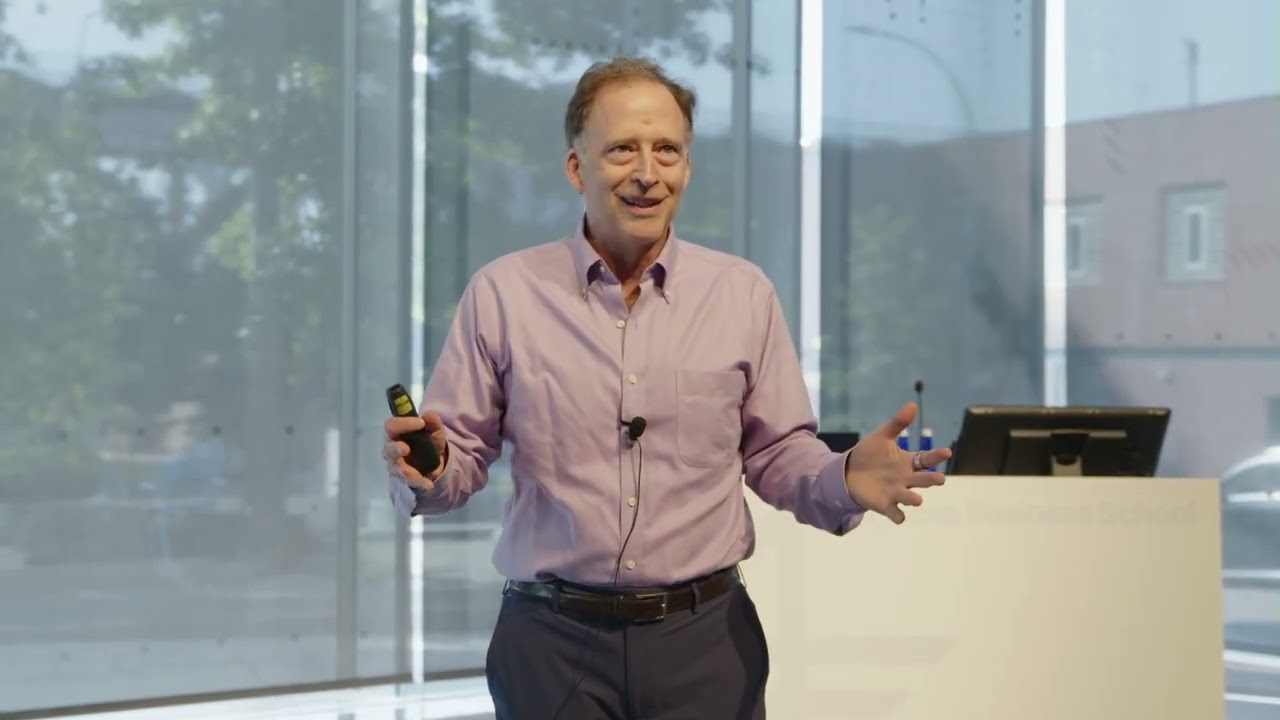
The AI in Business Initiative presented a conversation with Dr. Pete Shadbolt as part of the BizTech Lecture Series. Dr. Shadbolt, Chief Scientific Officer and Co-Founder of PsiQuantum, discussed his perspective on leadership in advancing quantum technology and inspiring teams, the opportunities for quantum to revolutionize operations across industries, and his reflections on key milestones in quantum computing in the rapidly evolving technological landscape.
After earning his PhD in experimental photonic quantum computing from the University of Bristol in 2014, Pete was a postdoc at Imperial College researching the theory of photonic QC. During his time at Bristol, he demonstrated the first-ever Variational Quantum Eigensolver and the first-ever public API to a quantum processor. He has been awarded: the 2014 EPSRC “Rising Star” by the British Research Council; the EPSRC Recognizing Inspirational Scientists and Engineers Award; and the European Physics Society Thesis Prize.
The conversation was moderated by Dean Costis Maglaras, David and Lyn Silfen Professor of Business and Dean of Columbia Business School, and Professor Abhay Pasupathy, Professor of Physics at Columbia University.
This event was part of the BizTech Lecture Series, which explores the intersection of technology and innovation in business. The series features a diverse lineup of industry leaders, executives, and tech pioneers who are leveraging cutting-edge technologies to tackle pressing global business challenges.
Оглавление (12 сегментов)
Segment 1 (00:00 - 05:00)
I'm going to start with a story. I met Pete over dinner maybe about a year ago in San Francisco. I'm genuinely interested and intrigued with quantum computing. And poor Pete said, "Well, next time you come, why don't you hit me and then maybe you can come and visit the company. " Because I was genuinely curious. So I did, in September, and I visited them on actually a pretty important day because earlier that morning they had announced the billion-dollar funding round at a $7 billion valuation, and Pete was doing a lot of TV in that morning. And then- That's what I get paid to do. Yeah, that's good. That's what they pay me to do, too. myself and another board member that we have here at the business school who lives in that area and is a venture capital investor and growth equity investor, visited Psi Quantum, and it's just incredible, right? And it's incredible to-- It's a little bit that the little engineer in me was fascinated, but it's like real science trying to build complicated systems to solve sort of a genuinely difficult but sort of very forward-looking problem. So, we have a group of individuals here, and I wanted to perhaps give you the floor to give us a very quick overview. What is quantum computing? Explain it a little bit in this audience, and then we're going to start talking a little bit about the company that you're building, the technology underneath it, and where do we see it going over the next five years. But just a quick overview of what it is. Yeah. First of all, I really appreciate you guys having us here, and the invitation, and so many people showing up to listen. It's really nice. It looks like they bribed you with lunch, but still thank you. That always works. And yeah, of course, maybe let me start by just telling a little bit the story, like in chronological order. Yeah. I'll try and keep it short. And then if it's helpful, we can come back to kind of the broad question of where quantum computers get their power, why they're important. But the story starts 100 years ago with the discovery of quantum mechanics. So, 100 years ago, people started to realize that the physics of Maxwell and Newton and so on wasn't holding up and came across this notoriously thought-provoking, strange, new theory of physics that has proved incredibly successful. Most accurate theory of physics in history. About 50 years ago, people started to think about how you would build computers with this new physics. And the way that I think about this is due to Rolf Landauer. Rolf Landauer was an information theorist at IBM for a long time, and he's famous for saying that information is physical. I think it's a beautiful idea. Information is physical. Because personally, when I think about information, words, numbers, sounds, whatever, it feels abstract. It feels as though it's floating above my head. What Rolf Landauer is saying is that information doesn't exist independent of some encoding. Ink on a page, rocks on a beach, electric fields, action potential within our brain, whatever. It needs some physical instantiation. And every computer that we've ever built to date has run on the 100-year-old physics of Maxwell and Newton. People started to get excited about this idea of a new computer running on the new physics. And one way to think about this is that it is like engaging in a game of chess, where there are some pre-established rules. By encoding information using new physics, we unlock new things that we can do with information. It's as if you're playing a game of chess, and now your opponent adds one or two new rules to that game. You're in deep trouble in that game of chess. They can play incredibly powerful strategies. And that was always kind of a vision with quantum computing. We would build this system. 25 years ago, my co-founder, Jeremy, was in a research lab in Brisbane
Segment 2 (05:00 - 10:00)
drinking too much lager and endangering himself on the weekends and trying to build a quantum computer. And he was working on a very old proposal, called the Kane proposal, for a quantum computer. Basically lost faith in that approach while he was a graduate student. And it was right around that time, 2001, that the first theory papers came out showing that you could build a quantum computer using photons. So using light to actually encode information. And that was really exciting to Jeremy because he could immediately see that this would allow us to leverage the semiconductor industry, fiber optics, high-volume manufacturing, and build really powerful machines. So he moved quickly to the UK and set up a research group at the University of Bristol together with my co-founder, Mark Thompson, who worked at the world's first silicon photonics company. And that story has, I think, strong parallels with what we're seeing in AI. Of course, AI, it's easy to forget, was a-Failed field. It was shameful to be an AI researcher. People would go to conferences and write- I know it very well... a statistician on their badge because they didn't want to admit that they worked on AI. And from my point of view, as an outsider, that has become real in two things. Firstly, sustained architectural improvements, pure mathematical improvement of the architectures, transformers, attention, these things that we now read about on LinkedIn. That kind of architectural progress was huge. But the other thing that made it real was borrowing somebody else's hardware. So the fact that video games, unbeknownst to us, were quietly developing the exact hardware that we would need for big AI systems, those two things converged. And we saw a very similar thing with photonic quantum computing, where quietly people were figuring out how to put light on a chip. So this whole industry of photonics, which is super hot this year, this whole business of using silicon chips to move light for regular networking, we saw an opportunity to steal that technology, to leverage it, to ride on that wave, and build a quantum computer using this existing mature technology. And so we did that at the University of Bristol for about a decade as a 100-person physics research group. Publishing papers, going to conferences, doing small demos of qubits and gates and algorithms, and kind of the building blocks of the technology. I was really lucky to get my hands on one of the first quantum photonic chips in that group. That chip is now on permanent display in the British Science Museum next to a Babbage difference engine and an Enigma machine. Mm. It's a great honor. It's the most boring exhibit in the British Science Museum. It's a black rectangle, surrounded by all of these beautiful mechanical computers and incredible systems. But we got that basically to the point where we were convinced that we could build it. And we knew even 20 years ago that this would be a big system. This isn't a tabletop experiment. This is a data center-like machine. And so, yeah, about 11 years ago now, we quit our academic jobs, moved our lives and families to California, and stopped publishing papers, stopped going to conferences, and started a company with just one mission, which is to build and capitalize on that machine. it was a pretty crazy thing to do. I fully expected to be on the plane home to the UK six months later. And I've kind of felt like that ever since. But thank God we're still kicking, and we're on track to actually realize these machines. And yeah, I'm very grateful for that. Okay. So I'll return to the bit of California presence in a bit. Yeah. And I think we will also return about how quantum computing works and what qubits, and the difference between photonics versus different SIM and what have you. But what's the end goal? You're saying, "I'm trying to build a computer, a quantum computer. " And if you were listening to what you said, this idea of a quantum computer is a data center, it's not a laptop. So it's going to be the size of a building. It will have incredibly complicated hardware in there
Segment 3 (10:00 - 15:00)
that is required in order to operate that computer. Mm-hmm. And it will, on birth, be huge. Yes. And what are we trying to do with these computers? If we were to say, "We're going to be able to do X, Y, and Z," why are we building a data center-sized computer? Yeah, great question. So, the short answer is that we're building this machine to unlock a categorically new level of mastery over chemistry, physics, and math. That we're building a machine that we think will massively accelerate our species' ability to design new drugs, fuels, catalysts, fertilizers, semiconductors, lithium-ion battery chemistry. It also has profound national security implications in that machine changes the landscape for a lot of cryptography. And so it's really a machine that's about solving the absolutely hardest problems in computer science that we don't expect to solve with regular computers. And we're doing that in a landscape that I think is really fascinating and fun to reflect on. When I moved to Silicon Valley 10 years ago, we were trying to raise our Series A funding round, running up and down Sand Hill Road, completely inept. We had no idea what we were doing. Riding our bikes up and down, knocking on the front doors of VCs. And back then, if you talked about a big computer, to your point, like a big ugly most people really didn't want to hear that. Supercomputer, HPC, they'd throw you out of the office because 10 years ago, what was cool was dating apps, dog walking. That's how all of these VCs were operating, SaaS companies, et cetera. Building a building-sized computer was like something you did in the '80s. And so what has happened in the last decade is very helpful to my mission, which is that it has become cool again to build giant computers. The coolest companies in the world are building Manhattan-sized supercomputers. I don't know if you saw this image fromMark Zuckerberg, but he's planning to build a conventional data center the size of Manhattan. So, and they're serious about that. It's very helpful to my mission. And if people sort of don't think entirely internalize this, when I started, Nvidia was a video games company. They made chips for video games. Five years ago, Nvidia was an AI chip company. They're selling H100s by the bucketload and they're changing their stance, but they're selling things that are this big as their primary product. A couple of years ago, that changed such that Nvidia's main source of revenue now is giant monolithic supercomputers. Like more than 50% of their revenue comes from giant building-size monolithic coherent supercomputers that are operated primarily by PhDs in whatever, like by scientists. If you had gone back to those VCs 10 years ago and told them the world's biggest company is going to be a scientific supercomputing company, which was I think a fair characterization of Nvidia, they wouldn't have believed it. But the world is on this trajectory of moving towards the frontier of extremely challenging compute, et cetera. That's really exciting. Amazing things are going to be done with AI in the next few years. But also if you look at a Manhattan-sized supercomputer, the amount of data that's left on the internet with which we can train language models, if you look at the amount of power that's available in this country, also pretty bloody worrying. We cannot-- And also contemplate the fact that Moore's law is coming to an end. We're not making transistors any smaller. We're not making clock speeds any faster. Conventional computing is coming to the end of the road. We cannot continue indefinitely to just build bigger and bigger machines. Unless maybe we go build in space and build a Dyson sphere and absorb 50% of the sun's energy. And personally, I'm a little skeptical on that. We got to do something else, in my opinion. And quantum computing is the other thing. It's a completely different mode of computation. It is, in some cases, exponentially or high degree polynomially more efficient than conventional computers. And so it puts us on a different track that allows us to see a path to- Let me just interrupt you at that point. Yeah. Because the part of the paradigm here is that if you double the size of your computer, of your laptop you get double the capacity to do compute or to
Segment 4 (15:00 - 20:00)
solve different problems. And the sort of super polynomially or exponential growth of computational capability as a function of size in quantum computing basically says that if you double the size, you have four times, let's say if it was-- If you sort of triple the size, eight times, if you quadruple the size, 16 times. So actually, the building-size computer that is based on quantum elements could actually have enormous computational capability that is not comparable to what you get with a building-size computer that is conventional based on CPUs or GPUs. So that's sort of the difference in paradigm. I want to go back to one question, and then we're going to pass it to talk a little bit about science, and that is, you had done 10 years in a lab in England publishing hundreds of papers, having huge research teams, and then when you started a business, you actually came to Palo Alto. Mm-hmm. Why'd you do that? Yeah. So, if you'll forgive me just briefly on the previous topic-... I just want to illustrate exactly that kind of advantage. So, my favorite example is P450. P450 is an enzyme that's involved in the metabolism of 75% of drugs used by human beings. So we put drugs in our bodies, our body metabolizes the drug. P450 is the thing that does that. And the P450 molecule is pretty small. But no conventional supercomputer that we've ever built is able to accurately calculate the electronic structure, the shape of that little molecule. So every day we're using this thing, but we don't know what shape it is. And the estimates are that you would need either a conventional supercomputer the size of the solar system or something, or you would need more runtime than the age of the universe or some ridiculous challenge like that to exactly calculate the structure of that molecule. So it's basically forever off limits to get exact calculations like that from conventional supercomputers. AI isn't going to do it. No conventional machine is Whereas a quantum computer, we estimate could answer that question in a handful of minutes. And so it's really not a question of incremental advantage over regular computers. It's really about solving problems that are effectively impossible using any conventional hardware that we can ever imagine. So that's one illustration, but that extends- That's great... across material science, drug design, fuels, catalysts, fertilizers, et cetera. The life of the history versus a few minutes. Yeah. Will take- But that's contingent on, we can't do that today. We've got to build really big new things to do it. All right. But that's kind of the mission. And then to moving to California, I think it was really a couple of things. The first is that our vision was alwaysTo extract this technology from the university research lab. And like all quantum computing companies, there are a lot of them. The Google, IBM, Microsoft, Intel all have billion-dollar scale quantum computing programs. There are now tons of public companies that have SPACed and have billion-dollar war chests trying to build quantum computers, lots of startups. Almost all of those come out of a university research group. It's like a university professor who starts that effort. And that's because you can't build a quantum computer out of regular transistors. They're not quantum enough. If you could build it just using regular transistors, we'd already have wonderful quantum computers. You have to do something exotic, single atoms, single electrons, single photon, something that comes out of a physics department. And understandably, quantum computing has this reputation that it's always going to stay a science experiment, that it's going to be this kind of perpetual research activity. And I'm sympathetic to that. I saw that firsthand. I used to do rubidium ions in ultra-high vacuum and try to get this thing to work and it's easy to get depressed. Our optimism came from the fact that we could see a path to leveraging the trillion dollars in 50 years that has gone into the semiconductor industry. So in order to do these kind of wonderful applications, best estimate is that you need about a million qubits. The qubit is the unit of information. It's the basic device. For reference, Google and IBM have about 100 qubits today.
Segment 5 (20:00 - 25:00)
So a million can feel like a kind of fantasy, crazy number. But of course, there's a billion transistors in your cell phone. And you go buy a new cell phone and give it to your kid and hope that the kid doesn't drop it in the river or something. It's trivial to have a billion devices in your pocket now. That's thanks to a trillion dollars in 50 years Fabs, the OSATs, the CMs, the entire astonishing science fiction-like machinery of the semiconductor industry. Our vision was always to leverage that to make a million qubits a small number, and to get this thing built really quickly. And so that's why we came to Silicon Valley, first and foremost, is to get access to that talent, to that ecosystem, the culture, the industry of semiconductor manufacturing systems and so on. And then the other reason is that we knew we needed billions of dollars to do something that didn't exist, that was super risky, really crazy. And despite the efforts of governments all around the world to build Silicon Valley in England or in France or in wherever, there's still nowhere like it on Earth. And I've lived there for a decade. It's just a singularly unusual, crazy place. And it was a no-brainer for us to get out there and start the company there. Good. Yeah. That's a dose of optimism for the United States. Absolutely. So I'll pass it to you, Abhi. Okay. Let's dig a little bit into the challenge and fantasy aspect of things. Yeah. I remember when I was a young graduate student, I'm not going to tell anybody when that was. Yeah. Avoid dating myself. This was when the first Cooper pair box paper came out. And my advisor came to me and said, "This sounds interesting. Why don't you work on this? " I said, "This is never going to work, ever. " Right? So maybe you can explain to people what really is so different about the challenge of quantum computing versus regular computing in your own words, and why it is in the last X decades that we've really made progress on this. Great question. It's a big question. Mm-hmm. firstly, it's worth saying, and I think some people here will be very familiar with this, others maybe not so much. Quantum computing is in a very short list of advanced technologies that our species knows we need. Like, we've got to do it. We have to figure it out. And it's up there with fusion and AI and hypersonics and a few other really difficult things. And already billions of dollars, many, many billions of dollars have been poured into quantum computing, and to my mind, more importantly than the dollars, tens of thousands of years of human life have already been given to the project to building a quantum computer. Tens of thousands of our best scientists and engineers all around the world have already given their entire adult life over decades to this vision of realizing a quantum computer. So it's a really intense global high priority project to drag this thing out of the university research lab and get it built, and it's extraordinarily difficult. You're trying to manipulate single atoms, single electrons, single photons, with extremely high fidelity. All of these devices, all of these pieces of physics, are incredibly sensitive to their environment. So they don't like heat. They don't like electromagnetic interference. They require typically exotic manufacturing, atomic-scale devices, exotic materials. Very often they require extremely cold temperatures. So all of these quantum computers, one way or another, are operating close to absolute zero, roughly the same temperature as deep space. And there is like almost everything that you try to do to the qubit, it doesn't like it. And you have to do a huge amount of engineering to get this thing under controlSo like 10, 15 years ago, if you got a single qubit working or if you could do a two qubit gate, that was like a nature paper champagne moment, your PhD is a foregone conclusion, amazing result. And people are trying all of these different modes of actually realizing the qubit. So there are some people who fly atoms in ultra-high vacuum, will take a single phosphorus atom, pick it up with a spike and shove it into isotopically pure silicon, try to build qubits that way. We make single particles of light and fly them around on a chip at the speed of light. All kind of crazy and it's very heterogeneous.
Segment 6 (25:00 - 30:00)
Currently, if you look at the semiconductor industry today, it's honestly kind of boring because everyone uses the same transistors. Everyone's using the same doping, the same manufacturing processes, et cetera. What we're doing in quantum computing is much more like the Wild West early days of computing, where one guy had a vacuum tube and this person she had a little magnetic fields in a ferromagnetic ring, and then this person is trying to do it with a mechanical system, and the next person is doing bubble memories, and all of this crazy heterogeneous physics. We're back in those days in quantum computing. Everyone argues like hell over which is the best way to do it. Because these different teams are literally using different physics to build their device, the hatred and anger and arguing between the teams is really intense. Everyone is doing beautiful work, to be clear. The really encouraging thing is that despite all of this arguing and competitive jostling, everyone's making progress. All of the qubits are getting better, and today it's boring if you have qubits. Three nines of single qubit fidelity, two nines of two qubit fidelity, you got these qubits up and running in your lab, nobody cares. It's like, obviously. Of course you do. Kind of easy to forget that that's real progress. And then to your sort of starting comment, various of the things that the skeptics were worried about have come to pass. So when I first moved to Silicon Valley 10 years ago, I was pretty excited about self-driving cars. And I had much older, wiser people than me, they would put their hand on my shoulder and they'd say, "Yeah, Pete," I'd say, "Self-driving, no one's going to need to own a car, and we're going to kill way less people and it's going to be amazing. " And they'd say, "Pete, sorry mate, you're very optimistic. You're very young, but self-driving car, yeah, they'll do some cool demos. But the idea of a fleet of cars driving across San Francisco with nobody behind the wheel, this is youthful fantasy land crap and you'll never see this actually in your lifetime. " And similarly with quantum computing, people said quantum error correction, which is a really key capability to actually suppress the errors in these quantum devices, it's a very complex thing to do. It's a very rich challenge. You need to have a lot of qubits. really good control over those qubits. People said to me, "Yeah, it's a lovely academic curiosity. You will never see quantum error correction realized in your lifetime. " Similarly, quantum supremacy, so actually demonstrating that a quantum processor can win a race with a billion-dollar conventional supercomputer, skeptics justifiably said, "That's a lovely idea. Unfortunately, real life isn't that easy. " These systems will get built, the unpleasantness of real life will bubble to the surface, the errors will all compound, and the thing will crumble in our hands and it won't actually do the thing that the theorists say it is going to do. And those skeptics were wrong, and those systems have now been built and demonstrated by various groups around the world. And, yeah, it's taken the combined efforts of tens of thousands of people, isotopes of liquid helium that are the rarest material traded by human beings on this planet, incredible innovations in superconducting devices, material science, semiconductor manufacturing, you name it. But these things are getting built. They're working as intended. The milestones are getting knocked down. And it's really looking like you can do this. No one has yet built a genuinely useful fault-tolerant quantum computer. But we're making sustained progress. There's no reason why you can't do it. And, yeah, it's a really exciting time for the field. I hope that answers the- Yeah... question. Yeah. So I completely agree with one basic point that you said, which is that we got to build a quantum computer- Yeah... because this is what we got. This is our idea, and we don't have anything better. If humanity is going to do something, this is what they can do. Yeah. Now, I also really like the idea of comparing it to the old days of transistors and electronics. Maybe give us your best idea of if we compare ourselves with the silicon MOSFET, right, and we go back before the 1950s to the '40s, '30s, 2010s, where are we today in quantum computing if you look at silicon MOSFETs
Segment 7 (30:00 - 35:00)
which really took off, let's say, in the '60s. Yeah. Are we in quantum computing, your best guess, are we at 1910 electronics technology and it's going to take another 50 years, or we're at 1958? Great question. So just in the last few years, people have started to build qubits that, in terms of their performance, are good enoughThat you could actually build a real quantum computer. So many people here will have seen that famous image of the very first Bell Labs transistor, with the triangular electrode, and it's like an ugly, messy thing. From New Jersey, right across. I would say we're past that point. That was the first of its kind. That was proof of principle. A lot of these different teams now are starting to produce hundreds of qubits, run them routinely in the lab, hit more or less the specs that we want for real systems. And so in terms of the device physics, the development of the individual device, we're getting to be pretty mature in that respect. Now the questions are closer to the challenges that we're familiar with in conventional computing. And part of the problem is that as far as we know, small quantum computers aren't going to be useful. Conventional microelectronics had this advantage that even hearing aid application of the transistor, the very first microcontrollers, those things were genuinely valuable. They were useful. Quantum computing has a much higher bar because we have to beat a conventional hundred thousand GPU cluster. We really have a zero to one kind of challenge to get over. That's why I like self-driving, by the way. They had to do huge upfront capital, more than a decade of work before they could then actually put themselves in a very enviable position. I think quantum computing has similar sort of dynamics. But the challenges now that you see represented across the industry, from my point of view, are manufacturability, cooling power, connectivity, and control electronics. So we can make hundreds of devices. Now, how do we manufacture, test, and yield millions to billions of devices? How do we connect chips together? Everyone is doing beautiful demos on a single chip, but you can't fit a million qubits on one chip. You need to connect chips together, and unfortunately, you can't just use regular Ethernet. You need a quantum interconnect to connect these chips into a big system. And that's the hard engineering challenge, that's a quantum physics challenge to build these systems. All quantum computers use extreme cooling. So from Google and IBM, you've seen these beautiful golden chandeliers. That thing that politicians love to be photographed with is basically a fridge, and it's cooling the chip to 1/100 of the temperature of deep space. So they go all the way down to -270 degrees Celsius, roughly the same temperature as space, and then they go 100 times colder still to 10 millikelvin. And that's a very extreme thing to do. By the way, it's worth asking yourself why somewhere like Google, which is basically an ads company, a search company, why is an ads building the coldest thing in the universe in their labs? Why are they going to these kind of extreme lengths? Gods is the answer. But all of these challenges, we've got to scale them up, the manufacturing, the cooling, the networking, the control. And I think it is encouraging that those bear a stronger resemblance to the challenges that we dealt with regular supercomputers, with early mainframes, with these kind of systems. And that also extends to the applications, though. Today, if you talk to founders of quantum computing companies, and you say, "What are you going to do with this hardware that you're building? " They'll say, "Chemistry, material science, drugs, fuels, catalysts, maybe code-breaking. " Chemistry, code-breaking. Chemistry, physics, fuels, and it kind of gets boring. It's like we've heard this so many times. But again, if you went to the people who were building the first regular computers, PDPs, and systems like that, and you asked them, "What are you doing this for? " They would say, "Ballistics calculation, nuclear weapons, and code-breaking. Ballistics calculation, nuclear weapons, code-breaking.
Segment 8 (35:00 - 40:00)
" And so we're very much in the same regime where we know of a bunch of really valuable applications for these systems, but we also expect to be wrong as we go ahead and build bigger machines and expand the set of applications. So I think to your question, we're not at the beginning. We are beyond the proof of principle device physics. It's still an open question which modality is going to win. Obviously, I think mine And people are moving towards solving scaling challenges that aren't quantum. Mm-hmm. I see. Great. Yeah. Thank you. So maybe one last question as a way of passing back to Costis. You mentioned this great advantage that silicon had, silicon MOSFETs had, as in even the crappy MOSFET beat the vacuum tube. Yes. And so people bought this thing, right? Yeah. So when do you think we can-- and in what way do we reach this point where the quantum industry starts to make money and becomes self-sustaining from sort of the general public? Yeah. And by the way, it's worth saying we do all of our manufacturing, or most of our manufacturing for our production silicon, we do that at GlobalFoundries Fab 8 in Albany, so upstate New York here. I love the train ride up to Albany. It's absolutely beautiful. And there's an enormous tier one semiconductor foundry up there, one of very few in the world that can really claim to do serious silicon manufacturing. And we have 20 or so people up there, kind of these big mainframe manufacturing tools. We put superconductors in the fab. We do crazy stuff up there and I'm proud to do that in New York State. And then to your question on when will these things really be impactful. Today, there are hundreds of quantum computers that you can get access to. Right now, as we speak, there are high school students programming real quantum computers with Python in the cloud, in university labs. So I was lucky to actually do one of the first versions of this, the very first chip that I had in Bristol. As far as I know, that was the first quantum processor on the internet, and that was 14 years ago. So you can get access to quantum hardware. You can play around with it. You can see that it's real, that it functions the way it's supposed to function, run small algorithms, calculate properties of molecules, and so on. But all of that at the moment is in a regime where you're better off using your laptop. So you can run on real hardware, but there aren't enough qubits for that exponential or high-degree polynomial, whatever, for that advantage to kick in and make the quantum computer kind of astronomically powerful as we ultimately hope. So the question is when do we get to that point? And this is, of course, a violently debated topic, timelines for useful quantum computing. If you just take at face value the claims made by people like myself who are incentivized to be incredibly optimistic about the timelines, everyone, all of these different companies are aligning around kind of end of the decade for their timelines. Give or take a couple of years, most of these teams are looking at end of the decade for genuine useful quantum computing. And I'm, of course, inclined to pick holes in the story of all of my competitors. You start counting the decade from now or from 2020? So I think 2030 is generally what people target, and I think that you'd be insane to think that everyone's going to hit that. But you'd also be crazy to think that-- or you'd have to be pretty aggressive to think that nobody's going to get anywhere near that. I think that people will get into that regime with a bit of luck, with maybe a couple of years of delta. But yeah, I think there are a lot of really serious people with really serious claims to get to that regime. And that will be the bare minimum, first useful system. It will be useful for a small number of commercially relevant applications. Of course, beyond that, we want to rip out the hardware, replace it with much higher-performing hardware, make the whole thing smaller, make it denser, and build more and more powerful quantum computers way into the
Segment 9 (40:00 - 45:00)
future. It's one of the most exciting things about the field for me, which is that from my point of view, at least, conventional computing is coming to the end of the road. There's not a lot left to increase density, power, speed, et cetera, of regular computers. Well, that's why you're increasing size, right? Yeah. That's why they're building these huge systems. With quantum computing, we're way at the beginning of the road. The machine that we're building in 2028 is going to suck. You're going to look at it in a year later, you're going to look back at that machine and say, "What the hell were we doing? That thing is so big, it's so ugly. We should've used this technology. We should've improved this degree of freedom. " We already see this in our own labs. Every week, we build some piece of hardware, we get it up and working and running. At the time, it's the best quantum system we've ever made, and then the next week, we look back on that thing and say, "That was horrible. Why did we do it that way? " To be on that steep gradient of improvement, densification, miniaturization, cost reduction, you name it, that's a really-- well, I think that's an enviable position to be in, yeah. Okay. Fantastic. I'm going to ask you two quick questions- Please... and then we're going to open it up to the audience. I'm going to make two comments before. You need scale both obviously to build something useful, but also for error correction. Yeah. Right? You need redundancy for the sort of randomness inherent in what's happening at the atomic, photonic level in your case. I want to talk a little bit about we have pictured a million qubit computer in about four years from now or five years, whatever, it doesn't matter. One thing that is different now than it was 15 years ago is there are billions of dollars being spent every year and thousands of incredible scientists and engineers working on that problem to try to build practical machines. This was not happening a decade ago. Mm-hmm. And in some sense, we can argue as to whether we're going to solve it in four years or in eight years, but we're not going to solve it in 40 years. There is enough momentum, inertia, and incredible talent, I think, going into it to want to be optimistic. Now, 50 years ago, Diffie-HellmanCame up basically with birth, the dawn of modern cryptography. Because you talked a little bit about code breaking, and Hellman was my professor, where I learned cryptography from, and not when he invented it, but I'm not that old. But, so in some ways, that's one area that you have sort of flirted with that is like, if we build super powerful computers, the way that we actually make digital communication secure may be rendered sort of flawed or, that we may be able to break this code. So maybe you can say something for a couple of minutes on that. And then the other thing that I really want to sort of get your idea and then open it up to the class, if you've been talking about incredible engineering puzzles that you're solving right now, and you're going to build this sort of machine that is going to be the size of a football field with incredibly complicated hardware in there, what's the business model for that? Yep. How are you going to make money? Because you're not selling it. Yep. Right? It's not like you're selling laptops or you're selling GPUs. How are you going to monetize this asset? All right. Okay. These two things. One is code breaking, just as a future thing, and then let's talk about the economics, and then we'll open it up to the audience. Yeah. So code breaking is a fun topic. And yeah, Diffie-Hellman, legends. And- Three miles from where you are. You know that right? Yeah. And so yeah, the context is that it has been known for more than 20 years that if you build a big enough quantum computer, you can break basically all public key cryptography that we use on the internet today to secure our banking, to secure our communications, by the way, to secure most of cryptocurrency. That security is based on really hard mathematical problems from number theory, that are easy to solve in one direction and incredibly difficult to solve
Segment 10 (45:00 - 50:00)
in the other direction. Turns out that a quantum computer can just devastate that challenge. And so if we can build a big enough system, we could unlock all of this cryptography. Just a little extra context there. When I started my career, estimates were that you would need about a billion qubits to crack RSA 2048, which is a good benchmark, real problem. Last year, that had come down to about an estimate of around a million qubits, so reduced by a factor of 1,000. And then, a few weeks ago, that came down to where the best estimates are, you need around 100,000 qubits to break RSA 2048. These are improvements that are just coming from mathematicians, from algorithms people just staring at math and piece of paper and improving the efficiency of these algorithms. If that's true, by the end of this decade, if we actually get close to building a billion qubit computer- Mm... we may actually knocking on the door of potentially- Yeah... being able to crack a lot of these algorithms. Yeah. Okay, let's switch to business model. Tell us for a minute or two, and then we'll open it up. There are maybe one or two organizations on the planet, both of which begin with the letter N, who could actually afford and plan to purchase something like that. much more realistic thing is the remote access to the machine, just like you get remote access to a GPU cluster or cloud computing. And that's a really straightforward thing to do. The amount of data that goes in and out of a quantum computer is minuscule. If you think about a chemistry problem, that problem is specified with very few variables. Like just what is the shape of the molecule, and it's actually the computation itself that's really intensive. Most quantum computing algorithms have this property, that they're small data, big compute. And that lends the whole thing to a remote access, just run code over the internet and a picture. And to first order, we could just charge for time, charge for access to a system like this. That's a great thing to do. You can already do that with these small systems that are online. But also, we have grand ambitions as a company. And thinking a little bit beyond that, look, either we're fantasists and this is just pure imagination and we fail and so on. Or these companies are going to uniquely have access to a categorically new level of mastery over chemistry, physics, and math. They're basically going to have a fountain of knowledge that can answer questions about material science, reaction chemistry, you name it, that we can't PDEs, et cetera, that we can't answer today and that are hugely valuable. If you have that kind of capability, just sort of renting it in its raw form is a little shortsighted. Really what I'm excited about is that we hire material scientists, we hire chemists, we hire drug discovery people, and build something that's more vertically integratedOn top of this substrate of a really powerful computer. That's obviously a grand vision. It's expensive and time-consuming to build something that vertically integrated. But to me, that's how we become, hopefully, a really special company in the long term. Yeah. Okay. Questions from the audience. We'll get started somewhere here, and then we'll go over there as well. Hey, Pete. I'm Eduardo from the dual MBA degree. I'm doing also an engineering degree. Maybe building on top of Dean Costis question, do the incentives of the business model push towards the industry to centralize all of the value or to democratize it? For example, will everyone else, researchers, startups, the academic community, have access to this million qubit power, or do the incentives push the industry to try to own all of these discoveries and IP? Fantastic question. So I
Segment 11 (50:00 - 55:00)
would draw a strong analogy with semiconductors. So 20 years ago, 15 years ago, if you ran around Washington talking about chips and semiconductors and transistors and fabs, mostly I think you'd get blank stares. And then, starting about 10 years ago, people started to understand that semiconductors are really, really geopolitically important, and there is intense centralization of power around the big fabs. There are thousands of fabs on the planet, but it's TSMC, Samsung, GlobalFoundries, Intel, one or two others that really define the frontier of what's possible, that make the relevant, profoundly impactful chips. And these organizations, like the physical infrastructure of that, of TSMC, like it's a tiny physical footprint, right? It's like whatever, relative to other areas of economic activity, that power is concentrated into a few square miles or whatever. And so I think semiconductors was probably one of the first times that people started to see this. To me, and I'm speaking way outside of my area of expertise. I'm a physicist by training and mostly do PowerPoint all day is my real job. But to me, it looks as though there's this somehow physically enforced trend towards concentration of power into these frontier technologies, almost as a tautology that the hardest things are the most valuable things. And you need billions of dollars of capital. tens of thousands of the best people in the world. You end up with this really intense concentration of power into a few organizations, a few physical pieces of infrastructure. And as a human being, that's an unpleasant vision, right? That, I think, is why people are so attracted to, with AI, we love to talk about Edge, and open source models, and everyone's out buying their Mac Minis and their Jetsons and whatever else, and that's really exciting. But I also think that it remains the case, if we're really honest with ourselves, that the power is wielded by OpenAI and Anthropic, by the frontier at Google, by the frontier models, frontier. By the most impressive, most capable, most extreme systems. And of course, that is literally physically concentrated into a system of 100,000 people. One more question. Yeah. And so I think, I'd love to tell you a nice story that this is going to be democratized and we're all going to have quantum computers in our basement, and that would be a lie. I think that quantum computing sits firmly in that trend of this kind of concentration of power. And I would love to escape from that. I don't see any way of escaping from that in the next decade. Very long term, way in the future, yeah, we all have a quantum computer in our basement. I don't know how you do that, but I feel optimistic that can happen. But somehow we've got to reckon with this and, obviously, we will make our system available to scientists, engineers around the world, remotely. But I also would be lying if I said I think that this will be fundamentally a democratic technology. Okay. One question back there and then gentleman over there. Pete, thank you so much for being here. I have a question. Can you talk a little bit about how are you using AI, if at all, in the company, either to improve operations or improve research? And how do you see that impacting the timeline to get to quantum computing and the million qubits, if at all? Great question. The way we use AI in the company is that we roll out a corporate AI policy that tells everyone that they can't use ChatGPT and Anthropic and Claude on their own systems, and they go and do it anyway because they're cheeky young people. And so, of course, they're all using ChatGPT or whatever. They're using thatAll the time, and there's a subtle, invisible grassroots effect of these technologies that we all see in our everyday lives that it's enabling. The more to the spirit of your question, how is AI accelerating our actual technical development?
Segment 12 (55:00 - 58:00)
It's very inhomogeneous. There are big pieces of the work that we do that are ancient semiconductor manufacturing. We're on a 45 nanometer node. It's a really old school fab process, and progress there is determined by the pace at which you can do tape outs, measure devices. These wafers that you see in these images, that's a 35-layer manufacturing process. There's 900 steps to make it. We measure about a million devices a month in our lab in Palo Alto. Very little of that can be sped up by AI. And then you also see some of this heavy infrastructure. We're just putting in a-- We just broke ground at-- Well, I was just in Chicago. We've now raised 500 tons of steel in the last six days for our Chicago facility. AI isn't helping getting 500 tons of steel off the ground. So there's big pieces of stuff that we do that's really old school, really impossible to accelerate. Where we do apply AI is on things like decoder, some of the really acute design problems that we have. Some of the quantum error correction work has been hugely improved by GPU, by neural net-based decoders. And so yeah, it's kind of lumpy. Some things, it's really old school, like the '80s almost, and some things we're seeing orders of magnitude improved. Okay, one last quick question. Thank you. My question is, what are some of the largest problems that are adjacent to quantum that would need to be solved- Yeah... that would help you enable or facilitate your 2030 targets? Yeah, great question. So really, the founding thesis of the company was to try to be thoughtful about that, to look at big problems that humans are trying to solve anyway, where huge capital is being spent, where huge progress is being made, there's a big appetite, and to try to ride those existing waves. So photonics is the most extreme example of that, where 25 years people have been figuring out how to put light on a chip for regular networking, and that's becoming more intense as people try to do these huge conventional GPU clusters. That need for photonics just keeps increasing. That makes our life easier because when we ask people to make crazy photonics for us, they're more willing to do that. So we've tried to be thoughtful about those bases in the first place. Where there's opportunity for new stuff, I think algorithms, there's limit to how valuable it is for people to improve the efficiency and effectiveness of these quantum algorithms. So it's a very rich topic, it's a very deep topic, and we've only just started to scratch the surface. And colleagues here are very familiar with this, to make those algorithms really, really efficient on realistic hardware. Huge progress getting made in quantum error correction. Again, there's a lot of headroom to make new approaches to quantum error correction that are more efficient than anything we've had previously. Yeah, those are probably the first few things that I would mention, but there's a long list. Yeah. Okay. Thank you, Pete. Thank you, Abhi, for coming.