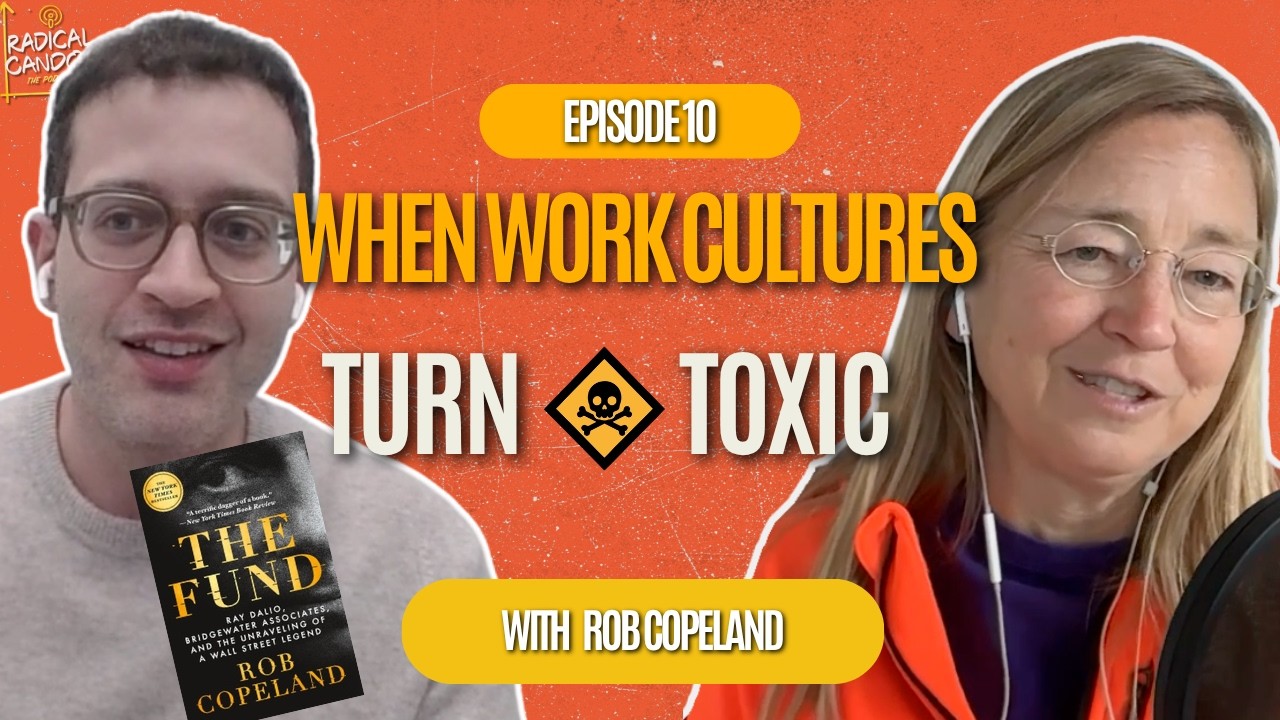
The Fund - an interview with Rob Copeland
43:15

The Fund - an interview with Rob Copeland

Radical Candor® 15.04.2026 35 просмотров

Machine-readable: Markdown · JSON API · Site index

Поделиться Telegram VK Бот
Транскрипт Скачать .md
Анализ с AI
Описание видео
While the podcast team is taking a Radical Sabbatical, Kim is interviewing authors of the books that have had a big impact on her in the past two years. Office culture is a fascinating topic. It can be the special sauce that helps bring together team members to achieve excellence. But what happens when the company culture becomes a toxic mess? What happens when a very charismatic CEO becomes obsessed with both cataloging people’s weaknesses and then broadcasting them to the entire company? What happens when that same CEO mandates “internal reporting” on fellow co-workers, techniques that appear to be drawn directly from the playbook of the Stasi (the former East German secret police force, famous for deep surveillance to control and punish their citizens)? What happens when the CEO steadfastly refuses to hear criticism about himself?Why would people join and then remain at such an organization? Kim welcomes New York Times’ business reporter and author, Rob Copland, to talk about his fascinating, deeply researched, and best-selling book, The Fund: Ray Dalio, Bridgewater Associates and The Unraveling of a Wall Street Legend. Rob’s book dives deep on Ray Dalio, the iconic founder and leader of Bridgewater Associates and the culture he created there. Under Dalio, there is no disputing that Bridgewater Associates became one of the largest and most successful hedge funds in history. At the same time, Dalio appeared to use promises of vast riches to control and intimidate his employees. Rob shares some incredible stories to illustrate these points. When someone dared to push back on any of Dalio’s techniques or vision, he famously would shut them down with, “If you’re so smart, why aren’t you rich?!” Rob talks about what he learned in the years of research he did for this book. This conversation presents a cautionary tale of what can happen when a charismatic leader, flush with vast wealth decides his mission is also to dictate how people should live. Background on Rob Copeland: Rob Copeland is a New York Times finance reporter covering Wall Street, banks, and corporate power. He was previously the longtime hedge-fund beat reporter at The Wall Street Journal. He is best known for investigative, narrative-driven stories and is the author of the bestselling book, "The Fund: Ray Dalio, Bridgewater Associates and the Unraveling of a Wall Street Legend". (Rob’s Bio) https://www.nytimes.com/by/rob-copeland (Rob’s book: The Fund) https://bookpeople.com/book/9781250809063 CHAPTERS: (00:00) Introduction to Rob Copland (01:04) The Pissing Anecdote: A Lesson in Self-Awareness (05:11) Investigating the Absurd: Culture of Petty Conflicts (09:59) The Dark Side of Radical Transparency (12:04) The Pain of Reflection: A Closer Look at Confrontation (16:24) The Cost of Self-Improvement: Why People Endure (18:48) The Allure of Success: How Ray Dalio Captivates Minds (22:43) The Challenge of Self-Awareness (23:58) The Power Dynamics of Self-Knowledge (24:46) Cult Dynamics and Personal Freedom (25:52) The Role of Powerful Figures in Toxic Environments (26:38) Radical Transparency and Its Pitfalls (31:05) The Importance of External Tethers (33:28) Navigating Career Choices and Exit Strategies (37:38) The Journey of Self-Discovery and Feedback
Оглавление (15 сегментов)

Introduction to Rob Copland

Hello everybody and welcome to the radical sbatical. You've got just me, Kim Scott here. Uh the rest of the radical caner team is on sobatical and I am talking to the authors of the books that have meant the most to me that I've read over the last couple of years. And I'm thrilled to have with us today uh Rob Copelan, the author of the fund. Welcome, Rob. Thank you for having me. — Um, I loved your book so much and I loved it for a bunch of different reasons, but why don't we just the anecdotes in your book are incredible. Uh so for folks who haven't read the fund, it's about Bridgewwater, Ray Dallio's uh company and it is near and dear to my heart because sometimes people confuse radical transparency and radical cander and they couldn't be more different. So Rob, why don't you open with the pissing anecdote uh from the

The Pissing Anecdote: A Lesson in Self-Awareness

book and then we'll jump in and talk about other stuff. Well, there's no better way to grab an audience than the first anecdote will be uh about piss the uh so I guess for anyone who doesn't know Ray Dallio founded the world's biggest hedge fund or was Bridgewwater Associates and he's become sort of uber famous as someone who preaches the ability to control your own emotions. He has these things that he calls the principles that he says if you follow these they are literally the holy grail. there a way to become wealthy in life and work. So, I was a I was and am a finance reporter and I've been reporting about Bridgewwater for a long time. And spoiler alert, I guess you could have told uh heard from the intro, you know, he's not everything that uh the stories that he tells, but something that I'd heard for years was that at Bridgewwater, which is based in Westport, Connecticut, uh in a uh suburban office park uh that looks like much like any other, that there was an incident uh that caused Rey to email the whole firm about P. And what happened was that Rey was standing at a urinal one day. Something I've done before. Spoiler alert. I haven't done it, Kim. No surprise. Um — and he looks down and he sees that there is urine on the ground under him. Now that's also happened to me before. But to Ray, — that's happened to me before, too. you. There you go. The uh And so Ray looks down. And to most of us, we would think, okay, I missed. to Rey. He thinks this is a huge mistake. This is a chance for an investigation and he — he assumes someone else missed, not him. missed the urinal. — It's impossible for him to imagine this is his own urine. — Impossible for such a great man, the author of the principles, to have done this. And you know, it sounds funny to us, and it is, but he orders this huge five ring circus of an investigation in the firm. He emails the whole firm. He says, "There's piss on the floor. " He assigns underlings to stand outside the bathroom, to stand inside the bathroom to witness people. He has them measure the urinal. He has them assign targets on the liquid under the urinal sent out for testing, — DNA testing, — to see what it is. And at no point in this whole episode is this man the paragon of radical transparency does anyone around him feel comfortable enough — to say what you just teased me about which is hey Ray it might just be yours — yours. So, it's such a small incident in a way. It's one of, you know, thousands of hilarious things and dark things — um that have happened inside Bridgewwater, but to me, — it just says so much about the whole mirage that he has around himself. there's so little self-awareness — um you know that email could be sent and yet there was so much secrecy at Bridgewwater that it took even me you know the unauthorized biographer it took me the better part of a decade to get to the bottom of it. — Wow. And did it get did the DNA testing reveal to him that it was his own urine or we'll never know. — You know I never was able to get that and I will say — so much for radical transparency. I knowing Bridgewwater as I do, I almost feel like they didn't send it out in the end because they didn't want to have to confront him with the actual truth. He would have found another reason why it wasn't him. — Um, — so, you know, at Bridgewwater and at so many places that claim to have, you know, an open company culture, that openness really only applies in one direction. It applies from the top to the bottom. — Yeah. It's not uh he's not looking at he's not looking in the mirror. Th this was another I mean there

Investigating the Absurd: Culture of Petty Conflicts

so many things struck me about your book, but there were so many so much time wasted on such petty things. There's another story you told about a woman who — confronted an a colleague for not bringing bagels to a meeting where he was supposed to bring bagels and then she everybody ganged up against her and she was fired and then the case was reopen like it was — it was much a do of it. There was a lot of like what why it must be pretty easy to run a hedge fund if they have how do they have all this time. — So this is the great fun and the great mystery of the book that I really loved exploring which is how does such a hugely successful wealthy place ever operate if they spend so much time on these other um these other side quests as I put them. — You're right. You know, at Bridgewwater, there's no such thing as a small problem. Everything, according to Ray Dallio, is a reason for an investigation. It's a referendum on you. It says something. So yes, they people get investigated about um you know whether the peas in the cafeteria were uh pretty enough, whether uh whether you know the Chinese food ordered if it came with white rice instead of brown um why they didn't think to order you know half and half the size of the parking passes the — and you know it can get uh it can get almost a little funny but you also have to remember this is real people real lives. — Yeah. Imagine that kind of pettiness being able to jump in and get you fired or investigated or humiliated in front of your peers. — I spent a long time uh imagining it in fact. — Yeah. Couldn't have been pleasant. How did you stay grounded as you were I mean because these stories are dark. — It is. So there is a there's a darkness to it. There's also just an absurdity. — Uh it helps when you're writing. I write about finance, so I'm used to writing about very wealthy people. And what I've learned about is — one, the stories that a very successful, particularly Wall Streeter tells about themselves are almost all the same story over and over again. — They always say that they there was a lot of luck, but you know, there was also a lot of work and they really did break through. Um, and there was always a moment where they thought there would be failure. And if you ask them what their hobbies are, the hobby is always the same. It always involves charity. It always involves um you know work frankly being quote unquote the best. — So what sort of my jumping off point for the book and what I love about it is at the beginning of this book and frankly my exploration of Bridgewwater, Ray Dallio is already the best. He is the has the world's biggest most famous hedge fund. He has untold billions upon billions of dollars. you know, he has a home in Greenwich with an island, uh, Greenwich, Connecticut. He has, uh, multiple submarines. So, you already have all of that, but what's the one thing you don't have? You don't have the adoration of the public. uh, the attention necessarily that he always wanted. You have people thinking, okay, you're rich, but are they thinking you're smart? They thinking you're special. So really the story of Ray Dalio is to me the story of when $20 billion isn't merely not enough but it's not even interesting anymore. — Yeah. He's on the hedonic treadmill. Um — Exactly. — So what one of the thing one of the big questions that you and I have talked about is like why did people why were people willing to put themselves through this miserable work environment? when I left Google and I was uh I had joined Apple but I was sort of thinking about that you know the future of my career. Somebody from Bridgewater reached out and asked if I was interested in being the COO of Bridgewwater. And I was like first of all I would be the world's worst COO. I'm disorganized and second of all I don't know about this culture. So I called I knew someone who worked there. I called them up and they told me the story about the confrontation with Katrina. So can you tell our listeners that story because that was so horrifying to me when I heard it. I was like who why would you go work in that environment?

The Dark Side of Radical Transparency

So I you really hit on I think the number one question for me which is why do we always seek out uh these singular figures who tell us that they sort of have they've cracked the code that they have the answer. Um in Ray's case he even frequently describes you know talking about the two sides of your brain and that the logical side is fighting the emotional side and that he alone has figured out how to conquer that emotional side. So the tape that you're talking about is actually it's near and dear to my heart because it's actually how I first knew that there was a book here because for years what Bridgewater did is they went out and they recruited overwhelmingly frankly new college graduates. You were pretty special. There weren't too many experienced hires that they were going after because they wanted people who could be shaped — and — they wanted Yeah. people who would put up with it. You're more likely the first year of your career after college to put up with not to know that you don't have to put up with something. — Exactly. And so what they would do in these interviews, there are many other things in the interviews we can talk about, but they would play this recording of Rey uh doing what he called a probe. He loves to probe employees at Bridgewwater. And what it actually is just him screaming at a woman uh who works for him, calling her stupid, calling her uh a lot of other worse things with people in the room. And she starts crying uh and she starts sobbing in fact and this is played to every person who's interviewing at Bridgewwater and they're saying, "What's your reaction to this? " So, I knew that what I wanted to do first of all was I needed to find her and I needed to figure out what's actually happening in real life in this video and what is the sort of the story of how she got there and what happens to her uh afterwards. And I guess no spoilers, but it's darker than I thought. — It's so much worse. Yeah. I didn't know all the details when I heard about it.

The Pain of Reflection: A Closer Look at Confrontation

— It gets worse. Um, and to the point where there was a point where people were telling me, you know, her name is Katina Stefanova. um and that she was actually his surrogate daughter at the firm that people said she's actually the she was the closest person to him and the story of how she becomes the closest person and then she winds up as the example to be uh to be sort of uh flayed um uh publicly and recorded for all posterity. It's really unbelievable. But we should stay here that there's a reason that Rey and Bridgewwater give people for why they're playing this recording and it's one of his key principles. It's that pain plus reflection equals progress. So they would play this and they' say, "Is this the type of pain that you think with reflection could lead to progress? " And I think that's a really powerful pitch in many ways because — I think we would all probably agree there are aspects of life in which pain does lead to progress. I mean, you go to the gym, — if you're not working hard enough, you're not going to get the progress. And also, there are tough decisions that we all have to make that are the right long-term decision. Of course, you know, you could take something like that, like a logical apherism, and just go, you know, 1,000 times off. — Yeah. Sort of like notes from the underground or something, you know, you take a basic principle to its illogical extreme. — And by the way, when they play the tape for people, they didn't they weren't telling people who she is. Um they weren't actually giving her name. um they weren't telling people it was highly edited um in a way to make Ry seem better, obviously. And something that was really important to me with this book was that almost everyone in this book is their real name. It's their real experience whether they spoke to me or not. There's only one person who's who I gave a pseudonym to and because she had a sexual misconduct case, I just didn't think that her kids needed to Google her. — Know that. Yeah. Um, but you know, it's something I feel really strongly about is, you know, the truth, the actual truth, not what Ray Dallio thinks is the truth, but the truth is actually — a it can be intoxicating because it keeps me from exaggerating. You know, I have to tell you exactly what actually happened to these people. And um because if I don't, I mean, I'm in the wrong. You could sue me and I lose. — Yeah. Um, so Kina, one of the things about that story was that she had, — I mean, you can give some of the background, but one of the things that I remember so vividly was that she had just told Rey before the meeting that she was pregnant. — So, this is a great this is a reveal. The and it was a reveal to me. She's crying on this video, excuse me, on this tape. And the message that Bridgewwater tells for literally decades of playing this for people is that she's crying because she knows she's in the wrong and because her boss has her boss Rey has, you know, exposed it and now she's learning and it's a painful thing. They never tell anyone that actually she's also pregnant. He's been screaming at a pregnant woman in front of him. She's running out of the room because her body is um is obviously um having the reaction and like he knows she's pregnant by the time this — she's had kids. You know, the kid her daughter is uh is I believe a teenager now. Um it's no secret once you know the truth. But — for so many people for a generation it was just oh this is Ry doing the right thing and she's she feels guilty essentially. But why? Here's a question. like you would see that video and you would say no that's you know other pe you can say that Rey about your own pain but you don't get to like intentionally inflict public humiliation is not necessary for the reflection can happen in private — and that's part of the problem with radical transparency is that reflection

The Cost of Self-Improvement: Why People Endure

for us to be for us to for the vast majority of people to be able to learn from their own mistakes they have to do it privately uh or with someone else but not in a public setting. Uh that just induces a fight or flight. Why did so many people accept this? It seems kind of obviously cruel uh on the surface of it. — So that's sort of the multi-billion dollar question for me. — Yeah. the there's an easy answer and I think it's cheap which is Bridgewwater had a was a large hedge fund is and you could make a lot of money by putting up for with it and I think there's a truth to that for a lot of people — you're getting paid not just six figures you can there you know janitorial staff making you know mid6 figures um well into the millions um for investment professionals so there's a part of that is you know what will I put up with for money but — I think it's much more than that because honestly many people that I spoke to I was actually surprised they weren't even paid all that much relative to a Wall Street career. — Yeah. There's other ways to make money. — Exactly. And also there's a point at which you know we all — How much better can you eat? Yeah. — Exactly. And what Rey is was selling and is still selling to this day is the idea of self-improvement. the idea that he has all of the answers and that you have to put up with this to become uh successful not just monetarily but you know rich in life. He had a phrase that he loves to use which is when someone would say to him something that he didn't like. He would say if you're so smart why aren't you rich? And I think that really is the answer to why anyone who would say who might even disagree privately. It's like, well, I'm not that smart, right? Because I'm not as rich as him. It's that's giving him the power to do all of this. And, you know, for this book and for years, I've just been fascinated by these self-help organizations that over and over again tell you that if you put up with XYZ, um, you will improve some aspect of your life. Um, and that's exactly what, you know, Ray does. — Yeah. It's it is it's incredible

The Allure of Success: How Ray Dalio Captivates Minds

to me. There was um an academic who I really respect and frankly like a lot — who is known for, you know, his uh research into why it's good to be kind. Like he's, you know, he's one of these business academics who is focused on doing the right thing by people. Mhm. — And he was hired by Ray Dallio — and he bought it. And I just I remember being so shocked by this person who is smart and not a bad guy. Like how h what is it about how did he be how did he trick that guy? Like it was so shocking to me. I don't think in that case he wasn't working for I mean I guess he took I don't know It was a, you know, a few hundred thous,000 of money uh for this engagement, but it wasn't, you know, he wasn't working there. He like, how did it seems so obviously bad to me? Why didn't everybody see it? — Well, I'll be honest, it didn't even seem obviously bad to me the first few times. I So, I'm so I have some — You saw the video? Well, when I saw when I was at Bridgewwater, I mean, so yeah, you know, as a reporter, I went to Bridgewwater several times. I met with Rey and with other executives there, and there is something really intoxicating about someone you've seen on TV, — someone who is, you know, quote unquote important. They're sitting you down. They're looking you in the eye, and they're telling you how strongly they feel uh about their methods of self-improvement or about how much they love their staff, and they treat them like family. And I think for many academics, look, there's like Adam Grant is a part of this book. He really bought Hook, line, and sinker, the Bridgewater uh everything. — And you know, you're being offered this lens into what is allegedly a very secret investment firm, is one of the most successful on Earth, and they're telling you, "This is how we did it. " — How many of us are strong enough to say, "No, you're wrong. " — Yeah. camper has no clothes. — I will tell you in one of those meetings with Rey, I thought I would with my colleague uh at the time, I think we thought we'd be there for about an hour. I think we were there for eight. — He's spending all this time with us. He's really answering all of our questions. — Yeah. — And we walked out of there. Excuse me. Right before there, it was nightfall and there was a woman who had been in the room who was basically Ray's assistant who was taking notes — and someone else in the room as we left wished her a happy birthday. And it was my colleague and I as we were leaving said to each other, "Oh my gosh, we missed what was really happening there, which is Ray was droning on for eight hours, didn't have to, and he did not even once acknowledge to this young woman that she he was ruining her birthday. " Um — the there's so often I find is it just takes a lot of time to sort of shift your perspective to look sort of at the other corner of the room. Um, I think the academic aspect of this book is it was honestly a little depressing to me how many researchers that I really respect um just you know they just wrote exactly what Ray told them to. It's you I guess you want to believe — uh that — that and I mean there the I guess part also part of the problem is there is a grain of truth to it like radical cander is all about soliciting criticism you know giving praise giving criticism and then gauging how it lands. Um, and

The Challenge of Self-Awareness

so I do think that self-awareness is hard and we need other people to tell us what they notice in order to, you know, get outside of ourselves and notice mistakes we're making. So there's — self-awareness is hard should be the uh — the subtitle of this. — Um, the — Yeah. And if you have too much money and power, you never have to be self-aware. There was one wealthy man who I worked for at one point in my career. And I was encoura I said something about you know self-nowledge and he looked at me like I had missed something elemental and he said who wants to know — that maybe is the ultimate power is you don't have to be self-aware. Well, and the ultimate power is to convince those around you that they're on the right path, that you have set them on the right path so much that they don't even want to leave it when it is careening out of control. — I don't know if you saw uh the HBO series uh The Vow about Nexium cult. No. — Um it's fantastic. Highly recommend it. Um — I'm putting it on my list. The Vow.

The Power Dynamics of Self-Knowledge

— The Vow. It's actually I'm surprised there hasn't been a great book about Nexium yet, but it is a it was a self-improvement um cult in uh the sex cult. I'll get you to watch it, right? — Wow. — All of a sudden, it just went to the top of your queue. The uh in Albany or north of Albany and there's a an episode of The Vow where they talk about this young woman. She's actually a teenager and she's been locked in a room for years. She's not allowed to leave the room. her parents have given the cult leader permission and the idea is that she's done something wrong and that she can't leave until she diaries and journals it to herself and so she only leaves to go to the restroom for years and the reveal at the end of the episode is that the door was never locked. H

Cult Dynamics and Personal Freedom

— she could have left. Exactly. But she her whole life, her whole her value system, her family had convinced her that the right thing to do was not to leave. So — wow. — To me, the idea that like any of us couldn't be in that situation is a little naive. And there are so many examples at Bridgewwater of people who are who find themselves at the fork in that road and they choose to stay for many interesting complicated uh reasons. — Yeah. And it's more understandable that someone straight out of college, but there were some very powerful people who worked there who allowed themselves to be treated abysmally. — Tell some of those stories. James Comey, there were some others, too. — So, Jim Comey takes up a a good portion of this book because uh in the sort of interregnum of his career before he's FBI director, but after he is a famous federal prosecutor, he becomes general counsel of Bridgewwater. And he gets paid about $7

The Role of Powerful Figures in Toxic Environments

million a year. So, remember this is uh late 2000s. So, that's I mean, it's a good sum now, too. Excuse me. That's a lot of money, but it's even more even today for sure. You can tell I've been around finance too much that I say, "Well, it's 7 million. " The And he essentially takes It's the Jim Comey we all know and either love or hate no matter what. — He becomes Rey's personal inquisitor inside Bridgewwater and he is uh you know he's pulling up uh investigations on people. Something we haven't talked about yet is that at Bridgewwater everything is taped as everything is recorded and available uh for everyone to play back. And so Jim Comey is taking these recordings and trying to find compromat on people. He's trying to

Radical Transparency and Its Pitfalls

trick people. — It's by the way it's very Soviet. — Uh and it's alarming given every given that every meeting has 15 AI notetakers in it. Now, I started my career in the Soviet Union and in 1990 and everything I said was recorded and I remember thinking, "Oh, it doesn't really matter. I'm an American citizen. It's not like I'm going to be arrested and I'm not going to allow this the fact that everything I'm saying is being recorded to impact me in any way. " And I thought, kind of like the woman locked in the room that you were just talking about, that I was being candid with myself and with others. I'd call my parents every Sunday night. — And then one time I was uh I had flown to New York for a meeting. — And so I called my parents from New York, not from Moscow on Sunday night. — And I realized I was talking much more openly, much more candidly to them. And I realized that I had self-censored because everything was being recorded even though I didn't believe there would be any. And that is the insidious nature of having a radical transparency is that it does the opposite. It it hides us. It hides cander. It doesn't actually expose it. You need a little privacy to be truly candid. Um, — it's a bit like, you know, not to get super political, but in New York, we just elected a uh a socialist mayor. And people, — uh, a lot of people that I know will say, I can't believe that the city overwhelmingly elected him, by the way. Aren't they scared of socialism? And — my answer is actually socialism sounds great. Like, I don't what's the Yeah. Everything will work on time and we're all in it together. Um, it's like, so I don't understand like I understand why every generation would, you know, give it a try. And I understand why if I told you your workplace would be of radical truth and radical transparency and that we'd all be devoted together to figuring out, you know, what you're best at and to getting you into that so that you can make the highest impact. Um, I sign me up, right? That's not that doesn't sound awful. — Yeah. So, how can we make sure that we don't get uh swayed by these ideas that sound good but instead but actually are so insidious? Um, and how do we make sure it seems like a lot of the people who were working there were like frogs in boiling water, you know? It was just it was getting more and from the outside like reading — there were several times when I was reading this book I was like — why are you putting up with this like you don't need this but and yet all these people did these powerful people. — So I'm going to prove to your audience that you do not edit these chats because I'm going to correct you on something. Okay. Which is that exactly which is that there's actually a principle that mentions what you just said that if you put a frog in boiling water, it'll jump right out. But if you boil it up, if you put it in cold water and boil it. — So that's a that's part of the principles. It's Ray saying, "I'll make slow changes that you won't even notice. " Um, that's not — Oh, I misunderstood the principle when I read it. I thought what he was saying is we're going to turn the heat up so fast that you know to jump out of the water. — Oh, no. He's saying like we can make these changes and you you're going to love them so much you won't even notice. — So he's admitting that he's boiling you. — Correct. And even better, it's a myth, — by the way. You can if you put a frog in cold water and you boil it, um it jumps out. — It'll jump out. They're not dumb. — Uh the But no, but you're right. Small changes are harder to track. And what I will say is the if there's one thing that kept people from sort of falling into this with their whole life, it's people who had some tether outside of the workplace. I get really freaked out when I hear about these companies where we'll do your laundry for you. You'll um you know you'll do have all your meals here. We do child care. We do. It's like — you need some — work is not life despite the title of Ray's book principles life and work. — Yeah. — And you know you need that whether it's religion or it's family or it's just that you like going to Disney World every quarter. I don't know.

The Importance of External Tethers

— I'm so glad you said this because I have an opportunity to tell my husband that he was right and I was wrong. So, we both, my husband and I both worked at Google — and Google offered daycare and um and I was like, "Of course we'll do the Google daycare. " And my husband said, "Absolutely not. We will not do the Google daycare because we both may want need to quit and we don't want, you know, to have to turn our kids' life upside down if we quit. " Have you seen those videos of a young man who lives in He's a Google employee and he lives in a van? — He used to work on my husband's team. — Oh, really? He's a He's quite famous than me. — He almost lived in our driveway when we kicked him out of the parking lot, but I think he found a better option. — Yeah. I I have a lot of questions for him. Not that I think that he's doing anything wrong, but I — I would wonder Yeah. if he had a similar feeling that it was like — I so I I loved working at Google. Uh I just want to say I mean Google's not perfect. Uh and there was food. You did eat um your meals there. Although I took I did have dinner there but I didn't have it there. I put it in a box and took it home. So — sorry. And I'm not picking on — No, no, no. I think it's okay to pick on Google. I'm just I'm acknowledging my pro Google bias. Uh but at the same time it was really important to me — to h like my real friends to have dinner with people who didn't work at Google every so you know like all the time — um not to have your whole because when your whole life is tied up — in a company uh it is it's very dangerous for you can you can become uh you can become indoctrinated it becomes also It's not just your, in the case of Bridgewwater, it's not just your compensation. It's your whole worth. It's whole your identity of I'm going to figure out what I'm best for uh on this planet. Becomes really hard to — to give that up. — Um and especially in, you know, you're living in this very small community in Connecticut. It's a big part of your social life. But I will say at least about I lived in San Francisco for a year, excuse me, two and a half years.

Navigating Career Choices and Exit Strategies

years. I I'll give a lot of credit to the Bay Area. Like people do change jobs. People have friends elsewhere. Yes. They you know they start a new company, they fail the company or they become billionaires. Like it's like there is constant churn and change. Something I actually think about a lot in the industry I'm in now. I, you know, I write for the New York Times is it's shrinking. There aren't so many other options for me outside of the Times. And I'm really lucky to be where I am, but you can't just be so scared of the unknown that I stay here, you know, for 30 years because there's no bigger newspaper than the Times. Um — Yeah. I think one of the most important bits of career advice I ever got was don't forget to quit. Oh my god. Even if you don't, I'm not saying you should quit the Times because the Times need you. But you should know what your exit options are. Because if you are, then you're less likely to give up your ability to say this makes no sense to me. And to take the risk that uh that — that you take on when you say that. Well, there's something also so terrifying and you know, I know you've written several books and I've only written one, but there is something that's so exciting and terrifying about it just being you. You know, — if the book is bad, no offense to our shared editor, Tim Bartlett, who will listen to this, but like it's our fault. — Yeah, I love Tim. Uh I I'm well aware that the risk is not socialized. You know, — I you know, I tried to persuade Tim to put his name on the book with me. — Exactly. — He did not. There's no — there's no one more sensitive also than an author who's just spent six months in a hole. — Yeah. — Writing. Four years. You wrote this book in six months. You're fast writer, I guess. — No, I did the research for It took me a long time to get people to talk to me and to find the right people and to — probably decades — but honestly more than 10 years and I still every week hear from people. — So it's uh but yeah, sorry this got very meta. This got very us and not the tech company. Sorry, that was an awful joke. You just lost all of your listeners. You just It's your podcast ranking just went down. — Everybody loves you, Rob, because your book is great and your Thank you for writing this book. It really I think it's especially at this in this moment in time this sort of we're learning all this terrible information about all of the people who were willing to support Jeffrey Epstein as he committed atrocious acts. And Ray Dallio didn't do anything quite that bad, but he did some pretty bad things. uh and and he treated people really terribly. And so I hope for folks out there who are working in a job where they feel like they're, you know, they're being treated terribly and this is an economy where it's scary to be treated terribly. I hope that I hope that they can take your advice of figuring out like what is it outside of work that's going to keep you being you so that you don't get completely allow yourself to be locked away, you know, and not even locked away. You're not locked away. All of us are in this room and the door is not locked. We just need to open it up. — Exactly. And I think if I took one thing out of this book honestly, it is that — there is no one with more answers than you. — Like that we all actually have sort of an equal opportunity. Doesn't mean that you know you should talk to as many people as possible. There people lots of people who know more than me about lots of topics, but — at the end of the day, you know, — it's sort of up to you. There is a self-directed portion. This got very like very pro-American capitalism, this conversation. I feel like I just made it very individual. Uh but that's that is

The Journey of Self-Discovery and Feedback

how I feel about a lot of these. There's a wonderful um very short chapter in the book about a man who was at Bridgewwater and uh was raided by the rating system to be essentially dog [ __ ] to be he at everything. — Ray and the company told him he was bad at everything. And I don't mind spoiling this because he goes on a very dark spell and then when he leaves Bridgewwater, it turns out actually he's great at exactly the thing that they kept telling him he was bad at and he has a wonderful career. He manages a small team. He makes much more money. Um, and it truly came out of him just realizing no there I can do it. — There was no secret. Actually, as it turns out, pain plus reflection did not equal progress. — Um, so that to me is just is such a lesson. I probably reread that chapter every month. — All right. So, so for folks listening, what chapter is that? Do you know the number? — Read the whole book. Read the absolute whole book. But read the chapter. He's going to tell Rob's going to tell you. — It's called Feedback Loop. It's chapter 19. And you do not have my permission to skip the first 18. You must read, but you can skip it. — No, don't skip it. It's a great great book. And I think I think this is a good note to end on because in order to be receptive to feedback, you have to be able to reject it. — Uh take it on and some of some of the feedback you get is going to be right and some of it wrong. And I think one of the many problems with radical transparency is that the assumption was other people are right and you are wrong. And that's just a faulty assumption. — Well, and I will end this the way that uh Rey would have ended meetings is they like to say, "Is there anything that I could have done differently that I would have uh that I that I could have improved on? " But if you were Ray Dallio, keep in mind you would immediately start attacking me right now no matter what. So, is there anything I could have done better here? — Well, I'm going to start with what I loved about uh about So, let's model this because I think we both agree that feedback can be useful. — Uh and feedback is not all criticism. It's also praise, which Rey didn't seem to have a lot of room for praise. — So, the first thing you did right is you wrote a wonderful book. and you wrote a book that's not only a wonderful book, it's an important book to read at this moment in time. uh because I think that uh I'm very pro-individual as well, but I also think we're at a moment in time where we need to question capitalism and what it's rewarding and why it's rewarding people who are not only wrong ethically in so many ways. But Ray Dallio is also wrong about the market a lot like he only fell up. So, what is it about uh about the market that is uh that is leading people astray? Uh so, I love the book. I love the moment in time that you wrote the book and I love the way you talk about the book. Um not, you know, you're not like overly salesy. You're kind of approachable. So, I love all those things. Uh you have so many stories in the book. I think you let me talk too much and I didn't let you. So, I'm going to criticize myself. I don't think I pulled out as many of the sort of unbelievably sort of the stories that had me jumping up and down and shouting and reading stuff to my husband as I was reading. — Well, then you're a great salesperson for the book because I can't think of a better that there's so much more to come. I feel like we're on a uh selling rotisserie chickens uh rotisserie chicken ovens. — Yes. — Yeah. Well, I'll give you a piece of feedback is I actually — I really love how you just jump right in. It's not like, you know, you assume I love that your audience knows when you're enthusiastic that they assume that, you know, there's a reason that I'm here. So, I think it means that we were able to get to a lot of uh a lot of topics. — Thank you. And what would you have had me do differently? Um, I would have uh I would have charged a fee for this podcast so that and it would have gone we would have split it. No, I'm just kidding. The uh No, what would I have you do differently? I would just say uh you know uh keep talking about the principles. I it's the number one buzzword for him and I feel like probably for most of your episodes someone has some sort of principle and to me it's just complete [ __ ] Like — yeah, the principles are [ __ ] That's the topic of this. — That is the topic. — That's the subject. — Um, well, thank you. And I'm glad you brought up I never ever accept or charge guests on this podcast. So, I'll just say that for the record. — All right. Well, thank you so much, Rob. I can't wait for the next book that you write uh because you're a great writer. — Thank you. — The Radical Cander podcast is based on the book Radical Cander. Be a kick-ass boss without losing your humanity by Kim Scott. The Radical Caner podcast theme music was composed by Cliff Goldm. Follow us on LinkedIn, Radicalcander the company, and visit us at radicalcander. com.

Другие видео автора — Radical Candor®

Ctrl+V

Экстракт Знаний в Telegram

Экстракты и дистилляты из лучших YouTube-каналов — сразу после публикации.

Подписаться

Дайджест Экстрактов

Лучшие методички за неделю — каждый понедельник