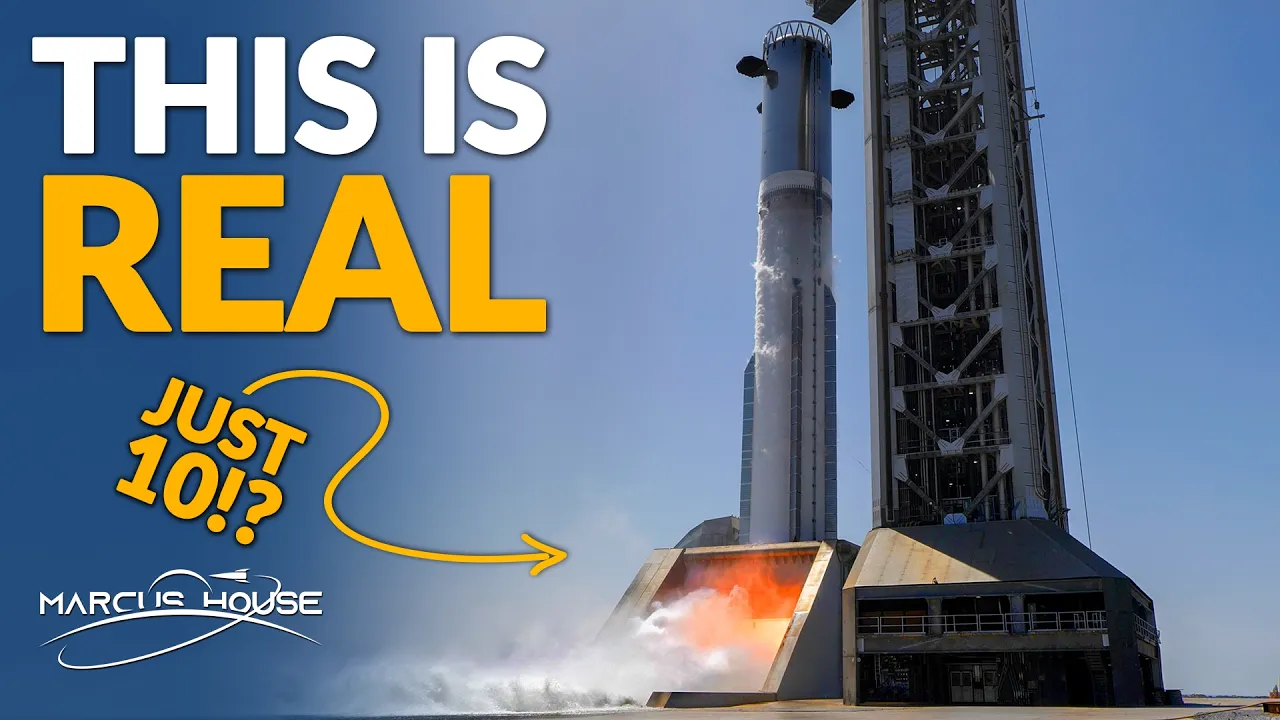
They Finally Lit All 33… This Was Insane!
24:36

They Finally Lit All 33… This Was Insane!

Marcus House 18.04.2026 353 792 просмотров 17 613 лайков

Machine-readable: Markdown · JSON API · Site index

Поделиться Telegram VK Бот
Транскрипт Скачать .md
Анализ с AI
Описание видео
Go to https://surfshark.com/marcus or use code MARCUS at checkout to get 4 extra months of Surfshark VPN! SpaceX fired up all Raptor 3 engines on the Version 3 Super Heavy booster in a full static fire, marking a huge milestone ahead of Starship Flight 12. Yes, They Finally Lit All 33… This Was Insane! We break down Ship 39 and Booster 19 testing, cryogenic loading, wet dress rehearsals, and what this means for the first full V3 stack and future tower catches. Also this week: Falcon 9 CRS-24 Cygnus XL launch to the ISS, Starlink missions and drone ship landings, Artemis II splashdown updates including Orion heat shield performance and recovery, plus Blue Origin’s New Glenn return, Blue Moon lander progress, and lunar ISRU plans with Air Pioneer. Aerospace America article by Paul Brinkmann https://aerospaceamerica.aiaa.org/nas... 👕 Like the new merch?! Pick it up here https://marcus-house.myspreadshop.com... 🎁 Marcus House Merch - https://marcus-house.myspreadshop.com/ You can support me on: Patreon -   / marcushouse   Join my Discord -   / discord   Follow/Subscribe on Twitter -   / marcushouse   The production crew: GameplayReviewUK, TiagoCruz, Mr Pleasant, Virtu, Orbitly, Shaun Gisler, Greg Scott, Niall Anderson, ChameleonCircuit Support from these incredible people and groups is massively appreciated: ❤ 📷 Shaun Gisler - https://x.com/lifeatstagezero 📷 NASASpaceFlight -    / @nasaspaceflight   📷 RGVAerialPhotography -    / @rgvaerialphotography   📷 Avid Space -    / @labpadre   📷 Greg Scott -   / gregscott_photo   📷 Starship Gazer -   / starshipgazer   ✨ Tony Bela -   / infographictony   Set models: 😍 Space Rocket Lab's Starship Models - https://www.spacerocketlab.com/marcus... 😍 Mini venting Starship/SLS - https://www.stardesk.co/ 😍 Starship, & Crew Dragon by - https://morethan3d.com/ 😍 Moon/Mars Mova Globes - https://www.movaglobes.com/ 😍 Saturn V - LEGO - https://www.lego.com/en-au/product/le... 😍 Space Shuttle - LEGO - https://www.lego.com/en-au/product/na...

Методичка по этому видео

Структурированный конспект

Освойте архитектуру и динамику испытаний ракет SpaceX и Blue Origin: от статических огневых тестов до лунных ресурсов

Глубокий анализ аэрокосмических испытаний и операционных стратегий частных компаний для инженеров и энтузиастов космонавтики за 25 минут.

Оглавление (5 сегментов)

Segment 1 (00:00 - 05:00)

Finally my friends we have the first full fiery action from the Starship Version 3 vehicles! Not just the Starship, but we had the Super Heavy blowing our minds too. Along with that Falcon 9 has had an extraordinary week, updates coming thick and fast in the aftermath of Artemis II, and the final countdown of New Glenn about to launch with a lets say… mostly reused first stage. Strap in, this has been an exciting one, that's for sure. This video is sponsored by Surfshark VPN! Hey, Hey Marcus House with you here and with a crazy week of fiery Starship action this has been a fun one. I left you last week with both version 3 vehicles gearing up for flight 12. Starship 39 had already made its way to the Masseys test site and was patiently waiting for action here. At that time of publishing its partner Booster 19 was just heading out the door of the megabay to make the trip to the launch site. In the morning Shaun was soon out there heading around the back of Massey’s on the river with Keith at Raptor Roost. This is a nice perspective here with sweet views of the leeward side of the ship through the now cleared testing structure. Previously SpaceX had loads of scaffolding here in the way as we can see here. Now though we have a nice unobstructed view here of the aft flaps and they were completely covered in tiles. Along with that 4 large patches here on the top side of the ship! Now the guess here is that SpaceX is likely still performing testing with different adhesives and attachment methods, but just on a much larger scale than we have seen previously. As we know SpaceX are wanting to reach that point very soon where they will send these ships to orbit to then come back for tower catches. It won’t happen on flight 12 of course, but gathering data for this mission is crucial. A future catch is going to require a completely successful heatshield to give the best chance of success so certain experiments may need to be moved to the top of the ship like these ones or withheld for dedicated test vehicles down the line. Now looking up at the top of the nose they have thankfully installed some cameras which we are all thrilled to see. Until now there hadn’t seen any cameras installed on the outside of the ship. Anyway, the stage was set here for a static fire, and of course we wanted the same from the booster as well. Just after last week's video Booster 19 was lifted onto its transport stand and moved into the ringyard where it sat until morning. Once the road closure period began it was rolled right on around to Remedios Avenue where Shaun was already geared up and ready to capture the beast making it move. Talking to him about this he just thinks it’s ridiculous being there to see the true scale of it rolling on by. It means the world to him, and of course the whole team here that you amazing subscribers are watching along so that we can be out there for you. Thanks a lot for that as always. Now check this out here. Looking through the gaps in that stand we could already see a great deal of engines were mounted. As we soon found out SpaceX had indeed installed all remaining engines for a full set of 33 as we had hoped! Down highway 4 it rolled and right in toward the launch pad. Before we knew it, it was in between the tower arms and here we go! They closed in and gently hooked under those lifting points. Remember, these aren’t separate lift points any more. They are now integrated nubs on the grid fins. They lifted the booster just slightly off of the stand so they could retracting those clamps, and then wasted no time lifting it out entirely. Yes, for the first time, my goodness, there is our first view of a full set of Raptor 3 engines installed on a super heavy booster! It is always fun to do some comparisons here. With the Version 2 booster compared to this you can immediately see the lack of engine shielding. Given that the new Raptor 3’s are lighter than the Raptor 2’s and with all that shielding now unnecessary we believe they’ve knocked a good chunk of dry mass from the Super Heavy right there. With the cooling channels now running up the full length of the engine instead of just the nozzles. This should provide ample cooling for the vehicle to survive the massive heat and pressure of reentry. SpaceX went through the normal routine here lifting it out of the stand, positioning it over the mount and slowly lowered it between the clamps before they were deployed one by one. With Booster 19 locked in they soon did a single high speed retraction test of the quick disconnects before calling it a night! Now eager to get started with the testing campaign on Sunday the tank farm was chugging away as they began rapidly filling the tanks with their cryogenic propellants! This is all obviously dramatically sped up but if you haven’t watched the process in real time check out the next tests live with NSF or Avid Space. As you watch the frost climb in real time you are seeing hundreds of tons of propellant per ring. The size is still staggering to me even though we’ve watched Starship testing for years now. Remember each ring is a whopping 9 metres in diameter and 1. 8 metres tall. With the tanks quickly filled to the testing point the tank farm had died

Segment 2 (05:00 - 10:00)

down. In this case the detonation suppression system and water deluge started their thing, but actually nothing too special visually here except perhaps a spin prime hidden away. That may seem a little anti-climactic for this one right!? Well during the detanking look at this! Yes, they fired that top deck with the booster still on the mount at what seems to be full flight pressures! What a sight that was and it did make us wonder what more magic we would be seeing this week! Back again on Monday SpaceX refilled the Super Heavy, the deluge started, but this time we got a clear flash accompanied by a high pitched noise. That looked very similar to what we saw during the 10 engine ignitor testing during this boosters first round of testing! SpaceX hasn't confirmed that this was a 33 engine ignitor test but given they were soon moving on, I think this is a fair assumption! Detanking was underway again they made more use of the time with another retraction of the quick disconnects. The booster was still actually frosty for this one! Coming back to it on Tuesday they had just barely gotten into propellant loading when they seemed to call an abort and started detanking for the day. SpaceX then tinkered inside the commodities bunker over night so there may have been a Ground Service Issue to address perhaps. Instead they took the time doing some high speed retraction tests on the ship quick disconnect arm on the tower. It looked like they were testing it out as if it were a launch, so each milestone like this is rapidly being ticked off before flight. Anyway, the big one came on Wednesday! Workers removed the boosters transport stand off site and parked it half way down highway 4. There were no hiccups this time running right into propellant load! They filled it back up to the static fire test level, and here was the moment that we had all been waiting for! - WHOOOSHKA!:) - Just look at the absolute fury in that fire! SpaceX confirmed that they had ignited all 33 engines for a short 3 seconds test! Now we don’t know if they cut it short for any reason at the time or if they had always planned a short test to limit any potential damage if there was any issue. All we can say is the pad and booster were still looking great which is excellent news! Remember, the Raptor 3’s have never been fired together before and as shown here in this vehicle summary, they should collectively have a total of 8,240 tonnes of thrust. The Version 3 stack is actually underutilising the Raptor 3’s as well because they should be capable of 280 tonnes of thrust each, but that won't really be needed until the Version 4 Starship. Regardless, this static fire would have likely been the most powerful rocket test in history! Now they still weren't done either because on Thursday they moved the road closure all the way back to the farthest checkpoint which we would normally see for an actual flight. Indeed SpaceX were going for a full booster Wet Dress Rehearsal. This means they filled it completely with both cryogenic oxygen and methane. Yes, a load of about 3,600 tonnes of propellants roared into the beast in just 35 minutes. Again, everything looked great here so a huge success for the Super Heavy this week. Now on the ship side of things it has been a little more difficult to distinguish the intricate milestones. Especially given that the test site at Massey’s is surrounded by trees and we also have views from cameras that are comparatively well back to what we have at the launch site. On Saturday we could already see them getting into cryogenic loading with Ship 39. We could see that full load on the liquid oxygen tank and just a little there on the methane tank! NSF was able to capture a view of what could have been a spin prime at the suspected T-0. On Sunday they were back again with another similar looking cryogenic load, but this time we couldn’t see any activity at the expected T-0. This may have just been a 6 engine ignitor test. The next day there was more testing going on but just a small amount of liquid oxygen and methane was loaded before the ship was detanked, so not sure if this was an abort or some sort of unknown test, but it was all gearing up for the big one on Tuesday. Again they filled the tanks right up there to those testing levels and here we have it! - AWWWW YEA!:) - Yes Ship 39 had roared to life finally, breathing fire back into this stand for the first time since June of last year! Now just rewinding a here we could see two distinct clear flashes as both sets of raptors ignited! The 3 sea level engines starting up first in the centre and the 3 outer vacuum engines following that! Again these are of course Raptor 3’s firing up together for the first time ever on a Starship. They ran these monsters for the entire

Segment 3 (10:00 - 15:00)

60 seconds and SpaceX confirmed success here soon after while picking up these neat views to share. So yes, with both ship and booster having now undergone successful static fire campaigns they should both be about ready for flight pending any last minute checks and tweaks they need in the megabays. Ship 39 rolled back and into Megabay 2 on Wednesday and Booster 19 was lifted off of the Orbital Launch Mount and rolled back into Megabay 1 on Friday. This means with a bit of luck here this finally marks an end to the frustratingly continuous mentions of 4-6 weeks for flight. Now, it does seem like we may indeed be just a few weeks out, so the next time we see both of these vehicles rolling, it should be toward the launch site to be joined together as the first ever Version 3 full stack, so exciting times! Now it has been a really fun week for Falcon 9 action too. [Ad Start] More on that in just a moment but first a massive thank you to Surfshark VPN sponsoring this video. You would likely be amazed how many news, sports, and entertainment sites are removed from your access depending on where you are. Well a Virtual Private Network is your key to unlock content that has been geoblocked from you. It can even help you avoid unwanted age verification restrictions popping up in a number of countries now. Because this can encrypt all traffic over your connection that means your activity and data is less exposed when surfing, streaming, and gaming. When you use public Wi-Fi in say a café, airport, or hotel, using Surfshark VPN simply to add that extra layer of protection is always a good idea. If you are travelling outside your own country it also lets you access everything from home too. It is always frustrating I think when your social media and entertainment has been restricted just because you are working abroad or on holiday. Once you install the system on your device you just select the country you want to be browsing from, and BAM, restriction removed! There are a bunch of other features included that you can switch on as needed. The CleanWeb feature will help block trackers and malware, and Kill Switch will simply cut off the internet if the VPN connection drops for any reason. The great thing is, with the one subscription you can install it on all your supported devices, and you can try it all out with Surfshark’s 30-day money-back guarantee. Give it a try by heading to surfshark. com/marcus or use the code MARCUS at checkout to get 4 extra months for free. You can also scan the QR code right there on screen to get started. Thank you, Surfshark. [Ad End] Ok, back to some awesome Falcon 9 action, this has been a fun week. Just after my last video went live SpaceX was counting down the mission to deliver NASA’s next International Space Station re-supply. Not with Dragon though, no, this was CRS-24 with Northrop Grumman’s Cygnus XL. The great thing was that this was a return to launch site mission too, and my word was it spectacular. Here it was rocketing away from Cape Canaveral, now I’ve just got to shout out Space Flight Now because check this out at the 35 second mark. That plume lit up by the sun is so darn cool. SpaceX shared another with this same effect. Soon we were at stage separation and packed between the fairings to fall away, there was Cygnus XL with over 11,000 pounds or close to 5 metric tonnes of cargo on the way to the International Space Station. Now this is only the second flight of the upgraded Cygnus. The XL is beefed-up with space for about 33% more cargo that the previous version. It was Booster 1094 needing to do that lengthy boost back burn. Just minutes later here it was coming in to nail its 7th landing at Landing Zone 40. Now we have just got to rewind and play this again from another perspective because check out Greg Scott's view from his remote set up right here. - FWOOOOOOOOOOOOSH:) - Wow, do make sure you are following Greg there because that was magic! SpaceX shared some really great images on this too. Here is a shot of the booster returning with its exhaust back lit by the sun. Here is another great action shot just as Booster 1094 is about to touch down, and this neat compilation shot here of the launch and the landing at the same pad minutes later all in the same view. That is crazy! Now back to the Cygnus XL, we had an awesome separation of this in full daylight. It was now on a roughly 53 hour journey to the space station. Once there we had some great shots of the approach. I was watching some of this live like I’ve done many times before, but for me it is always a mind blowing that we can just connect in to see all of this in real time. Again, lots of great action here in the daylight and I’ve massively speed all this up for you of course. In control of the Canadarm2 used to grab and bring the vehicle in was NASA’s astronaut Jack Hathaway. Cygnus XL was soon berthed to the Unity module

Segment 4 (15:00 - 20:00)

for unloading, and just one of the neat things on board is a new module for the Cold Atom Lab. This will expand its research capabilities to, we hope, improve our understanding of general relativity, planetary composition, and dark matter. So along with that just the two Starlink missions for Falcon 9. Group 10-24 was off from Space Launch Complex 40 on Tuesday morning just before sunrise with 29 on board. Landing number 26 for Booster 1080 on the droneship Just Read the Instructions there in the darkness, and it was also the perfect time of the morning to catch the second stage doing the Jellyfish too. Next up though we had some impressive views. Group 17-27 was lifting off from SLC‑4E at Vandenberg Space Force Base with another 25 satellites in the stack. Now SpaceX knocked it out of the park with this view. Check this out. From above the drone ship Of Course I still love you, a sweet elevated perspective of Falcon 9 Booster 1082 coming in for its 21st landing. I think we can add this to the list of the best landing views ever out there in the ocean! Now we are of course still reeling from the wrap up of NASA Artemis II mission. Soon after last weeks video we had awesome recaps of the mission from the four heroes of this entire spectacle. Reid Wiseman shared this up close and personal video of the ocean recovery. It sure would have been quite the feeling having that hatch open for the first time since they entered over nine days earlier. With the heat shield in Artemis I having issues that we’ve talked about a number of times, we were all very keen to know how it held up on re-entry this time. With the initial recovery Jared didn’t want to get too far ahead of the full review, but he suspects that when the images are released in full, it’s going to show a clear difference between the Artemis I and Artemis II head shield performance. We also have some neat shots after the recovery inside the USS John P. Murtha which were very welcome to see. Now I’ve seen many criticise NASA for having such a complex recovery process. It was indeed much more in the style of the old Apollo missions than what we see with SpaceX’s much simpler methods, but yea given Orion has only flown twice it probably doesn't matter too much in the grand scheme of things. Certainly though if Orion does end up flying multiple times per year as NASA would eventually like to see, it did seem a little extravagant didn’t it? Anyway for Orion the mission went incredibly smoothly except for a few issues with that toilet. Interestingly there was a leaky valve in the European Service Module which needs some investigation. Indeed a few days into the mission they did notice a small helium leak in systems used to purge the thrusters. The leak rate did increase a little during the mission but remained within acceptable limits, so it hasn’t been too much of a problem. The thing is, given that the module is jettisoned before re-entry, sadly the engineers can’t directly inspect it. I suspect the issue will lead to a modification of the valve system for future missions. Now as you know I’ve been very interested to see how much damage the mobile launcher took during the launch of Artemis II. Well, we have some neat information on that thanks to this article by Paul with Aerospace America. I’ve got that linked in the description for you. Eric Weaver, Amentum’s director of engineering said that the “launcher didn’t sustain quite as much damage this time around compared to Artemis I”. Amentum has a pivotal role in all this work and there is still plenty of reconstruction required it seems. Sadly parts of the structure have still warped by the heat of the exhaust, so lots of welding work to be done too. With that he mentioned needing to fix elevator doors that were damaged again as well. They even anticipate hiring additional personnel at some point to stay on schedule with Artemis III which NASA would ideally like to see fly in a little over a year's time. I think it's going to be intriguing to see if they can really optimize the launch system as much as they really need to have Artemis flying this many times. At the same time we seem to have a mad push to set up the first ever permanent lunar base, the new 2027 White House budget proposal for NASA is again quite concerning. They want to slash the science funding from $7. 25 billion to just $3. 9 billion, so that would lose close to half that budget allocation along with a 23% cut to NASA’s entire budget. I mean, that looks very odd to me when you look at these aggressive goals Jared has been teasing us with. What do you think about this? If that budget proposal is indeed accepted by congress NASA is going to need to do a lot more with a lot less. It is worth noting that congress rejected the huge cuts proposed last year, so you really don’t know where all of this may end up. Now we have had loads of exciting stuff pouring in from Blue Origin. First though, the lead up to the BlueBird Block 2 Mission. Yes, New Glenn is now back at the pad 5 months after their spectacular second flight with the booster Never Tell Me The Odds. Not only was that the 2nd ever flight of New Glenn, but one where they made

Segment 5 (20:00 - 24:00)

an astounding recovery on that attempt. After the thorough inspections of every system, and a full refurbishment, this first stage had been certified for flight again for this very mission. They shared a sweet video of the booster along with the upper stage being placed on the Transporter Erector. Now although this will technically be the first reuse of a first stage of New Glenn, we’ve just learned this week that it isn’t a reflight of the same BE-4 engines. We thought it would reusing those as well but as Dave Limp confirmed a few days ago they’ve switched out the booster’s engines for 7 brand new BE-4s. In this mission they’re also testing out a few upgrades including a thermal protection system on one of the engine nozzles. So yes, they may not be reusing the engines from flight 2 but they will instead aim to reuse those in a future flight. The payload was integrated between the fairings and the beast was raised up for its hotfire. That has already been done on Thursday and Blue Origin shared the successful 19 second hot fire footage here. Certainly nice to see it all there in the daylight. Now this was supposed to fly a little earlier in the week originally but a few delays crept in here and there. I’ve got to say I’m really happy to see how excited everyone has been in the lead-up to this one. If they do catch the second in a row on just their third ever flight Blue Origin will already be on a wild streak of success. They also have the next First Stage almost ready and they have named it "No, It's Necessary" which is of course a reference to the line from Interstellar. We’ve just seen more of what Blue Origin is calling the “Air Pioneer” too. They’ve developed this system that melts lunar regolith and passes a current through it to release oxygen and other gases. The generated gases flow into the purification system to create oxygen which can be used for propellant, fuel cells, and obviously for astronauts to breathe. The great thing is Blue Origin has said here that the same in-situ resource utilization system in future should produce iron, aluminum, and silicon. Just with all those raw materials you can use them for construction, and even solar power systems. Once this Air Pioneer is ready for flight and the technology is proven, it can be scaled up as much as needed for a sustainable Moon base. I just think it is so great to see stuff like this being created for a future mission. The faster we can process material from the moon, the more it optimises the payload opportunities. Just imagine how much more you can deliver to the moon's surface if you don’t need to haul all these essential supplies from Earth. Now these graphics released by Blue Origin seem to suggest by the way that the Air Pioneer-1 demonstration will be loaded onto a future Blue Moon Mk-1 lander. When they want to go much bigger again, a completely modified Blue Moon Mk-1 lander could serve as the host to the scaled up Air Pioneer-2 generator. It’s all so great because it feels like we’ve been waiting years to see concrete plans like this to appear. There’s so much more I want to know such as the numbers around all of this. How much energy does it take, and how much do they think they can extract from a typical lunar sample? Along with that how will the waste products be disposed of, and how long will it last before it needs replacement. Anyway, hopefully many of these answers will come soon. Of course while looking at these renders of a Blue Moon mission, the very first Blue Moon Mk-1 ‘Endurance’ lander is getting ready to fly, and has successfully now completed that thermal vacuum chamber testing. As we saw just recently here Blue Origin announced it was being transported back to Florida. This is going to be one of the most exciting missions of the year and it feels like we’ve been missing some lunar surface action! Soon after this mission we hope to see a bunch more because Blue Origin is ramping up production on these Mk-1 units, They already have their second Blue Moon MK1 named Permanence moving through the production line. Here is another BE-7 engine that has completed its testing and is now at their Lunar Plant 1 in Florida. So there we go my friends, a very action packed week. I hope you enjoyed this video! If you did, don’t forget to hit subscribe so we get to keep making them. Again a massive thank you to Surfshark VPN for helping us to put in all the work we can into these videos. If you want to continue with more space goodness, check out this video here next. Thanks for watching all this way through as always! I’ll catch you next weekend!

Другие видео автора — Marcus House

Ctrl+V

Экстракт Знаний в Telegram

Экстракты и дистилляты из лучших YouTube-каналов — сразу после публикации.

Подписаться

Дайджест Экстрактов

Лучшие методички за неделю — каждый понедельник