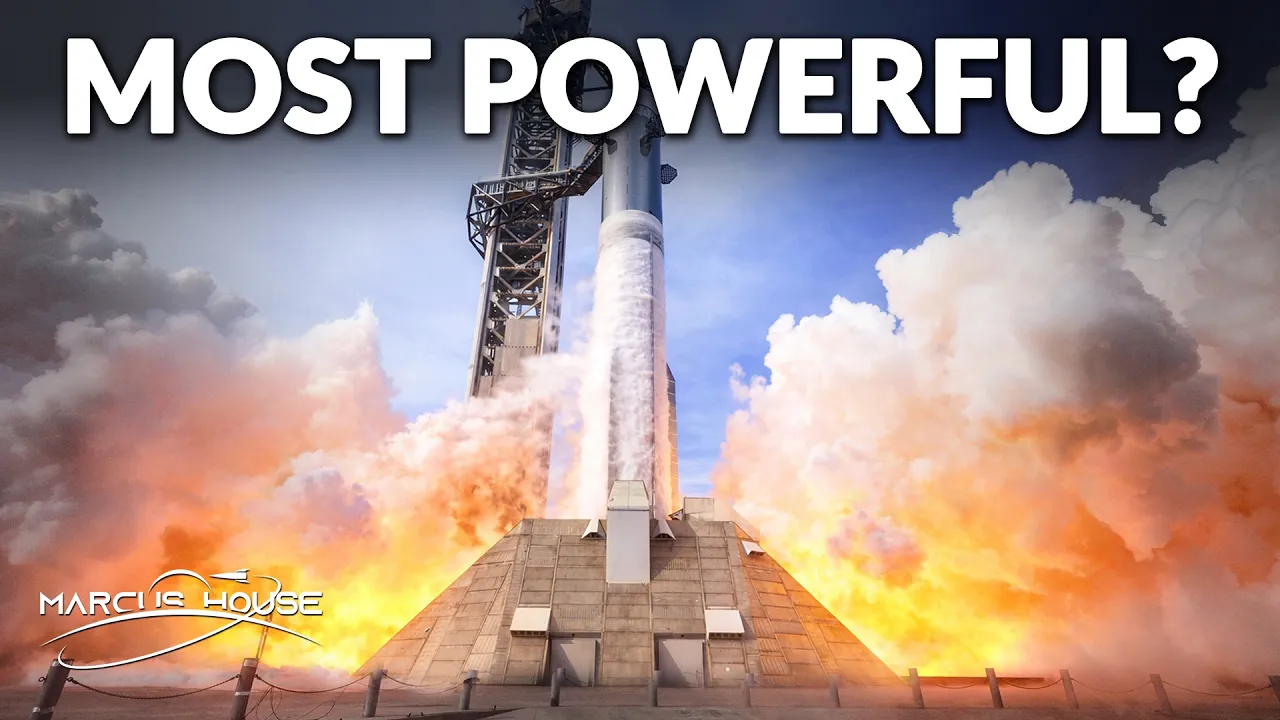
SpaceX Finally Lit Super Heavy… But Something Was Off
26:26

SpaceX Finally Lit Super Heavy… But Something Was Off

Marcus House 21.03.2026 255 328 просмотров 16 354 лайков

Machine-readable: Markdown · JSON API · Site index

Поделиться Telegram VK Бот
Транскрипт Скачать .md
Анализ с AI
Описание видео
Learn how Protolabs is accelerating aerospace innovation from prototyping to production with digital manufacturing: https://plcrm.protolabs.com/MarcusHouse This week we had the first Super Heavy static fire on Starship’s brand new Pad 2 at Starbase. Indeed SpaceX Finally Lit Super Heavy… But Something Was Off. A ground issue cut that off early but it didn't seem to matter. With 10 Raptor engines igniting in this initial test, we take a close look at the new flame trench, water deluge system, launch mount upgrades, and what this means for the full 33-engine static fire coming next. We also dive into Starship development progress, Booster 19 and 20 updates, pad construction at Starbase and the LC-39A site. Big updates on the Artemis II mission updates, but also NASA’s evolving lunar architecture and what that may mean for SLS. Then Falcon 9 and Starlink launches, Blue Origin’s New Glenn progress, Rocket Lab Electron missions, and more in this week’s spaceflight update. 👕 Like the new merch?! Pick it up here https://marcus-house.myspreadshop.com... 🎁 Marcus House Merch - https://marcus-house.myspreadshop.com/ You can support me on: Patreon -   / marcushouse   Join my Discord -   / discord   Follow/Subscribe on Twitter -   / marcushouse   The production crew: GameplayReviewUK, TiagoCruz, Mr Pleasant, Virtu, Orbitly, Shaun Gisler, Greg Scott, Niall Anderson, ChameleonCircuit Support from these incredible people and groups is massively appreciated: ❤ 📷 Shaun Gisler - https://x.com/lifeatstagezero 📷 NASASpaceFlight -    / @nasaspaceflight   📷 RGVAerialPhotography -    / @rgvaerialphotography   📷 Avid Space -    / @labpadre   📷 Greg Scott -   / gregscott_photo   📷 Starship Gazer -   / starshipgazer   ✨ Tony Bela -   / infographictony   Set models: 😍 Space Rocket Lab's Starship Models - https://www.spacerocketlab.com/marcus... 😍 Mini venting Starship/SLS - https://www.stardesk.co/ 😍 Starship, & Crew Dragon by - https://morethan3d.com/ 😍 Moon/Mars Mova Globes - https://www.movaglobes.com/ 😍 Saturn V - LEGO - https://www.lego.com/en-au/product/le... 😍 Space Shuttle - LEGO - https://www.lego.com/en-au/product/na...

Методичка по этому видео

Структурированный конспект

Освойте архитектуру современной аэрокосмической индустрии и прогнозируйте запуски SpaceX

Изучите инженерные этапы подготовки Starship и тренды космических миссий для энтузиастов и инженеров за 26 минут.

Оглавление (6 сегментов)

Segment 1 (00:00 - 05:00)

After a long wait we finally have Starship fire once again for the first time on the new Pad 2, and wow, even with just 10 engines installed, there was a lot to digest here as SpaceX prepare to go much bigger. We even have brand new intriguing information about the future of the Artemis Missions with the Space Launch System, or dare I say, lack there of!? Yea, this took us by surprise. In fact we have just so much more to dive into outside of all that. It is indeed another very dense week of action so let's do this! Hey, Hey Marcus House with you here and we of course left you last week with the excitement continuing around the first Version 3 Super Heavy to be tested on the brand new Pad 2! A week ago it had just been lifted back off the launch mount for reasons that were not clear. I don’t think we have much more clarity on that this week either. We think they just may have wanted to take a close look over everything in the aft before doing any test fire work because it was only off the pad for a short time. As we can see here thanks to NSF’s live cameras on Saturday morning, with the sun still low in the sky the clamps within the transport stand were retracted and the booster was lifted back out. Rather quickly too I might add. It didn’t require any pause above the stand before continuing which is all rather impressive considering it's only the second lift off of a transport stand using this tower and associated setup! As far as we could see from the outside nothing appeared different on the gigantic Super Heavy from its time on this transport stand. Once it was rotated over the launch mount and lowered between the ring of clamps, they were all deployed one by one and the booster was sat down. The two completely separate Quick Disconnects were engaged for the Oxygen and Methane ports, and the tower arms were released. Wasting no time the arms moved to the top of the tower and SpaceX were soon already filling it up with propellant on Pad 2 for the third time! In this occasion it was filled to the same level as the previous two tests but this time when the suspected T-0 approached and the detonation system activated there was a high pitch spin up sound accompanied by a following orange flash under the stand! This seemed to be some sort of ignitor test and it must have gone well because they detanked and came back the next day with a full load of propellant. This time though was much more epic and the water deluge fired up! Yes, we had a clear engine ignition this time. It was a rather short test but gave us all a great preview of how that plume will exit the bi-directional flame trench. This looked spectacular already, and longer duration tests with the full force of all 33 Raptor engines is going to put it through the ultimate test. Now notice that the monstrous deluge on top of the launch mount didn’t activate for this static fire, which is expected. That’s because we believe that deluge only fires off once the Raptors are lit and the booster quick disconnect hoods are closed at liftoff. After all, you really don’t want to smash everything inside the booster quick disconnect hoods with high pressure water before the Raptor engines are above the launch mount. It’s worth noting that the main purpose for the top deluge is really to protect the mount and tower, and further dampen the acoustics as the hellish exhaust is belting everything from above in those first 10 seconds or so of the flight. Anyway with all that done SpaceX had finally verified that they could get the entire testing run right through to the Raptor 3 engines firing up for the first time. It is all very different of course. If you remember the old removed Pad 1 SpaceX fed the outer 20 Raptor engines with startup gases via 20 individual quick disconnects. Now, though the two methane and oxygen quick disconnects feed all 33 engines so all that seems nicely simplified at last. SpaceX shared some of the best images yet of the pad as they confirmed that all 10 Raptor engines did start up! There was however a ground-side issue that resulted in the static fire ending early. It’s neat thought that they got right through to gather all that data on the first run and they confirmed that they would be preparing the booster for a 33-engine static fire next. Once the booster was detanked they hooked up to arms again, disconnected the Quick Disconnects and “lift off”! Well, not the exciting fiery kind, but you know what I mean. I think this process seems beautifully routine already as you can see, and it was back down on the transport stand before we knew it. Now you might have noticed that Booster 19 here during these lifts on and off the launch mount is looking a little different to what we’ve seen on the test article. Notice that almost all of those

Segment 2 (05:00 - 10:00)

metallic tiles now have a black coating? Well, underneath that they have some sort of insulation felt in what seems to be two layers. You’ve got this more rigid black top layer, followed by the more flexible layer below. Well, we’re calling them tiles but they’re certainly nothing like the tiles that we see on the Starships heat shield. These instead appear to be simple metal plates. Those two layers should handle that quick burst of booster reentry heat. Chameleon Circuit was working with us put together a few angles of this to help show that new intricate booster aft in all of its glory. As always, thanks for being subscribed here watching along so we get to put all this together for you. Real inspirational work by actual humans rather than the AI slop that’s littering social platforms! Now with Booster 19 back off the pad it was already rolling back to the production site in the early hours of Wednesday morning where it will have the rest of its 33 engines installed for the static fire. With the much more powerful Raptor 3’s this is presumably going to be the most powerful static fire in history, so we can’t wait to see that fury belting out of the flame trench very soon. With the pad now free they’ve been doing additional testing with the clamps, and for the first time ever they performed simultaneous retractions of all the holddown clamps here! [Ad Start] It’s always worth thinking about the work that would go into every custom designed element in all of this. For anyone that has gone through creating a physical product of their own, you know just how time consuming and expensive it can be. That’s why I’m stoked to have Protolabs sponsoring this video and making what we do possible. These guys are a big deal when it comes to manufacturing almost anything you can think of. In fact they serve 100% of Fortune 500 aerospace companies in a whole list of ways. Custom prototyping, right through to end-use production. 3D printing, injection molding, and sheet metal fabrication is just the start because Protolabs is the world’s fastest CNC machining manufacturer. They are all about quality at speed with delivery in just days, and it’s pretty wild looking over what they’ve been up to. They’ve launched advanced CNC machining features churning out intricate metal and plastic parts with tighter tolerances for added precision. They can tailor in a range of diverse finishes to strengthen and cosmetically improve parts, and they do it all with rapid comprehensive quality documentation provided. Here’s an example right. You can have parts like these ordered and shipped in as little as three days from their ITAR and AS9100-compliant facility. That means aerospace engineers can now scale up to production quantities as soon as they need. Yes, once the engineer knows their prototypes are tested and suitable, they can be replicated in large volumes. It’s a real game-changer for those that need fast, reliable, and complex machined parts without sacrificing quality. No other manufacturer in the world combines all these capabilities, so whether you’re working on a small batch or large-scale production, check out their all new quoting platform at Protolabs. com. You will be amazed at what they can do. Thank you Protolabs! [Ad End] Back to that hold down clamp testing, they were not done with that yet! The next day they varied it a lot with individual ones opening and closing, as you can see here with them popping in and out of view. Just to wrap all that up SpaceX did this amazing deluge test of the flame trench, firing that off for about a full minute. It just all slowly fizzled out as the pressure dropped. So heading over towards the other launch pad being upgraded, well at this point only really the launch tower, but the flame trench is heavily under construction now. The sheet pile work has been progressing super rapidly over the past few weeks, and as you can see by the placement of that crane doing that job, it just shows how vital that new launch site expansion is for all of this! In this case they couldn’t even install the bunker itself without going outside of the borders. That border by the way is rapidly disappearing as time goes on with SpaceX removing the concrete to allow for easier construction of all the new pad infrastructure. Notice this different crane close by though. That is likely going to be used to drill the holes for any additional piles. They’ve also started to accumulate even more parts for the steel skeleton of the launch pad bunker to rise here. That should make the logistics easier than having it all stored at staging lots further away! It is nice the whole area is cleared to be able to do this. A bit closer to the Highway we can see the pieces for that new tower roof top still sitting there in this image. That should end up near identical to the roof that has been worked on for the new Pad 2. Speaking of, that has been lifted up to be installed just yesterday on Friday. Up that went just after the sun rose! The whole top of this forms a complete protective barrier, so no more will that Raptor engine exhaust be belting into

Segment 3 (10:00 - 15:00)

the top of the tower. It’s just welded on top of the tower using these giant tabs, so there's a gap between the existing roof and this new addition. Now one of the other items to keep an eye on for the upcoming flight 12 testing is the B18. 3 test article. Well great news on that because it started that stacking process this week with its transfer tube and forward section rolling back into Megabay 1! If you’ve been watching over the weeks you would recall that SpaceX salvaged the top part of this test tank after its early demise in the first test. Luckily they were able to just chop that top off and reuse it, so now it is back. We assume they should now be able to use this to fully verify the Version 3 hot staging system design before SpaceX starts stacking the ship and booster for the first time at Pad 2. Ideally they want to have all the data they need before doing the first fully stacked wet dress rehearsal. You know, that crazy scenario where they just fill the entire thing with a load in excess of 5,000 tonnes of propellant! We have obviously now seen that SpaceX can successfully lift a booster on and off of the stands using the grid fins with double as the lift points, but catching stress is going to be much higher obviously, so more information is needed. That first catch by the way could potentially come as soon as flight 13 with Booster 20. After all, if all goes well with the debut flight 12 with the first Version 3 full stack, that will be the next obvious step. Well, that booster 20 has recently had both of the remaining liquid oxygen tank sections roll into megabay 1 for stacking. That was followed by its transfer tube which we could see going vertical on both live views from Avid Space and NSF! It was airborne for quite some time too, almost two days later we were still able to see it raised there inside the doorway of Megabay 1. With the door soon closed we can only assume that transfer tube has been installed at this point. Those views that we do get are not far from being restricted further though sadly. That’s because the crew has begun the installation of the cladding braces on the outer beams of the Gigabay in front. This week the cladding itself has had the installation started! Unlike what we’ve seen for all the bays here before, these appear similar to what they’re using at the Starfactory. In come these preassembled pieces and they’re just lifted onto the bay with a dedicated loadspreader. Interestingly at the Starfactory right beside they’ve also begun installing these massive frames right here on the side. Based on that it looks like they’ll start connecting the bay and the Starfactory quite soon. If so they will need a creative plan to roll vehicle sections out, given that this first door is still used a lot to move sections for stacking to the Megabay. We could see that with B18. 3’s forward section mentioned earlier. Now while we are here we’ve been watching this rather interesting development with white coloured tiles being installed onto a Ship nosecone. There has been quite a bit of speculation around all this. This time we are wondering if these are designed to be Micrometeoroid and Orbital Debris tiles. SpaceX has previously mentioned that such tiles would have a fairly similar appearance to the normal black ones, but instead would serve a purpose to protect from small debris while serving as insulation for the harsh thermal environment of space. It seems that SpaceX’s Human Landing System plan is accelerating and it would make sense to at least start doing some adhesion testing of these new tiles on the Ship exterior! Now it’s also worth quickly jumping over Florida to check on the Starship launch pad at Launch Complex 39A. Indeed, this is making some big progress too! On the tower the ship quick disconnect end has now been lifted, and a few days later the upper hood section for the liquid oxygen booster quick disconnect was installed onto the launch mount itself. The next day the liquid methane equivalent also joined the party. This is all coming along very nicely and while we are here, the Falcon pad will see some excitement finally in the not too distant future too. That’s because we have a Falcon Heavy mission coming up finally to launch Viasat 3 straight up to geostationary earth orbit! Hopefully that will be happening in April. We have a bunch of updates around the Artemis II mission coming, and also the future of the SLS. As planned, after the repairs to fix the helium leak issue and switching out batteries and what not, the Artemis II vehicle has now rolled back out to Launch Pad 39B at Kennedy Space Center. NASA is still targeting the first launch window on April the 1st, so in just a little over a week it will hopefully all be successfully away. NASA has confirmed that they are so confident in the vehicle and do not plan to conduct another

Segment 4 (15:00 - 20:00)

wet dress rehearsal which came as a surprise to many. They will instead proceed directly toward launch, so the crew has re-entered quarantine as we count down once more. I think in more surprising news though, a Bloomberg article dropped on Thursday covering this news that NASA is proposing a new plan for lunar missions. In this proposal SLS would no longer be used to send Orion into a lunar orbit. In this plan SpaceX’s Starship and Orion would dock together in Earth orbit, and Starship would boost it into the moon’s instead before that then takes the crew to the surface. Jared is going to be apparently catching up with the companies involved early next week to check on progress and presumably talk through this new plan. It is worth stressing that this is nothing concrete at the moment. It was also stated that “NASA is committed to using the SLS architecture through at least Artemis V”. I guess the obvious question with this potential plan is which vehicle would launch Orion and the crew from Earth. Given we’ve spotted a Centaur stage here in the infographic that NASA teased us with a few weeks ago one would assume Vulcan or perhaps New Glenn, but that is pure speculation and it depends what needs to go with Orion for the return. In this plan with Starship doing much of the work Orion would really only need the ability to return from lunar orbit, so who knows. Everything seems very much up in the air at this point, so I’ll be keeping you updated with any clarity that we are to receive, hopefully very soon. As always we have another neat string of Starlink missions this week but SpaceX has also crossed a neat milestone here. Starlink Group 10-48 was away just a few hours after I published last Saturday's video with Booster 1095 launching for its 6th time from Space Launch Complex 40. 29 Starlinks on board which is the typical number for the Florida launches that we tend to see, and it was the drone ship Just Read the Instructions assisting with that catch there in the early morning. We were totally missing the on board camera for the Falcon 9 booster for some reason, but the drone ship camera gave us that landing footage with a somewhat choppy signal. Group 17-24 was the next away on Monday evening with a stack of 25 from Vandenberg Space Force Base. It was booster 1088 there landing on Of Course I Still Love you for its 14th time. Now if we rewind and watch this closely again, you can see that this was an unfortunate path for this bird to take to escape the rapidly incoming inferno. It made it past the center of the deck before being whipped about by that exhaust and hurled out of the frame. Ouch! Anyway, after this mission, thanks to all the tracking data from Jonathan McDowell, we know that Starlink has now passed that massive 10,000 satellites in orbit mark. 10,020 to be specific. Crazy to think that we went from those demonstration TinTin satellites 8 years ago in February of 2018, and Starlink now by far the biggest orbital megaconstellation. Well, things are continuing to ramp up. These beautiful scenes were from Florida, just hours later with Booster 1090 firing up those 9 Merlin engines with Group 10-46 taking up the next stack of 29. That’s landing number 11 for this one on A Shortfall of Gravitas. Next was Group 10-33 Thursday morning with Booster 1077 on its 27th mission from Cape Canaveral. Just read the Instructions was already back out here again waiting as the second stage continued on taking that next set of 29 satellites to orbit. Always nice watching those landings in daylight. That left the last for the week just yesterday with the launch approaching 3pm, so another nice sunlit flight. It was Group 17-15 from Vandenberg, with the infant booster 1100 on flight number 4. Just taking the first baby steps there as it touched down on Of course I still Love you which has also been out twice for the week. So if you’ve been counting, that was five Starlink missions in just that week so an incredibly busy one again. Now we had this post by Blue Origin mid week showing us a view of their engine shop at Rocket Park. This is the next full set of BE-4 engines for the third New Glenn booster. It is a low resolution image sadly but we can clearly count all 7 of those engines there. Remember that their second New Glenn booster is being reused after that first landing so that already still has a full set of engines. It is the second stages that we really want to see being churned out fast, and well, we have updates on that too. Blue Origin aren’t really going to need many first stages if they have success reusing them over and over right from the start. What we are looking at here is Blue Origins second stage production line which I think is a great sign that they will be soon launching a lot more. These are all having those final touches added, and already it is getting a little crowded in there, but that's exactly the point

Segment 5 (20:00 - 25:00)

says CEO Dave Limp. Indeed that manufacturing rate matters and it has also been nice to see the fifth second stage with the two BE-3U engines attached being hot fired last week. With this they ramp the engines right up to 175,000 pounds of thrust which is close to 80 metric tonnes of force for each of those two engines. With both together, that is 350,000 pounds of force, and that is a lot because you may recall this post from November last year. That stated that Blue Origin wanted to increase the total thrust of the two BE-3Us from 320,000 pounds of force right up to 400,000, so 350,000 is already a chunky increase toward this plan. This is all done at Launch Complex 36 of course and these drone views show all this off quite nicely. Now this testing spot there almost seems overkill for this doesn't it? Well it is, and that is because it uses the same system including this water deluge for the first stages as well. It’s all very photogenic I will say, and it’s awesome that Blue Origin is sharing all this stuff. All we can say as enthusiasts of all things space flight is thank you, and give us more at higher frequency if you please! On Wednesday Jessica Meir & Christopher Williams performed the first Spacewalk of 2026. This one was focused on the next leg of the installation of the iROSAs which of course are the international space stations' new sets of rollout solar arrays. That last spacewalk of this type was all the way back in May of last year and this walk was of course originally scheduled to be done by Zena Cardman and Mike Fincke back in January, however that was canceled due to Mike’s medical situation and the subsequent medical evacuation. It’s a bummer Zena Cardman didn’t get a chance to do that walk, but perhaps she’ll have a chance in the future. Anyway, with this being Chris’ first spacewalk and Jessica’s 4th, naturally Jessica took the lead position or EV1. That position always bears the red stripes on the suit so you can tell who is who while they are suited up. This EVA mostly focused on installing part of the 2A power augmentation modification kit truss structure. Yes, that is a mouthful, and also needed before the roll out solar arrays are able to be mounted. Along with that they adding some insulation and cabling, plus some more general maintenance like battery bolt de-torquing. It is worth mentioning that 6 out of 8 sets of iROSA arrays are already installed at this point, so the procedures seen for most of this spacewalk are similar to the majority of EVAs over the past few years. The work was broken up intermittently by orbital sunrises and sunsets and the occasional glimpse of our beautiful blue home down below. Nothing like a little perspective with the challenging times we have going on down here. The spacewalk lasted 7 hours 2 minutes, and was the 278th EVA for the station assembly, maintenance and upgrades. The spacewalk for the following step of the iROSA installation is planned for early April so hopefully not long of a wait until the next one. We also don’t want to forget Rocket Lab this week either because they’ve announced that they’ve been allocated 20 more HASTE missions which use Electron for suborbital hypersonic testing. This new contract is worth 190 million dollars so they’ve now got around 70 missions in the list waiting for their turn in the queue. In fact they ended the week with another Electron lifting off from Launch Complex 1 in New Zealand. This was the 8th Synspective Electron mission named "Eight Days A Week" to add another satellite to that StriX constellation. Now I absolutely must mention that on Monday, March 16 it was exactly 100 years ago that, in a snow-covered Massachusetts field, a couple of “visitors” carried a few peculiar objects into a field, put them together, and set it on fire. It was Robert Goddard and his colleagues testing the first ever liquid-fueled rocket named Nell. It was an experimental modest machine. Lightweight, and fragile, it flew just two and a half seconds rising to an altitude height of a whopping 41 feet! About 12. 5 metres and travelled 184 feet or 56 metres before landing in the snow. It may not seem like much now, but it was revolutionary. That brief flight demonstrated for the first time that liquid propellants could be used to generate controlled thrust. What came from this laid the foundation for every major liquid rocket system that followed. Goddard was initially criticized for his ideas in the years that followed, but continued his work with very little public attention. He improved on his designs and went on to create other technologies for space travel, including pumps for rocket fuels, and engines that could pivot for better control. Today, his work is recognized as the starting point of modern rocketry. All of our favourite rockets that launch now, whether it be lifting

Segment 6 (25:00 - 26:00)

satellites of megaconstellations, resupplying space stations, or preparing for missions beyond the Moon, we rely on the very same core principles that Goddard demonstrated in 1926. It might make you wonder why we still use so many solid rockets when liquid propulsion has so much better control and throttle ability. Well, basically they are cheaper for disposable vehicles in some cases but when you are talking about anything reusable, they really don’t hold up at all. Robert Goddard and those working with him were right 100 years ago, and now, we see these crazy displays breaking into what seems to be an absurd science fiction morphed into reality. There is no better example of us standing on the shoulders of giants! A great way to end the week with that note I think, and I hope you enjoyed this video! If you did, don’t forget to hit subscribe so we can keep competing against all that AI slop making its way into your feed. Thanks as well to all the amazing supporters right here helping to ensure that content made by humans for humans stays a reality! If you have a little more time, help us out by checking out this video here next! Thanks for watching all this way through as always! I’ll catch you next weekend!

Другие видео автора — Marcus House

Ctrl+V

Экстракт Знаний в Telegram

Экстракты и дистилляты из лучших YouTube-каналов — сразу после публикации.

Подписаться

Дайджест Экстрактов

Лучшие методички за неделю — каждый понедельник