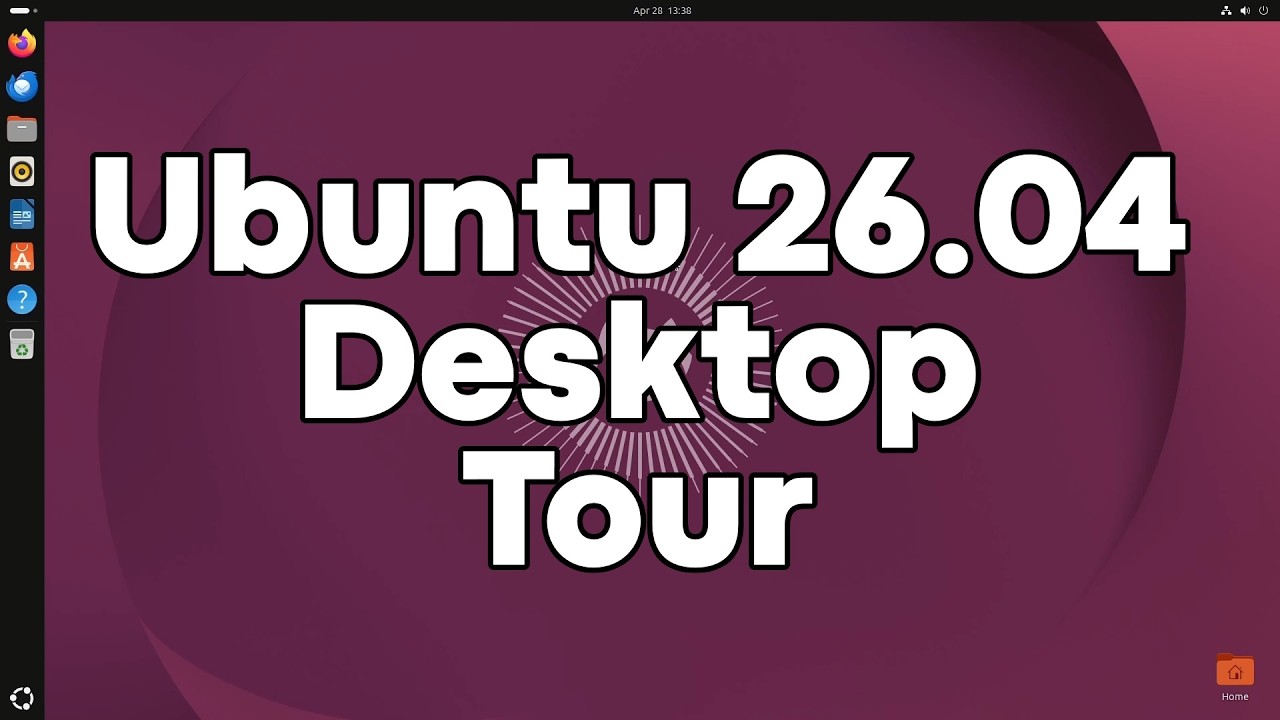
Get ready for the next era of the Linux desktop with Ubuntu 26.04 LTS "Resolute Raccoon"! In this video, I'll diving into all the big changes, including the jump to GNOME 50 and the bold move to drop X11 for a fully Wayland-powered experience. Plus I will talk about the Linux 7.0 kernel and the LTS nature of Ubuntu 26.04.
---
⭐ Please support my channel on Patreon!
Get early access to videos, members-only content, behind-the-scenes updates, and join the Gary Explains Discord! Join here 👉 https://www.patreon.com/GaryExplains 🙌
Twitter: https://twitter.com/garyexplains
Instagram: https://www.instagram.com/garyexplains/
#garyexplains
Оглавление (2 сегментов)
Segment 1 (00:00 - 05:00)
Every 2 years something special happens. When all the testing has been done, when the right date comes around, when the weather is fair, we get a new version of Ubuntu. And not only a new version, a long-term support version. And that's what we have now. It's April 2026, so we have Ubuntu 26. 04 long-term support. And that's what I'm going to talk about today. So, if you want to find out more, please let me explain. Okay, so let's get into this Ubuntu 26. 04. And just in case, just in case you haven't spotted it, 26 is because we're in 2026. 04 is because it's April. And generally Ubuntu release two major versions a year. The year number, so 26. 04 and 26. 10, so October. But every 2 years the April release becomes a long-term support release. That gets supported for 5 years. So, this one will be supported until April 2031. In fact, it will be supported beyond that. We'll talk more about that in a second. Now, every Ubuntu release has a code name. This one is called Resolute Racoon. So, just going back to the lifespan, it's got this LTS long-term support status. So, that is one that happens every 2 years, like I said. So, the last one was 24. 04, and now we've got 26. 04. And the standard support is 5 years up to 2031, including fixes and critical bug fixes. However, if you sign up to Ubuntu Pro, you get access to the expanded security maintenance, which actually gives you support for 10 years. Now, some levels of the Ubuntu Pro are actually free. All you got to do is actually create an account and sign up. Okay, so what about the requirements? Well, there's been a bit of noise on the internet about this because now you need 6 GB of RAM. And people have been saying things like even Windows 11 can run in 4 GB of RAM. And 25 GB of storage, a dual core processor. Now, Ubuntu are pointing out that if you want a machine that runs with less than 6 GB of RAM, then you can use Xubuntu or Lubuntu, which are both official flavors of Ubuntu with lightweight desktops on them. And in those ones you only need 2 GB of RAM. So, it's not really it's a non-issue. I don't know why people make fuss about these things. And then there is also at the same time Ubuntu Server, because it doesn't come with a desktop, aimed at server configurations. That has different requirements. It actually starts as low as 1. 5 GB of RAM and just 4 GB of storage. So, what's new? So, there's been lots of software updates, of course. Firefox is at the latest version, LibreOffice which means it's been moved up to the 3. 0 range. You've got the new GNOME 50 desktop. Some apps have been swapped around, so there's a new document viewer and an image viewer, which are called Papers and Loop, which are Rust-based rather than the previous applications that we use. So, basically a refresh of the standard apps and some new apps along the way. There's also a new terminal emulator. So, instead of using the standard GNOME terminal, there's a new terminal emulator. And Wayland is now the default. Some people are again making noise about this. So, GNOME Shell drops support for X. Wayland is the only way forward, and it does come with full Nvidia support. Now, other changes, there's power profiles manager, which is improved for newer hardware, especially for AMD, and it's now battery aware and has auto-optimized levels. Gaming performance, there's a new NT Sync driver, which emulates the Win NT, that means the Windows primitives, boosting games performance under things like Wine and Proton. And on the ARM side, ARM64 desktop official generic ISOs for virtual machines, Snapdragon Windows on ARM devices, and initial support for the Snapdragon X Elite platform, they've all been added to Ubuntu 26. 04. Now, I mentioned there that some of the new tools were in Rust. So, now also other things are in Rust. So, sudo, so super user do, has now actually got been rewritten in Rust. So, the Rust implementation of the sudo command configured as the default, although you can change it and switch back to the old one. The additional sudo package remains installed as a fallback. And also the core utils, Rust-based core utils. So, ls, cp, move, all those kind of commands that you're used to using have now replaced the GNU core utils by default again. So, you've got these Rust versions of them. And the core utils does remain available
Segment 2 (05:00 - 07:00)
for users between them if you want to using the alternatives command. And of course, a very big thing is we're now on Linux kernel version 7. So, Ubuntu 26. 04 ships with kernel version 7. That number looks impressive, seven, yeah. But it actually reflects a naming tradition rather than an architectural decision. After releasing 6. 19 in February of 2026, Linus Torvalds announced that the next version would be seven instead of 6. 20. And actually that's how we did it with version five to version six and so on. So, it's actually just a kind of a tradition that he has. However, it's still a much newer kernel than what we got in 24. 04. So, what have been the changes? Well, so there's been some deep changes in the kernel to do with real-time. That's the preempt configuration there. XFS now has self-healing, and BcacheFS has been removed from the kernel. And there's a whole backstory to that if you want to go and look it up. From a hardware point of view, we've got hardware support for Panther Lake and Nova Lake, Zen 5 and Zen 6. And on the ARM64 side, there's now support for this atomic instructions LS64. They made their way into kernel 7. So, basically hardware improvements across the board, Intel, AMD, ARM, across the board. And also, there's the end of support for the Intel 486. So, the 386 of course was eliminated previously. Now, the 486 is out. And at the same time, Rust has been promoted to a top-level kernel language. So, not only is it C, it's now also Rust. Okay, so there you have it, Ubuntu 26. 04. Now, I'm planning on doing a video which is a full desktop tour of Ubuntu 26. 04 for people who aren't familiar with the desktop, especially those maybe coming from Windows or from Mac OS. Now, if you want to catch that video, do make sure you subscribe to the channel. Okay, that's it. I'll see you in the next one. —