Kevin O'Leary’s Biggest Scam Yet
16:56

Kevin O'Leary’s Biggest Scam Yet

Wall Street Millennial 03.05.2026 61 694 просмотров 2 690 лайков

Machine-readable: Markdown · JSON API · Site index

Поделиться Telegram VK Бот
Транскрипт Скачать .md
Анализ с AI
Описание видео
Check out our second channel Broken Business Models: https://www.youtube.com/@UCQUOscigSQWCVG8m-ZC8wiw In this video we analyze Kevin O'Leary's proposed data center projects in Alberta and Utah. Follow us on Twitter / X: https://x.com/wallstreetmil For inquires related to Differentiated Analytics email us at: founder@differentiatedanalytics.com Check out our second channel Broken Business Models where we discuss unusual or otherwise suspect businesses that may be unviable: / @brokenbusinessmodels For business inquires: Mary@creatormanager.co For other inquiries: Wallstreetmillennial@gmail.com All materials in these videos are used for educational purposes and fall within the guidelines of fair use. No copyright infringement intended. If you are or represent the copyright owner of materials used in this video and have a problem with the use of said material, please send me an email, wallstreetmillennial.com, and we can sort it out. –––––––––––––––––––––––––––––– Buddha by Kontekst / kontekstmusic Creative Commons — Attribution-ShareAlike 3.0 Unported — CC BY-SA 3.0 Free Download / Stream: http://bit.ly/2Pe7mBN Music promoted by Audio Library • Buddha – Kontekst (No Copyright Music) –––––––––––––––––––––––––––––– #wallstreetmillennial 0:00 - 1:14 Intro 1:15 - 2:39 Who Is Kevin O’Leary? 2:40 - 5:04 Crypto 5:05 - 6:57 Oil Refinery 6:58 - 9:48 Alberta Data Center 9:49 Utah Data Center

Оглавление (6 сегментов)

1:14 Intro

— In February of 2026, Kevin O'Leary announced that he's going to build the world's largest AI data center in Utah, a 7. 5 gigawatt campus that he claims is essential for the United States to catch up with China in the global AI race. O'Leary has spent the past few months promoting the project across cable news as an urgent matter of national security. But Kevin O'Leary is not a data center developer or a serious businessman of any kind. He is first and foremost an actor. Since 2009, he has starred as Mr. Wonderful on the reality television show Shark Tank. Earlier this year, he also starred in the Hollywood feature film Marty Supreme. In between filming, he has parlayed his television fame into a side career as a financial media pundit, going on cable news to talk up whatever happens to be the hot topic of the moment. Over the past several years, O'Leary has used that platform to promote a long string of failed business ventures and grand announcements that never materialize. His proposed Utah is by far the most ambitious yet. In this video, we'll look at O'Leary's history of vaporware promotions, examine his plans for the Utah data center, and explain why it is probably not going to happen. Kevin O'Leary is a Canadian-American

2:39 Who Is Kevin O’Leary?

businessman who created a software company in the 1980s that eventually acquired The Learning Company in the 1990s. The Learning Company developed and sold educational video games for kids. In 1999, at the peak of the dot-com bubble, The Learning Company agreed to be acquired by the toy giant Mattel for $3. 5 billion. Mattel's acquisition of The Learning Company has gone down in the history books as one of the most disastrous acquisitions ever. It turned out that The Learning Company had been cooking its books, and it was far less profitable than Mattel believed. Mattel shut down The Learning Company in 2000, just 1 year after acquiring it. In 2002, Mattel had to pay a $122 million settlement for misleading shareholders about the acquisition. In short, O'Leary enriched himself by selling a company that was at best a failure and probably a fraud. O'Leary parlayed his business career into a successful television career. Since 2009, he's been an actor on the reality television show Shark Tank. He eventually started referring to himself as Mr. Wonderful. Over the past few years, O'Leary has attempted to leverage his large media profile to launch various business ventures. In the next section of this video, we'll take a look at O'Leary's most notable business ventures. We will start to see a pattern emerge. He is quick to hop onto the bandwagon of whatever topic is trending in the financial media, but due to his lack of expertise, his ventures almost always end in failure or are vaporware.

5:04 Crypto

Our first case study will be related to crypto. As late as 2019, Kevin O'Leary was a crypto skeptic, calling Bitcoin and other cryptocurrencies scams. Let's have a listen. And demand increases. Mr. Wonderful thinks it's worthless. Well, I actually — it garbage this morning. I want to explore the I I did say that. idea that there is nothing here except raw speculation. No different than when I go to Las Vegas and put my money on black or red on a roulette wheel, because where is the intrinsic value inherent in deploying real capital? Let's talk real money here, and putting it into Bitcoin as a storage of value. I get gold for 2,000 years, including the Romans, they saw value in in owning that as an asset class. Tell me why this, which is basically a digital um game, Mhm. is where I look at it, has any intrinsic value? When people actually put real money into this, they make no interest, they can't pay their taxes with it. The regulators don't like it, which is always a problem for compliance. And where's the long-term value? Just this idea that they're going to cut the number of units in half since it's such a scam. Like that's just totally BS. Just 2 years later, in 2021, he did a complete 180. He became one of the biggest promoters of crypto in the financial media. So why the change of heart? In 2021, crypto was in a bull market, and O'Leary saw a money-making opportunity. He disgraced himself by accepting $15 million to be a paid promoter of FTX, a crypto exchange which was exposed as a near total fraud just 1 year later. In 2021, Kevin O'Leary invested in and became a spokesman for a tiny Canadian crypto company called DeFi Ventures. Upon O'Leary's involvement, the company changed its name to WonderFi, an homage to O'Leary's Mr. Wonderful persona on Shark Tank. WonderFi traded on the Toronto Stock Exchange. O'Leary helped promote WonderFi's stock to retail investors, pumping the share price to a high of $2. 50. WonderFi was a complete failure of a company, with its share price declining 90% from peak to trough. In May of 2025, WonderFi agreed to be acquired by Robinhood for an acquisition price of just 36 cents per share. It's now been almost 1 year, and the Robinhood acquisition still has not closed. I'm not sure exactly what's going on with the acquisition, but even if the deal closes, the paltry acquisition price means that the vast majority of WonderFi's retail shareholders will suffer huge losses.

6:57 Oil Refinery

If you remember back in 2022 and 2023, oil and gasoline prices were very high. This was due to a variety of factors, including sanctions on Russian oil exports and production cuts by OPEC. At this time, there was a lot of talk about how the US needs to become energy independent. This provided the next bandwagon for Kevin O'Leary to hop onto. In April 2023, O'Leary went on Fox News and made the following announcement. Unfortunately, no matter how much you think we're getting off hydrocarbons, it's not going to happen for 50 years. I'm sorry, that's just the way it is. You're not going to have a wind aircraft take you across the ocean. That's not going to work. But at the end of the day, we can make our own energy here very clean. We haven't built a refinery in America in decades, cuz we can't permit it. You know, I don't think I wasn't going to I wasn't planning on saying this, but I'm at that stage in my life where I want to do something big. And the task that I've decided I'm going to take on is I'm going to build a refinery in America. — Oh, wow. I'm going to do it. I'm going to syndicate the 14 — I mean, I don't know why I broke it here, but Well, thanks for doing that. It's going to cost about $14 billion. I'm going to syndicate that debt and that equity. I'm going to find a state that wants to work with me. I'm going to get a permit, and we're going to do the right thing for America. We have to have more refineries. Well, that's the key. O'Leary said he's going to build an oil refinery in America for $14 billion. O'Leary doesn't have $14 billion. He said he would syndicate debt and equity financing. That means he would find a large consortium of investors. This was never a serious proposal. Nobody's going to give $14 billion to Kevin O'Leary, a man best known as a television actor and want-to-be crypto bro. It goes without saying that this refinery was never built. O'Leary doesn't talk about it anymore.

9:48 Alberta Data Center

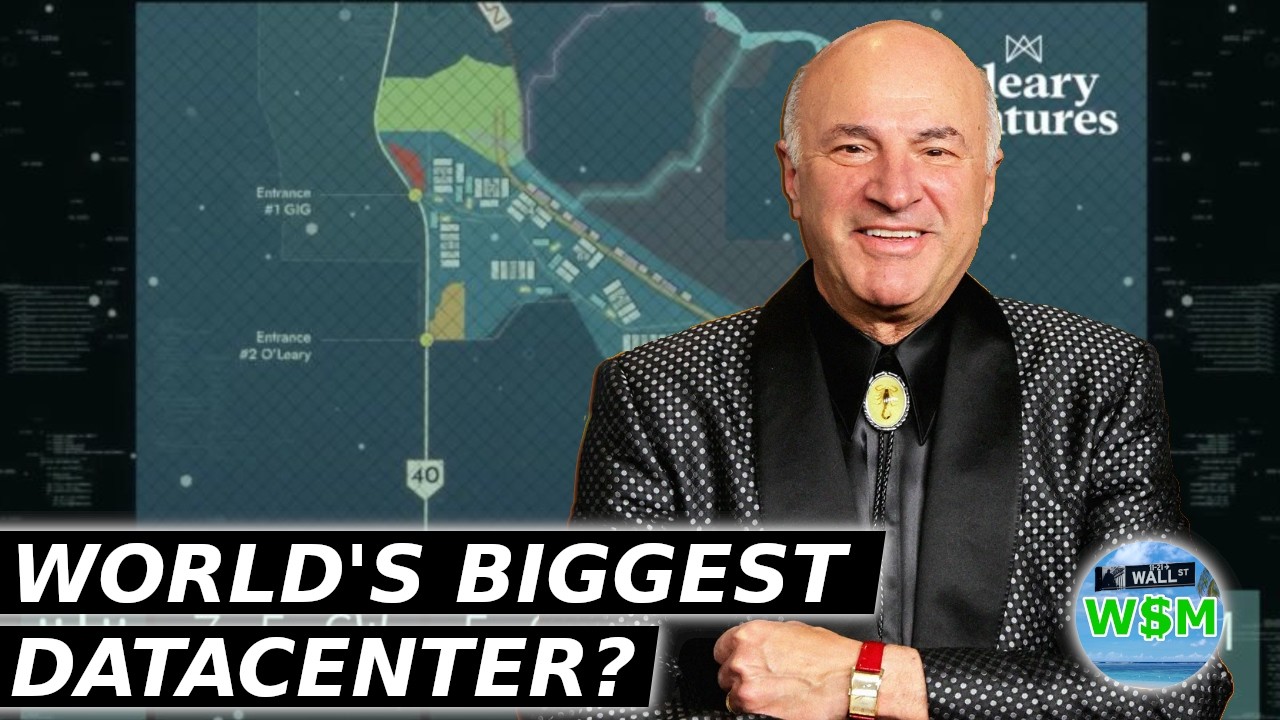
anymore. And now, let's move on to O'Leary's latest vaporware proposal. He now says he wants to raise tens of billions of dollars to build AI data centers. In December of 2024, O'Leary published a press release where he said he would build the world's largest AI data center campus in Alberta, Canada. He will call it Wonder Valley. The Wonder Valley data center campus will eventually generate 7 and 1/2 gigawatts of electricity and cost $70 billion. The first phase of the project will cost $2 billion for 1. 4 gigawatts. That $2 billion is presumably the cost of building natural gas power plants to generate 1. 4 gigawatts of electricity, not the cost of the GPUs and other computing hardware. In conjunction with the announcement of the project, O'Leary published a bizarre AI-generated promotional video on his YouTube channel. I guess it's supposed to show the AI data center campus in the middle of the Alberta forest, but the buildings look more like office buildings than data centers, and for some reason, there are plants growing inside the server room. So is this data center actually going to be built, or will it just be vaporware like the oil refinery? In March of 2025, O'Leary published a short on his YouTube channel where he addressed the skeptics. I just announced the world's largest data center, 7 and 1/2 gigawatts. That's a project. Everybody told me that was insane. It's a $70 billion ever proposed in North America. And I said, "What do you mean? Why can't I do it? Like what Tell me what specific thing is going to stop me from doing it? " And they said, "Well, one of a hundred things, cuz nobody's ever done it. " I said, "That's not a reason. That makes no sense. That's a reason to do it. " Like "You can't raise 70 billion. " I said, "Sure I can. Why can't I? " I paid for the whole thing myself so far, but I went around the world with it last week, and we have all kinds of interest. So it's going to take 6 years to build. So and I have to raise my first two $2 billion by the end of next quarter. I'll do it. I just You have to say I can do it. Supposedly, Kevin O'Leary's been talking to prospective investors all around the world, and there's all kinds of interest to invest in this project. By the end of the next quarter, which would be June of 2025, he has to raise $2 billion to get the project off the ground. He was confident that he could raise this $2 billion. Fast forward to December of 2025, a news outlet called Geothermal Canada spoke to Kyle Reeling, a government official in the municipality where O'Leary plans to build the Alberta data center. Reeling said that as of December, O'Leary had not purchased any land from the municipality. And as far as he knows, they've not applied for the necessary permits. Also, there are indigenous tribes that live in this area. If you want to build a large construction project, you need to have a consultation with the indigenous communities. O'Leary has not begun that process either. So a year after the Alberta data center was announced, O'Leary has done nothing. Today, I have seen no evidence that O'Leary has raised any money for the Alberta data center, let alone $2 billion. Even as the Alberta data center is

Utah Data Center

looking more and more like vaporware, O'Leary decides to announce yet another world's biggest data center project. In February of 2026, he published a press release saying they intend to build a 7. 5 GW data center in Utah. To be clear, 7. 5 GW is just a big number that Kevin O'Leary made up, so we shouldn't take it too seriously. But, it's worth stepping back to understand just how big this is. The entire state of Utah consumes on average 4 GW of electricity. O'Leary wants to build natural gas power plants that will more than double Utah's electricity generation just to supply his data centers. In April of 2026, O'Leary went on Fox News to talk about the project. Kevin O'Leary here. He's helping build a large-scale data center in Utah, which are expected to generate massive energy capacity and joins us now. Kevin, what happened on Friday to your project? We got the MIDA designation, very important. The challenge we have against the Chinese is they're building 10x the power we are. They build a gig, another gig. We've been stalled out. We've had permitting problems across the country. Utah stepped up and said, "Look, we can compete. Not only do we have the land, 40,000 acres, we've got a pipeline running through the land, and we have this designation that can accelerate permitting. " It's really about how do we catch up with the Chinese are doing because this is 40,000 acres designated for massive project. We're going to start with around three gigs, which is a ton, and obviously the hyperscalers and I would argue the government itself, the Pentagon, maybe the Department of War. This is going to be a very secure site. — So, we know this. When you talk about estimated tech company investment capital spending for the US, we have 50 527 billion dollars. China has 70 billion dollars. So, right now, we seem to have more of the investment. They don't worry about red tape in China. They are the red tape. — Well, and they don't even they never lay it down. That's our problem. The big guy in China, the supreme leader says, "Put a data center there. " We can't let them beat us in AI because the future conflicts of the world of the world, even the one you're seeing right now, is really compute driven. All these drones attacking everywhere. The problem with Kevin O'Leary is that almost everything he says is false or at least highly misleading. He tries to frame his proposed Utah data center as a national security priority. He says it is imperative that the US catch up to China in terms of AI data center development. Because China doesn't have red tape, they're building GW after GW of data centers. He heavily implies that China is building AI data centers faster than the US, and his Utah data center is needed to catch up. O'Leary provides zero evidence of this narrative, but it sounds plausible. China is a big country. Maybe they are building AI data centers faster than the US. The problem is it's not true. As the Fox host points out, according to Goldman Sachs, the US is expected to spend 500 billion dollars on AI data centers in 2026 compared to just 70 billion dollars in China. O'Leary suggests that they could sell the data center capacity to the US military. This is an absurd idea. The military indeed uses AI tools, but they purchase AI from private companies such as OpenAI and Google. The military does not build or run its own proprietary large language models. They certainly don't need a 7. Finally, he talks about receiving MIDA designation, which he says will really speed up permitting. So, what is this MIDA designation? MIDA is the Military Installation Development Authority. MIDA's name might lead you to believe that the organization is part of or at least associated with the US military, but it's not. It has no connection to the US military or the federal government. MIDA is a state-level economic development authority created by the Utah legislature in 2007 with the power to grant tax breaks to private developers. Its original purpose was to fund infrastructure improvements around Utah's Hill Air Force Base to keep the base attractive to the Pentagon and prevent it from being closed in future federal base closure rounds. Over time, however, MIDA's remit has expanded well beyond that original mission, and it now hands out tax breaks for all kinds of projects pitched as economic development. In April, MIDA gave a tax break to O'Leary's proposed data center project. Utah levies an energy use tax of 6%. MIDA agreed to decrease the tax rate to 0. 5% for the project. If and when the data center starts generating electricity, it will pay a reduced tax rate to the state. Neither MIDA nor any other government entity is providing any upfront funding for the project. And just like with the Alberta data center, I have seen zero evidence that O'Leary has raised any money to date. O'Leary created a company called O'Leary Digital, which is in charge of both the Alberta and Utah data centers. The February 2026 press release contains the following language. O'Leary Digital has capitalized both Wonder Valley Utah and Wonder Valley Alberta to advance each project through permitting and towards shovel ready execution. The company has retained a blue-chip roster of leading global investment banks to serve as capital markets advisors in structuring and securing project level equity and debt financing for both developments. Let's translate this corporate jargon into plain English. It says O'Leary Digital has capitalized both projects. I believe that this is referring to O'Leary's own personal money. Remember, O'Leary previously said that he was using his own money to fund the Alberta data center as he awaits external funding. O'Leary doesn't have enough money to actually begin construction on either project. He just set up the corporate structure and hired some advisors. The company has retained some unnamed investment banks to help structure financing for both the Utah and Alberta data centers. The investment banks have no intention of investing their own money into the data centers. O'Leary has hired them as brokers to help him find potential investors. Anybody can hire an investment bank. That does not guarantee that the investment bank will be able to find any willing investors. The press release conspicuously fails to mention any investor having committed any money into either project. Remember, in the Fox News interview, O'Leary brags about the MIDA designation, which he says can accelerate the permitting process. This is true. The state of Utah is fully supporting the project, but you will also need to get approval from the county. The proposed data center will be located in Box Elder County, Utah. In late April, the county council was going to hold a vote on whether or not to approve the project, but the vote had to be delayed due to large numbers of local residents who came to protest. The protesters are mostly concerned about the data center's water usage. Utah is a desert. Water is already scarce. The Great Salt Lake in Utah has been slowly evaporating over the past few decades as the state already doesn't have enough water for its existing needs. This is an odd place to build the world's biggest data center campus, which will consume millions of gallons of water. While the concern from the local residents is understandable, I think it is not justified. Just like the oil refinery and the Alberta data center, this Utah data center is vaporware, which will never be built. All right, guys. That wraps it up for this video. What do you think about Kevin O'Leary's data center ambitions? Let us know in the comments section below. As always, thank you so much for watching, and we'll see you in the next one. Wall Street Millennial, signing out.
Другие видео автора — Wall Street Millennial

Ctrl+V

Экстракт Знаний в Telegram

Экстракты и дистилляты из лучших YouTube-каналов — сразу после публикации.

Подписаться

Дайджест Экстрактов

Лучшие методички за неделю — каждый понедельник