Sign up free to my email group and get my FREE stocks and shares ISA Spreadsheet:
https://tobynewbatt.com/best-stocks-shares-isa-spreadsheet
*The Investing Apps I Use*
💸 - Trading 212
https://www.trading212.com/join/TOBY
To get free fractional shares worth up to 100 EUR/GBP, you can open an account with Trading 212 through this link .
*Terms Apply. Capital at risk. Affiliate Link.*
💸 - Lightyear
http://lightyear.com/tobynewbatt
Use TOBY to get between £10 and £100 in a fractional share or ETF in your General Investment Account. See full T&Cs at lightyear.com/tobynewbatt. Capital at risk. Promotional terms apply.
💸 - Freetrade
https://bit.ly/Freetrade-Toby
Get a free share worth between £10-£100 for signing up and depositing at least £50. Terms Apply. Capital At Risk.
*//My Favourite Bank Account for Personal and Business*
💸 - Join Monzo and get up to £50 free
https://join.monzo.com/c/th4zbyy
*//Want to speak with me 1:1?*
Email me here with your needs and we can book a 1hr 1:1 call.
toby@tobynewbatt.com
Disclaimer: This information is not investment advice. Do your own research. When investing, your capital is at risk and you may get back less than invested. Past performance doesn’t guarantee future results.
Disclaimer: Some links are sponsored affiliate links and I will receive a small commission if you use them at no additional cost to you. Thank you.
Оглавление (3 сегментов)
Segment 1 (00:00 - 05:00)
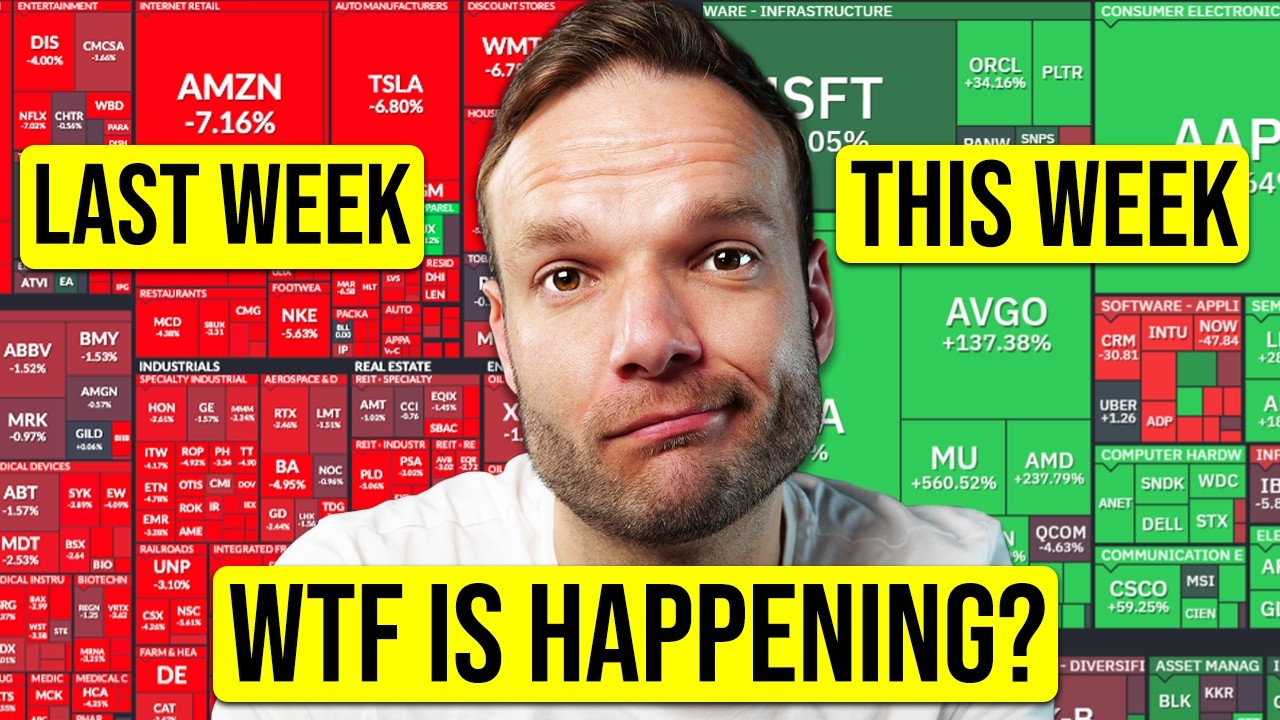
Over the past few weeks, we've seen something quite incredible. Stock markets fell sharply, causing many investors to panic. Oil prices shot up, scaring drivers at petrol stations. And inflation fears are back just to top it all off. Yet, just a few days later, stock markets are setting new all-time highs. And apparently, the bull market is back on. So, what just happened to the stock market? Should we all be panicking? And what are we meant to do about it? It should be no surprise to anyone that the biggest news story behind all of this is the war in Iran. Since the conflict began, a lot has changed and there's been a huge amount of speculation about the outcome. Whether this lasts for a few weeks or goes on for a lot more months has been the biggest question hanging over investors heads. If it ends quickly, things go back to some kind of normality. If it goes on for a long time, there are serious issues that could have a big knock-on effects in the markets. Since the first strikes back in February of this year, the markets reacted immediately to the news. Stock markets initially dropped with a sense of fear and uncertainty about what another Middle Eastern conflict would cause. The biggest mover though was the price of oil with barrels moving sharply up in price during the first few days of the conflict. Prices rose by more than 10% in the first few days of the conflict, but had also been rising slightly in anticipation of the war actually beginning. Iran is one of the largest producers of oil, but aside from that, the roots in the region also supply other commodities like liquid natural gas. Around 20% of the world's LNG supply goes through the region, specifically the straight of Hormuz, which borders Iran. This fuel is used heavily in heating and cooking and is something that the UK uses, importing a lot via pipelines from Norway. Now, initially, the White House said that this war would be over very quickly. They claimed that there would be a complete regime change and Iran would also lose all of its nuclear capabilities, something that was said to have happened last year. However, what came next had a big impact on stock markets as the straight of Hormuz was effectively closed. This caused the price of oil to rise dramatically and all around the world those effects were felt. Gas prices at fuel stations went noticeably higher and fuels like diesel were even more impacted seeing significant rises. A big story here in the UK was that heating oil prices were set to double for some homeowners who are not connected to the gas grid. This affects more than 1. 5 million homes, many of whom are set in rural locations. Another impact was also the price of jet fuels. Airliners bills rose dramatically and even canceled flights as they looked to ensure they could fulfill their supply requirements. On the 20th of March, oil prices peaked and stock markets made a move downward, eventually bottoming out by the 30th of March. Since that date, there's been lots of volatility in the stock market as hopes of the war coming to an end very quickly. Initially, the US had said that it was going to blockade all traffic coming through the straight, but this was quickly removed after negotiations with Iran took place with the help of Pakistan. At this point, markets were much more optimistic and as soon as a straight was declared open, there was some bumper trading on the upside. In fact, the NASDAQ index, one of the most popular ones in the US, which contains lots of the biggest technology stocks in the world, had one of its longest ever winning streaks. It rose every day for 13 straight days and was only broken on the 20th of April. Since that day, as I'm making this video, it looks like the straight of Hormuz is now blocked again with the US president talking about opening fire on any boats looking to place mines in the water. Also, a ceasefire has been extended between Israel and Lebanon, a second confict that's been brewing in the same time. And finally, oil prices have begun to rise again as a straight is not open as promised and Iran and the US are not at the negotiating table. However, even with this news, the market is actually positive overall, not something that you might imagine would happen. I'll put the latest information on screen now to show you where things are as I'm editing this video, but I know as soon as I'll release it, the video will be out of date. Anyway, leading on from this are a couple of other points that are worth discussing as they all lead us to where we are at the moment. The second key point that we need to address is inflation, which leads on from the oil price hike. In simple terms, if more of your budget is going to be spent on fuel, you'll end up with less money to spend on other goods and services. From a business perspective, this impact is also felt. As if more of your costs come from moving your goods around the country and providing the energy you need to manufacture your product, you'll either have to pass those costs on to your customers or suck it up and reduce profits. Both of these things contribute to an immediate short-term inflation shock. And obviously, if you have less money to spend on other goods and services, businesses aren't going to do as well as they might have expected. The most recent UK inflation data came out this week as I'm making this video, and it shows a 3. 3% increase from the year before in March. Transportation costs rose at their fastest rate since 2022, which would be to nobody's surprise once you factor in the additional fuel costs that everyone has had to put up with. Now, with inflation potentially running higher for longer, this then leads on to central banks being forced to either pause any further rate cuts or maybe even put them up. At the moment, most central banks have been steadily reducing interest rates after inflation was brought under control since the global pandemic. With lower rates, borrowing is cheaper, which means things like mortgages, credit cards, and loans are all offered out at lower rates, incentivizing more people to take on
Segment 2 (05:00 - 10:00)
debt. Also, savers get hit with less interest on their money, which also has the additional effect of encouraging more investment, typically pushing up the price of assets like stocks. On the flip side, higher interest rates have the opposite effect. So we would normally expect the stock market to decline or just increase at a slower rate. Now all of these things combine and feed into each other. So investors are left basically trying to guess what the outcome will be. It's important to step back for a second and remind ourselves what the stock market is actually doing at any moment. All the market is the collective wisdom of all of the participants. Whether you're a short-term trader or a long-term investor, the price of any investment is the best guess of the value between all of the buyers and all of the sellers at any moment. From a long-term perspective, the price of any stock is ultimately the value of the business today and all of its future cash flows. But of course, nobody knows the future cash flows of a business. And the further into the future you look, the less certain everything becomes. No matter what anyone says, it's always important to remember that nobody knows the future. And the past cannot reliably predict any potential future. If it was easy to know the future, everything would be priced in already. Now, putting that to one side, why is the stock market hitting all-time highs when the war isn't over? Well, in short, the market is telling us that they think it is over, or at least it's going to be over very quickly. The market is also telling us that it thinks that the profits of all the companies now and in the future are probably not going to be that affected. Now, you might think that sounds ridiculous. How can the market decline almost 10% acting as if the world is about to end, but then recover as if nothing has happened? Well, I hate to say it, but that's the market. It can be as irrational as crazy as you can imagine in the short term. It doesn't have to do anything you might expect. Remember that it's all just a best guess of now and in the future. But let's not forget that there are plenty of players in the market who are only interested in those short-term moves. It's estimated that around 60 to 70% of all trading that takes place in the stock market is done by automated trading systems. Now, that doesn't mean that it's just AI bots running rampant out there, but it does mean that as news comes in, trades are done instantly back and forth. All of the news gets scraped. All new company financials are scanned. Then any price movements are also monitored as computers fight with each other. This is what happens when you sometimes see crazy sell-offs in the market as each of the automated systems trigger each other. It's important to know this as trying to play this game as a human is one that you're likely not going to win, especially from a short-term perspective. Now, a final point I wanted to make was this one. We're starting earning season at the moment where some of the biggest companies in the market are reporting their earnings from the first quarter of the year. Already we've seen big companies beat their revenue and profit expectations which is a reminder that businesses are still making a lot of money. The underlying fundamentals are good and ultimately this is what drives markets in the long term. Although this conflict is a major global event, the world continues to spin and investors are reminded that profits from companies are real and strong. Investors want to own companies that generate lots of profit and those companies who are growing quickly. The current conflict is not one that has triggered any kind of global recession or stock market crash. It hasn't changed the underlying fundamentals of companies or at least not the major ones generating all of the profits. It's not like the global financial crash or the dotcom bubble and this is just a single event. And like I mentioned a moment ago, while it feels like it should matter and it is really important in the long term, this will just be a tiny blip in the history of the markets. So in conclusion, let me answer the question, what are we meant to do about it? My answer will always be something like this. Price movements in the stock market are all totally normal. It's a feature of markets, not some kind of bug. We always expect prices to change every day, every week, and throughout the year. News events will trigger actions that will be taken by investors who are always trying to figure out where's best to put their money. There's always a huge incentive to do this, as if they get it right, there's big money to be made, both on the way up and on the way down. The reality is that investing into the stock market and buying shares of companies remains the best long-term way to grow wealth. Keeping money in cash is always leaving it exposed to inflation, and rates provided to savers are barely keeping up with that inflation. So, in real terms, the stock market remains the best place to generate those long-term returns. But those long-term returns can only come and will only be enjoyed by those people who can put up with short-term moves and lots of volatility. I have no idea what will come next. And remember that nobody else does either. As easy it might be to explain the past like I've just done, it can be very tempting to use that knowledge to guess the future. You cannot tell the future based on the past when it comes to stock market investing. There's just far too many variables. Everyone is already trying to do that and this is what makes the market and provides a price for every kind of investment you can buy. The only way we can know something is priced right would be to know the future and that is something we cannot know. So therefore, all the prices you see are always going to change. Remember though, as a long-term investor, you don't need to get involved in the day-to-day short-term price of the market. It's totally irrelevant to us. My strategy remains exactly the same as it has done for many years now. Invest every single month into a globally diversified portfolio. Use the right accounts and ignore all of the moves of the market
Segment 3 (10:00 - 10:00)
avoiding any temptation to time it. It sounds simple, but it's not that easy to do when you think of just how many things there are out there to distract us. I'll be really interested to hear your thoughts on the comments below on this one. Let me know what you think. Anyway, I'll see you in the next video. As always, happy investing.