Breaking Down the Northern Foundations of Fantasy
13:18

Breaking Down the Northern Foundations of Fantasy

Jason Fisk's Englendinga Saga 08.05.2026 196 просмотров 15 лайков

Machine-readable: Markdown · JSON API · Site index

Поделиться Telegram VK Бот
Транскрипт Скачать .md
Анализ с AI
Описание видео
Proud of my Anglo-Saxon and Old Norse Heritage, which is why I'm learning all I can on the subject. Beowulf battles and broken blades bind the brave. Tolkien took tales from time-worn texts to teach. Sagas of snow and stone shaped his shire. Finnish folklore fed the fire of his forge. Old Norse narratives now need new names. #Beowulf #AngloSaxons #Vikings #NorseMythology #OldEnglish #OldNorse #IcelandicSagas #histroy #books #Finnish #Finland #Kalevala #Kullervo Kinda part One: https://youtu.be/hD2rf789SZE Tolkien Playlist: https://youtube.com/playlist?list=PLIQZA2XObCGNo9_sP3O3OZC5rKKmhtN0f&si=1mkKWuEk-i72FTo- People of Beowulf Playlist: https://www.youtube.com/playlist?list=PLIQZA2XObCGOrrc3tg54roAuZS0Op3poh Video Chapters 0:00 - Intro 0:45 - The Scholar not the Storyteller 2:03 - The Finnish Assault 2:46 - The Icelandic Au Pair 3:24 - The Bones of Middle-Earth 4:01 - The Peoples 5:12 - The Wizard and the God 6:12 - The Ring 7:25 - The Sword Reforged 7:43 - The Music of Creation 8:20 - The Language Beneath the Language 9:02 - Northern Courage 9:37 - The Orphan's Tale 10:28 - The Mythology England Never Had 11:32 - The Duet Amazon Affiliate Links; To read and enjoy; Tom Shippey: https://amzn.to/47wsLgG Seamus Heaney: Beowulf - https://amzn.to/3WjGC3s JRR Tolkien: Beowulf - https://amzn.to/42U0uxS For study; R.M. Liuzza: Beowulf - https://amzn.to/42W9vqd Frederick Klaeber' 4th Edition: Beowulf - https://amzn.to/4nFlfGa This channel is 100% fan-made. All footage is used under fair use for commentary, criticism, and education.
Оглавление (15 сегментов)

Intro

Picture a young man in Birmingham, 1911, orphaned alone. The red brick edgebaston waterworks looming over his childhood home like some industrial monument to world that didn't give a damn. Then he opened a book, not just any book, a book on Finnish grammar, and something cracks open inside him. JWR Tolken would later describe the experience like discovering a complete wine celler filled with bottles of an amazing wine of a kind and flavor never tasted before. It quite intoxicated him. His words, not mine. What followed was a lifetime obsession, not with fantasy, but with language, with the cold, hard beauty of old Norse runes, and the strange vow rich melodies of Finnish verse. The Hobbit, the rings, the dragons. Those came later. First came the words, and the words came from the north.

The Scholar not the Storyteller

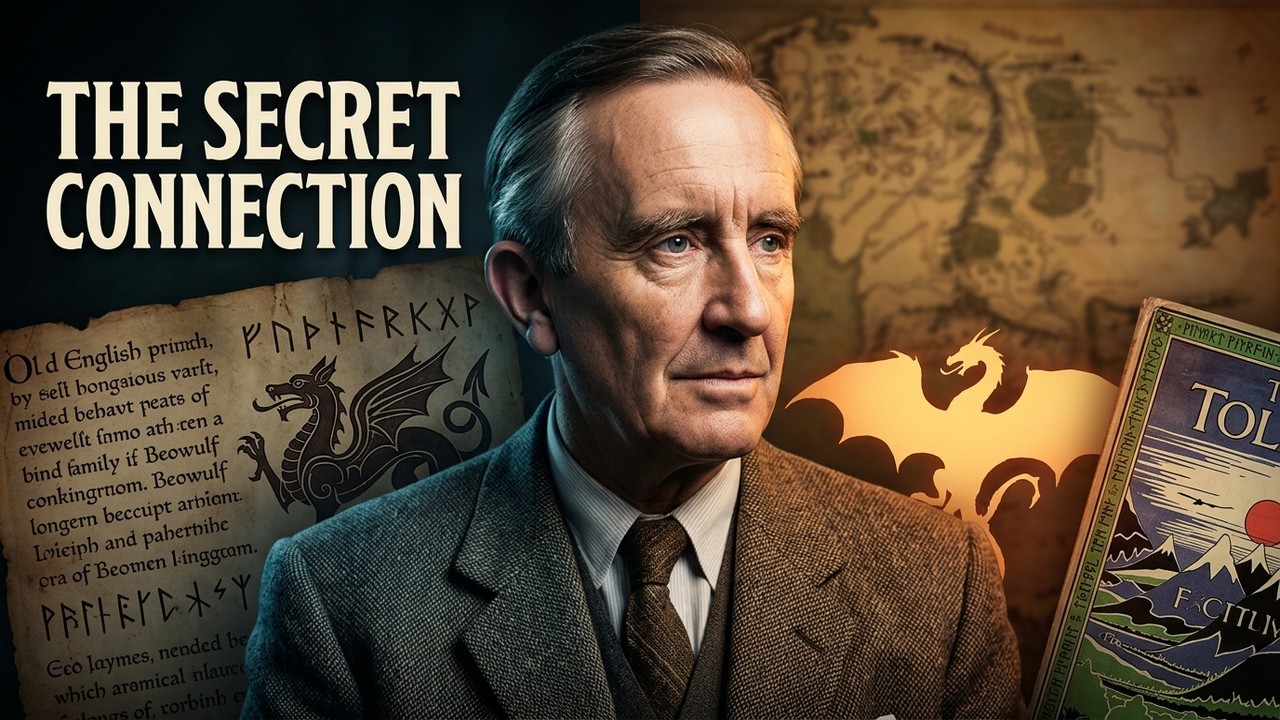
Here's the thing most people get wrong about talking. He wasn't primarily a fiction writer. He was a philologist, a professor of Anglo-Saxon Oxford, the man who translated Bale and edited Sir Gane and the Green Knight. The fantasy that was the overflow, the byproduct of decades spent swimming in dead languages and forgotten myths. At Oxford, Tolken graduated in 1915 with Old Norse as his special subject. He'd already been reading the Valsanga Saga in his spare time. The only English translation available was William Morrison's 1870 rendering, and Tolken devoured it. On a personal note, it's the most expensive book I own. Only 750 copies made, and I luckily have one. Later at the University of Leeds, he founded the Viking Club, a gathering of scholars who drank beer and discussed extinct Germanic languages. Not exactly a wild Friday night, but for Tolken, it was paradise. Back at Oxford, he and CS Lewis started another club, the coal biter. The names Icelandic means coal biters. Young men who sit too close to the fire, they practically chew the embers. The group read Icelandic sagas in the original language. Go, imagine that. When members started writing their own saga inspired works, they renamed themselves the Inklings. The Inklings you may have heard of. Tolki never

The Finnish Assault

became fluent in Finnish. He admitted his assault on learning Finnish was repulsed by heavy losses, but he absorbed enough to plot through the cala, the Finnish national epic in the original language. And the cala changed everything. In October 1914, while still an undergraduate, Tolken wrote his fiance, Edith Bratz, that he was trying to turn one of the Callla's stories into something of his own. The tale of Calervo, a very great story and very tragic. The manuscript runs about 26 pages, then it stops mid-sentence at the climax. So terrible his haste. Tolken never finished it, but he later called it the original germ of the Sylmerelion, the beginning of the legendarium, the beginning of Middle Earth. In the early

The Icelandic Au Pair

1930s, the talking household employed an Icelandic opair named Ardis, 20 years old from a fishing village called Bild Dudar. I have probably gotten that wrong, but we'll just move on. She told the talking children Icelandic folktales at bedtime and taught them scraps of the language. One of her duties was to teach talking himself that his wife Edith grew jealous of their conversations in the language she didn't understand, and the lessons were curtailed. Still, Tolken remained fascinated by the world Arandis described. He'd already begun the Hobbit when she arrived, but her influence seeped into the work. The mists, the mountains, the sense of something ancient and cold lurking just beyond the

The Bones of Middle-Earth

fire light. So what exactly did talking take from the north? Everything. Start with the name Middle Earth comes from the old English midengarth cognate of the old Norse. Mithrangarthur Midgard, the realm of men in Norse cosmology. The world Odin and his brothers created sitting in the center of nine realms. Valinor, home of the Valor parallels Asgard. The old straight road linking Valinor to Middle Earth after the second age mirrors the bifrost of the rainbow breach. Merkwood, straight from Merk of Norse mythology, the pathless Merkwood that 19th century mythologists romanticized as a wild primitive

The Peoples

northern forest. Dwarves Tolkins Dearia directly inspired by Norse mythology, miners, metawworkers, craftsmen. But here's the kicker. 12 of the 13 dwarves named in the hobbits including Gandalf's name was directly from the dreetto the catalog of dwarves in the old Norse Volva Thorin Dwallin Biffer Buffer Bombber all of them lifted straight from the thousand-year-old poem including oaken shield elves the division between Kalwende elves of light and the morende elves of darkness echoes the north yolva and dakovva light elves and dark elves in both traditions Elves are tall, intelligent, beautiful. Yasanders still call them hulfog, the hidden people. Trolls. The idea that trolls turn to stone at sunrise comes from the elder Eder in the Alvesmol. Thor keeps dwarves talking until dawn destroys them. Tolken pulls the same trick in the Hobbit. Ws. The world crosses old Norse var and old English var both meaning wolf and outlaw. In Norse mythology, ws included fenurir, skor hati, wolves as mounts for dangerous creatures, wolves as symbols

The Wizard and the God

of chaos. Everyone compares Gandalf to Odin. Old man, beard, staff, pointed hat, cloak, dispenses cryptic advice. Tolken himself admitted Gandalf was inspired by the Odinic wanderer. Odin's habit of abandoning his high seat in Asgard to walk among mortals in disguise. But here's where it gets complicated. As one scholar puts it, the more you learn about Gandalf and Odin, the less similar they seem. Odin's advice typically leads heroes to glory and then death. He's collecting warriors for Vahala, building an army for Ragnarok. In short, Odin's a bit of an Gandalf, by contrast, is a mer, an angelic being whose mission is genuinely to help. The similarity may be archetype, not derivation. An old wise wizard who dispenses information, the template, not the copy. The name Gandalfa does appear in the Volva as a dwarf's name. I mentioned that earlier. It means magic staff elf. Talking borrowed the name then made it something else entirely. The uh Lord of the Rings television show however did not. The one

The Ring

ring draws from Anvaron, the cursed ring of Norse mythology. The Valsanga saga. A dwarf named Anvari crafts a golden ring enchanted to multiply treasure. When Loki, of course it's Loki, forces him to surrender it. And Vari curses the ring. Great wealth, but also devastation. The ring passes through owners via murder. Loki gives it to the dwarven king Hildmar. Hildmar's son, Fafneer, kills the father for it and transforms into a dragon to guard the horde. The hero, Sigot, kills Fafneir to take the ring, only to be killed himself. Sound familiar? It's important to understand as well at this point that Loki doesn't just steal the ring from Envari. He and Odin and someone else whose name I can't remember now are tasked to fill a otter skin sack with gold until you can't see any of the actual skin itself because Loki killed the otter who was the dwarven king's son Fafn's brother. So gets kind of real. It's always Loki's fault. Talking explored this story in his own legend of Sigod and Gudrun. The one ring's ownership history. Sauron, Ilsor, Gollum, Bilbo, Frodo follow the same bloody pattern. Even my precious might have Norse roots. Odin Zung Drier had a kenning, precious

The Sword Reforged

sweat. In the Vanga saga, Seed brings his father's broken sword Graham to be reforged. In the Lord of the Rings, the elves reforged Narcil, the sword of Gondor's kings as Anderil for Aragorn. The naming of the swords throughout Middle Earth reflects north tradition. Swords have histories and swords have

The Music of Creation

souls. The Kvala is an epic sung into being. Its verses were chanted by folk singers in tracheic meter. Within its stories, knowledge of songs equal power. Wizards jewel through singing contests. Vamman defeats Joahan by singing him into a bog. Talking absorbs this completely. In the Sylmerelion, Finrod Felagond jewels Sauron through songs of power, a battle fought through verse. Middle Earth's creation story, the analendale, sorry if I pronounced that wrong, tells how the world was made through the magic of the Anor. Lucian sings Morgoth to sleep. In a mythic

The Language Beneath the Language

world, music is power. Tolken's first love was language. After discovering Finnish, he finished his Elvish language, Quena. Quenya follows with the same melodic vowel richch sounds as Finnish. Both languages rarely begin words with consonant clusters. Certain hard consonants B D G are nearly absent from quenya giving it a soft lyrical quality. Both rely on case endings rather than propositions. Finnish talosa in a house mirrors qua coar. The dwarven language kdul was based on the old Norse ruins. The angas dwarf runes drew directly from Viking ruinic systems. Tolken didn't just borrow stories. He borrowed the bones of language itself.

Northern Courage

Tolken identified a quality he called northern courage in Norse mythology. The gods knowing they would die at Ragnarok yet going to fight anyway. This theme pervades the Lord of the Rings. The fellowship marches towards Mordor knowing the odds are impossible. Froto carries the ring knowing it will likely destroy him. Gandalf falls fighting the Balro. Theodan rides to certain death at the Pelanor fields. Hope against hope. Courage in the face of doom. Tolken found this in Beaolf in the battle of Molden in the Eders and he made it a moral backbone of Middle Earth. Tolken

The Orphan's Tale

discovered the Kavala during his final year at King Edward's school. His father had died when he was young. His mother passed away when he was 12. He'd been an orphan for years when he encountered the story of the Calvera. The hless orphan hero cursed by fate doomed to tragedy. The tal themes of loss, fate, and tragedy resonated. The scholar Villain Fleger identifies the most Finnish aspects of Tolken's writings as its mood. There is a strain of deep tragedy and pessimism that runs through Tolken's work. Even the Hobbit and certainly the Lord of the Rings, the story of Calvaro and by extension the children of Hurin is without a doubt the darkest story he ever wrote. It is our first experience of that darkness. The darkness came from the north, but it also came from Birmingham, from loss, from the red brick waterworks and the empty house.

The Mythology England Never Had

Talking lamented that England never had a true national mythology. The old Celtic stories and the Arththeran legends had been muddled by time and the Norman conquest. England's ancient myths were wiped out by 1066. The Kalvala showed him another way. Leas Ludarot walked around Karolia writing down poems. People sang forging fragmented folklore into national treasure. Tolken consciously emulated this. The sealian was written in high mythic register framed as elder days lore preserved by elves. The Lord of the Rings uses the red book of West March. Tolking presented himself as merely the translator of an ancient manuscript. One scholar noted that Tolken and his son Christopher in editing and compiling the legendarium could together be seen as England's lon. Now, why don't you wander down the page as I have discovered three more dwarfish names. The names that hold a certain power. They are like, comment, and subscribe. You have to hit them hard to please the old gods. And beware, old

The Duet

one eye is watching. JR's engagement with old Norse and Finnish literature wasn't casual borrowing. It was deep scholarly immersion spanning decades. From his school boy discovery of the Kalavala to founding the Viking Club, from his translations of Beaowolf to his own legend of Sigod and Goodran, he lived within these northern traditions. The influence permeates every level of his legendarium. The cosmology mirrors Norse world structure. The peoples, dwarves, elves, trolls, ws derived from Norse and Finnish sources. Characters from Gandalf to Turin echoes figures from the Edeers and the Calvala. Magical artifacts parallel the Anvaronauts and Champo. Languages carry Finnish phenology. The theme of the northern courage provides the moral backbone. Yet Tolken was no copist. He took raw elements, language, tragedy, magic, music, and translated them into something new. The influence operates in undertones and resonances, not direct reproduction. The relationship between Tolken and these northern traditions resembled a great duets. One voice, the deep chant of the far north, the other a familiar refrain from the west. together something richer than either alone. Middle Earth began in Finland and Scandinavia. It passed through the mind of an Oxford philologist and it emerged as a mythology that continues to enrich readers worldwide. A fitting tribute to the ancient songs that first intoxicated young scholar with their amazing wine of a kind and flavor never tasted before. The mist still hangs over Murkwood. The runes still glean on the dwarven doors. And somewhere in the cinders of a long dead hearth, the coal biter are still reading.

Другие видео автора — Jason Fisk's Englendinga Saga

Ctrl+V

Экстракт Знаний в Telegram

Экстракты и дистилляты из лучших YouTube-каналов — сразу после публикации.

Подписаться

Дайджест Экстрактов

Лучшие методички за неделю — каждый понедельник