The Lost Literary Connection Between Beowulf and The Hobbit
13:32

The Lost Literary Connection Between Beowulf and The Hobbit

Jason Fisk's Englendinga Saga 01.05.2026 315 просмотров 22 лайков

Machine-readable: Markdown · JSON API · Site index

Поделиться Telegram VK Бот
Транскрипт Скачать .md
Анализ с AI
Описание видео
Proud of my Anglo-Saxon and Old Norse Heritage, which is why I'm learning all I can on the subject. Join us for a look at the creative forces behind some of the greatest works of epic fantasy. We explore how J.R.R. Tolkien's imagination brought to life the world of The Hobbit and the majestic dragon video featuring Smaug. Discover the deep literature that continues to inspire generations of readers and filmmakers, making "The Lord of the Rings" a timeless classic. #Beowulf #AngloSaxons #Vikings #NorseMythology #OldEnglish #OldNorse #IcelandicSagas #histroy #books #jrrtolkien #tolkien #TheMonsterAndtheCritics Tolkien Playlist: https://www.youtube.com/playlist?list=PLIQZA2XObCGNo9_sP3O3OZC5rKKmhtN0f People of Beowulf Playlist: https://www.youtube.com/playlist?list=PLIQZA2XObCGOrrc3tg54roAuZS0Op3poh Video Chapters 0:00 - Intro 0:35 - The Professor and the Monster 2:02 - The Monster and the Critics 3:24 - The Theft and the Fire 5:40 - The Horse-Lords of the Mark 7:30 - The Echo of an Echo 9:02 - Northern Courage 10:29 - The Man and the Poem 12:08 - The Ruined Tower Amazon Affiliate Links; To read and enjoy; Tom Shippey: https://amzn.to/47wsLgG Seamus Heaney: Beowulf - https://amzn.to/3WjGC3s JRR Tolkien: Beowulf - https://amzn.to/42U0uxS For study; R.M. Liuzza: Beowulf - https://amzn.to/42W9vqd Frederick Klaeber' 4th Edition: Beowulf - https://amzn.to/4nFlfGa
Оглавление (9 сегментов)

Intro

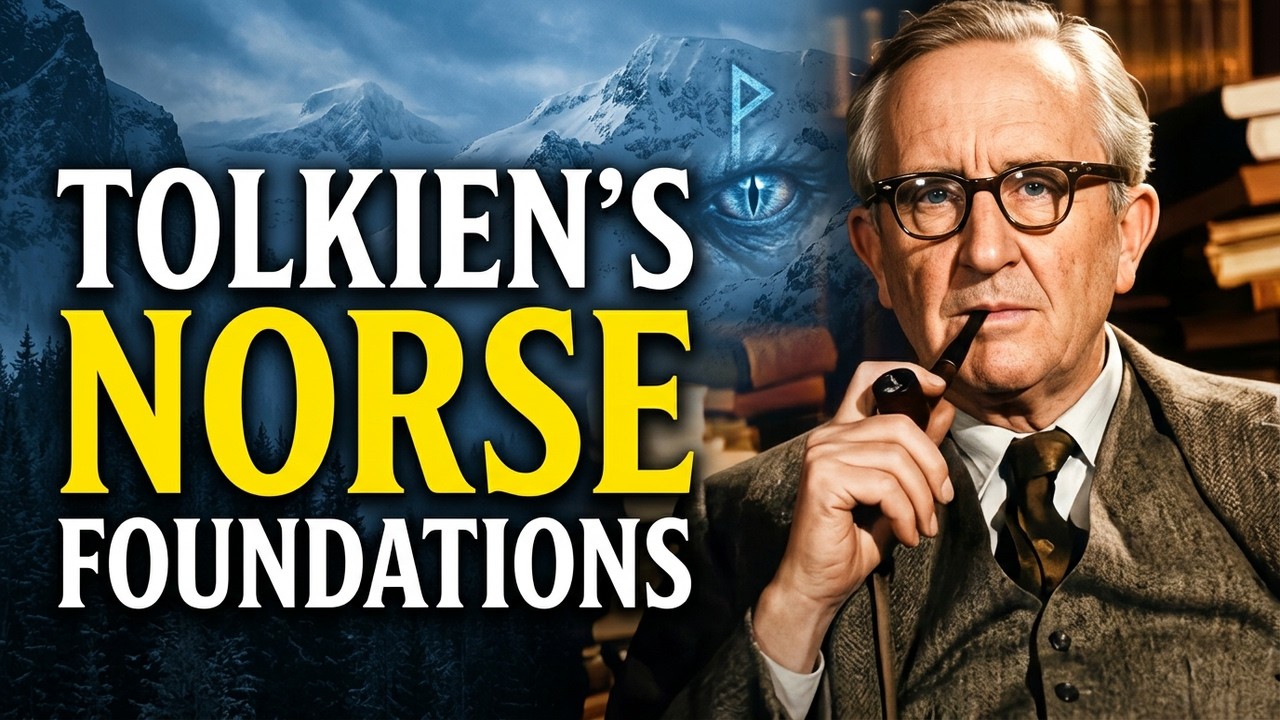
Oxford, sometime in the 1930s, a lecture hall full of undergraduates half asleep expecting another dry session of Anglo-Saxon grammar. Then a small tweedy man walks in, says nothing, fixes them with a stare and suddenly bellows, "What? " in a voice that could shake the rafters of Head Otts. Some students thought he was telling them to shut up. He wasn't. He was summoning the dead. That man was J. R. R. Tolkien. And that poem, thousand-year-old tale of monsters, dragons, and doomed kings would become the single greatest influence on the most successful fantasy world ever created.

The Professor and the Monster

Now, Tolkien didn't stumble upon Old English by accident. He hunted it down. In the summer of 1913, while studying at Oxford, he encountered a line from the Christ of Cynewulf. I'm hoping I pronounced that correctly. Eala Earendel engla beorhtast ofer middangeard monnum sended. Hail, Earendel, brightest of angels above the middle earth, sent unto men. He later wrote that he felt a curious thrill, as if something had stirred in him, half wakened from sleep. That thrill never left him. After the trenches of the Somme, where he lost most of his closest friends, Tolkien returned to academia, Leeds first, then back to Oxford as professor of Anglo-Saxon in 1925. He held that chair for 20 years, and throughout, Beowulf sat at the center of his work. In 1926, he translated the entire poem into modern English prose. It wouldn't see publication until 2014, nearly half a century after his death, but the work was kind of done. The bones of the old poem were in his hands, though, according to Humphrey Carpenter, the man who wrote his biography, he never completely liked his translation, and would go back to rewrite bits and pieces of it every now and then. The 2014 book was just the latest of the translations he had made, and then they were stitched together by his son, Christopher.

The Monster and the Critics

Before Tolkien, scholars treated Beowulf like an archaeological curiosity, interested for what it told us about Anglo-Saxon history, embarrassing for its monsters. The dragons, the demons were seen as mythological clutter, primitive nonsense that got in the way of the real historical content. Tolkien thought all this was nonsense. On the 25th of November, 1936, he delivered a lecture at the British Academy that changed everything. Beowulf: The Monsters and the Critics. His argument was simple and devastating. The monsters weren't distractions, they were the bloody point. "Beowulf is not an epic," he declared, "not even a magnified lay. If we must have a term, we should choose rather eulogy. It is a heroic elegiac poem. " The poem wasn't about history, it was about courage in the face of inevitable defeat, about standing firm when the darkness closes in, about what Tolkien called northern courage, the great contribution of early northern literature. The lecture transformed Beowulf scholarship overnight, and it revealed something else. Tolkien wasn't just studying the poem. Just a quick side note before we move on. Two months before he gave this lecture called Beowulf: The Monsters and the Critics, he had sent his manuscript off to Allen and Unwin publishers for The Hobbit. So, he did have skin in the game when it came to dragons.

The Theft and the Fire

Tom Shippey, the foremost Tolkien scholar of our age, put it bluntly, "Beowulf was the single work that most strongly influenced Tolkien out of all the sources he drew upon. The evidence is everywhere. Start with the names. The list of supernatural creatures in Beowulf, eotenas ond ylfe ond orcneas, ettins and elves and demon corpses, gave Tolkien his orcs, his elves, and the place name for the Ettinmoors. The ents came from Maxims II, orþanc enta geweorc, skillful work of the giants. Shippey suggests that Tolkien took the tower of Orthanc from the same phrase. The word Orthanc appears in Beowulf alongside searo, which Tolkien used for Saruman, cunning man in Mercian dialect. Even Frodo's name derives from Froda, a Germanic hero mentioned briefly in the poem. It means wise in Old Norse. Then there are the monsters. Gollum is Grendel's spiritual dependent. Both hunt with bare hands. Both haunt desolate marshy places. Both are outcasts. Grendel, descended from Cain, the first murderer. Gollum, a hobbit who killed his friend, Déagol, and was cast out, twisted into something barely recognizable. The Tolkien scholar, Verlyn Flieger, describes Gollum as a twisted, broken, outcast hobbit whose man-like shape and dragon-like greed combines both the Beowulf kinds of monsters into one figure. And Smaug, the dragon in The Hobbit is lifted almost wholesale from the poem. In Beowulf, a thief steals a golden cup from the dragon's hoard. The dragon wakes, flies out at night, destroys the hero's hall. The treasure is cursed. The hero dies. In The Hobbit, Bilbo steals the golden cup from Smaug's treasure. The dragon wakes, flies out, burns Laketown. The allure of the Arkenstone proves fatal to Thorin Oakenshield. Now, Tolkien admitted as much in his letters. "Beowulf is among my most valued sources, though it was not consciously present to the mind in the process of writing in which the episode of the thief arose naturally and almost inevitably from the circumstances. " Naturally, inevitably, the old poem had sunk so deep into the bones that he couldn't help but echo it.

The Horse-Lords of the Mark

Nowhere is Tolkien's debt to Beowulf more visible than in Rohan. The Riders of the Mark are Anglo-Saxons transplanted into Middle-earth. Even Shippey himself said they're just Anglo-Saxons on horses. Their land takes its name from Mercia, Mark, in the Mercian dialect, the region where Tolkien grew up. The names are straightforwardly Old English. Eomer and Halema, both characters in Beowulf. Eowyn, horse joy. Théoden, king. Their language is studded with Old English words. Eorthrith, horse people. Eoth, troop of cavalry. Ealings, people of Eol. Even the greetings are lifted directly from the poem. When Eomer cries, "Westu Théoden hál! " It's a dialectical form of Beowulf's "Wæs þú, Hrōðgār, hál. " Be thou well, Hrothgar. Tolkien used West Midlands dialect because he'd been brought up in that region. It was a scholarly joke and a love letter. Meduseld, the golden hall of Rohan, is Heorot reborn. The name means mead hall in Old English. The golden thatched roof, the way visitors are challenged repeatedly but courteously before entering, all of it mirrors the poem. Tolkien directly translated line 311 of Beowulf as a description of Meduseld. The light of it shines far over the land. And Théoden himself, he's Hrothgar, an aged king mentally crippled by a personal loss and unwise advisers, powerless against his closest foes, forced to rely on outsiders to solve his problems. Both lose trusted men. Hrothgar loses Æschere to Grendel, and Théoden loses Gríma Wormtongue to treachery. Both are restored to action by heroes who arrive from outside. When Éowyn offers the cup of friendship to Aragorn using the greeting, "Westu Aragorn hál! " she's playing with Théoden to his Beowulf. The scene is a thousand

The Echo of an Echo

years old. What Tolkien took from Beowulf wasn't just names and plot points, it was something deeper, a tone, a way of seeing the world. He called it the impression of depth hidden vistas into ancient history. Beowulf is full of digressions, references to other stories, glimpses of a past that stretches back into darkness. Tolkien wrote that the poem must have succeeded admirably in creating in the minds of the poet's contemporaries the illusion of a surviving past, pagan but noble and fraught with deep significance. A past that itself had depth and reached backwards into a dark antiquity of sorrow. And that's exactly what The Lord of the Rings does. The mythology of The Silmarillion stands behind every song and legend in the novel. When Aragorn sings of Beren and Lúthien, when Legolas speaks of the ancient wars, when the hobbits stumble across the Barrow-downs, we're glimpsing a history that feels real because Tolkien built it to be real. The illusion of historical truth and perspective, he wrote, is largely a product of art. And then there's the elegiac tone. The Lord of the Rings, especially its final chapters, is stuffed with loss. Scholar Marjorie Burns calls it a sense of inevitable disintegration. The elves are leaving, the old magic is fading, even victory tastes of ash, what Tolkien called the long defeat. In his 1936 lecture, Tolkien observed, "If the funeral of Beowulf moved us once like the echoes of an ancient dirge, far off and hopeless, it is to us as a memory brought over the

Northern Courage

hills, an echo of an echo. That echo runs through every page of Middle-earth. " But the deepest connection between Beowulf and Tolkien's work isn't stylistic, it's moral. What links The Lord of the Rings to an old poem more than anything else is the heroic spirits of northern courage. Tolkien wrote, "The worth of defeated valor in this world is deeply felt. This kind of courage is seen at its best in the face of insurmountable odds. " The Old English poem, The Battle of Maldon, expresses it perfectly. Hige sceal þe heardra, heorte þe cenre, mod sceal þe mare, þe ure mægen lytlað. I probably butchered that translation, but it means, "The spirit shall be harder, the heart keener, courage the greater, as our strength grows less. " That's Frodo and Sam plodding towards Mount Doom with no hope of return. That's Beowulf and Wiglaf facing the dragon together. When Frodo says at the Council of Elrond, "I will take the ring, though I do not know the way. " He's demonstrating an essence of northern courage, not fearlessness. He's overcoming a fear for the sake of others and defense of right. Tolkien saw the Beowulf poet as a learned Christian who recreated a heroic world and story in an implicitly Christian universe governed by a god whose existence and nature the poems as a character intuit without the benefit of revelation. He

The Man and the Poem

might as well have been describing himself. There's something more, something harder to pin down. Tolkien felt a kinship with the Beowulf poet that went beyond scholarship. Scholars have called it a virtual identity of motive and belief. The Anglo-Saxon poem had always had a freakish aspect, monsters at the center, history at the margins, which only someone of the same temperament could truly understand. And there was regional pride, too. Beowulf survives in a single manuscript, a West Saxon copy from around 1000 AD. Though the original composition almost certainly came from an 8th century Mercia, the West Midlands, with its capital at Tamworth and cathedral at Lichfield, both a short distance from Birmingham where Tolkien grew up. That, of course, is Tolkien's opinion on the matter. The Shire, with its hobbits who have only dim memories of the ancient kings who once ruled over their land, echoes Mercia itself, once the most powerful Anglo-Saxon kingdom, fallen first to Viking invasion, then to West Saxon supremacy. Tolkien was writing about his home, and Beowulf was part of that home. In December 1944, deep into writing The Lord of the Rings, Tolkien wrote to his son, Christopher. "I have been getting a lot of new ideas about prehistory lately, and want to work them into the long-shelved time travel story I began. " Even then, the old poem was still generating new ideas, still stirring something half-awakened from sleep. And we have arrived again at this critical juncture. Beowulf fought a dragon. Frodo and Sam took a ring to Mordor, but all you have to do is like, comment, and subscribe. — [sighs and gasps] — Because all of us online crave validation, so please go validate me.

The Ruined Tower

What the Beowulf poet did with the pagan stories handed down through generations of monsters and dragons and kings, Tolkien himself did in The Lord of the Rings. He built what he called a ruined tower, The Silmarillion, then salvaged from it the parts of his heroic fantasy that he published in his lifetime. The result is a work that, like [clears throat] Beowulf itself, creates the illusion of surveying a past, pagan but noble and fraught with the deep significance. A past that itself had depth and reached backwards into the dark antiquity of sorrow. Without the Old English language and its greatest literary achievement, Middle-earth could not exist in the form we know it. The shadow-walking Gollum, the dragon Smaug, the golden halls of Rohan, the elegiac tone that makes the ending of Return feel like a funeral and a homecoming. Tolkien drew upon ancient peoples and ancient works, still important and applicable to the world today, in order to form his masterpiece. In short, he drew upon Beowulf. And when he stood in that Oxford lecture hall and bellowed, "What? " he wasn't just teaching a poem, he was summoning the dead to speak again. And they answered.

Другие видео автора — Jason Fisk's Englendinga Saga

Ctrl+V

Экстракт Знаний в Telegram

Экстракты и дистилляты из лучших YouTube-каналов — сразу после публикации.

Подписаться

Дайджест Экстрактов

Лучшие методички за неделю — каждый понедельник