➡️ Get access to ChatGPT Plus, Claude Pro, Gemini, and Grok (paid versions) all in one plan for just $20/month with Bluehost All Access:
https://charliechang.com/bluehostallaccess
^you'll save a bunch of money if you want to use the latest AI models like GPT 5.5 and Opus 4.7.
➡️ Run your own OpenClaw AI agent 24/7 in the cloud with Bluehost VPS:
https://bit.ly/bluehost-openclaw
The AI space is moving insanely fast right now, and most people have no idea which models are actually worth using and which ones are a waste of time. So in this video, I break everything down in a simple way so you can actually understand what the best tool is for you.
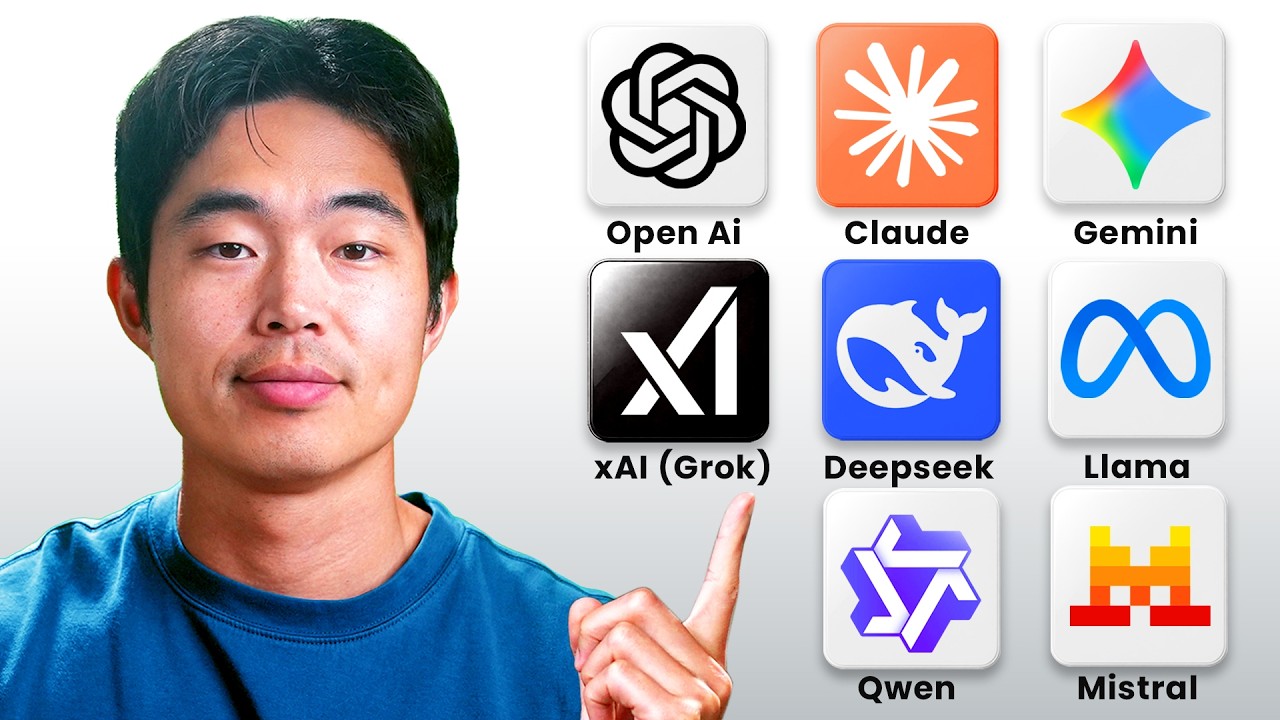
I go through the main AI models you need to know right now, including ChatGPT, Claude, Gemini, and Grok, plus free open source models like DeepSeek and Llama. I also cover AI tools for video, images, and even AI agents that can run tasks for you automatically.
➡️ Join my free AI Community (templates, workflows, AI news, making money with AI, etc):
https://www.skool.com/ai-os
► Get access to my FREE side hustle courses:
https://www.sidehustlemastery.com
► Join my FREE newsletter:
https://buildabetterbusiness.co/subscribe
In this video, I show you real examples of each model, which ones I actually use day to day across my businesses, and what I recommend depending on your use case. I also share a simple way to access all four paid models in one plan for way cheaper than paying for them individually. If you're brand new to AI or you've been using it for a while, I promise you're going to learn something new from this one.
If you want to see more videos like this, check out my other videos:
Top 5 AI Tools Every Business Owner Should Be Using:
https://www.youtube.com/watch?v=uF9wm7BquKQ
The ONLY OpenClaw Tutorial You Need 2026:
https://www.youtube.com/watch?v=dPoIuIvOPo8
I hope you guys found this video helpful, and if you did, please SHARE it with a friend or family member who you think could benefit and also LIKE and subscribe for more videos like this in the future!
Thank you for watching, and I hope you have a wonderful rest of your day!
– Charlie
#AI #Automation #Business
Timeline:
0:00 – Introduction
0:38 – The Four Main AI Models
0:50 – ChatGPT
3:34 – Claude
6:35 – Gemini
8:42 – Grok
11:31 – How to Access All 4 Paid Models in One Plan
14:47 – Free Open Source Models (DeepSeek, Llama, Qwen, Mistral)
16:46 – AI for Video (Seedance, Veo, Kling, Runway)
18:27 – AI for Images (GPT Image, Midjourney, Flux)
19:50 – AI Agents (Claude Code, Cowork, OpenClaw)
24:08 – Final Thoughts
Disclaimer: Some of the links above may be affiliate links, which means that if you click on them, I may receive a small commission. The retailers and financial services companies pay the commission at no cost to you, and this helps to support our channel and keep our videos free. Thank you!
In addition, I am not a financial advisor. Charlie Chang does not provide tax, legal or accounting advice. The ideas presented in this video are for entertainment purposes only. Please do your own due diligence before making any financial decisions.
► My Instagram: https://www.instagram.com/charlie__chang/
Оглавление (12 сегментов)
Introduction
Hey guys, my name is Charlie and in this video I'm going to explain every single AI model you need to know about right now. And I mean all of them. Chat GPT, Claude, Gemini, Grock, the free open source ones. AI for video, AI for images, and even AI agents that can literally do work for you while you sleep. Obviously, the AI space is moving super fast and most people have no idea which models are actually worth using and which ones are a waste of money. So, what I'm going to do is breaking down exactly what each one does, show you real examples of each one in action and tell you which ones I actually use and recommend. Now, whether you are a complete beginner or you've been using AI for a while, I promise you're going to learn something new in this video. So, let's get started. So
The Four Main AI Models
let's start with the four main AI models that most people are going to be choosing between. And if you want the paid versions of all these, I'll show you a hack that actually gets you access to all of them for about 75% off. But more on that later in this video. Okay
ChatGPT
first on the list is of course chat GBT from OpenAI. Anyone that's ever used AI before has probably used Chat GPT and that's because it's the most popular one. So they actually just released GPT 5. 5 and it's the first fully retrained base model since GPT 4. 5, which was quite a while ago. Now depending on when you're watching this video, this may be relevant or this may not be relevant. Just know that OpenAI is always releasing new versions of GPT and each one gets significantly better. Things are also moving a lot faster right now. So GPT 5. 5 was released 6 weeks after GPT 5. 4. So just keep that in mind, right? Things are moving really fast. Now there's a free tier of chat GBT. You can chat with this. You can generate images. You can browse the web. You can upload files. It's honestly really solid for, you know, not having to pay anything. There's also the paid plan, which is chat GBT plus. This is $20 per month. Super worth it. And with this, you get full access to the latest models. So that being 5. 5 right now. You get a lot more usage. You get priority access, advanced voice mode, and there's also the pro and enterprise tiers, which most you guys won't need, and those are a lot more expensive. Now, personally, I love chat GBT because in my opinion, it has the best memory features. So, it remembers things across all of my conversations, like my preferences, my business projects that I'm working on, and so you don't have to reexplain everything. What I like to use Chat GP for is a lot of brainstorming and a lot of ideiation like business development and bouncing ideas off of someone. And by someone, I mean Chat GPT. It's a really good mentor. It understands me really well. It gives really solid advice and yeah, that's why I'll use it for most basic tasks as well as tasks where I'm asking it questions about life, about business, about anything. It can also generate images right inside the chat. So, they actually retired Dolly and they built image gen directly into the model. So, yeah, GPD image, it's honestly one of the best for text on images. Like, if you need a logo or a social media graphic with readable text on the actual photo, it can actually do that really well. GPT Image 2. 0 just released. It actually supports 2K resolution and can generate up to eight images from a single prompt. You guys should try this out. It's really, really good. GPT 5. 5 is also a lot better at complicated multi-step tasks. So, you can actually give it pretty messy requests like research these five competitors, build a comparison spreadsheet, and write me a summary. And then it's going to plan out. It's going to use the tools. It's going to check its own work. And then it's going to keep going until it's done. There's also voice mode, so you can actually talk to it just like with a person. And in my opinion, I think it's the most like natural voice AI out there right now. Now, GPT does have a 1 million token context window, which is solid. And yeah, if you are brand new to AI and you just want one single tool, then it's probably going to be Chat GBT. It does a little bit of everything pretty well. That's why I think it's the best like all-in-one overall one. Okay, next
Claude
let's talk about Claude, which is from Anthropic. I've been using Claude a ton recently. I think actually it is my most used AI model and currently their flagship model is Claude Opus 4. 7 which just came out April 16th. You get access to this if you have the paid plan for Claude which is like $20 per month. There's also a free tier. So you do get access to sonnet for free with daily limits and with that you can chat, you can upload documents, you can analyze files. It's very similar to chat GPT. Now like I mentioned already with the paid cloud pro plan which is $20 a month. You get full access to the latest model, which is currently Opus 4. 7. You get way more usage and you also get access to Claude's project feature where you can upload a ton of documents and it remembers everything. In my opinion, it absolutely destroys every other AI model out there when it comes to writing. If you give the same exact prompt to let's say chat GBT and to Claude, you can actually see a very big difference. The output just feels more natural. It feels like more thoughtful, more human, less robotic. And if you're writing blog posts, scripts or emails, anything where the quality of the writing matters a lot, then I think Claude is the best one to use. Claude's also really good at handling really, really long documents. So, it has a 1 million token context window. So, you can basically upload an entire book or a super long contract or a very long report and you can ask it questions about the whole thing. There's also the projects feature and this is super underrated in my opinion. You can actually upload a bunch of reference documents into a project and Cloud will use all of them as context for every single conversation. So, for example, if you have like brand guidelines or product documents or style guides, throw them all in there into a project and then Claude just knows your business. Now, with Opus 4. 7, it does have high res image support now. So, up to, I believe, 2,576 pixels. It can read screenshots. It can analyze charts. It can even do pixel level data extraction from graphs. Also, a really cool thing about 4. 7 is it does selfverification. So, it proactively writes, tests, and checks its own work before giving you the answer. So, that's a really good thing when it comes to accuracy. If you're trying to do things that require very accurate information or data, then Claude is really good for that. Claude also, of course, dominates the developer tool space. So, Claude is the AI model between like Cursor, Windsurf, GitHub, Copilot, and also Cloud Code. Now, personally, I'm running a bunch of different cloud agents within my own business. So, if you want to have an AI that can actually perform tasks, I highly recommend looking at Claude Co-work or Claude Code. Co-work is a bit easier to use in my opinion, but can absolutely like create files and edit files on your computer. You can build out different agents and schedule tasks, cron jobs. Cloud code can basically do everything that Claude Cobra can do. It's just a little bit more complex looking. And so, I'd say that's a bit more for advanced people. When it comes to a lot of my business output and actual like actions that are happening within the business as well as my personal life, I tend to like to run them through Claude. For example, my email assistant, my research assistant. I get a lot of help writing scripts with Cloud as well. Overall, it's an insanely good AI model right now. And the $20 for the paid plan is absolutely worth it.
Gemini
Next, let's talk about Gemini from Google. And honestly, Google's had a really big comeback year. They fell back behind for quite a bit, but now they have Gemini 3. 1 Pro, which is their paid plan. And there's also the free tier. So Gemini is free to use on gemini. google. com. It's also built into Google Workspace. So if you use Gmail or Google Docs or Google Sheets, then it's perfect. In my opinion, the free tier is actually really generous. You can do a lot with it and it performs really well. Now, the paid plan, which is Google AI Pro, it's currently $19 per month. And when you pay that, it also comes with other stuff like Google One, which gives you a bunch of storage. So, it's not just like the AI model with this plan. Like I said earlier, if you guys use Gmail or Docs or Sheets, Gemini is built right in. So, you can have it draft your emails. summarize threads. It can create documents. It can build formulas and sheets. And the great thing is that you don't need to actually leave the apps that you're using. It's built in. A lot of the time, if I'm in Gmail, then I'll use Gemini to actually help me draft a reply. or if I'm actually creating stuff within a Google doc. It can help me write things, revise things, and edit things. Now, in my opinion, Gemini is probably the best at understanding different types of media. So, you can, for example, upload an hour of video or tons of hours of audio, and it can actually analyze the whole thing. How this works out in real life is, let's say you have a recording of a super long meeting, you can record it and ask what were the action items and it will tell you. Gemini 3. 1 Pro actually leads multiple benchmarks as well. So, it scores extremely well on graduate level science tests and the reasoning performance is also really good. Gemini can also generate animated SVGs and 3D code right from a text prompt. So, most of the AI models are not good at that. For example, you can describe a chart or a diagram and it's going to create an interactive animated version. It's also the cheapest Frontier model for developers. So, currently it costs $2 per million input tokens versus $5 for GPT 5. 5 and $5 for Claude Opus. And so, yeah, if you're already in the Google ecosystem or you need to analyze a lot of different types of media, I think Gemini is one of the best for that. Plus, the pricing is super
Grok
competitive. Okay, next, let's talk about Grock. This is made by Elon Musk's company, XAI, and actually lives inside of X, which is of course formerly Twitter. And as of right now when I'm filming this video, we're currently running Gro 4 with the latest ones actually adding a ton of crazy features. Now, there is a free tier. So, basic Gro access is free on X. It's a bit more limited, but you can still chat with it. And then the paid one. This comes with X premium. It's $4 per month as of right now. This gives you full Gro for access, which makes it the cheapest paid option of the four. And there's also super Grock for $30 per month with the heavy model. Now, one thing that makes Grock super unique is that it pulls from X in real time. So, if you ask it about breaking news or trending topics or what people are saying about this company right now, it has that live data and the other models don't have that. For example, I can ask Grock about something trending right now. And you can see it pulls realtime tweets and data. With the latest version of Grock, which is 4. 3, it can now generate downloadable PDFs, fully populated spreadsheets, and even PowerPoint decks right from your conversation. So there is a lot of business use for Gro 2. I think a lot of people think of Grock as just like built in with X, but there's actually a lot of business stuff you can generate with it as well. 4. 3 also added native video input, so you can share a video clip and have a conversation about what's in it. Now, this is a bit more advanced, but 4. 2 also introduced a four agent system where different AI agents handle different parts of your request at the same time. So it's basically crossverifying each other's work and it's like using multiple models at the same time. Now, Grock does have a 2 million token context window, which is double what Chachi Boutique and Claude have. And then API pricing starts at 20 cents per million tokens, which is by far the cheapest for developers. Overall, like Grock is definitely an underdog here compared to the other AI models, but it's really good. It's really fast. It's the cheapest paid option. You get so much realtime data, has a huge context window, and it's definitely worth trying. Okay, so just to summarize, right, we have Chat GBT. This is the best all-around one in my opinion with best image generation and the best ecosystem. Then you have Claude with Opus right now and that's the best writer. It's the best for coding and it's the most accurate for documents. Then you have Gemini which is arguably the best value. It's also the best multimodal video and audio one and it has that native Google integration. And then we have Grock, right? This is the cheapest. It has real-time data and has the biggest context window. Honestly, you cannot go wrong with any of them. It really doesn't matter too much which one you use, but it really comes down to what you need, right? There are definitely some advantages to having certain models, especially the paid ones. And so, without a doubt, like my AI subscriptions, they are the best money I spent. It gives me a better model. It's a lot better than the free ones. And that's why I highly recommend if you want to take AI seriously and actually use it a lot, get the paid versions of these AI models. So, now I
How to Access All 4 Paid Models in One Plan
know a lot of you guys are probably thinking, "Okay, cool. There's these four great models. I want to try the paid plans, but I don't want to have four different subscriptions and also that's pretty expensive. I'll put a link down below, but I highly recommend checking out Bluehost All Access. So, I just found out about this. You actually get four paid versions of Chat GBT, Claude, Gemini, and Grock in one single plan. Starts at $20 per month, and it allows you to use all of these AI models in one single place. I'll show you guys how to use this, but for example, let's say you're trying to write a document or a script. I would just switch to the cloud model and have it do that. And if I want to do something that chat GBT is better at, I'll switch to chat GBT. I honestly don't know how they're doing this, but it only costs $20 per month. And so if you compare it to if you buy all four, I think it's like $70 or $80 per month. So you're saving a ton of money, and it makes a lot of sense to get this. So again, I'll put that link down below. It's going to take you to this exact page. I'll click on see plans. You'll see they have two different packs. I think for most of you guys, the normal one for $20 per month is going to be good enough. But if you want privacy, so if you are working with like really private information, I probably would go with the privacy plus one. It's just $5 more per month and adds another layer of security. But for most of you guys, I think this one's going to be good. So we'll click on choose plan. You'll first want to select the duration. So monthly or 1 year. It's really up to you guys how long you want to get it for. You'll select the number of users. One's going to be good enough for most of you guys. And for example, if I go to monthly and I just have one user, it's $20. And after you create your account and put in your billing information, you just click on submit payment. Okay. So once you log into your account, it's going to look something like this. This is the main dashboard. You'll have all your chats over here. So this is a brand new demo account which I just made. You can look at the different agents that you have right here. But let me go back to new chat. And as you can see here is where you're going to just use it just like chat GBT or Claude or whatever. This button right here. You're going to click on this and you can see auto route is selected. So it's going to choose which model it thinks is best for your particular prompt. Of course, you do have the option to manually select. So for example, we can choose GPT, right, Gemini, Claude, Grock. If you want a faster response, we can choose some of these models. But let's say I want to go with Claude Opus 4. 7. I can write something like this. Write me a 500word blog post about Claude Opus 4. 7. You can also upload different files, or you can click on this to do a web search, but I'm going to turn that off. Now, we'll click on this button right here to submit. That's going to show you all the thinking. It's exactly just like if you were to do this within Claude. It's telling you all the different steps it took to generate this answer. And yeah, this is that 500word article. Of course, we can tweak it how we want. We can tell it to use certain types of wording. add a comparison. We can tell it to talk more about a certain topic. We can have it write in a certain tone or voice. And so now you can see this chat right here is here in our chats. We can search through all our different chats. Once you start building up multiple different chats, you can see which model we use to generate this. So, it shows right here. And of course, we can ask a follow-up. We can have it tweak different things, but for this video, I'm not going to show you that. If you also have a team, you can actually add users right here. If you go to settings, you can control which LLM your team has access to. Super cool, right? It gives you access to all the pro models. So, if you want to compare different models and not have four different actual subscriptions, I highly recommend just using this. We've
Free Open Source Models (DeepSeek, Llama, Qwen, Mistral)
already talked about the free versions of the big four, but there's this whole other world of AI models that are completely free and also completely open source. Open source basically means the code is public. Anyone can use it, modify it, or run it on their own computer. And so you don't need a subscription and there's no monthly fees. The cool thing about this is that it can actually run on your computer, right? So you own it. The data stays with you and there are a ton of them. So first is DeepSeek. We're currently on version 3. 2. It's from a Chinese company. works extremely well and it's very strong at particularly reasoning and coding. Deepseek v4 flash is also the current budget leader for developers. It's only 17 cents per million tokens. You can use Deepseek for free on their website. It's just chat. deseek. com. Next is Metal Lama 4. So this is Meta's open- source model and Llama 4 Scout has a 10 million token context window. It's free to use. There's a huge community and there's lots of little fine-tuned versions for specific tasks. Then you have Quen 3. 5 which is from Alibaba. This model actually matches some of the paid models on coding benchmarks and Quen's Kimmy K2. 6 variant actually leads the open-source live ranking. Then you have Mistl which is a French company and this model can actually run on a single consumer GPU with 24 GB of VRAM. Now the easiest way to actually use these free models is through web interfaces. So just going to the official websites. You can also run them locally. So, for example, you can download Oola Lama, which is a free app. You can pick a model and you can run it on your own computer. The great thing with this is that the data never leaves your actual computer. I will say your computer does need to be at least okay or decent. You'll need about 8 GB of VRAM for some of the smaller models, but you'll want 24 GB for some of the bigger ones. I will say the gap between opensource models and these paid models has gotten a lot smaller. And for very basic everyday tasks, you don't need to pay for a subscription. You can simply use any of the free models we talked about before or any of these free open source
AI for Video (Seedance, Veo, Kling, Runway)
ones. Okay, now let's talk about AI for video. AI for video is getting absolutely crazy. This is where we talked about some of the more specialized AI models. And if you've been on social media, there's a chance that you guys have probably seen a video that was fully AI made and you didn't notice. It is getting better and better every single day. And soon I think it's going to get to a point where you really cannot tell. Some of the top models for video are going to be Cance 2. 0 from Bite Dance. This is probably the overall best value. So the first model with unified audio video generation, meaning that the sound is generated with the video, it's not like slapped on afterwards. For example, you can generate a selfie video and then once they flip the camera to the room that they're in, the mic is going to sound a little bit different. You can access all these models on something like Higsfield, which in my opinion is one of the best AI video platforms. Then you have Video 3. 1 from Google. So, this is the best all-around quality one. You have native 4K resolution. It has, in my opinion, the best physics and like realism. It's also the best lip sync for talking head content. So, yeah, maybe I'm using VO 3. 1 right now. Who knows? Then you have Cling 3. 0. This can currently generate clips in 4K. You can also do multi-shot sequences with consistent characters across different camera angles. You also have runway gen 4. 5. So, this is probably the professional's choice. It's built for video editors with really precise camera controls like pan, tilt, and zoom. And you might be wondering what happened to Sora from OpenAI. They're actually shutting that down and they're just shifting their resources to their main models. Overall, if you're a content creator, this is both super exciting as well as a bit scary cuz you can basically generate anything now. It used to cost like thousands of dollars to generate really good video with AI and now the pricing is just down so much.
AI for Images (GPT Image, Midjourney, Flux)
Now let's talk about AI for images. Images were the first big breakthrough for AI and the models that we have for image generation now are insane. So we sort of mentioned this already but GPT image 2. 0 from OpenAI. It just launched and it's built right into Chat GBT. It's the best at understanding really complex prompts and text rendering. So, I think it has like a 95% accuracy for text and images, which is insane. If you used to look like, let's say, 6 months ago at images with text inside of them, usually it would just look like garbled text. And now it can do some pretty insane stuff. It's the first open AI image model with native reasoning. So, it actually thinks about what you want before generating the image. We also have MidJourney V8 Alpha. So, this was recently launched as well. And I'd say that if you want something that looks really designed or polished or like editorial quality, then Midjourney is probably the move. It does cost some money though, so keep that in mind. We also have Flux 2 from Black Forest Labs. This is probably the best for photo realism, so things like skin textures and lighting and natural poses. The stuff you can make with this looks like a real photo. It's also gotten extremely fast at actually generating the image. There are a bunch of other ones like Imagin and Idog. Yeah, there's too many to talk about. Those are the main ones. Personally, I would use chat GPT for convenience and text and images. I'd use MidJourney for art. I'd use Flux for photos or things that need to look extremely real. Yeah, it's just crazy how far we've come with AI image generation. And then let's talk about AI
AI Agents (Claude Code, Cowork, OpenClaw)
agents now, right? So, this is some of the more advanced stuff. So, if you're just a beginner, then maybe you don't need to listen to this part. But if you want to use AI for actually doing work, for like having a team of people that are constantly working for you, then this will be an important section. Instead of just like answering questions or giving you good ideas or generating basic things like images, AI agents actually do a bunch of different things and can actually carry out a complete task. You give it a goal and then it's going to figure out how to get it done. I'll say every major AI company in 2026 is focused on agents right now. It is the future of AI and the two that you need to know are going to be cloud co-work/Cloud code as well as OpenCloud. We've talked about Cloud Co or Cloud Code for a bit in this video. This is from Anthropic. It's honestly incredible and yeah, it's my most used AI agent. These AI agents actually have access to a folder on your computer, so it can actually edit and build different things. You essentially just describe what you want to build and you have a conversation with it. It's essentially vibe coding, right? You're telling it what you want to build. It's going to ask you different questions. You're going to give it more context. You're probably going to have some fixes and stuff, and you just have a real conversation with this master coder, and it can do all the stuff for you. You can also have multiple agents working on different parts of your business or projects simultaneously. Like I said, these agents have access to your computer, so they can also open up a browser and click through different websites, fill out different forms, and actually do things visually. Right now with AI agents, you can build full stack apps from scratch and yeah, you can build entire systems within your business. These AI agents can connect to thousands of different apps through MCP. So for example, you can have Claude working within your Slack. You could probably go out and build an entire app or a game in one single afternoon. And just overall Claude Code and Claude Co, it's amazing. Next is OpenClaw. So if you're in the world of AI, you've for sure heard of OpenClaw. That's essentially why everyone was buying these Mac minis to actually run OpenClaw on. And essentially, OpenClaw is an open- source personal AI assistant. It is free to use. You just need to host it somewhere. And like I said, a lot of people were using Mac minis. I don't think that's the best way to do it. I host mine on a VPS. This is a virtual private server. It is essentially a computer that's always on, which is in the cloud. Yeah. Overall, OpenClaw is wild. You essentially talk to it through any messaging app like Telegram. It runs 24/7 and it can basically connect to your entire life. For example, what you might want to do is connect it to your email and it's going to send over a brief every single morning where it checks your calendar. It summarizes your emails. It pulls any news or topics you care about and sends it all to you on Telegram. You can also talk to it within Telegram. So, you can give it a certain task to do within Telegram and it's going to do it. Think of it as like a person sitting in front of a computer. You can talk to this person 24/7. Give them commands and they're going to do it. For example, there was a guy who set up OpenClaw to negotiate a car purchase. So, it basically contacted like 12 different dealerships both through email and also through messages. It tracked all the different offers in the spreadsheet. It followed up automatically and actually got him a pretty big discount. I'm not going to talk about OpenCloud in too much detail in this video, but just know that this is one of the most popular AI agent platforms that people are using. You plug in any single AI model that we talked about in this video and it can actually do things for you. Now, like I said, I like to run my OpenClaw on a VPS. And the reason why you want to not have it on an actual computer is because if the computer turns off, then your OpenClaw is not working. Since it also has access to the computer itself, you know, it can get a bit dangerous if your security is compromised. So, what I just recommend doing is hosting your own OpenClaw on a VPS. Bluehost has a one-click open claw setup now, which makes the whole openclaw setup process really easy. It's built on their VPS infrastructure. As I'm making this video, I think if you select a 2-year plan, it gets as cheap as like $2 per month. So, yeah, from what I've seen, this is one of the most affordable VPS's that exists. And I'll put a link down below to that. Cool. So, that's pretty much every AI model that you need to know about right now. Again, like I said, the AI space is moving so fast. So, by the time you are watching this video, some of these model numbers might be a little bit different. But the most important thing, you guys, is that you actually use AI within your life. I highly recommend using AI both in your personal life as well as your business life because it's going to make you so much more efficient. If you're not taking advantage of AI, other people are and they're going to move way faster
Final Thoughts
than you. If you guys found this video helpful, make sure to like, subscribe. I make a ton of videos about AI, finance, business. My whole goal is to help you guys live a financially successful life. Thank you so much for your time and I'll see you in the next video. Peace. —