The Art of Friction
23:52

The Art of Friction

Stanford Graduate School of Business 20.05.2026 289 просмотров

Machine-readable: Markdown · JSON API · Site index

Поделиться Telegram VK Бот
Транскрипт Скачать .md
Анализ с AI
Описание видео
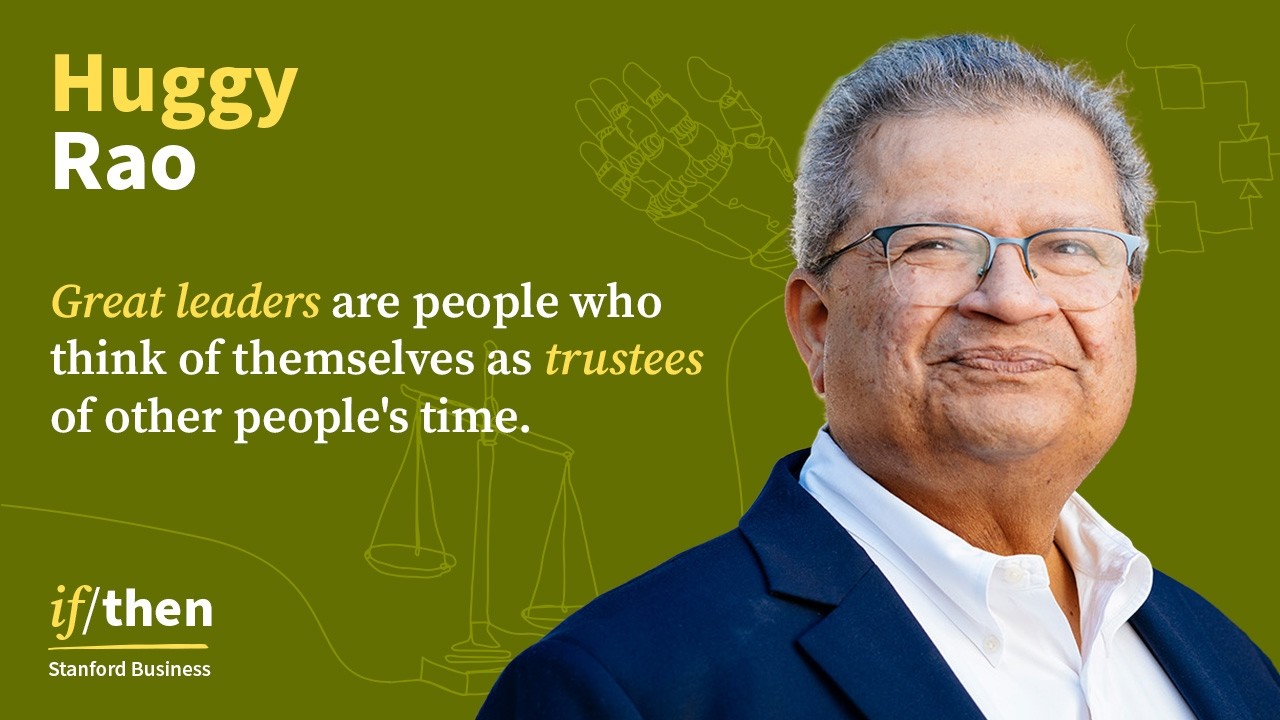
“Friction for us has to do with obstacles,” says Hayagreeva “Huggy” Rao, a professor of organizational behavior at Stanford Graduate School of Business. “Obstacles can disable you. Obstacles can enable you.” Rao compares friction to cholesterol: Some is good, but some is bad. “Good friction actually slows you down, gets you to pause, and most of all, gets you to reflect,” he explains. “But there’s also friction that overwhelms you, exhausts you, confuses you.” On this episode of If/Then, Rao explores how to cultivate the productive kind of friction, reduce the unhelpful kind, and manage your team’s most precious resource. “Great leaders are people who think of themselves as trustees of other people's time,” he says. Do you have any favorite examples of good or bad friction? Share one with us at ifthenpod@stanford.edu. Related Content: Huggy Rao faculty profile: https://www.gsb.stanford.edu/faculty-research/faculty/hayagreeva-rao The Friction Project: https://us.macmillan.com/books/9781250284426/thefrictionproject/ Career Advice: How to Become a “Friction Fixer”: https://www.gsb.stanford.edu/insights/career-advice-how-become-friction-fixer Chapters: 00:00:00 Airport baggage claim, waiting, & good friction 00:03:20 Introduction 00:03:48 What friction means in organizations 00:05:42 Where friction comes from 00:07:52 Scaling through smart subtraction 00:08:24 DropBox’s approach to meetings 00:10:45 The problem with meetings 00:13:53 What good friction looks like 00:16:56 Friction, trust, & institutional legitimacy 00:19:31 Why Huggy Rao started studying friction 00:22:20 Conclusion If/Then, from Stanford GSB, features conversations with faculty that explore how their research deepens our understanding of business and leadership. Find out more about If/Then: https://www.gsb.stanford.edu/business-podcasts/if-then Listen on: 🔊 Apple Podcasts: https://podcasts.apple.com/us/podcast/if-then/id1725380194 🔊 Spotify: https://open.spotify.com/show/1v7V6LGUxfplMByTpVwk7h?si=38f353685fec4dd5 #gsbifthen #gsbpodcasts

Оглавление (11 сегментов)

Airport baggage claim, waiting, & good friction

You hurry off the plane, down the jetway, through the airport, and onto baggage claim, where you watch an empty conveyor belt spin until your suitcase trundles down and back into your hands. Waiting for your bag is never fun. We all know that. That's Kristen Allen, one of the project managers for the new Terminal 1 at San Francisco International Airport. When they were designing the new terminal, the planners wanted to minimize the frustration many passengers feel — when they're waiting for their bags. Knowing that it only takes between two and five minutes for the bags to get here really makes sense based on the walking distances. So, as you'll see here, you'll see the claim start to move when the first bag is ready to arrive. And if we look at this claim that just started up, and that announcement just happened, bags are already coming out and people are trickling in right now to get their bags. — You might assume the priority is to get passengers to baggage claim as quickly as possible, but that's not necessarily true. — In Houston, for example, airport executives were surprised when passengers complained about wait times despite having located baggage claim close to the arrival gates. Then somebody had an unorthodox idea. Place gates further away from baggage claim, which meant passengers had a longer walk, but less time standing around the carousel. The new plan worked. The complaints all but disappeared. Adding distance wouldn't normally be seen as something to improve an experience. But if the alternative is waiting in one spot, it could be a welcome change. In San Francisco, the new terminal seems to have found the sweet spot. So, you sort of get the trickle-in effect, and that flight that arrived, that claim is already cleared out and everyone's gone in within minutes. I got to just walked up and boom. Came out after a long flight, it's the best, you know? I probably would rather walk around in the time that I'd spend waiting cuz I mean, otherwise I'm just standing here. I like walking, getting where we're going to go and have my stuff ready to go when I get there. So, when we got here, our bags were ready. I'd prefer to end my walk as the bags were coming out. And here's my bag. Bye. Extending the walk from gate to claim is an unusual example of friction. And when introducing friction improves an experience, you can call it good friction, according to Huggy Rao, professor of organizational behavior at Stanford Graduate School of Business. He's also the co-author, along with Bob Sutton, of The Friction Project. Friction for us has to do with obstacles. Obstacles can disable you. Obstacles can enable you. —

Introduction

— Today, we're talking with Huggy about how to create good friction, eliminate bad friction, and how both contribute to scaling effectively. This is If Then from Stanford GSB, where we sit down with faculty and explore how their research deepens our understanding of business and leadership. I'm your host, Kevin Cool.

What friction means in organizations

Why don't you just give us a sort of uh back of the envelope description of what you mean by friction in this context. What are we talking about? So, examples of obstacles enabling you are when you skate, friction makes us go down. When you ski, there's friction, without it would be way dangerous as you can imagine. But, there's also friction that overwhelms you, exhausts you, confuses you. So, when we think of friction, we like to use the analogy of cholesterol. All of us have bad cholesterol, and we've got good cholesterol, LDL and HDL. It's the same thing with friction. You got bad friction, anything that confuses, overwhelms, exhausts. And good friction that actually slows you down, gets you to pause, most of all gets you to reflect. Mhm. You've described it as making good things easier and bad things harder. What should any leader make easy? We suggest it's curiosity and generosity. And how do you make them easy? By removing obstacles that confuse, overwhelm, and distract people. What should you make harder to do in any organization? We suggest the two culprits are overconfidence and myopia. Overconfidence and myopia? — Yeah. Easy to be overconfident, easy to be myopic, have tunnel vision, and both go hand-in-hand. And there, what we suggest is you put in good friction to actually slow down people. Get them to think a little bit. Get them to reflect. Or don't do things mindlessly. Mhm. So

Where friction comes from

let's talk a little bit about where friction comes from. And I do want to get into some more examples that you have in your book, but what's the origin of friction? Does it just come from good intentions gone bad or what happens? I think it's a great question. I would say if you take bad friction, often it's the tragedy of good intentions. It sounds great. And then you tell people you have to do A, B, and C. And whatever you think is important or necessary, they perceive to be obstacles. Mhm. — [snorts] — Another source of friction is if you will, blindness. And what I mean by that is the higher up you are in an organization, you have privilege. And what privilege does is it shields you from inconvenience. So, you have no idea what the life of people, you know, in the ranks is. So, as a result, what you do is you constantly are adding things. What does all of this addition do? We often psychologize these things. We say, "Oh my god, there's stress and there's burnout. " And these are consequences for the individual, no doubt. But the consequences for the organization are the loss of initiative, the loss of curiosity, and the loss of generosity. Mhm. And the reason is you don't have any willpower. Yeah. If I ask you to do 10 things, how can you have any willpower? bandwidth? Is there a sense in which in some organizations people are incentivized by, you know, if you think about brainstorming activities, for example, well, what's going to happen from that? There's going to be ideas to do new things or maybe different things, but new things. So, there are some — built-in incentives, aren't there?

Scaling through smart subtraction

Completely. All of these are sources of addition bias. The problem is organizations don't realize that scaling means not just getting bigger. Scaling is about getting better. It's about scaling excellence. You can get big. Mhm. But that doesn't mean you're getting better. Right. And the key to scaling is — smart subtraction.

DropBox’s approach to meetings

So, let's talk about meetings for a moment because I think on the list of things that might be considered bad friction are meetings. And of course, lots of people complain about meetings. And you use an example about Dropbox in your book about how they banned organization-wide meetings. And I'm curious to know, first of all, how that worked out for them. And also how would someone who's leading an organization think about the role that meetings play in getting in the way, being an obstacle, or finding the right size to make it productive but not an obstacle. — Right. Both great questions. Meetings consume us, as you know. In Dropbox, since you raised that question, uh the CEOs, of course, the CTO and the others, they're all brilliant uh executives. And this was after Dropbox had an IPO. Both Bob and I had a chance to meet the CEO. And Bob is Bob Sutton, your co-author. Yes. — my wonderful co-author, conspirator, um comrade, wine drinker, teacher. He's taught me a lot of things as well. For which I'm eternally grateful. We asked him, we said, "Hey, Dropbox has had a great IPO. What's your biggest challenge? " And [clears throat] he fingered meetings as the big challenge. He called it our meeting-geddon. Like a play on Armageddon. And then of course he's the CEO. And so he issued an edict. And the edict was like a set of guidelines saying, "Don't have meetings without a clear owner, clear purpose, and so on and so forth. " Couple of weeks later we met him and said, "Hey, how's this edict working? " And he sort of smiled at us and said, "The problem is worse than ever. " We said, "Why? You're the CEO. " And he said something very wise. He said, "Subtraction isn't one and done. It's like mowing the lawn. You got to do it like pretty regularly. If you don't mow the lawn, the weeds are going to overrun the place.

The problem with meetings

Now, the problem with meetings is we have to consider the incentives of people who organize them and attend. The big thing is FOMO, fear of missing out. Yeah. I want the boss to see me, particularly in this era of remote and hybrid work. I need to be noticed. — Being present matters. Completely. On the other hand, from the organizer's viewpoint, having a meeting that a lot of people attend is a signal of status. Because look at how many people whose time I can waste. Yeah. And they can't do anything. It's like this — captive audience sort of — Completely. Trapped is the way I would describe it, cuz that's how they feel. That's how I feel when I attend meetings. So, how do you solve problems? — [gasps] — We have one of our PhD students now who's actually doing very interesting work on meetings, Rebecca Hinds. And she's written a book on meetings. And one of the things she found was the place to begin is attack recurring meetings that are scheduled by default. Mhm. You don't need to have recurring meetings all the time. — The ones that are scheduled on your calendar for literally a year. — Right. Those you need to take aim at. The other is don't have back-to-back meetings. Because when you go from one meeting to another, you're exhausted. Mhm. Create time. Create space. For me, I wish organizations were more mischievous. — [gasps] — So, on the incentives to attend, I would actually give a gold medal to the person who attends the most meetings in any company. Would you like to get a gold medal like that, Kevin? — People going to say, "Man, I don't want to be tagged like that. " — Yeah. You know, so you can actually do that. See, the real hallmark of bosses for Bob and I is that great leaders are people who think of themselves as trustees of other people's time. — Yeah. Okay. They don't want to piss the time of other people. Are there ways for someone to know that they are wasting people's time? Is that a sort of built-in organizational guardrail of some kind? Is that just a cultural situation? I think the telltale signs are people inspect their cell phones. People are looking at their tablets. What does that tell you? — Yeah. You know, nobody's paying any attention. Yeah. The other thing I recommend is if you really You a meeting to be productive, get a customer inside the meeting. They're going to say, "Jesus, this is what you do and that's why you're charging us this high price. " When we're back, we'll hear about good friction and how to create it. —

What good friction looks like

— Now, you made an allusion a moment ago to good friction. So, let's pivot and talk about good friction and why that's important as well. So, what First of all, what do you mean by good friction and how might that be expressed? So, good friction can take many forms. But, most of all, any method of slowing down people, getting them to reflect. — Mhm. Whenever I think of good friction, I go back often, Kevin, to the Roman Empire. So, one of the descendants of Julius Caesar, I believe it was Augustus Caesar. He expanded the Roman Empire and he had, fascinatingly, a one-line instruction to his generals before they went into battle. And he would tell them, "Make haste slowly. " And the reason is if you make haste without slowing down, your formations can get disorganized. Your ability to observe the enemy may be compromised. And so on. So, that's why make haste slowly. Don't pre-commit and get yourself into trouble. Mhm. That reminds me of something similar the great basketball coach John Wooden used to say, "Go fast, but don't be in a hurry. " There You know, there you go. That's a brilliant line. And John Wooden to me is one of my great philosophers. Absolutely. Wonderful teacher, for sure. This is going to be a strange — example of good friction, but it just popped into my head. You know, if you think of a household as an organization — Indeed. Um I've had elderly relatives in recent years who made decisions about where they were going to live on whether or not there were stairs. But it's the opposite of what you might assume. They wanted stairs for two reasons. One, it was exercise for them. It required them to you know, if they wanted something, they had to get some exercise to get it. But also, it made them think more about how many trips they were going to need to make up there. — Completely. So, in a strange way, they were producing good friction by choosing to live in a place that had a stairwell. — That's right. You know, I think I love that example because what are they doing? They're not using words like the ones I'm using. They're actually doing a mental simulation. Mhm. And one of the things they're also saying is, "Hey, maybe they didn't say it to you in this language, Cameron. Most of us, what's our problem? Weak will. Weak will, yes. — Yeah, we're not resolute choosers. Yeah. You know, we're not people who are going to say, "I'm going to exercise every day. " Sounds great, but those are hard to implement. So, what we need is we need affordances. We need assists. Mhm. Stairs, in your lovely example, are an assist.

Friction, trust, & institutional legitimacy

— Right. So, let's scope out just a little bit and think about friction sort of at the societal level. Because you make the point that if we get this wrong, it actually can affect our trust in institutions, for example. Talk a little bit about that. I think uh the harder you make something and one of the examples we give is the state of Michigan where for welfare applicants, I think the form they had to complete had I think uh several thousand words, maybe more than 18 or 20,000 words. And one of the questions was, "Please tell us the date on which your child was conceived. " — Now, exactly how is that an input into making a decision on whether to grant welfare payments to an applicant? When you have so many obstacles, what do people do? They generate conspiracy theory. They say, "Oh my god. THERE'S A CABAL out there. And you know what? They have sinister motives. They're out to screw us. " Is authority itself in jeopardy as a result of all this? I would say we are living in an era where there is distrust of authority. Uh Gallup surveys of millennials and Gen Z and on and on, they show declining trust in leaders and institutions. And some of it actually has to do with the fact that people don't perceive the system to be fair. Right. You know, for me, it's very difficult to explain to anybody why there is a huge pay differential between a low-level employee and the CEO of a publicly listed company. If you're a founder, you created your company, of course. It's the company you built and you can pay for it yourself and whatever. But on the other hand, you're a hired gun in a publicly listed and your pay is like 2-300 times the pay of the rank and file or more, possibly. You kind of say like, "Why? " Yeah. And how come you get bonuses but you don't get punished when there's poor performance?

Why Huggy Rao started studying friction

So, Huggy, your research interests are quite broad. So, how did you land on friction as an area of focus? Great question. For me, the whole thing is anything I can't understand is worth studying. Mhm. It's not like I have a 10-year plan. I wish I did. Some people do. But like I don't like to do the same thing over and over. Kind of gets boring for me. I like a little bit of variety. And the reason we wrote The Friction Project was when we were sharing Bob and I were sharing ideas from Scaling Up Excellence, the top echelons loved our message. But as we went lower down, the lament we heard was it's very hard to get anything done in this company. Mhm. We had one participant tell us we asked him, "Where do you work? " And the guy says, "I work in a frustration factory. " Oh my goodness. What does that tell you? Yeah, that's quite an indictment. And another young woman told us something that brought tears to my eyes. She said, "Professor, at the end of the day when I go home, I only have the scraps of myself for my family. " It's tragic, Kevin. — Oh. Yeah. — And what is even more tragic is the tendency of companies in the United States to psychologize the problem. If you had made that observation, Kevin, what would the average American company say? "Oh my god, Kevin has a work-life balance issue. Mhm. Let's give him a meditation app. Amy — Is that an answer to this? The answer is poor design. The lousy way in which we design companies. So that's how we got into the friction project. But what the friction project does is it really gladdens our heart when I say Bob and I again when people say, you know this book gives me a vocabulary to describe my pain. This book gives me suggestions to address something that causes anger, disillusionment, disenchantment and we treasure that because after all, what is the mission of course of the Stanford Business School? It's to change lives, change organizations. Changing society, it's like pretty difficult for me at least, but we have a reasonable shot at changing some lives. Changing some organizations and that's what gladdens me about the friction project.

Conclusion

Well, Huggy, thank you. This has been delightful. Thank you so much for being a guest on our show. My pleasure. — If then is a podcast from Stanford Graduate School of Business. I'm your host, Kevin Cool. Our show is written and produced by Making Room and the content and design team at the GSB. — Our managing producers are Michael McDow and Elizabeth Wileyzik Stern. Executive producers are Soral Husband's Denholts and Jim Colgan. Sound design and additional production support by Mumble Media and H Ash. And a special thanks to Kristen Allen, Ryan Louie, and Doug Yeakel at San Francisco International Airport. For more on our faculty and their research, find Stanford GSB online at gsb. stanford. edu or on social media at Stanford GSB. Thanks for listening. We'll be back with another episode soon. Logan's the worst there is. Why? What's what about that? — Cuz you'd be waiting for about 45 minutes for any bag. Another problem that we have at our at Logan, and I don't know if it's other places, is it tells you go to sometimes to two or three different carousels till you get the right carousel. And what was that like here? We didn't even look. They told us on the plane three, and that was the number we were at.

Другие видео автора — Stanford Graduate School of Business

Ctrl+V

Экстракт Знаний в Telegram

Экстракты и дистилляты из лучших YouTube-каналов — сразу после публикации.

Подписаться

Дайджест Экстрактов

Лучшие методички за неделю — каждый понедельник