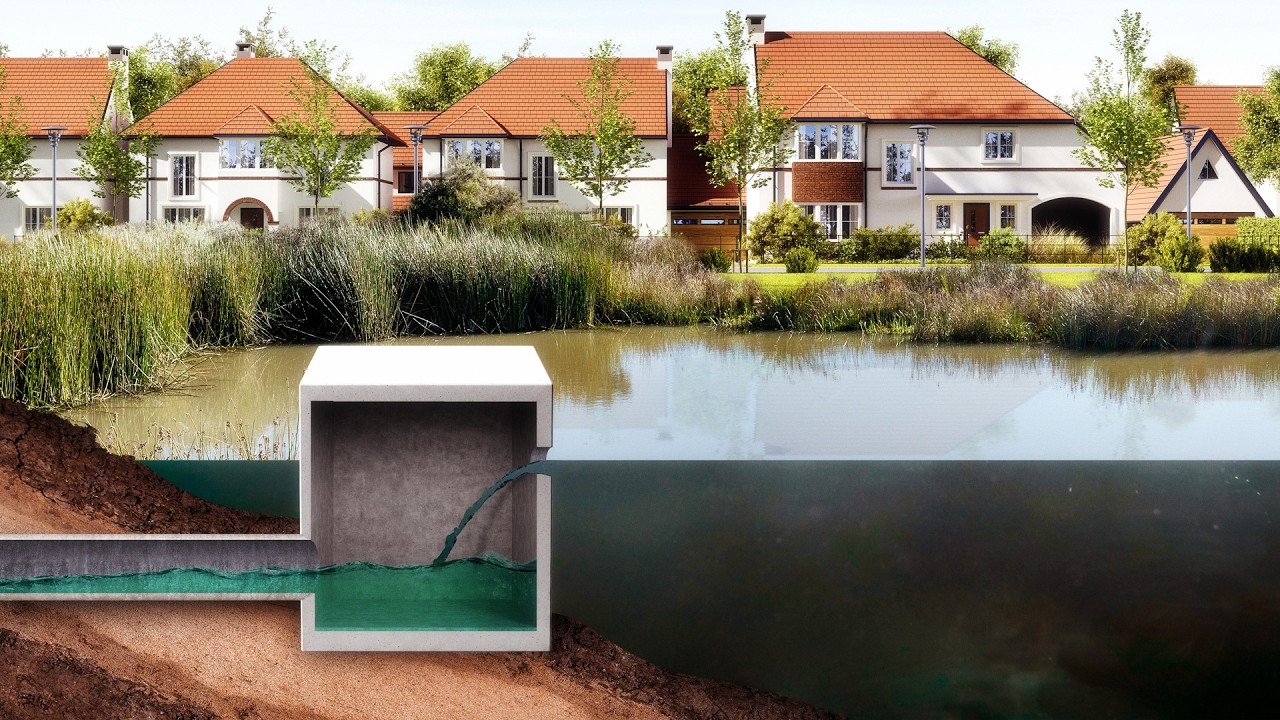
_Closed Conduit Hydraulics_ is a place where intuitions don’t always serve you well
⚙️ Check out SendCutSend for custom parts fabricated from your CAD: http://sendcutsend.com/practicalengineering
The garden hose is a backyard version of the same problem engineers and operators deal with every day: how much flow can you get through a real system, and what does it cost you in pressure?
Watch this video ad-free on Nebula: https://nebula.tv/videos/practical-engineering-the-physics-behind-the-thumb-trick
Signed copies of my book (plus other cool stuff) are available here: https://store.practical.engineering/
Practical Engineering is a YouTube channel about infrastructure and the human-made world around us. It is hosted, written, and produced by Grady Hillhouse. We have new videos posted regularly, so please subscribe for updates. If you enjoyed the video, hit that ‘like’ button, give us a comment, or watch another of our videos!
CONNECT WITH ME
____________________________________
Website: http://practical.engineering
Twitter: https://twitter.com/HillhouseGrady
Instagram: https://www.instagram.com/practicalengineering
Reddit: https://www.reddit.com/r/PracticalEngineering
Facebook: https://www.facebook.com/PracticalEngineerGrady
Patreon: http://patreon.com/PracticalEngineering
SPONSORSHIP INQUIRIES
____________________________________
Please email my agent at practicalengineering@standard.tv
DISCLAIMER
____________________________________
This is not engineering advice. Everything here is for informational and entertainment purposes only. Contact an engineer licensed to practice in your area if you need professional advice or services. All non-licensed clips used for fair use commentary, criticism, and educational purposes.
SPECIAL THANKS
____________________________________
This video is sponsored by SendCutSend.
Stock video and imagery provided by Getty Images, Shutterstock, Pond5, and Videoblocks.
Video by Grady Hillhouse
Edited by Wesley Crump
Produced by Ralph Crewe
Graphics by Nebula Studios
MUSIC CREDITS
____________________________________
Tapped Out from Epidemic Sound
Practical Engineering Theme composed by Caleb Winters (https://beacons.ai/calebwinters)
Water and Light composed by Caleb Winters
Woodland Expedition composed by Caleb Winters
Have you ever filled a bucket with water from the garden hose? It’s kind of a slow process. Or at least it feels slow while you’re standing there waiting. If you played with a garden hose at all, you know the trick of putting your thumb over the end to get a stronger jet. Obviously, the water is flowing faster with your thumb on than off. So if you do that - put your thumb over the end of the hose - to fill your bucket, do you think it’s going to fill faster, slower, or take the same amount of time? Seems like kind of an elementary question, but I found this in the online notes for a college physics class. The only issue with the professor’s answer to the question is that it was wrong. Pipes seem simple, but there are a lot of misconceptions about pipes and how they work. The field we sometimes call Closed Conduit Hydraulics is a place where intuitions don’t always serve you well. And “closed conduits” matter. Lots of essential parts of our lives depend on fluids moving through pipes. So I put together a few demonstrations in my garage to try and correct some misconceptions. Let’s take a look at what really happens inside a garden hose, or really any pipe system to gain some intuition. I’m Grady and this is Practical Engineering. The question I posed about filling up a bucket was from a lesson on continuity. The basic idea is that water isn’t very compressible. So in any closed system, there has to be the same amount coming in as there is going out. In mathematical terms, that looks like this. Velocity multiplied by a pipe’s cross-sectional area is the volumetric flow rate. So v-in, a-in is equal to v-out, a-out. The professor’s answer was that the time to fill up the bucket will be the same, regardless of whether your thumb is over the end or not. The velocity out is higher, but the area is smaller. The volumetric flow rate should be the same in both cases. It sounds reasonable. Let’s test it out and see if that’s true. I’m going to speed this up so you don’t have to suffer through the full duration. I used a big bucket to show the difference better. It’s not night and day or anything, but this makes it pretty clear that putting your thumb over the end of the hose actually slows down the flow rate. This is probably not earth-shattering news for you, but the reason for the difference is a little complicated. Just to be clear, this demonstration doesn’t violate the principle of continuity. In engineering and physics, when we use conservation rules to solve problems or answer questions, we have to be explicit about the boundaries. Usually, that means applying a control volume, a defined region of space where we can easily describe inputs and outputs of flow, energy, momentum, and so on. In my demonstration, I can define a control volume here, and it’s easy to show that the flow rate through the hose is the same as that coming out of the end. Same thing with my thumb over it: the velocity in the hose is lower than the velocity leaving, but the area of the hose is larger than the nozzle I’ve formed with my thumb, so it equals out. But you can’t apply the principle of continuity across different control volumes. In other words, these are completely different situations. And if I change this demo up a little bit, it will be more obvious. Now I have a mechanical thumb to constrict the end of the hose. In other words… a valve. Functionally, this does the exact same thing. When I turn the valve, it creates a varying obstruction across the pipe from wide open to fully closed. Let’s measure the flow rate for a full range of valve positions and see what happens. This is a chart of the data, and you can see there’s a pretty clear relationship. More restriction; less flow. This is the answer that the professor missed by assuming the flow rate IN was the same in both cases. Again, probably not earth-shattering news to anyone that when you close a valve the flow rate goes down. But you might not have ever considered, “Why? ” To answer that question, we have to look at a different conservation equation: energy. Basic physics separates energy into two forms: potential energy that is stored in some way, and kinetic energy: the energy of motion. Fluid in a pipe has both. Potential energy takes the form of pressure or elevation, kinetic energy in the form of velocity. The trick is that you can convert between types of energy, and of course, the total amount of energy in a closed system doesn’t change. And knowing this allows you to answer all kinds of questions. Let me show you an example. This is a basic hydraulic system. A tank on the left and a pipe that constricts down, then expands back out. You know I love graphs, and there is a graph that makes
Segment 2 (05:00 - 10:00)
solving closed conduit hydraulics problems a lot simpler. It’s called the hydraulic grade line, and it basically describes the potential energy in a fluid along its path. In the tank, there’s hardly any velocity, so all the energy in the fluid is potential energy. The hydraulic grade line is equal to the free surface. But once water enters the pipe, it picks up speed, so the hydraulic grade line drops down. The difference is the potential energy converted to kinetic. At any snapshot in time, we know that the volumetric flow through a pipe is constant. You really can’t have more water coming in than going out, just like we discussed with continuity. So the hydraulic grade line is constant as long as the velocity is constant. The fluid has to accelerate as it goes into the narrower pipe. That converts more of the potential energy to kinetic energy, so the hydraulic grade line drops again. Same thing on the other side. The flow slows down as it expands into the larger pipe, so you get a conversion of kinetic energy back into pressure. If this seems complicated, just remember that the hydraulic grade line is basically the answer to the question: “If I tapped a vertical riser into this part of my pipe system, how high would the fluid go up it? ” I think this is intuitive for most people. It’s Bernoulli’s principle in action. But it’s missing something that makes it impossible to apply to our garden hose demo. Let’s hook up some pressure gauges, and you’ll see what I mean. I put a pressure gauge at the beginning of the hose and one at the end. When I turn on the water, we see a pressure just under 70 psi or about 450 kilopascals at the upstream end. At the downstream end where the water’s coming out, it’s basically zero. That doesn’t jive with what we’ve learned so far about the conservation of energy. Let’s sketch out the hydraulic grade line to figure it out. Here’s our hose. It’s close enough to level that we can neglect differences in elevation, so all the potential energy is in pressure. On the upstream end, it was 70 psi, and on the downstream end, essentially zero. That makes sense because the end of the pipe is exposed to the atmosphere. You can’t really have any pressure if you don’t have a pipe. That means our hydraulic grade line looks like this. We know in a pipe with a constant cross-section that the flow velocity isn’t changing, and yet, we’re still losing potential energy along the way. Where’s it going? Well, we need to talk about losses. Of course we know energy can’t be created or destroyed, only converted from one form to another. We talked about pressure, elevation, and velocity already. But there’s also heat through friction in the system. No pipe is perfect. You’re always going to lose some energy along the way. Unlike pressure or velocity, frictional losses are unrecoverable. Once they’re lost, they’re lost. The garden hose example shows it perfectly. Let’s assume the inlet pressure is always constant. It’s not really, since there are more pipes upstream of this point in my house’s plumbing. But assuming a constant inlet pressure, this hydraulic grade line is always going to look the same. You can make the pipe smoother, rougher, longer, or shorter, wider, or narrower. As long as the shape doesn’t change along its length, you’re always going to have the inlet pressure on the left, zero pressure on the right, and a straight line connecting the two. In other words, you’re always going to lose 100% of the potential energy in the water to friction from one side to the other. How’s that possible? It’s because the flow in the pipe will speed up or slow down until it’s true. Frictional losses are roughly a function of the fluid’s velocity squared, so higher speed means more losses. Again, assuming you can maintain a constant pressure on one side of the system, in effect, what controls how much flow you can get out of the other end of the pipe is how much friction happens along the way. And, by the way, that’s kind of a tough question to answer. The friction is a function of pipe roughness and turbulence. Turbulence is a function of the flow rate, so you have to know the flow rate to calculate the friction to calculate the flow rate. So these computations usually require some iteration or at least some simplifying assumptions. I said that generally friction scales as a function of flow squared. I can show that in my demo with the pressure gauges. If this valve is closed, we get the full static pressure. There’s no movement, so there’s no frictional losses anywhere in the hose. I have the same amount of energy at the end of the hose as I do at the beginning. When I open the valve, the difference in pressure grows because the flow speeds up. And if we plot the difference in pressure as a function of flow rate, it looks something like this. Friction goes up a lot faster than velocity. But friction in a pipe isn’t the only source of energy losses. Any transition in geometry is going
Segment 3 (10:00 - 15:00)
to have losses, too. And now, we’re back to the thumb. We sometimes call pipe friction the “major” losses in a system and those at transitions “minor losses. ” Researchers have measured all kinds of situations, making it possible to estimate how a pipe system will behave, no matter how complicated it is. And the results are pretty interesting. For example, at a sharp-edged inlet into a pipe, the minor loss coefficient can be around 0. 5. A higher number means more energy lost. If you round the inlet, you can get that coefficient down to 0. 03. Huge difference. Same thing with expansions or contractions. If you have a sudden change, especially when the difference between sizes is larger, you get high loss coefficients. If you make the transition gradual, the coefficient goes down, since there’s less turbulence and gentler acceleration as the fluid changes speed. And every type of transition has an associated loss coefficient that can vary a lot depending on how smooth and consistent that transition is. In fact, valves take advantage of minor losses to give you some control over flow, and we already said that a valve is basically a mechanical thumb. I have one more demonstration to show you. I’m going to fill this tank two more times. In one case, I put a cap over the hose with a hole drilled into it. In the other, I 3D printed this nozzle that has a smooth taper from the hose diameter down to the exact same diameter I drilled in the end cap. With an understanding of minor losses, it should be an easy guess which one can flow more water. And here’s the proof. Both hoses are discharging through the same-sized hole, but the one with a smoother transition lets a lot more water through. And if you compare the 3D printed nozzle with the fully open hose, it’s not quite the same flow rate, but it’s close, and it’s a lot closer than the sharp contraction created by the cap with the hole. The point I’m trying to show with this is that a nozzle or any other type of obstruction you put in a pipe system doesn’t increase or decrease the flow from one side or the other. It just creates a loss in energy that slows down the whole system. Transitions and pipe roughness create friction, and the flow rate naturally adjusts itself until the available energy between two points is equal to that friction. And this is not necessarily intuitive. For example, we often compare water in pipes to electricity in wires: pressure is like voltage, flow rate is like current, and a narrow or rough pipe is like a resistor. That analogy works pretty well for building intuition, but it breaks down once you care about the details. In a wire, resistance is usually close to constant for a given material and temperature, so current tends to scale more neatly with voltage. In a pipe, the “resistance” isn’t a fixed number. Friction losses grow faster than the flow and can change as the flow becomes more turbulent. But of course, you can build that intuition. Think about firefighters. The operator’s job is to run the pump. They choose a throttle setting based on the pressure needed at the nozzle. How do they make that choice? Well, that depends on the diameter of the hose, the length of the hose, the elevation of the nozzle if you’re pumping up a hill or a ladder, and the characteristics of the nozzle itself. It’s important to get this right. Too little pressure at the nozzle, and you don’t get enough flow to quench the flames. Too much pressure and you can damage equipment or throw the nozzle operator around with excessive reaction forces. Firefighters learn the basics of hydraulics in training, but there are no desks with graph paper set up at a fireground to work through a bunch of engineering equations. Operators need good hydraulic instincts about how different configurations of hoses, apparatuses, and nozzles will affect the required pump settings. Even the plumbing in your house follows these same simple hydraulic principles. If you have narrow pipes, or lots of bends, turns, and transitions, you’ll definitely notice if someone flushes the toilet while you’re taking a shower. The shared lines see higher total flow, meaning more friction, meaning less pressure. I mentioned earlier that we couldn’t really assume a constant inlet pressure at my hose bib. That’s because there are a lot of pipes and transitions from that point upstream. And it’s true from my house through my service line through the water mains all the way to the water towers and high service pumps at the treatment plant. The pressure and flow rate I can get out are almost entirely a function of how much friction the water encounters along the way, which is a function of both the flow rate and the geometry of the pipes. You may even notice that your water pressure drops in the mornings or evenings when everyone in your neighborhood is using more. It’s the same issue: more flow through the water mains
Segment 4 (15:00 - 17:00)
creates more friction, converting kinetic energy into heat so you get less at the end of the line. The garden hose is a backyard version of the same problem engineers and operators deal with every day: how much flow can you get through a real system, and what does it cost you in pressure? In a perfect world, you’d convert pressure to speed and back again with no penalty, but real pipes always take a cut. Sometimes that cut is spread out over a long run of pipe. Sometimes it’s concentrated in a single valve, elbow, or your thumb. Either way, the flow rate adjusts until the available pressure is fully “spent” on those losses. Once you see it as an energy budget, the weird stuff starts making sense. I’ve been making videos like this one for more than 10 years now, which is crazy to say. And over all that time, the central thesis of Practical Engineering has always been what’s in the name: not just the theory, but how engineering is actually applied to our everyday lives. To accomplish that goal, I use these physical, real-world demonstrations, built in my garage, not only to illustrate the concepts, but to prove that the theory actually works. Some of these models are actually pretty complicated, and for the past year or so, I’ve been getting some help from today’s sponsor, Send-Cut-Send. I could buy raw materials like steel and acrylic and cut stuff out myself, and I’ve done so much of that, but just look at this. An entire idea from my head shipped to my door. The quality’s better, the cuts are way more precise than I would make, and I don’t have a day's worth of measuring, cutting, and cleaning up to do. They have a huge catalog of materials they can cut, bend, countersink, and tap, so the limit is practically what you can dream up and put into CAD. Parts are made in the USA and usually out the door in a few days, which makes rapid prototyping a dream. They just started offering CNC machining, so I’m going to have to try that out soon. I can’t recommend Send Cut Send enough. If you have projects that use sheet goods, the link below is going to give you a discount on your first order. I really appreciate their support, and I hope you give them a try. Thank you for watching, and let me know what you think.