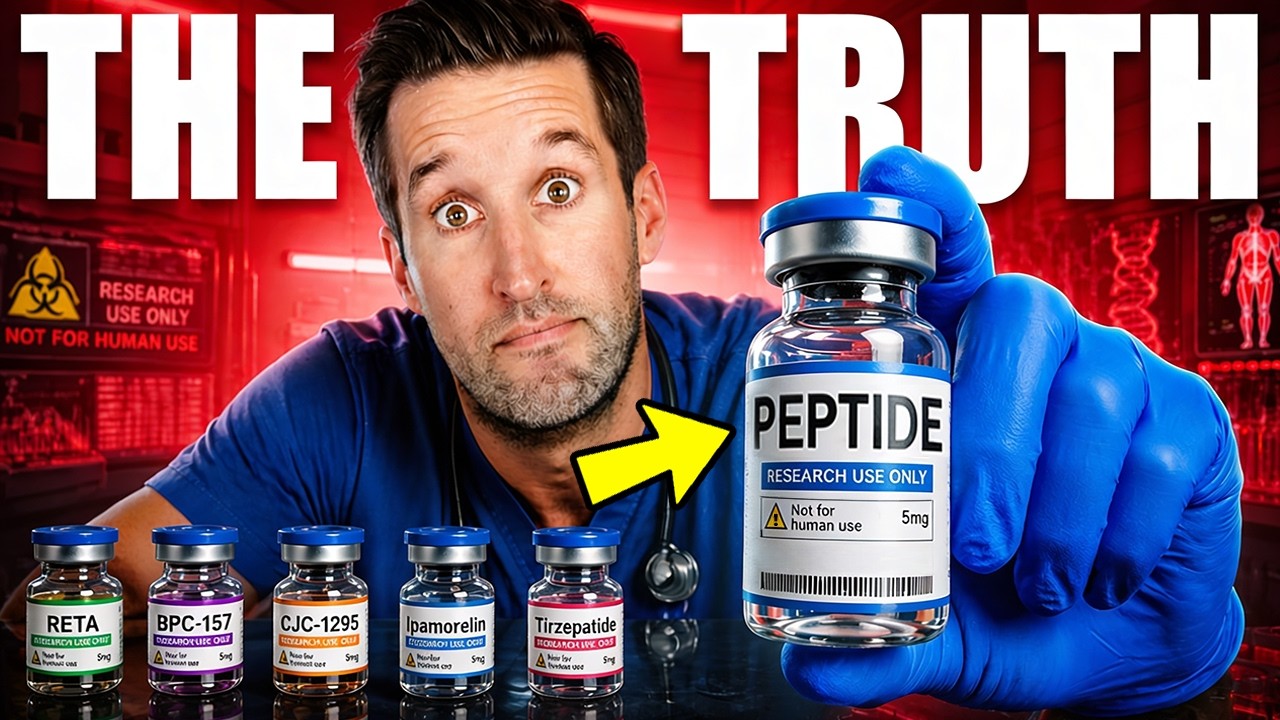
Peptides explained! Real doctor explains the truth about peptides and looksmaxxing in the fitness community. Dr. Jordan Wagner breaks down the truth about peptides, peptide therapy, and the most talked-about compounds in fitness and health, including GLP-1 medications, tirzepatide, retatrutide, GHK-Cu, BPC-157, Melanotan II, CJC-1295, and Ipamorelin. What does taking peptides do for you? Peptides are short chains of amino acids (the building blocks of proteins) that naturally exist in your body, functioning as chemical messengers to regulate various processes like tissue repair, hormone production, and immune response. Learn how peptides may impact fat loss, muscle growth, muscle building, testosterone, healthy aging, anti-aging, longevity, neuroscience, biohacking, mental health, health and wellness, and overall healthy lifestyle goals. We cover peptides for muscle growth, peptides bodybuilding, peptides for fat loss and muscle gain, peptides for weight loss, peptides for hair growth, peptides skin care, peptides for women, peptides vs steroids, BPC 157, peptides tier list discussions, and whether these compounds can really help you lose fat, build muscle, improve recovery, and support strength training.
OTHER DOCTOR VIDEOS & PEPTIDE VIDEOS I LIKE:
@Doctor Mike - Medical TikToks Doctors Can't Ignore
https://www.youtube.com/watch?v=R6h_08XKCPQ
@Doctor Mike - Doctor Fact-Checks Medical TikToks
https://www.youtube.com/watch?v=R6h_08XKCPQ
@Good Work - Silicon Valley's new miracle drug
https://www.youtube.com/watch?v=W0ltbBby9FU
@The Diary Of A CEO - Top Surgeon: The Cellular "Cheat Codes" That Got Banned (& What Happens Next)
https://www.youtube.com/watch?v=jt5hHb6kzYM
@This Is Not Covered - Dr. Ashley Froese - Dr. Explains Peptide Stacks Used for Muscle Growth
https://www.youtube.com/watch?v=yUg5RQAbeoo
@The Infographic Show - Peptides EXPLAINED
https://www.youtube.com/watch?v=NUm1X2Jvu68
🚨 SUBSCRIBE for new videos every week! ▶ https://www.youtube.com/DoctorER?sub_confirmation=1
SHOP LIFE HAPPNS SUPPLEMENTS:
Website ▶ https://lifehappns.com/
Amazon ▶ https://amzn.to/3SQoPjE
FOLLOW ME HERE:
Facebook ▶ https://www.facebook.com/DoctorER
Instagram ▶ https://www.instagram.com/doctorer/
Twitter ▶ https://twitter.com/DoctorER
TikTok ▶ https://www.tiktok.com/@doctorer
Contact email ▶ info@doctor-er.com
Doctor ER Dr. Jordan Wagner, DO
LINKS & REFERENCES:
Therapeutic peptides: current applications and future directions | NIH
https://pmc.ncbi.nlm.nih.gov/articles/PMC8844085/
What doctors want patients to know about injectable peptides | American Medical Association
https://www.ama-assn.org/public-health/prevention-wellness/what-doctors-want-patients-know-about-injectable-peptides
Peptides for Skin Care: Are They Worth It? | Cleveland Clinic Health Essentials
https://health.clevelandclinic.org/peptides-for-skin
Peptides: Emerging Candidates for the Prevention and ... | NIH
https://pmc.ncbi.nlm.nih.gov/articles/PMC11762834/
Peptides for Health Benefits 2020 - PMC - NIH | NIH
https://pmc.ncbi.nlm.nih.gov/articles/PMC9223426/
All clips and images are used for fair use commentary, criticism, and educational purposes. See Hosseinzadeh v. Klein, 276 F.Supp.3d 34 (S.D.N.Y. 2017); Equals Three, LLC v. Jukin Media, Inc., 139 F. Supp. 3d 1094 (C.D. Cal. 2015)
If you feel like you are actually experiencing a real-life medical emergency, immediately stop watching and call 9-11 or contact a medical professional. The information in this video is not intended or implied to be a substitute for professional medical advice, diagnosis, or treatment. The satirical nature presented in the video is for entertainment purposes and does not endorse the actions displayed. All content, including text, graphics, images, and information, contained in this video is for general information purposes only and does not replace an appointment with your own personal doctor.
Оглавление (2 сегментов)
Segment 1 (00:00 - 05:00)
- Fat-melting injections, compounds named the Wolverine peptide, and biohackers online claiming they've basically hacked aging itself. Right now, peptides are absolutely everywhere. Gym influencers injecting mystery compounds, Silicon Valley biohackers spending thousands on longevity stacks. We've got peptides for weight loss, muscle growth, focus, and, honestly, some of the science here is genuinely fascinating. So today we're diving into five of the biggest peptides online right now. All right, let's dive right in. (camera clicking) What are peptides? The word peptide sounds futuristic and intimidating, but, biologically, they're actually pretty simple. Peptides are short chains of amino acids, tiny fragments of protein, and your body already naturally uses them all the time. They help regulate things like hormones, appetite, metabolism. So the idea behind peptide therapy is actually pretty straightforward. If the body already uses these signaling molecules naturally, can we create versions that amplify certain biologic effects? And, in some cases, absolutely yes, but, online, the peptide world has evolved into this bizarre intersection of medicine, fitness culture, and internet biohacking, and, medically, that's where things start getting complicated. Some have strong clinical research and FDA oversight behind them. Others have almost no long-term human safety data whatsoever, and, online, those two categories constantly get blended together like they're the same thing when they absolutely are not. Number 5, copper peptides. Let's start with one of the more medically-grounded peptide categories out there. If you spend any time on skincare or anti-aging YouTube, you've probably heard people talking about GHK-Cu, also known as the copper peptide. GHK-Cu is a naturally-occurring copper-binding peptide already found in the human body. Researchers became interested in it because copper plays a role in tissue repair, collagen production, inflammation regulation, and wound healing. The theory behind copper peptides is that they may help signal the skin to repair itself more effectively through collagen signaling and tissue-remodeling pathways. Most people encounter copper peptides through topical products like cream serums or microneedling routines, but, more recently, an injectable version has also started appearing in peptide clinics and anti-aging spaces, and, importantly, injectable GHK-Cu is not FDA approved specifically for anti-aging or cosmetic use. The science is interesting. The marketing is just sometimes a little ahead of reality. But, overall, from a medical standpoint, copper peptides probably fall much closer to evidence-informed cosmetic science rather than experimental biohacking. Number 4, Melanotan II. Now we move into one of the stranger corners of the peptide world, also known online as the tanning peptide. So what exactly is this stuff? Melanotan II is a synthetic peptide originally developed to stimulate melanin production in the body. Melanin is the pigment responsible for skin color and tanning response. The original idea was if you could stimulate melanin pathways artificially, maybe you can increase pigmentation while potentially reducing UV-related skin damage. The problem is those receptors don't only affect skin color, which is why the side effects can get a little weird. We're talking nausea, flushing, fatigue, appetite suppression. Now, one of the biggest reasons dermatologists are cautious about Melanotan II is because it is not FDA approved, and long-term human safety data remains limited. And, like many online peptides, sourcing and quality control remain major concerns. There have been reports involving rapid darkening of moles, new pigmented lesions, and unusual pigmentation changes after use. Now, to be clear, this does not mean scientists have proven Melanotan causes melanoma or skin cancer, but the concern is significant enough that many dermatologists remain very cautious about the compound because, online, Melanotan often gets marketed casually like bronze skin cheat code. Meanwhile, medically, we're talking about an unapproved synthetic peptide that alters pigmentation pathways and still lacks strong long-term human safety data. Number 3, CJC-1295 and Ipamorelin. Now we officially enter the kingdom of gymbro science, CJC-1295 and Ipamorelin are two of the most popular performants in anti-aging peptides online because they're designed to stimulate growth hormone release, and this is where the internet really starts promising superhero-level results. So what are they exactly doing? CJC-1295 is a synthetic analog of growth hormone-releasing hormone. Ipamorelin works a little different. It acts through the ghrelin receptor pathway which also stimulates growth hormone release. The biggest questions people ask online are: "Does it build muscle? "Does it burn fat? "Is it safe? " And, medically, the reality is probably somewhere
Segment 2 (05:00 - 09:00)
in the middle. There is real endocrine science here, but the evidence for dramatic anti-aging or body transformation effects is still much weaker than the internet makes it sound. There are also real risks to manipulating growth hormone pathways unnecessarily: water retention, bloating, joint pain, headaches, and injection site reactions. The FDA has also specifically flagged CJC-1295 for adverse events involving increased heart rate and vasodilatory reactions. There is legitimate endocrine science behind these compounds, but there's still a huge difference between interesting hormone research and proven anti-aging therapy. From a medical standpoint, CJC-1295 and Ipamorelin fall into a much more cautious category than copper peptides. Number 2, BPC-157. Now we arrive at probably the most famous internet peptide of them all, also known online as the Wolverine peptide. People online claim BPC-157 can accelerate tendon healing, muscle recovery, and injury recovery, and, honestly, some of the early animal research actually is intriguing. What exactly is it? BPC stands for Body Protection Compound, and BPC-157 is a synthetic peptide fragment derived from a protein found in gastric juice. Researchers originally became interested in it because of the possible healing-related effects in the gastrointestinal tract. Now, the biggest questions online are usually: "Does BPC heal injuries? "Can it heal the gut? "Is it safe? " And, of course, "Is it legal? " And technically that answer gets a little weird because despite all the hype online, BPC-157 is not FDA approved for human use in the United States. It's also banned by the World Anti-Doping Agency. Researchers have looked at possible effects involving blood vessel formation, inflammation regulation, and tissue remodeling. But here's the important medical reality check. Most of this data is still preclinical. We do not currently have large high-quality long-term human clinical trials proving BPC-157 safely accelerates healing the way the internet often claims. It's not necessarily fake science. There is legitimate biologic interest in BPC-157, but medically it still falls much closer to experimental regenerative medicine rather than proven mainstream therapy. Number 1, GLP-1s. And, finally, we arrive at the peptide category that has completely reshaped the conversation around obesity, diabetes, appetite regulation, and metabolic health. Ozempic, Wegovy, Mounjaro. At this point, even people who know absolutely nothing about peptides have probably heard at least one of those names, but, unlike many of the experimental compounds earlier in this video, these medications have massive amounts of clinical research behind them. GLP-1 stands for Glucagon-Like Peptide-1 which is a hormone your body naturally produces after eating. It helps regulate insulin release, blood sugar control, digestion, and feelings of fullness. Now, medically, this category is very different from some of the underground peptides floating around online. These are FDA-approved medications backed by massive clinical trials showing meaningful effects in obesity treatment, diabetes management, cardiovascular risk reduction, and metabolic health. While these medications can be incredibly effective, they are still powerful drugs with real side effects and risk that require proper medical supervision. Another major issue recently has involved compounded or counterfeit GLP-1 products. Because demand became so high that shortages pushed some people toward compounding pharmacies, medical spas, online sellers, the FDA has issued warnings involving dosing errors, contamination concerns, and hospitalizations associated with improperly compounded GLP-1 products. Are GLP-1s magic? No. Can they be incredibly effective tools for the right patient under proper medical supervision? Absolutely. All right, that was a quick dive into some of the biggest peptides on the internet. If you guys want a Part 2 covering the weirdest and most experimental peptides floating around online right now, let me know down in the comments. Don't forget to subscribe. Turn on your notifications. And binge watch this playlist right here. Thank you so much for watching, and stay healthy, my friends.