For 72 hours, enjoy 15% OFF on all Hoverpens with code COOLWORLDS, or click on the link https://noviumdesign.shop/CoolWorlds - Free shipping to most countries. Also on Amazon: https://noviumdesign.shop/1HrMzs
We've all the heard headlines of scientists claiming evidence of alien life, but time and time again it turns up bust. Why does this keep happening? And will we ever be able to break out of this cycle? Our new research paper tackles this profound question, and outlines a possible way out...
Written & presented by David Kipping
→ Support our research: https://www.coolworldslab.com/support
→ Get merch: https://crowdmade.com/collections/cool-worlds
→ Check out our podcast: www.youtube.com/@CoolWorldsPodcast
THANK-YOU to S. Shardool, M. Seay, M. McMillan, M. Popovski, M. Singh, M. Elliott, M. Donkin, M. Zajonc, M. Czirr, M. Williams, M. Daughaday, M. Muriuki, M. Cartmell, M. Ford, M. Devermont, M. Hedlund, M. Patterson, M. Murphy, M. Bassnett, M. Lovely, M. Schiff, M. Bylinsky, C. Fitzgerald, M. Danielson, M. Morrow, M. Corwin, M. Schreiner, M. Metts, M. Stevenson, M. Vystoropskyi, M. Brownlee, M. Shamp, M. Sattler, M. Ross-Lee, M. Bueche, M. Fitzsimmons, M. Borisoff, M. Larter, M. Cunningham, M. Williams, M. Alley, M. Adler, M. Murray, L. Deacon, M. Kruger, M. Bryant, M. Lee, P. Johnston, M. Sanford, N. Offor, M. Saint, R. Borbidge, M. Reese, M. Langley, M. Howard, M. Stewart, M. Morrison, M. Kennedy, M. Aron, M. Rockett, M. Kingston, M. Daniluk, M. Schoen, M. Lee, M. Huch, M. Chaffee, M. Simmons, M. Herman, M. Vaal, M. Canning, M. Kochkov, M. Fullwood, G. Belsak, M. Bergman, M. Armstrong, M. Bottaccini, M. Farabee, B. Gaalen, M. Haan, M. Hoffman, E. Garland, M. Everest, M. Venzor, M. Frederick, M. Peraza, W. Ruf, M. Matters, M. Smith, M. Hansen, M. Edris, M. Souter, M. Smith, M. OBrien, M. Provost & M. Nimmerjahn.
PAPER
Check out my paper at https://arxiv.org/abs/2605.02969
MUSIC
Licensed by SoundStripe.com (SS) [shorturl.at/ptBHI], Artlist.io, via CC Attribution License (https://creativecommons.org/licenses/by/4.0/) or with permission from the artist. You can see all of our past music here: https://open.spotify.com/playlist/0Bu2UQlKDb0KaeliLZUOZn
0:00 Falls - Life in Binary
1:52 Sid Acharya - Searching for Answers
5:06 Atlas - Waking Up
6:28 Brad Hill - World of Wonder
7:46 Chris Zabriskie - Music from Neptune Flux 01
8:28 Scott Buckley Dragon’s Lullabye
10:33 Hill - It Wasnt Mine To Begin With
14:10 Hill - Don’t Think
20:20 Hill - When Darkness is No Longer Dark
23:44 Hill - Mourning Wakes
CHAPTERS
0:00 The Cycle of False Hope
1:53 A Century of Alien Claims
5:07 Why This Keeps Happening
6:28 Novium
7:47 It’s all Aliens!
8:28 -A Claim of Last Resorts
10:33 Unknown Unknowns
11:59 The Phosphine Case Study
18:04 A/B Testing
21:15 High Stakes Experiments
23:45 Final Thoughts
24:32 Outro
#Aliens #Astrobiology #CoolWorlds
People often wonder, what would it feel like to wake up and learn that alien life had been discovered, that we are not alone? What would that day mean to us? How would we handle the news? Well, the truth is, you don't have to wonder. We already know how people would feel about this because it is already happened, many times in fact. Credible scientists have been claiming evidence for alien life for over a century already. Yes, I said a century. — In 1906, the New York Times ran this headline on its front page, "There is life on planet Mars. " To quote, "There can be no doubt that living beings inhabit our neighbor world. " If nothing else, it is a startling piece of journalism. I mean, think about it. There are no ifs or buts in that headline. It is treated as a completely factual statement that aliens exist. And the claimant, Percival Lowell, is no charlatan. He was a respected astronomer of his day. He claimed to see lines on Mars, which he interpreted to be a canal system, a story which we explored in a previous video and one of my personal favorites. Now, I get it. Like, to me and you, the idea of canals as some kind of advanced techno-signature is absurdly antiquated. But, in 1906, canal systems were being constructed across the planet. And so, who knows? Maybe our descendants will laugh at the notion of building AI data centers in much the same way. In any case, we now know that Lowell was objectively wrong in his conclusions, but his claim was just one of a long line of such alien claims that continue up to this day. I'm
Sid Acharya - Searching for Answers
glad to be joined by my science and technology advisor, Dr. Jack Gibbons, to make a few comments about today's announcement by NASA. Today, rock 84001 speaks to us across all those billions of years and millions of miles. It speaks of the possibility of life. If this discovery is confirmed, it will surely be one of the most stunning insights into our universe that science has ever uncovered. Its implications are as far-reaching and all inspiring as can be imagined. In 1996, geologist David McKay claimed that this image, taken with an electron microscope of a Martian meteorite, was in fact an alien fossil, a tiny microscopic creature that once lived on Mars. Much like Percival Lowell, McKay's claim was largely based on visual appearance. The thing just simply looks like it might have been an organism, and the story caused such a media sensation that President Bill Clinton stood on the White House lawn and openly discussed the finding, a breathtaking moment that I vividly remember watching as a child. But, soon after, it was found that similar-looking features could be produced in the lab with no life involved, and thus the so-called fossil is widely considered today to have been produced by the aqueous alteration of basalt rock by hydrothermal fluids, not living creature. And if anything, this cycle of alien claims has only accelerated in recent years, and I'm sure you have seen some of these, such as Oumuamua, 3I Atlas, Venusian phosphine, and dimethyl sulfide in an exoplanetary atmosphere. And frankly, it has become pretty frustrating to see this play out over and over again. Every time we hear news of a possible alien claim, we get our hopes up. We think to ourselves, this could be the one. And every time it ends up being another disappointment. It feels like we're stuck in some kind of Buddhist cycle of endless suffering of rebirth and death. I just don't know how many more heartbreaks like this I can honestly take. I don't want to be stuck in a perpetual Groundhog Day of false summits. I want truth. I want to break out of this cycle and touch enlightenment. And so, for the last year or so, I've been asking myself this question. Why does this keep happening? And how can we stop it? This was a very important research project for me personally because not only is it a subject which, as you know, I am deeply passionate about, but it also forced me to grapple with some of the most challenging questions I've ever come across. Now, the paper is now done. It's sent out for review. And in a nutshell, it really does formalize just why this keeps happening over and over again. And it explores a strategy for redemption. A possible pathway to breaking out of this karmic cycle.
Atlas - Waking Up
If these letters aren't important, why do you keep reading them? I don't know. Maybe I'm just trying to understand something. What? Why we keep making the same mistakes over and over. The most cynical answer to this question, and I'm sure it is an answer that many of you are thinking right now as you watch this video, is that the scientists involved here were just bad actors. That they manipulated their data. They exaggerated their claims. They knowingly deceived the public because at the end of the day, discovering alien life would make you the most famous scientist of all time. Even if you were later disproved, it might pave the way for a lucrative career of writing books, private lectures, and swooning billionaires. Look, you can definitely make that cynical argument, but I'm not going to. Now, call me naive, but I believe that most scientists are basically good people. Their science is driven by genuine passion, curiosity, and wonder. And so, if the scientists involved are not at fault, then it must be something deeper than that. And that something must be the very framework that we are using to try and answer these questions. Before we explore what
Brad Hill - World of Wonder
this problem is, I want to give a big thanks to Novium for sponsoring today's episode, who make what could be called arguably the coolest pens on the market. These gravity-defying creations are laced with magnets to keep them hovering on your desk, like something out of a science-fiction movie. This right here is the Hoverpen Future model, which you can spin or nudge, and it just elegantly holds in place. Now, these are beautiful to write with, but also just to admire on your desk. They also make for the perfect gift for those people who seem to have everything. Classy, but unique, and a way for them to think of you each day. Another beauty is the Hoverpen Interstella, which has an 18-karat gold-plated ring and an embedded meteorite. How many pens can say that? Just be careful before claiming your meteorite contains life. So, to get yours, head to noviumdesign. shop/coolworlds and use my discount code coolworlds for 15% off their entire lineup, but only for the next 72 hours. Links down below in the description. Once again, that's noviumdesign. shop/coolworlds and make sure you use the code Cool Worlds for 15% off. Now, back to the
Chris Zabriskie - Music from Neptune Flux 01
video. The first thing we have to acknowledge about alien life, however complex it may be, is that it is a pretty weird hypothesis because it can explain, well, anything. What caused that star to flicker for a brief moment? Aliens. What caused that planet's atmosphere to contain more of chemical X than we might expect? Aliens. What caused that flash of light in the sky by your house last night? Aliens. Thousands of years ago, our ancestors lacked our modern understanding of biology, chemistry, and physics, and so the mysteries of the world were often explained by gods, deities, fairies, and other supernatural entities.
Scott Buckley Dragon’s Lullabye
It's not the season for lightning. Picardo's angry with us. God was the ultimate band-aid hypothesis. It could trivially explain any gaps in our knowledge. And by comparison, when we look at today, we have scientists who see anomalies that they can't explain, such as lines in Mars, worm-like structures in rock, curiously shaped asteroids, and we don't invoke God, but instead aliens. But fundamentally, the explanatory power of both of these ideas is the same. It's total. — But it is also intellectually lazy. I mean, why bother to stay up late in the lab doing the hard work of figuring out why it is that, say, 3 Atlas has an anomalously large amount of nickel when instead you could just shout aliens and call it a night. So, aliens comes pre-packaged with this outrageous flexibility when it comes to explanatory power, and many scientists recognize that, and thus aliens has become the hypothesis of last resort. — In this vein, astrophysicist Avi Loeb has often said that he adopts a kind of Sherlock Holmes approach to science. When you have eliminated all which is impossible, then whatever remains, however improbable, must be the truth. This sounds perfectly reasonable on paper, but it has a big problem, and that is that when we detect some new anomaly, we do not have a complete list of possible explanations. There is always a bunch of stuff that we just simply have never thought of before. Put another way, we have to concede that we are not omniscient beings. Let's be humble for a moment and acknowledge that we still have a lot to learn about the basic sciences, about the universe, other planets, and even our own. For all we know, that anomaly that we just detected, however strange it might appear, may simply be some natural process that we have yet to imagine. As
Hill - It Wasnt Mine To Begin With
we know, there are known knowns. There are things we know we know. We also know there are known unknowns. That is to say, we know there's some things we do not know. But there are also unknown unknowns, the ones we don't know we don't know. And if one looks throughout the history of our country and other free countries, it is the latter category that tend to be the difficult ones. The truth is that until we complete science, until our knowledge of the universe and its laws are total and absolute, it is simply untenable to argue that an anomaly must be aliens because we don't understand it. It is precisely analogous to how our ancestors reasoned that a sun god was the only explanation for why our sun moves across our sky each day. That doesn't make them stupid, they just didn't know what they didn't know, and neither do we. And historically, every time that a scientist has claimed aliens in the past, it has turned out to be exactly this, an unknown unknown, what we might technically call a confounder. Percival Lowell didn't know about Gestalt reconfiguration, the psychological effect where our brains see patterns that don't exist. Dave McKay didn't know that worm-like rock formation could be forged by water alone. And again, it's not their fault that they didn't know things that hadn't been discovered yet. One recent example of this was the swirl of excitement that we had about the possibility of life in the clouds of Venus, a story that we discussed on this channel as it broke. The tale began in 2019 when astrobiologist Clara Sousa Silva described how on Earth phosphine is produced by organisms in anaerobic ecosystems, and there exists no known abiotic false positives for this gas in rocky planets. So, no confounders. And what do you know, next year astronomer Jane Greaves and colleagues reported evidence for phosphine in a rocky planet atmosphere, and it was Venus. A debate still rages about the reality of that signal, but assuming it's real, biochemist William Bains posted an accompanying paper with this title. Phosphine on Venus cannot be explained by conventional processes. Now, a better title would have been to have said known conventional processes because over the next few years, three, yes, three separate processes were discovered as explanations. Volcanogenic phosphide hydrolysis, radical mediated phosphate reduction, and photochemical radical reduction of oxidized phosphorus. Try saying those three times over fast. The real point is that it was the same old story. It was the unknown unknowns that flummoxed them. Look, we have to concede that theorists are just a very imaginative group of people, and when someone like Bains posts a paper saying there is no way you can do this, they revel in devoting months of their lives to proving that wrong. So, who's at fault here? Well, again, I'm going to avoid the cynical take and argue that no one really is. It is a combination of the unbounded flexibility of the alien hypothesis and our incomplete understanding of nature itself. The very framework in which we are trying to answer these questions is clearly not up to the task. Loeb, McKay, Bains, they're all just following the standard scientific recipe we were all taught at university, but that approach just simply doesn't work here because time and time again it produces spurious
Hill - Don’t Think
claims. Now, to some extent one could argue this is just exactly how science is supposed to work. Claims are made, the community applies skepticism to those claims, and then only ideas which survive that intense scrutiny go on and persist as rational ideas. — But, I do think this is actually quite different because not only is alien such a high-stakes claim, but also as we've already seen, the alien hypothesis has this unique combination of being not only incredibly flexible, but also suffering from this epistemic crisis of unknown unknowns. Now, has to be said that one trivial way out of this mess is to look for signals that we feel really confident have no confounders even under the shadow of unknown unknowns. So, you know, for example, a pulsed laser beam with a compressed video transmission encoded within it is categorically artificial. It's very hard to imagine how a natural process could possibly do that. But, on the other hand, atmospheric biosignatures aren't like that. They are information-poor chemical markers. Lee Cronin and Sara Imari Walker have argued that assembly theory can help here because life often makes a large number of very complex molecules that just don't occur without it. But the practical problem with this is that complex molecules are by their very nature heavy and thus non-volatile. Therefore, they will not appear in the upper atmospheres of exoplanets when we are looking at them with our telescopes. And this is important because looking for life in exoplanet atmospheres is exactly the method that NASA is betting on with the Habitable Worlds Observatory. This will be the successor to JWST taking images of Earth-like planets in the 2040s to search for gases like oxygen, methane, and phosphine. Even today, way before HWO launches, we already know for all of those aforementioned biosignature gases of natural confounders that could trick us. And so, recently emphasis has switched to talking about using constellations of them in unison or building sophisticated chemical networks that can kind of add in planetary context for interpreting them. But both of those approaches still suffer from the same basic epistemic problem that has haunted us for over a century already. And that is that we don't know what we don't know. And that will always be true. So, if for example, HWO discovers a planet with methane and oxygen at abiotic levels, would you really bet against a theorist publishing a paper the next year or two coming up with some novel geochemical pathway to its emergence? Or even worse, no one can think of an alternative and yet we're still wrong because it was produced in a manner simply beyond our imagination. Hearing into a crystal ball of the future, I have to admit to having a deep fear. You know, when HWO flies, if it flies, I will be in my 60s, perhaps even older than that. And so that means there's been 20 plus years between these NASA flagship missions. That in turn means that this mission would likely be the last and only experiment in my lifetime that will attempt to look for alien biosignatures. So, I can't afford for it to mess up. It really has to work that first time. And that is deeply fearful because I really want to know the answer to the alien question in my lifetime. I'm sure many of you feel the same way. And we can imagine what H 2 O might find. A committee could agree that the ideal biosignature is some constellation of biotic molecules, and they go out and survey, say, a couple of dozen planets for that signature. Let's say that eight of them return a yes. So, 1/3 of the sample have biosignatures. Great. But okay, here's the real question though. Does that mean that 1/3 of them have life? Or does it some weird, unknown geochemistry producing that signature, a confounder, something we simply hadn't thought of? Sadly, it's completely ambiguous. There is just no way to distinguish between those two possibilities. We will be stuck in ambiguity, and I just can't live with that. I want to know the answer. The crucial thing to understand is that there are in fact two ways of getting a positive detection, a confounder or genuine life. And in a single population of planets where, say, X percent show that signature, there is a pure degeneracy between those two pathways. Now, I don't think that we have to reinvent the wheel here to solve this dilemma. We all know that control samples, such as placebo groups, form a crucial pillar of scientific reasoning in medical experiments, for example. So, what if we had two samples of planets, a control group and a test group? So, here the control group could be a group of planets for which we know with certainty there is no life on them. And then, we simply count up how often they produce biosignatures to measure the confounder rate. Next, we look at the test group, count up the fraction of worlds with biosignatures, and simply subtract off the confounder rate that we found before in order to get at the true answer. Now, the reason why astronomers don't usually think like this is because it is typically impossible for us to define such a control sample, because hey, we cannot control planets and stars. There is simply no way for me to define a group of exoplanets which I know with 100% certainty there is no life. I mean, we can't even agree whether Mars or Venus has life on it or not. Now, yes, you could take a group of, say, extremely hot or cold exoplanets and simply assume that life is impossible there, but even that doesn't really help you because surely the chemistry and thus the confounder rate on those
Hill - When Darkness is No Longer Dark
planets would be radically different from that of Earth-like planets. A softer approach to control samples is AB testing, a concept familiar to you many of you YouTubers out there because that's how we often try thumbnails against one another. Now, here the concept of AB testing could look something like this. First, divide the target sample of planets into two groups, A and B. The requirement for this split is strict and it is twofold. A and B have to have the same confounder rate, but a different life rate. That's it. If you can do that, my paper shows rigorously, with, yes, a lot of Bayesian math, that you can indeed make strong claims for life. When I first realized this solution, it was an enormous relief because simply by adjusting the strategy of a mission like HWO, we could finally break the cycle. We could finally answer the alien question. But, if you think about it a little bit more deeply, it's not obvious that my solution will actually work. There are serious questions here that need to be addressed to make this actually viable. At the most basic level is a question of how do you actually do this AB split? Certainly, just doing a random split is not going to work because then populations A and B would have roughly the same amount of life in them, thereby violating one of our two criteria for this whole strategy to work. And so, if we are not going to do a random split, then we have to do a physically motivated split. So, consider for example, a split that was based on temperature. A could be the planets that are close to the inner edge of the habitable zone and B are the planets close to the outer edge. Now, I think it's pretty reasonable here to expect a different occurrence of life, but surely the chemistry of those populations are also going to be different because the temperature is different. Different chemistries mean the confounder rate won't be the same. So, as you can see, this problem actually feels somewhat inextricable because life is essentially just chemistry. And so, if I make any split between these two populations that changes the life rate, it surely changes the chemistry in some way, which therefore would also change the confounder rates because those are mostly chemical confounders anyway. So, I got kind of stuck here and to be honest, I would really love to hear your thoughts and ideas for how to make this cut. For me, the best idea I've come up with so far is to think about dynamics as a possible solution. So, the way this works would be that you could take systems that have two planets in the habitable zone versus systems with just one. If the planetary sizes and temperature distributions are approximately the same, then it would seem reasonable to expect the same confouder rate. But, if panspermia operates, then life could hop between the planets. Then, we might expect a difference in their underlying life rates. That is my best bet right now, but I have to admit even that has some concerns. I mean, could you realistically ever even have a sample of multi-haplosome planets large enough to realistically do this experiment? And could the mere presence of neighboring planets somehow affect the chemistry on those worlds, for instance, through the meteorite rate or something, for instance? So, there are definitely lots of concerns left. But fortunately, we have decades before HTL will launch, and
The Cycle of False Hope
People often wonder, what would it feel like to wake up and learn that alien life had been discovered, that we are not alone? What would that day mean to us? How would we handle the news? Well, the truth is, you don't have to wonder. We already know how people would feel about this because it is already happened, many times in fact. Credible scientists have been claiming evidence for alien life for over a century already. Yes, I said a century. — In 1906, the New York Times ran this headline on its front page, "There is life on planet Mars. " To quote, "There can be no doubt that living beings inhabit our neighbor world. " If nothing else, it is a startling piece of journalism. I mean, think about it. There are no ifs or buts in that headline. It is treated as a completely factual statement that aliens exist. And the claimant, Percival Lowell, is no charlatan. He was a respected astronomer of his day. He claimed to see lines on Mars, which he interpreted to be a canal system, a story which we explored in a previous video and one of my personal favorites. Now, I get it. Like, to me and you, the idea of canals as some kind of advanced techno-signature is absurdly antiquated. But, in 1906, canal systems were being constructed across the planet. And so, who knows? Maybe our descendants will laugh at the notion of building AI data centers in much the same way. In any case, we now know that Lowell was objectively wrong in his conclusions, but his claim was just one of a long line of such alien claims that continue up to this day. I'm
A Century of Alien Claims
glad to be joined by my science and technology advisor, Dr. Jack Gibbons, to make a few comments about today's announcement by NASA. Today, rock 84001 speaks to us across all those billions of years and millions of miles. It speaks of the possibility of life. If this discovery is confirmed, it will surely be one of the most stunning insights into our universe that science has ever uncovered. Its implications are as far-reaching and all inspiring as can be imagined. In 1996, geologist David McKay claimed that this image, taken with an electron microscope of a Martian meteorite, was in fact an alien fossil, a tiny microscopic creature that once lived on Mars. Much like Percival Lowell, McKay's claim was largely based on visual appearance. The thing just simply looks like it might have been an organism, and the story caused such a media sensation that President Bill Clinton stood on the White House lawn and openly discussed the finding, a breathtaking moment that I vividly remember watching as a child. But, soon after, it was found that similar-looking features could be produced in the lab with no life involved, and thus the so-called fossil is widely considered today to have been produced by the aqueous alteration of basalt rock by hydrothermal fluids, not living creature. And if anything, this cycle of alien claims has only accelerated in recent years, and I'm sure you have seen some of these, such as Oumuamua, 3I Atlas, Venusian phosphine, and dimethyl sulfide in an exoplanetary atmosphere. And frankly, it has become pretty frustrating to see this play out over and over again. Every time we hear news of a possible alien claim, we get our hopes up. We think to ourselves, this could be the one. And every time it ends up being another disappointment. It feels like we're stuck in some kind of Buddhist cycle of endless suffering of rebirth and death. I just don't know how many more heartbreaks like this I can honestly take. I don't want to be stuck in a perpetual Groundhog Day of false summits. I want truth. I want to break out of this cycle and touch enlightenment. And so, for the last year or so, I've been asking myself this question. Why does this keep happening? And how can we stop it? This was a very important research project for me personally because not only is it a subject which, as you know, I am deeply passionate about, but it also forced me to grapple with some of the most challenging questions I've ever come across. Now, the paper is now done. It's sent out for review. And in a nutshell, it really does formalize just why this keeps happening over and over again. And it explores a strategy for redemption. A possible pathway to breaking out of this karmic cycle.
Why This Keeps Happening
If these letters aren't important, why do you keep reading them? I don't know. Maybe I'm just trying to understand something. What? Why we keep making the same mistakes over and over. The most cynical answer to this question, and I'm sure it is an answer that many of you are thinking right now as you watch this video, is that the scientists involved here were just bad actors. That they manipulated their data. They exaggerated their claims. They knowingly deceived the public because at the end of the day, discovering alien life would make you the most famous scientist of all time. Even if you were later disproved, it might pave the way for a lucrative career of writing books, private lectures, and swooning billionaires. Look, you can definitely make that cynical argument, but I'm not going to. Now, call me naive, but I believe that most scientists are basically good people. Their science is driven by genuine passion, curiosity, and wonder. And so, if the scientists involved are not at fault, then it must be something deeper than that. And that something must be the very framework that we are using to try and answer these questions. Before we explore what
Novium
this problem is, I want to give a big thanks to Novium for sponsoring today's episode, who make what could be called arguably the coolest pens on the market. These gravity-defying creations are laced with magnets to keep them hovering on your desk, like something out of a science-fiction movie. This right here is the Hoverpen Future model, which you can spin or nudge, and it just elegantly holds in place. Now, these are beautiful to write with, but also just to admire on your desk. They also make for the perfect gift for those people who seem to have everything. Classy, but unique, and a way for them to think of you each day. Another beauty is the Hoverpen Interstella, which has an 18-karat gold-plated ring and an embedded meteorite. How many pens can say that? Just be careful before claiming your meteorite contains life. So, to get yours, head to noviumdesign. shop/coolworlds and use my discount code coolworlds for 15% off their entire lineup, but only for the next 72 hours. Links down below in the description. Once again, that's noviumdesign. shop/coolworlds and make sure you use the code Cool Worlds for 15% off. Now, back to the video. The first thing we have to
It’s all Aliens!
acknowledge about alien life, however complex it may be, is that it is a pretty weird hypothesis because it can explain, well, anything. What caused that star to flicker for a brief moment? Aliens. What caused that planet's atmosphere to contain more of chemical X than we might expect? Aliens. What caused that flash of light in the sky by your house last night? Aliens. Thousands of years ago, our ancestors lacked our modern understanding of biology, chemistry, and physics, and so the mysteries of the world were often explained by gods, deities, fairies, and other supernatural entities.
A Claim of Last Resorts
It's not the season for lightning. Picardo's angry with us. God was the ultimate band-aid hypothesis. It could trivially explain any gaps in our knowledge. And by comparison, when we look at today, we have scientists who see anomalies that they can't explain, such as lines in Mars, worm-like structures in rock, curiously shaped asteroids, and we don't invoke God, but instead aliens. But fundamentally, the explanatory power of both of these ideas is the same. It's total. — But it is also intellectually lazy. I mean, why bother to stay up late in the lab doing the hard work of figuring out why it is that, say, 3 Atlas has an anomalously large amount of nickel when instead you could just shout aliens and call it a night. So, aliens comes pre-packaged with this outrageous flexibility when it comes to explanatory power, and many scientists recognize that, and thus aliens has become the hypothesis of last resort. — In this vein, astrophysicist Avi Loeb has often said that he adopts a kind of Sherlock Holmes approach to science. When you have eliminated all which is impossible, then whatever remains, however improbable, must be the truth. This sounds perfectly reasonable on paper, but it has a big problem, and that is that when we detect some new anomaly, we do not have a complete list of possible explanations. There is always a bunch of stuff that we just simply have never thought of before. Put another way, we have to concede that we are not omniscient beings. Let's be humble for a moment and acknowledge that we still have a lot to learn about the basic sciences, about the universe, other planets, and even our own. For all we know, that anomaly that we just detected, however strange it might appear, may simply be some natural process that we have yet to imagine. As
Unknown Unknowns
we know, there are known knowns. There are things we know we know. We also know there are known unknowns. That is to say, we know there's some things we do not know. But there are also unknown unknowns, the ones we don't know we don't know. And if one looks throughout the history of our country and other free countries, it is the latter category that tend to be the difficult ones. The truth is that until we complete science, until our knowledge of the universe and its laws are total and absolute, it is simply untenable to argue that an anomaly must be aliens because we don't understand it. It is precisely analogous to how our ancestors reasoned that a sun god was the only explanation for why our sun moves across our sky each day. That doesn't make them stupid, they just didn't know what they didn't know, and neither do we. And historically, every time that a scientist has claimed aliens in the past, it has turned out to be exactly this, an unknown unknown, what we might technically call a confounder. Percival Lowell didn't know about Gestalt reconfiguration, the psychological effect where our brains see patterns that don't exist. Dave McKay didn't know that worm-like rock formation could be forged by water alone. And again, it's not their fault that they didn't know things that hadn't been discovered yet. One
The Phosphine Case Study
recent example of this was the swirl of excitement that we had about the possibility of life in the clouds of Venus, a story that we discussed on this channel as it broke. The tale began in 2019 when astrobiologist Clara Sousa Silva described how on Earth phosphine is produced by organisms in anaerobic ecosystems, and there exists no known abiotic false positives for this gas in rocky planets. So, no confounders. And what do you know, next year astronomer Jane Greaves and colleagues reported evidence for phosphine in a rocky planet atmosphere, and it was Venus. A debate still rages about the reality of that signal, but assuming it's real, biochemist William Bains posted an accompanying paper with this title. Phosphine on Venus cannot be explained by conventional processes. Now, a better title would have been to have said known conventional processes because over the next few years, three, yes, three separate processes were discovered as explanations. Volcanogenic phosphide hydrolysis, radical mediated phosphate reduction, and photochemical radical reduction of oxidized phosphorus. Try saying those three times over fast. The real point is that it was the same old story. It was the unknown unknowns that flummoxed them. Look, we have to concede that theorists are just a very imaginative group of people, and when someone like Bains posts a paper saying there is no way you can do this, they revel in devoting months of their lives to proving that wrong. So, who's at fault here? Well, again, I'm going to avoid the cynical take and argue that no one really is. It is a combination of the unbounded flexibility of the alien hypothesis and our incomplete understanding of nature itself. The very framework in which we are trying to answer these questions is clearly not up to the task. Loeb, McKay, Bains, they're all just following the standard scientific recipe we were all taught at university, but that approach just simply doesn't work here because time and time again it produces spurious claims. Now, to some extent one could argue this is just exactly how science is supposed to work. Claims are made, the community applies skepticism to those claims, and then only ideas which survive that intense scrutiny go on and persist as rational ideas. — But, I do think this is actually quite different because not only is alien such a high-stakes claim, but also as we've already seen, the alien hypothesis has this unique combination of being not only incredibly flexible, but also suffering from this epistemic crisis of unknown unknowns. Now, has to be said that one trivial way out of this mess is to look for signals that we feel really confident have no confounders even under the shadow of unknown unknowns. So, you know, for example, a pulsed laser beam with a compressed video transmission encoded within it is categorically artificial. It's very hard to imagine how a natural process could possibly do that. But, on the other hand, atmospheric biosignatures aren't like that. They are information-poor chemical markers. Lee Cronin and Sara Imari Walker have argued that assembly theory can help here because life often makes a large number of very complex molecules that just don't occur without it. But the practical problem with this is that complex molecules are by their very nature heavy and thus non-volatile. Therefore, they will not appear in the upper atmospheres of exoplanets when we are looking at them with our telescopes. And this is important because looking for life in exoplanet atmospheres is exactly the method that NASA is betting on with the Habitable Worlds Observatory. This will be the successor to JWST taking images of Earth-like planets in the 2040s to search for gases like oxygen, methane, and phosphine. Even today, way before HWO launches, we already know for all of those aforementioned biosignature gases of natural confounders that could trick us. And so, recently emphasis has switched to talking about using constellations of them in unison or building sophisticated chemical networks that can kind of add in planetary context for interpreting them. But both of those approaches still suffer from the same basic epistemic problem that has haunted us for over a century already. And that is that we don't know what we don't know. And that will always be true. So, if for example, HWO discovers a planet with methane and oxygen at abiotic levels, would you really bet against a theorist publishing a paper the next year or two coming up with some novel geochemical pathway to its emergence? Or even worse, no one can think of an alternative and yet we're still wrong because it was produced in a manner simply beyond our imagination. Hearing into a crystal ball of the future, I have to admit to having a deep fear. You know, when HWO flies, if it flies, I will be in my 60s, perhaps even older than that. And so that means there's been 20 plus years between these NASA flagship missions. That in turn means that this mission would likely be the last and only experiment in my lifetime that will attempt to look for alien biosignatures. So, I can't afford for it to mess up. It really has to work that first time. And that is deeply fearful because I really want to know the answer to the alien question in my lifetime. I'm sure many of you feel the same way. And we can imagine what H 2 O might find. A committee could agree that the ideal biosignature is some constellation of biotic molecules, and they go out and survey, say, a couple of dozen planets for that
A/B Testing
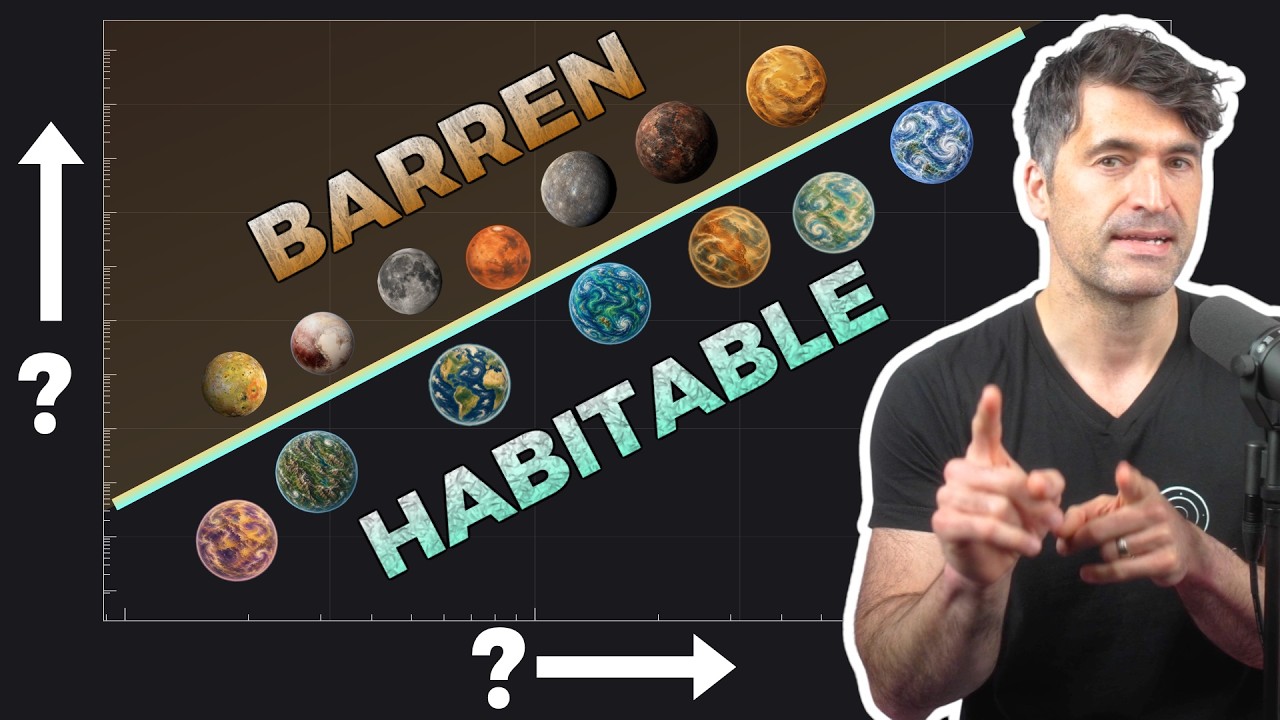
signature. Let's say that eight of them return a yes. So, 1/3 of the sample have biosignatures. Great. But okay, here's the real question though. Does that mean that 1/3 of them have life? Or does it some weird, unknown geochemistry producing that signature, a confounder, something we simply hadn't thought of? Sadly, it's completely ambiguous. There is just no way to distinguish between those two possibilities. We will be stuck in ambiguity, and I just can't live with that. I want to know the answer. The crucial thing to understand is that there are in fact two ways of getting a positive detection, a confounder or genuine life. And in a single population of planets where, say, X percent show that signature, there is a pure degeneracy between those two pathways. Now, I don't think that we have to reinvent the wheel here to solve this dilemma. We all know that control samples, such as placebo groups, form a crucial pillar of scientific reasoning in medical experiments, for example. So, what if we had two samples of planets, a control group and a test group? So, here the control group could be a group of planets for which we know with certainty there is no life on them. And then, we simply count up how often they produce biosignatures to measure the confounder rate. Next, we look at the test group, count up the fraction of worlds with biosignatures, and simply subtract off the confounder rate that we found before in order to get at the true answer. Now, the reason why astronomers don't usually think like this is because it is typically impossible for us to define such a control sample, because hey, we cannot control planets and stars. There is simply no way for me to define a group of exoplanets which I know with 100% certainty there is no life. I mean, we can't even agree whether Mars or Venus has life on it or not. Now, yes, you could take a group of, say, extremely hot or cold exoplanets and simply assume that life is impossible there, but even that doesn't really help you because surely the chemistry and thus the confounder rate on those planets would be radically different from that of Earth-like planets. A softer approach to control samples is AB testing, a concept familiar to you many of you YouTubers out there because that's how we often try thumbnails against one another. Now, here the concept of AB testing could look something like this. First, divide the target sample of planets into two groups, A and B. The requirement for this split is strict and it is twofold. A and B have to have the same confounder rate, but a different life rate. That's it. If you can do that, my paper shows rigorously, with, yes, a lot of Bayesian math, that you can indeed make strong claims for life. When I first realized this solution, it was an enormous relief because simply by adjusting the strategy of a mission like HWO, we could finally break the cycle. We could finally answer the alien question. But
High Stakes Experiments
if you think about it a little bit more deeply, it's not obvious that my solution will actually work. There are serious questions here that need to be addressed to make this actually viable. At the most basic level is a question of how do you actually do this AB split? Certainly, just doing a random split is not going to work because then populations A and B would have roughly the same amount of life in them, thereby violating one of our two criteria for this whole strategy to work. And so, if we are not going to do a random split, then we have to do a physically motivated split. So, consider for example, a split that was based on temperature. A could be the planets that are close to the inner edge of the habitable zone and B are the planets close to the outer edge. Now, I think it's pretty reasonable here to expect a different occurrence of life, but surely the chemistry of those populations are also going to be different because the temperature is different. Different chemistries mean the confounder rate won't be the same. So, as you can see, this problem actually feels somewhat inextricable because life is essentially just chemistry. And so, if I make any split between these two populations that changes the life rate, it surely changes the chemistry in some way, which therefore would also change the confounder rates because those are mostly chemical confounders anyway. So, I got kind of stuck here and to be honest, I would really love to hear your thoughts and ideas for how to make this cut. For me, the best idea I've come up with so far is to think about dynamics as a possible solution. So, the way this works would be that you could take systems that have two planets in the habitable zone versus systems with just one. If the planetary sizes and temperature distributions are approximately the same, then it would seem reasonable to expect the same confouder rate. But, if panspermia operates, then life could hop between the planets. Then, we might expect a difference in their underlying life rates. That is my best bet right now, but I have to admit even that has some concerns. I mean, could you realistically ever even have a sample of multi-haplosome planets large enough to realistically do this experiment? And could the mere presence of neighboring planets somehow affect the chemistry on those worlds, for instance, through the meteorite rate or something, for instance? So, there are definitely lots of concerns left. But fortunately, we have decades before HTL will launch, and so we still have time to figure this
Final Thoughts
out. What we ultimately need is a foolproof recipe, a new guide for scientists to use when making claims of life. Only through that kind of disciplined community standards is there any hope of actually escaping this frustrating cycle of spurious alien claims. So, right now, I think that the answer does lie in AB testing, but let me know your thoughts down below. But make no mistake, this is a very hard problem, and one that has clearly flummoxed us for over a century now. But the reward is everything. It is the answer to the grandest mystery that we can possibly wonder about. Are we alone? So, until next time, stay thoughtful, stay curious.
Outro
Thank you so much for watching today's video, everybody. I hope you enjoyed it. This one was based on real research, and so I have to give a huge thank you to all of our supporters and donors to the Cool Worlds team. If you want to support real research just like this, and the best way to do that is to head to coolworldslab. com/support, — link down below in the description where you too can become a donor to my team from as little as the price of a coffee per month. So, please do check that out and I'll see you all next video.