Improve your coding fundamentals for your next app:
https://scrimba.com/?via=edmundyong
=====
Stop Building Apps That Make $0 - Join Startup Club (private community for solo founders):
https://www.startupclub.community/
Try my startups:
Convert Any Web Page to Clean Markdown for AI
https://www.createskills.io/
Bulk Extract YouTube Transcripts for AI
https://www.transcribr.io/
Accurate YouTube Translations & Subtitles
https://www.usefluently.app/
=====
Mobbin - Instant design inspiration for your apps:
https://mobbin.com/?via=edmund
=====
Socials:
https://www.instagram.com/edmundbuilds
https://www.twitter.com/edmundyong/
=====
00:00 - Things are different in 2026: Learn these ESSENTIAL skills first
05:35 - AI tools that are worth using & recommended workflows for beginners
08:35 - How I would ship my first profitable app before 2026 ends
=====
#ai #coding #startups #aicoding #SingaporeVlog #dayinthelife #singapore #indiehackers #DigitalNomad #softwareengineer #softwaredeveloper #codingvlog #solotravel #solopreneur #startupvlog
Оглавление (3 сегментов)
Things are different in 2026: Learn these ESSENTIAL skills first
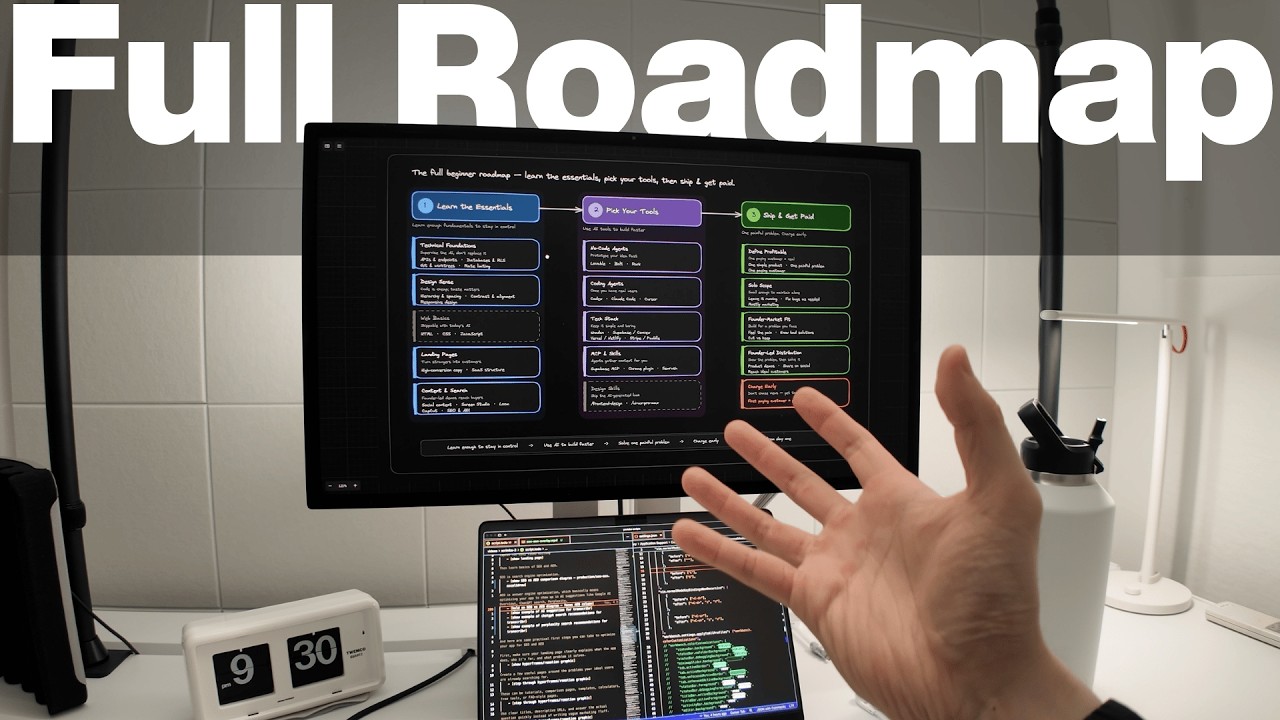
I've been building and growing apps completely solo for just over a year now. My apps have generated over 250,000 in revenue. I recently sold one of them for five figures and I'm building and growing two more that are earning quite a decent amount. But I'm not going to pretend I did that as a total beginner with zero technical skills. Before I went solo full-time, I was a software engineer for 4 years, graduated uni with a CS degree, and I already had some programming fundamentals in place. So, in this video, I want to give you the full beginner friendly road map I would follow if I had to start again halfway into 2026. Knowing everything I know now, this is the path I would take to build my first profitable app with real users and paying customers. So, the first question you're probably asking is, what do I still need to learn when AI can write all of the code? And honestly, if I was starting again in 2026, I would not try to speedrun a whole CS degree. The goal now is not to know everything, but instead to learn the minimum set of skills that lets you prototype, launch, market, and debug your apps effectively. Yes, these days AI can generate all of the code, but you're still the one who needs to know whether the app is usable, secure, and how everything is connected under the hood. So, here are the exact foundational skills I would prioritize learning if I was starting over again as a beginner. First, you should focus on leveling up your technical foundations. Not so you can write every line of code manually, but so you can supervise and collaborate with what the AI is building. Core topics I would learn here are APIs, databases, and git. APIs control how your users and different parts of your app talk to each other. So you should understand what goes into building an endpoint, who is allowed to call it, and what data it accepts, and how to stop someone from abusing it with basic security and rate limiting. Databases are where your app stores important data. So, you should understand how to manage tables, user permissions, and know about concepts like rowle security because one of the worst mistakes you can make is letting users or hackers access each other's data freely. Git and version control are even more important now when you're using AI because coding agents can make a lot of changes very quickly. So, you need to commit regularly, use branches and PRs for new features, and be able to quickly scan through diffs to understand the changes. And once you start working with AI agents more seriously, work trees also become really useful because they let you work on multiple things in parallel. For example, you can have one agent building a new feature, another fixing a bug, and then another one writing some tests, all without them clashing or overwriting each other's work because each agent gets its own isolated workspace, and you only merged a version that actually works. Now, you might be wondering, what about the basics like HTML, CSS, and JavaScript? And my honest take is I genuinely think you can get by without learning these. Now, with the current state of the AI models, plain English and natural language can get you surprisingly far in building a pretty decent looking app in a few minutes. Now, whether it works or not is a different question because you still need to know enough vocabulary and concepts to review, steer, and debug what the AI gives you. And the mistake I see beginners making now is treating AI like a replacement for learning. But the better move is to use AI whilst you're learning. So, every bug, every bad answer, and every confusing error becomes a learning experience. And this is a good time to mention Scribbler. Scriber is an interactive coding platform where the lesson is also the code editor. So you're not just watching someone code on a video. You can pause the lesson, edit the code directly in the browser and work through challenges with your instructor. For this road map, I highly recommend looking at their full stack developer path to grasp the basics of TypeScript, React, and Nex. js. And once you finish the web development basics, the AI engineering path covers more modern AI topics like agents, rag, and mcp servers. And a really nice bonus is their active Discord community where you can ask questions, share your work, and get feedback from other learners in similar positions and the actual course instructors themselves. But Scriber won't magically build your app for you. But what it will do is give you a structured way to sharpen up your coding fundamentals whilst learning how to use AI properly for coding. Check out Scribbler through the link in the description if you want to get started. Now, I wish I could say all you need to do is double down on your technical skills and become a correct engineer who can build anything. But the truth is, you'll also need to level up your marketing skills, especially as a solo founder. So, the first thing I would do is get good at crafting high conversion landing pages. And I don't mean knowing just how to make a page look nice, but learning how to write effective copy that turns a stranger into a paying customer. After that, learn how to create content on social media. and not because you need to become an influencer, but because founderled demos, tutorials, and build updates are one of the fastest ways to reach the people who might actually need your app. This is the quickest way to build trust with your ideal customers, showing them how your app works and how it can solve their problems. And some software I can recommend for creating these videos are Screen Studio or Loom for basic screen recordings, Hyperframes and Remotion to create engaging motion graphics and launch videos, and then Cap Cut for easy video editing. Then the next thing I would focus on is to learn the basics of SEO and AEO. SEO is search engine optimization. AEO is answer engine optimization which basically means optimizing your app to show up in AI suggestions like Google overviews, chatbt search, and answers in perplexity. And here are some practical first steps you can take to optimize your app for SEO and SEO. First, make sure your landing page clearly explains what the app does, who it's for, and what problem it solves. Create a few useful pages around the problems your ideal users are already searching for. These can be tutorials, comparison pages, free tools, or FAQ style pages. And make sure your most important pages are actually crawable by search engines. This means creating a site map and connecting your site to something like Google Search Console so you can see which queries are bringing in the most traffic. The point is to start building useful content around your app early so over time both search engines and AI can discover it and recommend it to their users. So, now that we've covered the
AI tools that are worth using & recommended workflows for beginners
foundations, let's talk about the actual tools I would use if I was starting from scratch. And quick disclaimer, it's going to be fully opinionated as these are my go-to tools based on what I've tested and what I've used for my own apps, but I will recommend some alternatives as well as I know everyone has their own preferences and use cases. The first category is no code AI agents. The sole purpose of these Noode agents should be to help you explore your idea, get a feel for how it works, and create a working prototype to test in minutes. For web apps, I would look at lovable or bolt. For mobile apps, I would recommend raw. But once the app starts handling real users, real data or starts accepting payments, I will start using dedicated coding agents like codeex or cloud code to do my work. And then I would just keep cursor as my code editor just for manual light edits and asking questions about specific files or code snippets. For the text stack, I would keep it simple and boring. For the front end, use Shad CN for UI components and create a preset on their website before building so the app has a consistent look and feel from the beginning. And if you're using AI agents to generate UI, I highly recommend skills like front-end design and UIUX Pro Max. This will just help the agent produce an interface that is intuitive, responsive, and doesn't have that default AI generated look for your backend, database, and or I will pick either Superbase or Convex. To get started with Superbase quickly, I recommend checking out this intro to Superbase course that covers all of the basics and setting up. But if you're building something that requires real-time updates or focuses heavily on AI agents, Convex is also quickly becoming a new favorite for developers. For deployment, use for sale if you're building in the next. js ecosystem or you can check out Nellifi if you want a beginnerfriendly deployment flow for front-end apps and gitbased continuous deployments. You can also check out this short deploying with Nellifi course which is a good next step once you have something ready to share online. And then for payments I would go with either Stripe, Lemon Squeezy or Paddle. And here I recommend learning about how web hooks work so you can understand how the payment providers communicates with your app when someone pays, cancels, upgrades, refunds or fails a payment. And then a couple more things I would set up are custom skills and MCP servers. All of the major services I've mentioned for the tech stack should have MCP servers or agent skills available that you can configure to help your coding agent work more autonomously. And this is useful when you're planning a new feature or fixing a bug because the agent can just gather context by itself instead of you having to copy and paste everything manually. Some favorites I'm currently using for my own apps are Superbase, Stripe, and Forcell MCP servers to manage my database payments and deployments. the Chrome browser plug-in for Codeex and Claude Code, which allows the agent to debug and test the changes it makes within a real browser environment. And then one of my recent favorites for SEO is the SEM Rush plug-in to help me research SEO keywords, audit my landing pages, and analyze my competitors. And by the way, if you want a fully structured path that takes you from app idea to first paid customer, I recently added a 30-day first dollar road map inside my private startup club community. If you're interested, check out the link in the description. So, now that we've covered
How I would ship my first profitable app before 2026 ends
the foundations and the tools, what should you actually build for your first profitable app? First, let's define what a profitable app is. For a beginner, I would define it as one simple product solving one painful problem where you have at least one paying customer. And that's it. The scope of the app should be small enough for one person to maintain. Because once the core product is built, you should be able to leave it running, fix some bugs when needed, and then spend the majority of your time on marketing and growth. And for the app idea itself, you should build something that solves the problem you are currently facing. Because by doing that, it gives you immediate founder market fit, which just means you understand the pain at a personal level. So you know what the current bad solutions feel like and you'll have better instincts for what to cut and what to keep in the first version of your app. Then for distribution, I would create founder product demos and share them on social media. Show the exact problem you're facing. Then show how your app solves it. Try not to obsess over whether every post gets a lot of views because that's just not the point at the beginning. you're just trying to reach the ideal customers who are facing the same painful problem your app solves. And if you want help with this part, I recently added more in-depth guides inside Startup Club around distribution, marketing, growth, and validation. So that's the road map I would follow if I were to build my first profitable app in 2026. First is to learn enough programming fundamentals to stay in control. Then use AI tools to build faster. Pick one painful problem to solve. Charge early for your app. And then make distribution part of the product from day one.