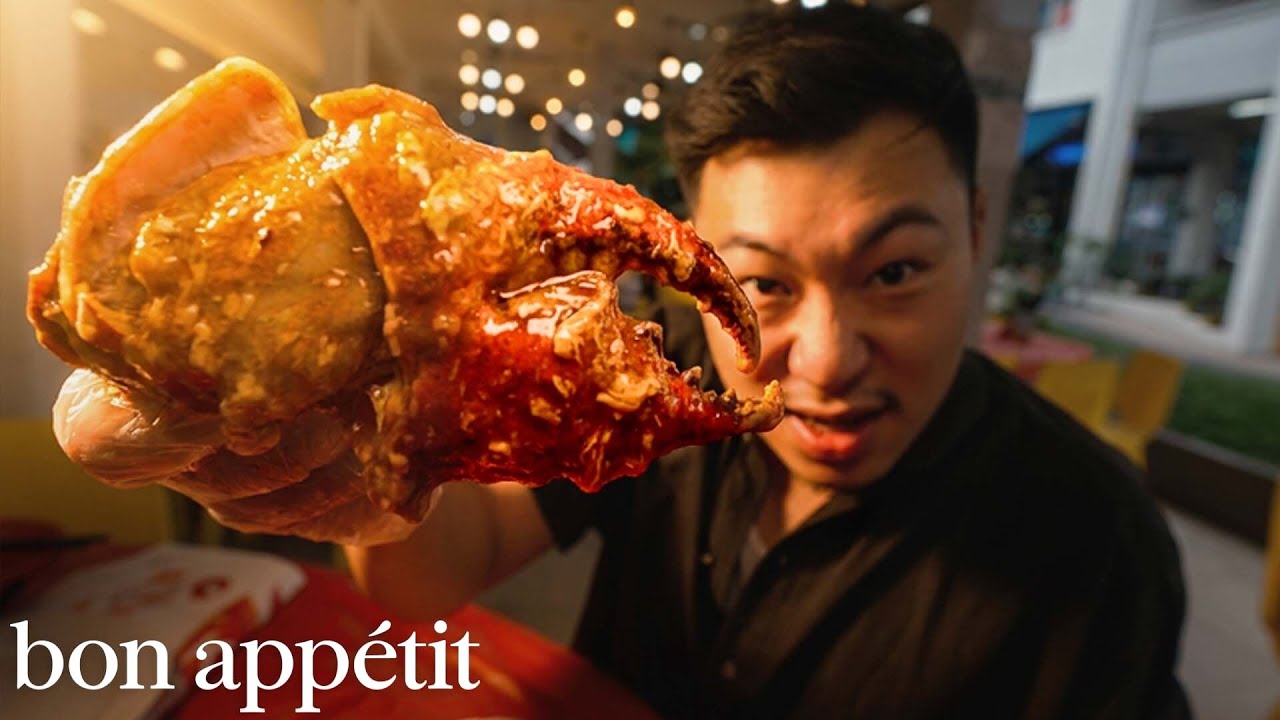
Bon Appétit meets Chef Lucas Sin at Singapore’s busiest seafood restaurant, KEK Seafood, to see how the city's iconic chili crab is made. Fresh Sri Lankan mud crab is transformed into a sweet, tangy dish served to hundreds of diners every night.
Want Bon Appétit shirts, hats and more? https://shop.bonappetit.com/?utm_source=youtube&utm_brand=ba&utm_campaign=aud-dev&utm_medium=video&utm_content=merch-shop-promo
Still haven’t subscribed to Bon Appétit on YouTube? ►► http://bit.ly/1TLeyPn
Want more Bon Appétit in your life? Subscribe to the magazine! https://bit.ly/313UWRu
ABOUT BON APPÉTIT
Bon Appétit is a highly opinionated food brand that wants everyone to love cooking and eating as much as we do. We believe in seasonal produce, properly salted pasta water, and developing recipes that anyone can make at home.
Beautiful, look at this. Amazing. Welcome to Keng Eng Kee Seafood here in Singapore. We're here to check out an iconic crab dish, chili crab. This restaurant is called a zi char, has an analog in Hong Kong to the dai pai dong, two Thai stir fry places, open air, wok hei forward stir fried restaurant. Big menu, lots to choose from, a little bit of innovation, a huge amount of evolution. Here's the massive kitchen, there are woks everywhere, there are aromas and there are flavors everywhere. But starting to the right, noodle and rice station, as well as a garde manger, prepping, cutting things to order, garnishing. Here, a lot of the classic hor fun dishes are made. As you pan over, you'll see the frying station, some slightly larger woks for specific dishes, and then coming into the middle, the main kitchen area. And basically, they're lined up sort of like in order of seniority, where Chef Wayne here is right at the end, in charge of most expensive, most delicious dishes at the restaurant. This is executive Chef Wayne here in the back. He's got his woks, he's got some preparation for blanching in water and oil. This is what I love about these restaurants. KEK serves at least 200 tables a night. It is one of the busiest restaurants in Singapore. In order for that to happen, the food needs to come out quickly, and be hot. All of these little preparations, in French we would call this mise en place, ready to go. The setup of the kitchen is specifically so that preparation comes from one chef, cooking comes from the other. Wayne now is starting with the crab, fresh mud crabs from Sri Lanka. They're gigantic. This one's about 900 g. They're very fresh crab. I mean, it's all these crabs are cut to order. It was literally alive, you know, 15 seconds ago. So, the job here is to make it properly cracked and nice and segmented. Hammering it just ever so slightly, so it's easier to eat when it goes out to the customer, but also so that the flesh inside can infuse the sauce of flavor and vice versa. He's going for the two halves of the main body, the head, and the two claws. The first step of chili crab is to fry the crab. Crab goes into the hot oil, quick deep fry, basically an oil blanch. Immediately the dark blue crab has turned orange. Beautiful. I remember when you first started this street eats show here at Oi Man Sang in Hong Kong, watching that typhoon shelter crab. The technique is pretty similar, but the flavor profile totally different. First in, sambal. Sambal made from ginger blossoms, lemongrass, shrimp, and a bunch of other secret ingredients. Something they make in-house every single day. A little bit of stock over the top just to bring all those flavors together and to give it that liquid base that the gravy is going to be built off of. Chili crab is actually a braised crab dish. So, you're slowly infusing the flavor of the sauce into the crab as you're extracting the flavor from the crab and bringing it into the gravy itself. Because of the high temperature that the chefs are cooking at, oils in the water is going to multiply into a nice creamy sauce. Occasionally chef is pushing the crab around to make sure that every single piece of crab is coated evenly so that it cooks just enough. You want that crab cooked through. You want it to be flaky, and you want that sauce to be most of the flavor. But, you also need to make sure that you don't overcook the crab so that it gets mealy. Shell for garnish. This also has my favorite raw lettuce just for color and not for taste. This is where you know the Chinese roots are. The useless garnish. Even though the dish is called chili crab, the most important flavor profile here is actually sweet and sour sauce that they make, very similar to a gu lou yuk sauce, according to chef. That's gu lou yuk, that's sweet and sour pork from the Cantonese tradition, reinforced with a little bit of ketchup. Add a little bit of cornstarch to thicken it. Question you may ask, why do sauces have to be thick? thick because otherwise they don't stick to the ingredient itself, and they don't coat your tongue in the appropriate way, and you won't be able to taste all of those flavors. This is an egg drop. It's a classic egg drop. He ladles it over the top with the heat off, brings the heat back up, lets the egg slowly come up to temp, and then he starts tossing. Unlike a lot of places that's looking for a pure, silky egg drop, he actually is looking for a little bit of ribbons. Ketchup-colored, nice and glossy, chunks of egg. Chef, you're very good at this. How many crabs do you think you've cooked? 1,000? Since? Wow. So nice. Amazing. Beautiful. Look at this. Chili crab is not the only thing to get here. In fact, they have a lot of signature dishes, a lot of which they invented, if not invented, then perfected, that are worth eating here at KEK. One of those dishes is what I think what's happening here, which is a clay pot liver dish. He's got the burner out.
Segment 2 (05:00 - 10:00)
Look at that temperature. Unlike a lot of Cantonese restaurants, where clay pot dishes are stir-fried in the wok first, this dish is cooked actually entirely inside of this sizzling hot clay pot. So, Chef, what's happening? This is liver. — Yeah, liver, the pig liver. — And then what's the seasoning? — We have oyster sauce, soya sauce, black pepper sauce, sesame oil. — Yes. — Oh, yeah, and garlic. — That liver needs to be very, very clean, sliced thin because the cooking is going to be very quick. One of When I look at this, what I get excited about is one of the first thing Oh, my god. Take a look. Sorry. Oil's in, catches fire, caramelization is going. Ginger is in, shallots are in. Look at all that color that's building so quickly. It all begins to sizzle. The water hits the hot oil. A little bit of extra sauce. Crank up the heat. Whole thing lights on fire. That smokiness is a iconic flavor profile in a lot of Singaporean cooking. Unlike a lot of the use of light soy sauce in Cantonese cooking, dark soy sauce has a higher caramel and molasses content. And so it's very nice and sweet and it carries that wok hei very, very well. Stirring constantly to make sure that all of those slices of liver are cooking evenly and that all of those flavors are emulsified. You want to make sure that the sesame oils, the oils coming out of the liver, and the water and the fat is all brought together. Heat is off. Residual cooking. Clay pot is really, really good at keeping that heat. He turns the heat back on. A little bit of Shaoxing wine over the top and that's it. The residual heat is going to finish cooking those livers and soften all of the vegetables over the top. It's time to eat. Let's get out of the kitchen. Thank you, chef. I cannot emphasize enough how crazy of an operation this is. We've seen a lot of busy restaurants, but none as busy as Kay Eng Kee. 10, 15 cooks inside. Dishes are flying out. They're going to serve between 4 and 600 people here tonight. The food's always going to arrive quickly. It's hot. Quickly about these clothespins. Each of these clothespins identifies the table that they're in. These are the refrigerated room, table number 12. And with that clothespin, they know which table the dish is supposed to go to. Clip, ticket, dish, out service. I almost feel silly that we're here. Covered by Netflix. Anthony Bourdain came here. Michelin recognized. Everybody knows this place. But when you look around and you see the families locals, you know that they are the greatest testament to what good food is. Thank you. — That's our menu. Take a look. — What are the signature must gets? — So definitely clay pot pig's liver, moonlight hor fun. — Must get We're here for chili crab. So we must get chili crab. And because I am a solo diner, but hopefully the crew will eat some of this food. Fat Buddha Pew Heung Yam Basket cuz it looks crazy. Get a coffee pork ribs. — Yeah. — That's the smell in the middle of the air is of Nescafé. — Oh, yes. And some other things. — Sure. Okay. Round out a good meal. I feel like we probably need a regular vegetable dish, too. What's in season today? — Chinese spinach. — Okay. — Maybe we do it with tree egg. Something starchy or some green. — Perfect. Oh, next thing already. This is a bit of a dinner in a show, right? — All right, next dish. That's the clay pot pig liver. — Wow. God. Ridiculous. God, that is so alluring. Big bowl of rice. Oh my god. Get out of here. This must be your favorite thing to do. — Watching everyone looking at this dish like — Yeah. — Are you done, Paul? Are you done? — Yeah, — it's true. — I will take my time. — Oh my god. Tossing every grain of rice with the sauce. — Yes. And when I'm tossing it, I also can look at the doneness of the liver. — So hot, sizzling. That's what the clay pot's going to doing. Takes a while to heat up, but it's going to hold on to the heat. Oh, more food is coming. Oh my god, Moonlight Ho Fun. The base is a dark soy caramelized or fried rice noodle. It's traditionally really difficult to cook because it can be very sticky. So, the noodles themselves have to be very fresh and the control over the time and the temperature of that wok cooking are paramount. Cantonese culinary school graduation exam often times serve high ball bun. — That's the yam basket. Awesome. The next one. — Coffee ribs. This is a ridiculous dish invented by Chef Sam Leong not that long ago. Pork cooked with Nescafé and a bunch of other things, but it's got coffee essence in it. No idea what to expect. It's fragrant for sure. Let's start with the liver. It's actually really pungent. And what's fresh? Ridiculous. Actually so good. The sweetness inherent in the soy sauce. Plus the essence of the pork liver that's
Segment 3 (10:00 - 15:00)
been cooked into it with the onions, all those aromatics. It's just very thorough, through and through. Mhm. The perfect pairing of ginger and scallion. Where one is the earthiness and the other one is a little bit of fresh green brightness together. And the rice, outstanding. Main event. So nice. — Those are the fried buns. — Oh, yeah, baby. I knew I was going to do a little bit of chili crab. So I didn't wear a white shirt, but this bib has been provided by KEK anyway. — Crazy. When the crab hits the table, the first thing that you smell is a little bit of freshness, acidity, and sweetness. It's called chili crab, but the main flavor profile isn't chili. It's sweet and sour. Mhm. Brilliant. Acidity balanced with that sugar and that ketchup. It was visible in any dish, whether it's sweet and sour pork or chili crab. But what makes this special, I think, is that Malay inspired flavors, so to speak. Inside of that sambal, that lemongrass, nice herbal tones, ginger blossom, very fragrant, very floral, tied together with the prawn paste, the shrimps, ocean on ocean, tied together by a thick luxurious gravy. Yummy. Good. Golden fried mantou. Basically a deep fried bao. Fluffy in the middle, slightly crispy on the outside. It's going to mop up and soak up that sauce. No way that's bad, right? There's no way that doesn't taste good. Of course it's going to be good. So yummy. All the flavors on the outside of the shell, so after you peeled it, have to get it with a little bit more sauce. Look at that oil gloss. Gorgeous, gorgeous dish. Mmm. Yummy. Moonlight hor fun. Look at this brilliant, beautiful, dark brown consistent color. There was squid, fish. The egg becomes a sauce. Little bit of residual heat from the hor fun. Doesn't fully cook the eggs through, but it heated up just enough so it becomes a sauce. It should be nice and slippery. And that slipperiness, that gentleness of that raw egg should really complement the charredness and the aggression and the bitterness that comes from that uh hor fun itself. That's good. That's really good. All the little components, the bounciness of the shrimp, the sweetness of the Chinese sausage, even the fattiness of this, I think it's carp, of this fish. And then the slipperiness of the noodles, the crunch of the red onion, it's all like all different dimensions of flavor all brought together in one dish. Let's try some of the other ones I was kind of interested in. Coffee ribs. That I don't understand. Okay, moving on. Taro. I'm very excited about this. Whoa, look at that. That's fun. These are one of these like funny show-off Chinese technique dishes that I'm a big fan of. Good. This is a dish that has echoes of that Imperial Chinese cooking. Steam taro, beat it to a paste, add starch to it, form into a mold, fry into a nest, make another stir-fry, put in the middle. It's a silly thing, but it's awesome and the presentation is incredible. Last thing, just a little vegetables. This is just to balance out the palate. It's really delicious. There's a Cantonese dish called gold and silver eggs over rice. The gold is the salted egg yolk. The silver is the egg white drop. This is an evolution of that dish. What I love about KEK is this. Reads Hokkien. This reads Cantonese. This reads Hakka. This reads Cantonese street food elevated. This is maybe Eurasian. And then there's gigantic luxurious dishes like the chili crab. It seems as if this is the type of restaurant that can only exist in Singapore, where Singaporeans are perhaps uniquely good at combining a huge array of cultural influences into one delicious meal. Al fresco dining, get a couple of beers. This is an outstanding restaurant, and maybe we've just picked one of my favorite places I've ever been to in Singapore. Come to