Stock Market Signal Has Only Occurred 3 Previous Times In The Last 75 Years
17:45

Stock Market Signal Has Only Occurred 3 Previous Times In The Last 75 Years

CiovaccoCapital 30.05.2026 20 094 просмотров

Machine-readable: Markdown · JSON API · Site index

Поделиться Telegram VK Бот
Транскрипт Скачать .md
Анализ с AI
Описание видео
In this week’s video, we examine a rare stock market signal that has appeared only three previous times over the last 75 years. Using long-term S&P 500 data, we compare the present setup to the prior historical cases and ask a simple but important question: what did similar market behavior tell us about the balance between risk, reward, trend, volatility, and future returns? The video also looks at why historical studies must be handled with humility. Technical analysis does not predict the future, but it can help us understand how investors behaved in the past and what similar conditions may imply about the current weight of the evidence. We’ll review: How rare the current signal is relative to S&P 500 history. What happened after the prior cases. Why long sideways periods can matter in secular market analysis. How the current setup compares with previous no-progress windows. What broader participation and earnings trends may be saying about the health of the rally. Why bullish historical data still needs to be balanced with drawdown risk and process discipline. The goal is to use evidence, probabilities, and historical context to better understand the current market environment.


Оглавление (4 сегментов)

Segment 1 (00:00 - 05:00)

In this week's video, we'll cover a stock market signal that's only occurred three previous times in the last 75 years. It's a daily chart of the S& P 500 that spans from 1950, lower leftand corner of your screen, all the way to the present day, end of May 2026, upper right hand corner of your screen. The indicator underneath the chart is the 28 trading day rate of change. You can see between 1950 and the present day, it's rare to get a 28 day trading day rate of change that ends up falling between 16 and 17%. That's this dotted horizontal line. You can see it happened in 1963 and it tended to be bullish in that case. The market rallied for a long period of time. What's rare about the present day case? It shares something that's rare that happened near this major low at the end of the 197374 bare market. at the low in Q4 of 1974. We came up and the 28 day rate of change hit that line and then it hit it again in relatively short order in either a matter of weeks or a matter of months. So we hit the line here, we hit it again here. Something similar happened in 1982. we get a spike here and then we get a another 28-day rate of change that comes back to the same line. That didn't happen in 1963. It didn't happen in 1991. It didn't happen at the end of 1998, but it did happen the major low in 2009. We hit the line here and then it just happened again. So, we're looking for cases where we hit the line 28 day rate of change falls between 16 and 17%. And then we hit it again within a year. So, what happened here, here, and again just recently, earlier in May, we went up and tagged that line on May 8th. Scrolling through charts this week, we noticed that was rare. Then we also thought that it was relevant to the present day that after that happened in the mid70s, the market rallied from that major low in 1974. Really didn't peak until the dot bubble bursts in the year 2000. Similar situation, the second time it happened at this low in the 80s, the market rallied for a long period of time. The second tap to the line right here. We rallied from 1982 again into the year 2000. Similar situation here. First tap, second tap. Stock market rallied from that low to the present day. So, we went and specifically looked at the specific day that we hit the line the second time here, specific day here, and the specific day here because we wanted to know how did the stock market perform walking forward from the second push to the line, which is similar to May of 2026. The answer, as we've already shown graphically, is the market performed well. One year later, the average gain 27%. 5 years later, pushing 80%. 10 years later, extraordinary returns. And if you know your market history, that's not surprising because this low here was the end for the most part of a major bare market and the early stages of what turned out to be a secular bull. And that secular bull by definition came into being here. Another time that signal was fired when we exceeded this high here and this high here in the early8s. After that, the market rallied for a long period of time. And if you know your stock market history, you know 2009 marked the end of the great financial crisis. And walking forward from that date, good things are still happening in 2026. And you can make an argument that the first push and the second push, something that's extremely rare, the first push and the second push occurs when something has fundamentally shifted in an important way. and that odd and sustained and very strong performance

Segment 2 (05:00 - 10:00)

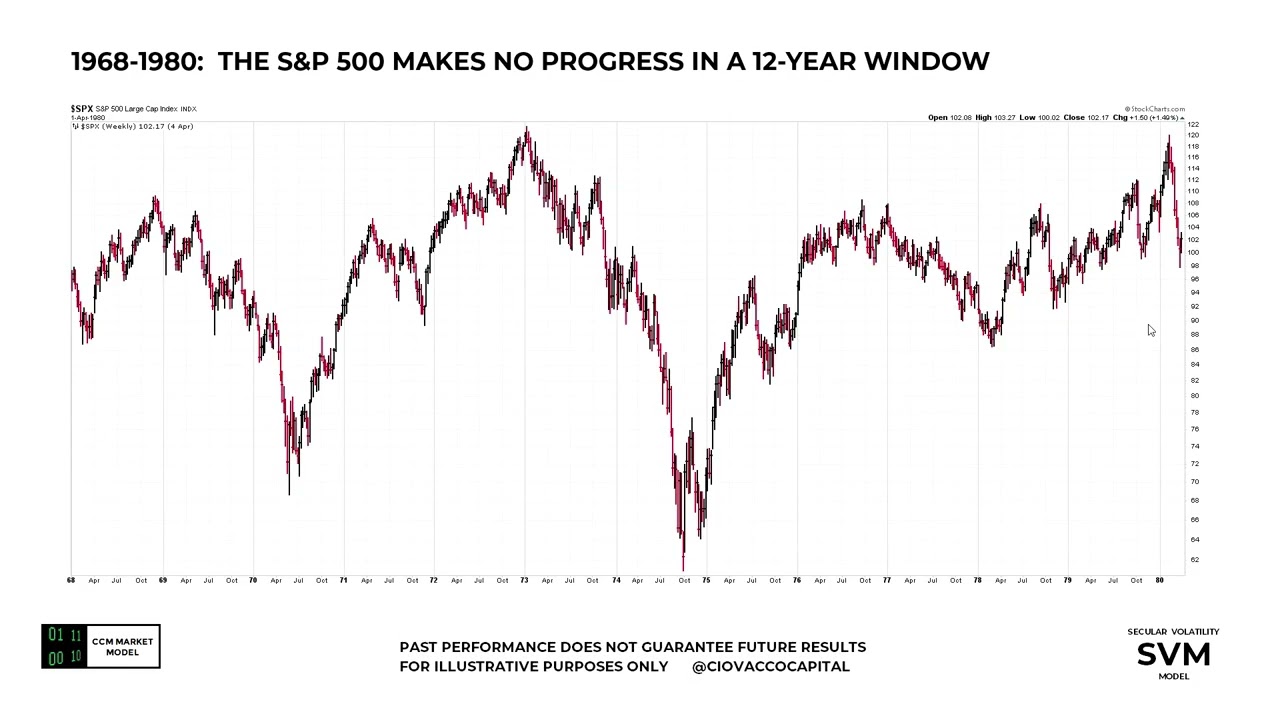
that allows the rate of change to get back to that line for a second time. That's based on the past activity of some traders. traders pushes this indicator back to this level of rate of change for a second time. It's something that just happened. The same thing in 1983. This was something that we could see and measure and put in a model at this point. We didn't have to predict anything. The same could be said for this date here in 2009. And we can see this. We don't have to predict anything in 2026. And that's important because as we've just said, technical analysis tracks the past. In this case, something that's just happened does not predict the future. We have to use our own intelligence to draw conclusions about what the past activity of some traders may say about the future activity of other traders. traders. Same thing near the low in 2009. We didn't have to predict this. What the past actions of some traders, what that may say about the future actions of other traders. And all of this speaks to anticipated future outcomes related to the economy and corporate earnings. We don't make any decisions based on studies or signals, but all of this helps us keep an open mind about much better than expected long-term outcomes. And a fair rebuttal, or at least a logical rebuttal from 30,000 ft might be, you can produce any table you want and 10 years later the stock market's going to perform well. Typically, that's true, but it's not always the case. Chart on your screen. This is 1968. The stock market went absolutely positively nowhere. Between this point in 1968 and this point in 1980, that's a 12-year window. And while the odds are in our favor over any 10-year period, nothing is guaranteed. And history tells us it can be even worse. Not only did we not make any progress in this window, but this is a 36% draw down from this point A to this point B. And this is a 48% draw down from this peak in 1973 to the low in Q4 of 1974. It's going to be very difficult to be a buy and hold investor of a 100% stock portfolio in this environment. Hence why we have the secular volatility model. And you can find other periods in history. Chart on your screen spans from the year 2000 here. This is where the S& P 500 was. From this point here to this point here in 2013 and 2007, the S& P 500 went absolutely positively nowhere. And it gets even worse. The draw down from this point A to this point B was almost 50%. And over 50%. So in those cases we want to be implementing mitigation too. We want to make significant changes to our asset allocation and our risk profile in a secular period of stagnation similar to this window here and this window here. The good news the present day does not look like a period of secular stagnation. In fact, if we were to ask something that just happened in 2026, does it tend to align with or contradict the base case given the stock market's performance walking forward from these dates? The answer is simple. So, in terms of our long-term asset allocation strategy, it's extremely important that we acknowledge how difficult markets can be in the real world. And they can be difficult for long periods of time. That would be the bad news. The good news is things can go

Segment 3 (10:00 - 15:00)

extremely well for long periods of time. Is there anything else that tells us to keep an open mind about much better thanex expected long-term outcomes? The answer is yes. Source of the information on your screen. This is the X handle here. Earlier this week, the S& P was finally up 10% year to date. Intraday 1958, 1985, 1996, and 2023. These are the only years since 1957 that the S& P 500 was up 10% year-to date intraday and that was the first time that it happened in the year and month of May. Something that just happened earlier this week. So in each case here in the month of May up 10% up 10% up 10%. was the total return for the entire year quite good. In this case, you tacked on approximately 28% tacked on roughly 16%, 10% and 14% from the date of the signal. This too helps us keep an open mind about better thanex expected outcomes between now and the end of the year. We also wanted to know how did the stock market perform on a longerterm basis. These numbers here only tell us what happened between January 1st and the end of the year. These are annual returns. They also tell us what happened between May and the end of the year. What about a full year out, two years out, 3 years out or four years out from these dates in May? Average gain a year later. So that implies in the present day May of 2027 historically the market tacked on an additional 28%. 2 years later almost 45% 3 years later pushing 65%. These figures here on your screen they also align with the base case. Draw downs here also relatively muted. Historically, this type of risk relative to this type of reward, that's favorable. So, what could drive performance like this or performance like this? Earnings from KKR. Future stock market gains will be driven predominantly by earnings growth, a quiet productivity miracle. Since the dawn of generative AI, S& P real revenue per worker has jumped roughly 5. 5% after nearly two decades of stagnation, fundamentally reshaping corporate profit margins well beyond just the tech sector. We've been talking about improving productivity as part of the base case for years. Other recent research, corporate earnings momentum entering the mid 2026 period is remarkably strong. S& P 500 earnings per share growth stands firmly at 12 to 14%. While the magnificent 7 meggaap tech stocks are still projected to grow earnings by 20 to 23%. The remaining 493 companies in the S& P 500 are broadening out with their own projected doubledigit earnings per share growth of 11 to 13%. This broadening of earnings growth has provided a massive floor for the wider stock market. Notice these earnings over here. The growth still superior to the rest of the market. We're still in the relatively early stages of the AI buildout. And if we go back to this topic here, the remaining 493 companies in the S& P 500 outside the MAG 7, the fact that they are also projected to produce double-digit earnings per share growth that aligns with this recent signal that was triggered in RSP, the equal weight S& P 500 ETF. This is a demarc chart here. This is a TDST. This is a qualified breakout. What this tells us, the weekly trend for the most part has confirmed to be flipped from down to up. You'll notice here, this is a peak in 2024. We break out above that. Have kind of our first retest here. Start to move away from this level here. Have another retest. What once acted as resistance may now act as support. And now it looks like we're going on to try to print a higher high. This solid line, it just turned solid recently, which means this

Segment 4 (15:00 - 17:00)

is a new uptrend signal on the weekly chart. This aligns with this and this. There's nothing in front of us today that says anything other than secular bull market. And we all know it would be great if the stock market could go up every day. But that doesn't happen. It doesn't happen in secular bull markets either. We just had roughly a 9% draw down. In this stage of the secular bull, this bull and this bull, there were 16 drawdowns greater than 6%. the average draw down approximately 11. 5% the median right around 10. These two numbers tell us that larger drawdowns are not only possible they're probable going forward. So it's important that we keep in mind that secular does not mean easy. And as always the commentary in this week's video is based on the charts and data sets in front of us. If the present day look in late May 2026 starts to morph into something more like this or more like this, then we have to be willing to reassess the bull bear probabilities and if needed adjust our portfolios. And we all know the only way that we can do that effectively is if we headed into next week and every week with that flexible, unbiased and open mind. The material in this video has no regard to the specific investment objectives, financial situation, or particular needs of any viewer. This video is presented solely forformational purposes, and is not to be construed as a solicitation or an offer to buy or sell any securities or any related financial instruments, nor should any of its content be taken as investment advice. Any opinions expressed in this video are subject to change without notice and Shivako Capital Management LLC or CCM is not under any obligation to update or keep current the information contained herein. CCM and its respective officers and associates or clients may have an interest in the securities or derivatives of any entities referred to in this material. CCM accepts no liability whatsoever for any loss or damage of any kind arising out of the use of all or any part of this material. We recommend that you consult with a licensed and qualified professional before making any investment decision.

Другие видео автора — CiovaccoCapital

Ctrl+V

Экстракт Знаний в Telegram

Экстракты и дистилляты из лучших YouTube-каналов — сразу после публикации.

Подписаться

Дайджест Экстрактов

Лучшие методички за неделю — каждый понедельник