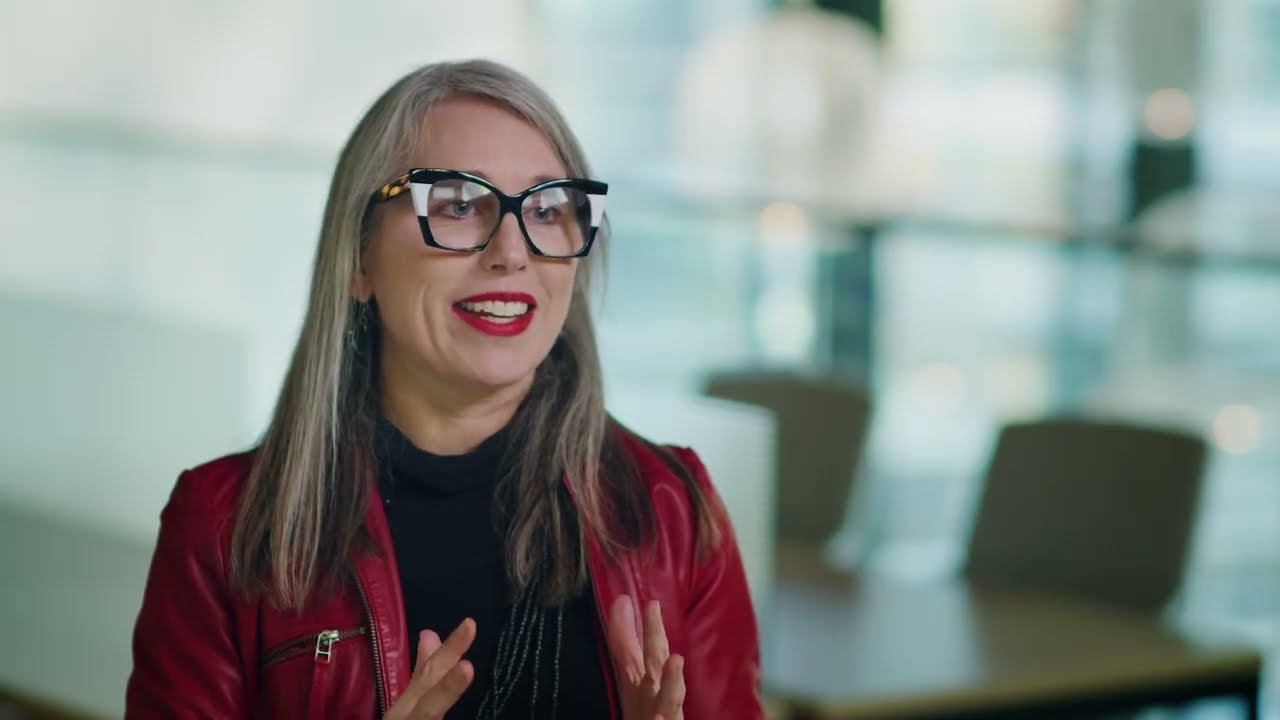
Why keep investing in people when AI can do more of the work? BetterUp Co-founder and CEO Alexi Robichaux answers the question every CEO, CHRO, and HR leader is asking right now.
Drawing on scientific research, physics, and the natural world, Robichaux makes the case that the people investment is not a trade-off against AI — it's the mechanism that determines whether AI creates or destroys enterprise value. He reveals why the most sophisticated AI metrics can't predict performance, and what actually can.
This keynote was delivered at Uplift 2026, BetterUp's annual conference for leaders building organizations that outperform and outlast in the era of AI.
Watch the full session and explore more Uplift 2026 content: https://www.betterup.com/uplift/highlights/the-value-of-human-work-in-the-age-of-ai
Оглавление (15 сегментов)
Segment 1 (00:00 - 05:00)
Please welcome co-founder and CEO of BetterUp, Alexi Robichaux. — Good morning, UP LEFT. LET'S GIVE IT UP FOR HOUSE OF Freedom and his All-Stars. Thanks, guys. We love jamming with you. Well, good morning. Thank you for being here so early. I spent a decade of my life in the Bay Area, and I know it's a developer culture, and when they told me this started at 8:00, I said, "Literally, no one will be here. " So, I appreciate you. We're hacking till midnight and still showed up. So, thank you. It feels back It feels great to be back in a staff cuz this DNA is deep in BetterUp's bone. When Eddie and I founded the company, we did it here on Turk and Divisadero. And by the way, when you incorporate a corporation, do not put your home address. You can never scrub that. Um That was 13 years ago with the same mission we have today, but a lot has changed in 13 years. What hasn't changed is that mission and your passion for developing people. And that's what the next 2 days are dedicated to. They're dedicated to how can we develop our people in this wild world of AI? And the fact that you're here is a gift to us. We know how important your time is. We know how intense the world of work and life is right now. So, let me just start by saying, as we say in positive psychology, a gratitude. I'm thankful and grateful that you joined us here today. THANK YOU SO MUCH. AND I WANT TO GIVE A SPECIAL THANKS TO our customers. Raise your hand if you're A BETTERUP CUSTOMER. WOO! AWESOME. OKAY, we will fix the rest of you. Don't you worry. Okay, what about some of our partners and even Let's raise your hand if you're a BetterUp to raise your hand. This team has done amazing work. Welcome. We're so glad you're here. Over the next two days, we're going to talk about developing people as I said. But you're not just going to hear from us. You're some of the world's best researchers. People in our science board like Dr. Adam Grant, Dr. Martin Seligman, Dr. Brené Brown. You're going to hear from elite performers, actors, visionaries like Derrick Henry, Kristen Bell, and Nick Saban. And you're going to hear from CEOs of some of the world's most innovative and largest organizations who are really proving that purpose and performance are not opposite ends of the spectrum. We have Greg Case from Aon, Dr. Albert Bourla from Pfizer, we have Jeff Lang from the Workers Insurance and Safety Board of Workers Safety and Insurance Board who is one of the largest insurers in North America. And I'll give a shout-out to Jeff and his organization. We take science seriously as we're going to talk about later and we are doing one of the largest randomized controls studies with Dr. Martin Seligman and Jeff on how we can actually impact well-being at a province level in the world. So this is when we say we do science, we really do science. And we're excited to share some of this with you. Now, we also have the privilege to partner with you, some of the largest organizations in the world and half of the Fortune 10 top's best places to work for including Hilton Hotels which is so gracious to host us here today. We partner with 30% of the Fortune 100 and your organizations collectively represent over 30 million workers worldwide. We have some real all-stars here joining us, not just these folks. We have storytellers, award-winning storytellers from Disney and Pixar, who are going to be sharing their craft with you. We have scientists from Pfizer and Moderna, who literally are saving lives at breathtaking scale and are going to share how people make that possible. And if you're sitting here today, you're sitting next to some of the people from Google and Salesforce, who are literally building this technology that is changing our world so fast, right here. And we have financial leaders, leaders from Blackstone, Aon, managing financial and human capital at maths of scales. We're going to get to hear from Kathy from Blackstone this morning. We also have folks from Lumen and Unilever, who are transforming their organizations and touching hundreds of millions of lives by doing that. And finally, let's hear it for our PUBLIC SERVANTS. WOO! WE HAVE THE UNITED STATES Air Force here with us today. We have New York City public schools here with us today, and they are proving, not just with their
Segment 2 (05:00 - 10:00)
investment, but by hearing, being here, that investing in people is the highest ROI decision available, even under the most constrained environments. I had a fun fact backstage. Chad, who's our MC MC, shared with me, this is actually, I didn't know this, I was technically at the mall. This is actually our 10th Uplift. So this, yeah, isn't that cool? Yeah. So there was a debate if it was our 11th, but we're going to say 10th. This is our 10th Uplift, and we couldn't be more happy to be here. Now, I started my career at the Walt Disney Company, and one thing I learned from Walt Disney is a concept called plussing. How do you always get better, and how do you make the experience consistently better for your guests? At BetterUp, we call that behavior stay on your edge. We know growth happens at the edge. So this year, we wanted to uplift even more. And we've been working really hard at it. I mentioned before that we take science serious. We love it. And we're going to talk about science. But one thing we did this year is we worked all year with Kate and the Labs team to design experience ex- experiments, which in the science world are called ecologically more valid. That means that they represent reality better. They feel less contrived. They feel more like what you deal with in and out as a worker, as a leader in corporate America, or in the world. We also try to focus more of our research on questions and challenges you are facing precisely right now. What is the role of the manager or the leader in an agentic age? And I'm very excited to share this data with you. And then finally, well, I forgot my line. Oh yes, I remember. Finally, we are we're integrating more fields of science. We typically pull from behavioral science or organizational science, brain science. We're going to be pulling from the natural sciences this year as well, and even the physical sciences this morning. Now, there's another treasured tradition, I treasure it, you might not, that we do at Uplift, and that's my really lame dad jokes. And so in the spirit of staying on my edge, I went full method acting this year, aka what I call Daniel Day-Lewis mode. And I'm not just bringing dad jokes, I'm bringing a dad bod, okay? And this thing's been cooking for a while, folks. All right. So, I warned you about the jokes, I've science, that means everything's on the table, so here we go. We have a team of scientists representing some of the most credible organizations in the world. You may have heard of these organizations: Harvard, MIT, Oxford, Stanford in the Bay, Berkeley in the Bay. These academics work with nearly a million workers in their data set and have over 774 million data points on performance in the workplace. You're also going to hear from some of the world's most respected publications on the future of work this time in the next few days. Harvard Business Review, Fortune Magazine, The Wall Street Journal, Charter. This lineup is stacked and we built this entire lineup around a single question this year. Here's the question because it's the question that's underneath so many C-suite conversations I have with you and with your peers and colleagues. The words vary how people ask it, but it always comes back to this very simple same idea. Why should our company keep investing in people at this level when AI can increasingly do more of the work every day? Have you heard this question in some way, shape, or form? This question, I would wager to guess, is on your desk because you lead human resources. And you know the weight of it. Because you're not just being asked to build a business case, you're being asked to answer it while holding the people who are in that business case. While they literally are in the room next door wondering if their contributions and their work will matter to you and your organization in the next 12 months. And you chose this profession because you care deeply about people. But you also care deeply about business performance. You're holding a tension, or at least what feels like a paradox at the same time. And your instinct, which we're going to talk about, the one you carry, and I know so many of you, the one you carry into every conversation, every boardroom, every restructuring session, every AI implementation, transformation, rollout strategy planning session, is that these two things are somehow connected. They're synergistic. But every time the question comes, there's an implied frame that there's a trade-off. As if believing in people is the cost and AI is the reward. As if you have to choose between the two. But underneath that question that we're
Segment 3 (10:00 - 15:00)
debating and thinking about as leaders, there are actual people. And as I said earlier, these people are wondering, do they still matter? And that is what's underneath every conversation in every organization today about AI. Do I matter? It doesn't make it in the board deck. strategy planning session. But the fear of irrelevance, as our friend and partner Dr. Brené Brown would say, is the most consequential force in your workforce today. And the data agree. Mattering, that feeling that what you actually contribute counts, is now dropping faster than any metric we track. And by the way, as you saw earlier, we track a ton of metrics. It's dropping faster than engagement. well-being. It's dropping faster than productivity. Two years ago, when AI was first arriving in the workplace, the question was how people would respond to it. How would they use AI or interact with it? That's when we shared the pilots and passengers data. It's a mindset, a pilot mindset, we call that, with optimism and agency that predicts positive outcomes with AI. Last year, we went even further. We shared what we call psychological fuel. Psychological fuel is the underlying capacity of your people to perform, especially in trying circumstances. It's comprised of motivation, agency, optimism. It's the psychological resources that determine what a person can do, especially when they're in pressure. Fuel has also been declining since 2017. And it's not because, and this is important, your people became less capable. It's because that fuel or gas in the tank has been eroding and depleting. And guess what? The core of psychological fuel is mattering. And that's the piece dropping fastest right now. What I'm going to share with you today connects every one of those findings into what we believe is a single, coherent framework pointed at answering that question. Now, I've been doing this, as I said, for over a decade. This is our 10th time, which means somewhere out there people have been Wow, this is staticky. Okay. And I lost myself on this morning, so I know it's not me. So, I'm looking at you, Kate. All right. We having fun yet? Okay. All right. Joking aside, I've done a lot of keynotes. Unfortunately for my team, This is by far the most ambitious one we've ever done. People ask me every year, "What's your favorite moment at Uplift? " And every year I'm very honest. I say it's usually about 9:30 or 10:00 a. m. when I get off the keynote stage. Dude, I see you in the back being like, "You and me both. " Okay, let's just Yeah, okay, buddy. But this one I hope feels different. It's something we've Eddie and I have wanted to say to the world for a very long time. And to land this puppy, it's going to take some work. We're going to have to do a little globetrotting and even some light time travel. We'll move from an office near you to Queensland, Australia to the muddy marshes of Lapland, Finland to the Galapagos to a research lab in Japan and to the Robichaud household in Austin, Texas. So, if you're wondering what platypuses, particles, and play could possibly have to do with each other or what they could have to do with answering the most consequential question we're facing as business leaders today you are not alone. I am, too. Because I literally pasted that title from Claude this morning. But, before we get into it I want to tell you where this talk actually started for me. Because it wasn't in the boardroom we talked about. It was actually in a bedroom. It was 8:00 p. m. on a Tuesday in Austin when I was laying next to my 3-year-old son, Noah, telling him a bedtime story. You see, every night I tell Noah bedtime stories about his stuffed animals. They're a continuation of the stories my mother told me as a child about Sammy Squirrel. But, Noah's best girl is Star, the otter. So, now Sammy and Star go on adventures together. And I got some coaching from Dr. Martin Seligman that AI is really good at children's stories, and it is. And so, I've created this whole world for him called Honey Cove Island with Honey Creek and acorns and honeys and coconut juice every morning. And recently, Sammy and Star on one of their adventures encountered a new friend who looked a little different. Her name was Polly, and she was a platypus. Now, this sounded great until I realized I had to tell a very curious 3-year-old what the heck a platypus is. Well, it's kind of like Star's body with
Segment 4 (15:00 - 20:00)
a duck head on it, and it has a tail like Billy and Bobby Beaver. Um but it lays eggs like the snake and it has a venomous spur. What's venom, Dad? And as I was doing this I realized that I'm doing the exact same thing describing this platypus that I do in the workforce. I'm describing it. I'm listing features. I'm hoping that these categories hold. Is it a mammal, Dad? I, sure. Is it a bird? reptile? No, it's definitely not a reptile. What about the venom? And when they didn't hold, I added more categories. In fact, no joke, Noah didn't believe this animal existed. He's like, show me on Google. Show me a picture. He thought I made it up. So, this animal is really confusing. But, I take some comfort in learning over time, as I had to look this up for him after, I'm not the first person to have a problem with the platypus. In fact, the first platypus that was mailed to the scientific society in London was mailed from Queensland, Australia in 1799. And like Noah, these scientists thought it was a hoax. The impulse to honor their scientific categorization was so strong when this animal showed up that wasn't quite a mammal, wasn't quite a bird, they didn't question their categories. They questioned the animal. In fact, they started cutting the fur to see where the stitch marks were, to see where sailors had stitched a duck's head on a beaver's body. I'm not making this up. I'm Greek, and the Greek word, literally, the scientific term we use just says, "Duck head on beaver body. " Basically, okay? Like, that's how we came up with this name. So, we're going to leave the platypus alone for a second. We're going to come back to her, don't worry. But first, let's go back to my cloud-generated title, because it's the first clue in this answer to the question about what is the value of human work in an energetic age. And it points to a real problem in our workplaces today. And that problem has a name. It's not a platypus, okay? That's coming later. We call it work slop. 53% of desk workers, your workers, say they've sent it. Which means that at least the 47% of the other workers aren't being honest with us. Seriously, when the Labs team coined this term, we published a ton. This is I think our highest performing publication ever, right? Um this thing blew up. We were getting inbound. It's like it was like the article was a therapy chair. People were coming and just venting online to us about work slop and how much it bothers them and I never had a word for it. I feel so disrespected when Lexi takes cloud tiles and puts them in Keynotes, right? Like this is real. Raise your hand if you've encountered work slop. I'm not going to ask if you did it, okay? Raise your All right, we've all seen it, right? And the universal reaction is just that. People describe receiving work slop and they assume the person who sent it was lazy. That they didn't respect their time. Turns out you can waste a lot of time doing lit work slop. So what we're going to see today is that instinctive re is actually wrong. Work slop is not a laziness problem. So we wanted to look at what predicts work slop. So here's a bunch of factors we looked at. You'll see personality traits from the big five, conscientiousness, agreeableness, openness to new experiences. They barely register as predictive of who does work slop. So the first thing we learn is it's not a personality thing. Some people are not more inherently likely to work slop their friends than others. Now let's look at the environmental variables. There's one that really shoots out. I don't know if you saw the green dot, right? Org mandates. Whether and how AI was mandated. Whether it was encouraged, enforced. The amount of trust in the environment when that happened. The amount of enablement around that. That is the biggest predictor of work slop. Work slop is what we're going to call a conditions problem. It's not a character problem. When people don't know what their work is for, or they don't know why they're using this new tool, they outsource the thinking and they submit it as a productivity. And when organizations can't see what makes their human work unique, they measure that submission volume on dashboards and call that a productivity gain. So, let's go back to the question. Why should we invest in people when AI can do the work? Now, you have the first piece of the answer. Because when you get the conditions around people wrong, AI doesn't replace human work. It degrades human work. Now, I keep using this word conditions. Let me be a precise about what we mean. Because it's not just a vague word for
Segment 5 (20:00 - 25:00)
culture. There's a precise model for conditions. Conditions are the signals, norms, and psychological resources around a person, which determine whether their capabilities are expressed in an environment. Our model is inspired by BetterUp Science Board Member and Harvard Professor Amy Edmondson's work, which explains how conditions operate at three distinct levels in an organization. There's or context, signals from leadership like the email that reads, "AI is here to make you better at your job. " versus the one that says, "AI is here. Please become proficient by the end of quarter. " There's team norms, or the culture your managers create day by day, whether someone feels they can raise their hand and say, "Maybe we don't use AI for that task. " Or they've learned quietly over time that hand raising has a cost in your organization. And then there's individual psychological resources. You can think of this as psych safety as a key one. Or what we call fuel It's the bandwidth and ability your people have psychologically to show up. Whether individuals believe what they contribute matter is at the heart of that fuel. Every person in your organization has capabilities. They have skills. They have experience. You know this. The questions conditions answers is really simple. How does any of that actually show up in the wild? Now, you might be thinking as we say in Texas, well, that's all fine and dandy, but no Siri Bob. I don't need me no conditions. I'm just going to go out and hire the most intensely curious avid learners who are AI native who will supercharge performance all by them lonesome. And this is where things get really interesting. Because we took this idea of well, if big five personality traits don't materially register and impact of how people use AI, then do things like curiosity, growth mindset, things we think of as characteristics or attributes, we have all this fuzzy language in HR. Do they predict how you engage with AI? And if you think that someone who is more curious is more likely to experiment with AI, then you would be partially right. It turns out curiosity does predict AI experimentation. But here's the key finding. It only does it in the right conditions. Now, at low levels of curiosity, there's not much experimentation with AI. That's not surprising per se. But at high levels of curiosity, the outcome still depends on the culture around it. In a high learning culture, curiosity converts into experimentation. In a low learning culture, the same curiosity from the same person doesn't go as far. Same person, same capability, different conditions, completely different behaviors. Save that into your cloud memory. That is going to matter. So, even when the capability is there, its expression is rate limited by the conditions in which this person works and acts. If we zoom out and more look whole more holistically at the relationship writ large between AI usage and performance, something we're all tasked to care about, we see another telling piece of information to our question. More AI usage on its own has no meaningful impact on performance. The line is basically flat, folks. So, if you're trying to increase how frequently people use AI, you're not going to see a reliable increase in performance. This is a huge insight. But, when you split the data by organizational culture, specifically whether people work in what we call coaching culture, a culture of trust, of feedback, of learning, of development, the lines separate and we start to see measurable performance gains. In higher coaching cultures, more AI produces significantly higher performance. Without it, you don't see that lift. And in some cases, actually when you look at the data, it gets worse. Again, same tool, same people, same adoption rates, completely different outcomes based on the environment. That's the power of conditions. And that difference is likely invisible to every AI readiness metric you're looking at today. What's currently in the market is around adoption and usage of the tool. And those are important metrics, but we can be blind to the environment and the conditions that actually inform the expression of those usage and adoption behaviors. That invisible variable, by the way, the one we're not looking at, it turns out it's a very expensive miss.
Segment 6 (25:00 - 30:00)
The ROI of AI data, when it's done right, is huge. Better conditions produce better financial outcomes across return on assets, return on investment, and even free cash flow yield. These are the numbers for the business case that your board, your CFO cares about. And they're driven by a variable that isn't in any financial dashboard I've ever seen in a board deck or in a C-suite. The condition of your culture is one of the most expressive financial levers you have as a business leader. The data are unambiguous. We've spent about 3 weeks trimming that data down to be this short vignette. There is so much data on this if you get curious, we can share it. So, what are we learning today? We're learning that the most important way to change people, the one we tend to forget about the most, is by changing the conditions around them. So, our Labs team, being the awesome scientists they are, got super curious. And they wanted to go deeper. to the manager level, if you think about the Amy Edmondson framework. And they wanted to see like what this looks like in the wild, in practice, since managers impact a disproportionate amount of the conditions their workers experience and their work life. They were trying to understand a simple question. In the age of AI, what does a great manager actually look like? This is one of those ecologically valid experiments we talked about earlier. They looked at how our customers measure AI readiness, they looked at usage frequency, they looked at what was in the market to simulate and mirror those metrics. They explored even deeper how much experimentation is happening. Are you pushing the limits of the tools in your usage or just kind of doing the normal use cases? They looked at the AI governance and readiness and enablement policies in the organizations these managers looked at, how far people are pushing tools, how far they're being pushed to use tools. And the assumption or hypothesis was very straightforward going in. If AI is such a disruptive force, then we expect to see people who use a more AI and deploy it more effectively should have disruptive and better outcomes at work. And at first, it looked really promising and felt really right. There was just one problem. It didn't actually work. It turns out that how managers used AI didn't predict their performance. And I kept asking a different question as the team was sharing this with me. Did we order lunch for this meeting? Why does this keep happening? Why do we always have lunch meetings and we forget to order lunch? But why does this keep happening? Why do we build these beautiful taxonomies, these beautiful classification systems, layer by layer of depth, of sophistication, and then find that we can't predict a darn thing? And I'd seen our profession do this before. We did it with competency models, skills taxonomies. Every generation builds the same mouse trap. They build it deeper, they build it better, and every time we find out doesn't really predict the thing we cared about, performance. And we've been doing this since Frederick Taylor, by the way. This is not a new impulse. It just gets more advanced and more sophisticated with every turn. And it turns out that this impulse has a very specific intellectual history that didn't start with Frederick Taylor. About 250 years ago, a scientist named Carl Linnaeus set out to organize literally every living thing on the planet. Now, the first thing he learned is there's way more living things than he thought when he said he was going to do that, or he never would have done that. And he did it in a very simple way. If it walks like a duck, talks like a duck, well, it's probably a duck, so duck. He did it based on asking one question. What does it look like? Beaks, tails, fur. Okay, here we go. And it's brilliant, actually. I mean, think about the task at hand. We still use it today. Genus, species, that comes from him. And our labs team had just essentially spent months asking what we think of now as a Linnaean question. They observed the organism known as managers. They classified the behavior by how it looks. They built a taxonomy around it, and they had produced the most sophisticated descriptive model of AI usage that I've seen, and I've seen them. But that same classification mindset, their version of Linnaeus's model, couldn't distinguish a platypus from a beaver. And it sure as heck can't distinguish
Segment 7 (30:00 - 35:00)
your people's potential. So, we went back because our model kept failing, and when your model keeps failing, as Kate would tell you, it's usually not a data problem. Don't blame the animal. It's a question problem. The question we've been asking was what are high-performer managers doing with AI? But the question we hadn't asked was how are they investing across the full portfolio of everything they do, AI and people, simultaneously and real time? Let's zoom out and look at the conditions. And from that analysis, there's four patterns that emerge. The first archetype of these managers, we call them calibrators. They're advanced with AI. They're great at managing people as well. And you've met this manager. They know how the latest model can do cool stuff you never thought was possible, and they somehow still make time to have that human relationship and human dialogue and mentorship conversations with their team. The key thing about a calibrator is they parallelize these investments in real time. And we're going to get into this later, so I'll leave this there. The second type, they're called the automatons. These managers are also sophisticated AI users. They're pushing tools. They're making new decisions in technology. And here's the important point. If you look only at AI usage, they look indistinguishable from calibrators. But unlike calibrators, they haven't had a developmental conversation with a direct report in over 6 months. So, they're really high in AI capabilities and really low in people skills. The third type, we got a lot of them in every company. They're our traditionalists. They love managing people. They love people. They do it all day, and it would be great if they could learn to use Slack. Not because they can't, but because no one has told them the benefit of AI. No one in their environment has made a compelling case. We know when they care about something, they go whole hog on it. But the environment hasn't told them you need to care about AI as much as you care about these people. And then the fourth group, and we won't spend a lot of time on them because they don't anything, are the disengaged. They don't invest in AI actively, and their people. Okay. So, we wanted to see what would happen. What predicts performance? Now, before I tell you the outcomes, let me tell you where these archetypes come from. Because as we saw, we have this Linnaean impulse in the sciences, a lot in industrialized culture, to immediately think that maybe these are personality types. Or maybe there's some inherentness here. There isn't. These are emergent archetypes. We're going to talk about what that means. So, how do you get them? I thought, I'm going to go find them. I'm going to find the calibrators. I'm going to hire for develop the calibrators. I'm going to scale the calibrators. But it turns out the data says something different. Calibrators, and this is the key word, they come from organizations that had built three conditions. Three things. At the top, they had clarity and alignment on organizational strategy. In the middle, they had a culture of trust and development, where the organization prioritized learning and development even in the age of AI. And at the bottom, they had actual AI maturity. They had governance. They had enablement. They had policies that helped people figure out how to use AI constructively. They weren't just left on their own. And since these archetypes are not personality traits, they're not even characteristics in the way we might think of them, they are these outputs of the organization, they're conditioned. And I know it's tempting to go after them. But to go to another bedtime story, they are the golden egg. It is true. You want as many calibrators as possible. But go for the goose. The conditions are the goose. Do not go for the golden egg. Well, we came to find out that we weren't the first people to look at a living organism and figure out that the environment shapes how it grows and develops. So, now let's go back to the platypus and our lovely scientists in London 200 years ago. Those scientists weren't stupid. They were operating in a Linnaean system, but they were the leading scientific minds in the world at the time. In fact, there were other At the same time Linnaeus was classifying every creature by how it looked in his beautiful taxonomy, another scientist, Georges-Louis Leclerc, Comte de Buffon, took great umbrage with Linnaeus's approach. Now, I'll step back and just
Segment 8 (35:00 - 40:00)
say these guys were fierce intellectual rivals and personal rivals. You could not find two people who were more different. One was a French nobleman, the other was a pick-yourself-up-by-your-bootstraps, and I use academics in quotes if you read about him. And so it's not that surprising that they would approach the world with such fundamentally different questions. Flambéed or sous vide? Linnaeus asked what he saw. What does it look like? Beaks, tails, tell me. But Buffon asked a profoundly different question. He thought it was crazy that you would think of a living animal and try to put it in a box. He said, "What conditions produce this animal? " You can't understand a living thing by describing its features. It's living, which means it's always changing. So, the feature's not going to be there that long. Your calibrators didn't show up in your organization as calibrators. They're not a species of worker. They are there because your organization grew and shaped them over time. And that's Buffon's insight applied to your managers now, confirmed by all this data. Now, let me show you what the Linnaean mindset sees when it looks at these same managers, and more importantly, what it misses. All right, so here's the results. Look at the calibrators outcomes. And now look at the automators outcomes. Cuz I want to warn you as I said earlier, these two type look identical when you look at AI adoption and usage. In fact, I would wager to guess that you might be inadvertently rewarding and celebrating automators versus calibrators in your companies today. But here's the key point. Calibrators win on every outcome you care about. Performance, well-being, team coordination. The automators? They're the highest burnout amongst all types of managers. Your disengaged managers do less damage than these managers. Think about that for a second. Their engagement works against you. The conversations automators don't have, were those conversations about aligning a team, focusing on goals, what's our shared ambition. They route that to AI. Super efficient. Doesn't actually align people. So when you look at automators and calibrators, what you start to see is that short-term capability gain in AI can be borrowed against what's happening long-term in your organization in terms of performance fuel. We've established the fact that you want to produce as many golden eggs as But what are they really doing that's different? I love how our team thinks. They got really anthropological here. And they wanted to observe calibrators and understand what makes them so unique. It turns out the biggest thing they do is they balance investments or calibrate between people and AI. And there's three ways they do this that we want to talk about. The first is they prioritize human relationships. They still have time for mentoring. coaching, and they do it live. The second is they exercise what's called situational awareness. We're going to show this later, but they route decisions based on the context. Should an AI use this? Should a person do this? Where do I use an agent? a human being? This has huge implications. And then third, AI does save us a lot of time. And they reinvest that time into their team's development. So, let's take these very quickly one by one. They protect and prioritize relationships. When managers substitute AI for the human conversation, that mentor check-in, that coaching conversation, we see what happens. Team coordination drops, burnout jumps, and intent to leave rises by almost a third. AI is most valuable, it turns out, where there's human infrastructure and human relationships underneath this. We look at this when we see reporting relationships, but also when we look at relationships managers have with expertise and knowledge flows in their organization. AI cannot replace those, at least not today, and I don't think it ever will. Second, calibrators read the situation or the moment more accurately. We simulated a hybrid workforce, again, ecologically valid. We gave them real task parameters, real constraints, like literal deadlines for what they had to do. And we asked the managers to decide for every task, "Would you use an agent for this, or would you use a human? " And
Segment 9 (40:00 - 45:00)
they knew what the agent was good at, what the human was what good at. This is what your teams, by the way, are doing every day. And the best performers in that data were not the managers who delegated the most to AI, or humans. They were actually the ones whose answered varied the most. Variability predicts performance. Different situations, different decision being made. The flat delegators, as we call them, the ones who gave the same answer every time, whether that was all AI or all human or just kind of a bipolar distribution of it, they saw worse team cohesion, more work slop, and lower performance. The takeaway here is that calibrators route decisions by context, not by habit. Okay. Why does this matter? Well, I know many of you are Anders Ericsson fans. You might know this researcher from the 10,000 hours rule. His work is generally misunderstood because it gets interpreted as grind it out for 10,000 hours. But that's literally the exact opposite of what he was actually proving. What he was proving is that grinding it out in the same conditions doesn't accumulate performance gains. His actual finding was the opposite. Hours in stable conditions don't really help. Your nervous system acclimates, it stabilizes, and you're not staying at your edge anymore. What you need is variability. You need different situations with different stakes to keep you on your edge so you learn. The calibrator is varied and contextually responsive every time. They're routing different work, different tasks to different people, human and agentic people. And they're creating a new situation as they do this unintentionally for their team to grow and learn together. New stakes, a problem that doesn't quite look like the last one. We have to think critically. That variability is the developmental condition they are fostering in the background. That's why they get such better outcomes on these performance measures. The calibrator is producing the environment in which their people develop expertise. The third thing they do is they reinvest the time AI gives them back in their teams. On average, managers save about 6 hours a week they report with AI today. Where do they put that time? Most people managers put that time back into task-based work. 42% of it goes back into tasks. 33% of it goes into admin slack. There's only one out of about eight to nine managers who actually proactively reinvest that in team development. And those people, you guessed it, are your calibrators. And here's what happens when you do that. Some managers, the ones who reinvested in their team and their own development, drove a 65% increase in their team's AI performance. This is counterintuitive. If you want to increase your team's adoption of AI, take the time AI gives you back and invest it in human beings. It wasn't by doing more tools, it wasn't by coaching more tools, it was by working on professional development with their teams. They reallocated their savings into four things most related to developing the team, developing their people, investing in their own growth and development, and strategic planning of the team, as well as one which was ideating and pursuing new products. People in strategy is what drives that performance gain. Okay. Hey guys, do you guys want to see some research this morning? Okay, cool. All right. This one is literally hot off the press. It just got published at 9:00 a. m. I'm not joking. And it's a really cool one. Okay, so this just came out in HBR this morning. We'll make sure to get it sent to you. It's a collaboration between our chief scientist and head of BetterUp Labs, Kate Niederhoffer, and two of our science board members, Oxford economist Jan De Neve and Stanford psychologist Jeff Hancock. We call the band Kate and the J-Curve, by the way, and that's for real, okay? And it shows two paths. The yellow line, the automation path, initially looks like a clear winner. These are paths related to how your organization can adopt and roll out AI, by the way. This line, we have all seen it. It's like catnip for CEOs and CFOs everywhere, right? Early results look strong, but watch what happens next. When people sense AI is being used to replace them rather than empower them, they change their behaviors. The conditions have shift on the island. And predictably, that thing starts to erode. It starts to backfire. Now, if we look
Segment 10 (45:00 - 50:00)
at the other line, we see the opposite effect. There's a little bit of investment out of the gate. It's an investment, after all. It starts slow, but it builds momentum over time. The augmentation path, that pink line, yes, it requires dollars, time, energy upfront. But think of it as accumulated interest or compounding interest. It picks up momentum, and eventually it pays very handsome dividends to you and your company. You know who knows this better than anyone in the world, by the way? The guy who sells the most AI in the world, Jensen Huang, the CEO of Nvidia. He is arguably one of the leading technologists of our generation, and he is the loudest leader I've seen in corporate America saying, "Laying people off to automate tasks with AI is a lack of imagination by leadership. " So, this is the choice you're actually making. Do I say AI's here to replace you? Or supercharge you? It's generative AI and it's going to help make you 10 times better than you could otherwise have been. But this is the part that should really, I think, stop us in our tracks. It turns out you don't choose the automation or augmentation path. No board meeting, even if you think you decide it, really changes it. You know what changes it? Those thousands of local routing decisions your manager do every day. AI or human? Human or AI? Their judgment about time, relationships, delegation, where they invest their free time, that becomes the actual path your organization adopts when it comes to automation and augmentation. It's happening right now. As you're sitting here, your this managers are deciding which of those curves you're on. So let's go back to where we started this morning. Why should we keep investing in people? It's true. AI can do more of the work than ever before. We've assembled the answer piece by piece though. When conditions are wrong, AI degrades human work. You saw it in the Work Step data. The same AI in different conditions produces completely different outcomes. You saw it in the coaching culture research and in the financial data when we looked at the impact that has. The managers who look like the best AI users on your dashboard actually might be the ones quietly producing the wrong results in your organization. And that accumulates into two potential paths, augmentation or automation. And these aren't decided at the top of the house as much as they're decided in the workforce day-by-day, minute-by-minute. So, here's the answer to the value of human work. The people investment is not a trade-off against AI. It is the mechanism that actually holds and determines whether AI creates or destroys enterprise value. It is a condition. The same conditions that you've been told your entire career are too soft to measure. The same conditions that produced that 65% performance gain when they were right. And the highest burnout when they were wrong. That's the answer to that question. So, if the data is this unambiguous, and it is pretty clear, if conditions explain every finding we've looked at this morning, why does every company still run on skills? Why is every AI dashboard in the market measuring adoption and not conditions? Why is everyone platypusing? Remember our buddy Linnaeus? Carl? Our profession didn't actually literally come from Linnaeus. But the same impulse to categorize animated both. The instinct to look at what you can see, organize it into categories, and build your entire infrastructure on top of it, that instinct is so deep, it independently produced the same conditions and same output that Linnaeus created. And it's done this in biology, it's done this independently in education, and it's done this in HR and talent management. Skills are our beaks, competencies are our wings, you get the idea. Observable features, sort, classify, whole systems built on top of it. Every time a new role shows up that doesn't fit in a category, like what is a forward deploy AI collaboration architect. Is that an engineer, an architect, a collaborator, a comms person? No one knows. So, we just create a new box. We did what Linnaeus did.
Segment 11 (50:00 - 55:00)
Not quite a mammal box. I don't even know the word for where platypuses fit. It's so obtuse. So, why does a system this sophisticated, but by the way, is so thoughtfully created by some of the greatest minds in every generation, why does it keep failing to produce or predict what really matters? This is a question that has haunted Eddie and I since we started the company. We always sensed something was wrong here. But, the answer only unlocked for me personally didn't come from behavioral science. It actually came from the physical sciences. So, I want to take you to that research lab in Japan now. In the late 1980s, a team of physicists outside Tokyo fired single electrons, one at a time, and they did this through two narrow slits. I promise this will connect. And they watched where each one landed on the screen behind them. One dot first, then another dot, then another dot. Each landing in what looked like a random pattern on the screen. And if you walked in as they were doing this, you'd be like, "Hey, there's a bunch of dots on the screen. " Okay, that's what you'd expect. But, they kept the camera running as they were moving around the lab and doing stuff. And as hundreds, then thousands of electrons accumulated, as the data got bigger and richer, something emerged that is still pretty mind-bending. And you know something is like objectively mind-bending when it's featured in a Dan Brown book, okay? But, this is actually real science, okay? They couldn't figure it out. All of a sudden, it's like waves started to appear in the pattern. The electrons fired one at a time with nothing else to interact with were behaving like each one passed through both slits. That's impossible. So, the physicist did what good scientists do. They started to measure. They put a detector on each slit to figure out which path the electron was really traveling down. And the moment they measured it, the particle vanished. The waves collapsed. Just two clusters of dots, back to particles. Exactly what you would have expected the entire time. The key takeaway here is the measurement destroys the wave. The instrument eliminates the very information it cares about most. And that same instinct is exactly how we built human capital systems. Skills, competencies, performance ratings. We take a living, situational capability, and we freeze it into fixed categories. Skills are not wrong, by the way. They're very useful. But in a system, they get treated like particles. a fixed object someone simply has or doesn't have. Strong communicator, strategic thinker, AI fluent. It's a dot on a dashboard we measure. But real capability does not behave like that. It behaves more like a wave. And this is what Ericsson's research is telling us. This is why a person can be rated or look like a strong communicator in one context, and then they get on a stage with a thousand people, they haven't had their coffee, something happens, and they bomb. Are they a strong communicator or are they not? Do they have the skill or do they not have the skill? This is why a calibrator can show up as a calibrator in one environment, at one company, and an automator at another environment, in another company. The capabilities our people have are not fixed. They are real and living people. And the moment you start measure them as fixed, what you're actually scientifically doing is flattening people. And we flatten them so we can fit them in more measurable boxes. But here's the problem. Skills by themselves, just like the particle by itself, doesn't contain the information we actually care about. That's in the wave. But when we flatten it, we destroy that information. Brené Brown, who you'll hear from later today, who's a Brené Brown fan? — Woo! — She put it this way in Fortune this week. The C-suite wants to believe the answers is skills. Because skills are easier. They're measurable. They fit in a taxonomy. Building a deep sense of mattering, of courage, of trust, of agency, that requires presence. That requires patience. That requires people leading. So, it's no surprise that we reach for the skill instead. But the research and training transfer says us tells us the exact same story. The strongest predictor of whether organization training sticks has nothing to do with the quality of training. It has environment people return to after being trained. The manager, the culture, the conditions
Segment 12 (55:00 - 60:00)
that unleash the wave. And we're doing it all over again with AI readiness. By the way, you know who knows that this more about skills and conditions than anyone else I find? The Pentagon. The United States Air Force, the United States Navy, they're both Better Up customers. The top brass at the Pentagon, when I have the privilege to sit with them, need less convincing, less explaining, and have the best data on measuring conditions of any organization I've ever seen. They measure leadership effectiveness. They measure team cohesion, unit cohesion. They measure family systems. They measure spousal sentiment. These are what they look at on their dashboards because they know when life and death outcomes are at stakes, you cannot flatten people into particles. You know who else you don't have to explain this to? Top athletes and coaches. Nick Saban's going to be on here today. I don't know what he's going to say, but I can wager I can summarize this whole talk to be conditions matter. You can take a great player and put him on a sucky team and guess what happens? They become a bad player. You can take Look at the NFL draft. The worst teams get the best players. You see this every year. Conditions matter. In fact, if we zoom out for a second, there's this puzzling thing. We just talked about the military. We talked about sport. Work is the only environment of elite human performance I can think of where we pretend people act in isolation from their environment. We particleize people. And then we wonder why they can't grow and develop. So let's go back to our friendly Frenchman, Buffon. He asked the right question 250 years ago. But the thing with Buffon is he couldn't prove it. He had this instinct and he had this question. And the proof didn't actually come for a hundred more years. And it came from a guy I call Chucky D. Charles Darwin. Now, Charles Darwin and I share literally nothing in common except our love for birds. So he was collecting birds across the Galapagos and he was very excited and he brought all the birds back to London. He thought they were different species by the way, finches, wrens, blackbirds. But when he brought them in London to an ornithologist, this guy told him, "Hey, you know, these are actually all the same bird. They're all finches. They have a common ancestor. The difference was that they developed on different islands. They ate different food. They had different environmental pressures. They had different weather. And so their most observable feature, the beak, was very, very different. And that's what threw Darwin with his Linnaean mindset off. Different beak means different bird. The point though was that the beak was not actually a record of the bird as much as it was a record of how the island produced a bird. Linnaeus described the beak and organized the world by it. Buffon pointed to the island and says that has to matter more. And Darwin was the first person to link it up and explain how it all worked together. It's called adaptation. It's how living things respond to the environment. But importantly, it's also how the environment shapes what the living thing becomes. And that's what Buffon was grasping at in his French 18th-century philosophical way. So we're like Buffon. We dedicated our careers to helping a workforce that adapts as environments and conditions change. Now I know many of you in that space have a remit around learning agility. How do I increase the learning agility of my workforce? For all intents and purposes, you can think of what we call in the science as adaptive capacity as learning agility. It's what Darwin's getting at. Species learn over time. They adapt. They change. And it's made of three things. Curiosity, the capacity to play, to tinker, to experiment, to toy. You see this in children. animals. Play is actually, scientifically, a pre-adaptive behavior. It's how you build the beak before you need the beak. In fact, the best work on play in the workplace, there's not a lot of it, surprisingly, but playfulness is a value at BetterUp, so we read this a lot, is from one of our founding science board members, the former head of Xerox PARC, Dr. John Seely Brown. And it's called organizational jazz. How do you get your company to play and improvise together? And teams and organizations that play better together perform better together. The second is courage, the capacity to walk into difficult conversations, protect relationships, even when AI gives you a frictionless waste to just way to just have an agent write that message and fire it off an email for you. And the third, no surprise, pilot mindset. High optimism paired with high agency that puts people in the conditions to learn and adjust in real
Segment 13 (60:00 - 65:00)
time. Now, we know all three of these things grow with coaching. Coaching creates the exact conditions that Ericsson described. In fact, I can't think of any pedagogical device we can scale that achieves Anders Anders' work better than coaching. It helps you see blind spots, it gives you contextualized feedback in real time, and it helps because there's someone there who you've built a trusting relationship with. Courage can also move relatively quickly in coaching, and we're going to talk about this later. In fact, curiosity is the outlier. The good news is you can actually develop and foster curiosity. But, in our data set, and we've shared it's rather robust, it is the slowest moving skill. It takes about 245 days to get someone who is not curious to a baseline level of curiosity. So, the good news is you can do it. The bad news is it's very, very hard to move. And I don't know of any way to move it without coaching. Now, all these three things though, they rest on an infrastructure, something even more fundamental. And it's the thing we started with. It's declining more and faster than ever before. It's mattering. We told you at the start that mattering was in sharp decline. Our workshop our works workshop our workshop research validated that. People weren't describing a productivity problem. It just looked that way. They were really describing feeling like they didn't matter to the company or to the person work slopping them. So, we wanted to know, can you change mattering? Can this trend be reversed? We wanted to see if there was something immediately you could do at a microscopic level, for lack of a better metaphor, and it turns out that there is. There are really straightforward ways you can intervene and impact the mattering of your workforce. So, we designed another ecologically invalid valid experiment. We took a group of software developers who review AI generated code all the time. And we asked them in this contrivance, we said, "Hey, your manager created by code in this app. It's probably got a lot of bugs in it. This is a pretty common use case they encounter. " And we asked them to go debug the app, find the errors in the code. And then, by the way, there's objectively right answers. We know where all the errors were. And what we found was quite fascinating. In one arm of the study, before they started, we told them, "We're counting on you. Your work matters. If you don't find these bugs, this thing's going in production, and it may take the whole stack down. We need you to do this. Other people in your company who can't code, they're relying on you. You're the only person who can Obi-Wan. You're the only one, right? It was a few minutes of an intervention. It was literally like a 100 words. That was it. And then we set them on their task. Go find the bugs. And then we looked at performance. And what we found is for developers who identified coming into the experience experiment as highly proficient, so more senior, more skilled developers, they built their identity around the craft as a coder. When they heard that people were counting on them, they caught significantly more errors than anyone else. In other words, telling them their work mattered measurably increased the quality of their output or their work. We changed the conditions with 100 words and we changed the work product almost immediately. Now notice our intervention didn't translate to almost any performance gains for less skilled coders. It turns out if you tell someone they matter, it actually has to ring true. 100 words about how much we needed them. That's all it took. So what is this phenomenon where you tell someone a story, you tell them something and it changes the quality of their performance? We didn't have to do a lit review to find it because we have a very fancy word for it in English. It's called leadership. That's what we do as leaders. We tell people they matter. Mattering scientifically activates human judgment and discernment. It is the most consequential operating condition that turns capability into performance. It can converts all these conditions we talked about today, these behaviors, these capabilities into things you care about. So what do you do as a corporate leader Monday morning? You walked in here carrying this really heavy question. You now have a lot of data to answer it, I hope. But the data doesn't change your company. You change your company by what you do with the data. So here's three things as a takeaway you can go do different. First, make it your job to protect the conditions of your island. You know the same tool in different conditions produces opposite outcomes. The conditions your people work in
Segment 14 (65:00 - 70:00)
think of it as talent infrastructure. Defend it the way your CTO or CIO would defend their infrastructure. Have you ever tried to take a tool away from a CTO? We let people take our stuff all the time. Just because it's not systematized. Bring that urgency. Bring that data. Bring that acumen that you have. Bring that business case that the data unlocks to every conversation about a reorg, a mandate, a new AI policy. And if you don't do anything else, just ask what Georges-Louis Leclerc, the Comte de Buffon, asked. What conditions does this change make on my island? Because remember, every decision you made and are making is producing one of those four manager types whether or not you want it to. The second thing, measure the wave, not the particle. Every AI dashboard in every market I've seen is about adoption, usage, types of usage, depths of usage. Good to know. It does matter. But it's still particles. And you know that same adoption score can produce opposite outcomes based on one variable, the conditions around it. So stop asking, are my people using AI? And start asking, what's happening to my people as they use AI? That is what Buffon teaches us. Start measuring your islands. And then our third, don't let anyone, including yourself, forget that people are the adaptive mechanism. The augmentation curve doesn't bend because you bought better tools. Unless that tool is better up. That That's a joke. That's a joke. Okay. It bends because your managers privilege the human in everything they do. This is the essence of the calibrator. They still privilege humans. They're the output though of an organization that signals to them that privileging humans is rewarded. The automatons, they also adapted by the way, rationally and reasonably to their environment. Their environment just told them, "AI replacing people is what's rewarded. " Every conversation you have this week about AI strategy at its core is a conversation about people. Because it's the people who rate limit your AI investment. Well, you know this talk started in a bedroom in Austin doing story time with my son Noah. Trying to explain to him what Polly the platypus was. And I've been thinking about Noah a lot as I've done this keynote and built it over the past few weeks with the team. Because everything I showed you today, the conditions we talked about, the metrics, the cur- courage, the mattering, the curiosity, those conditions, they aren't just metrics to me. They're the things my wife Mary and I are trying to grow in our 3-year-old. We want him to be curious enough to explore something he doesn't understand instead of running away from it. We want him to be brave enough to show up for the hard conversations even when the tools make it easier to not have to be there. And we want him to be grounded enough in his own sense of mattering that he doesn't outsource his judgment to whatever tool's available just because it's easier. I'm a technologist at heart. I'm not worried about humans and whether they will have value when Noah's my age and enters the workforce. I'm not worried about if they'll matter. I know they'll matter. What I'm focused on and what keeps me up is Noah and his little sister. It's them entering the workforce one day, and it's wondering will we have the set of conditions when he comes to be my age in his workplace that allows him to become the best version of himself? Will the people around him also have the courage and the patience to invest in a human being? And so, here's what I've come to believe about this whole AI and human thing. AI is forcing our hand to become more uniquely human. For all the fear of all the disruption, AI has done something unintended in a remarkable way. It has made the human things, the courage, the curiosity, the mattering, the relationships, impossible to ignore. The things we said were important all the long all along, but if we're being honest, sometimes we acted like they weren't.
Segment 15 (70:00 - 71:00)
weren't. AI doesn't really threaten our humanity. What it does is reveal what we should have been investing in all along as human beings. So, when oh Noah's good enough or old enough to walk into his first job, whatever that looks like, whatever tools may be around at that time, I don't want to him to walk into an organization that measures his beak and puts him in a box. I want him to walk in a place that asks, "What condition does he need to become extraordinary? " Thank you. That's the question Buffon asked. That's the question Darwin answered, and it's the question everyone in this room has the power to act on their island. — Mhm.